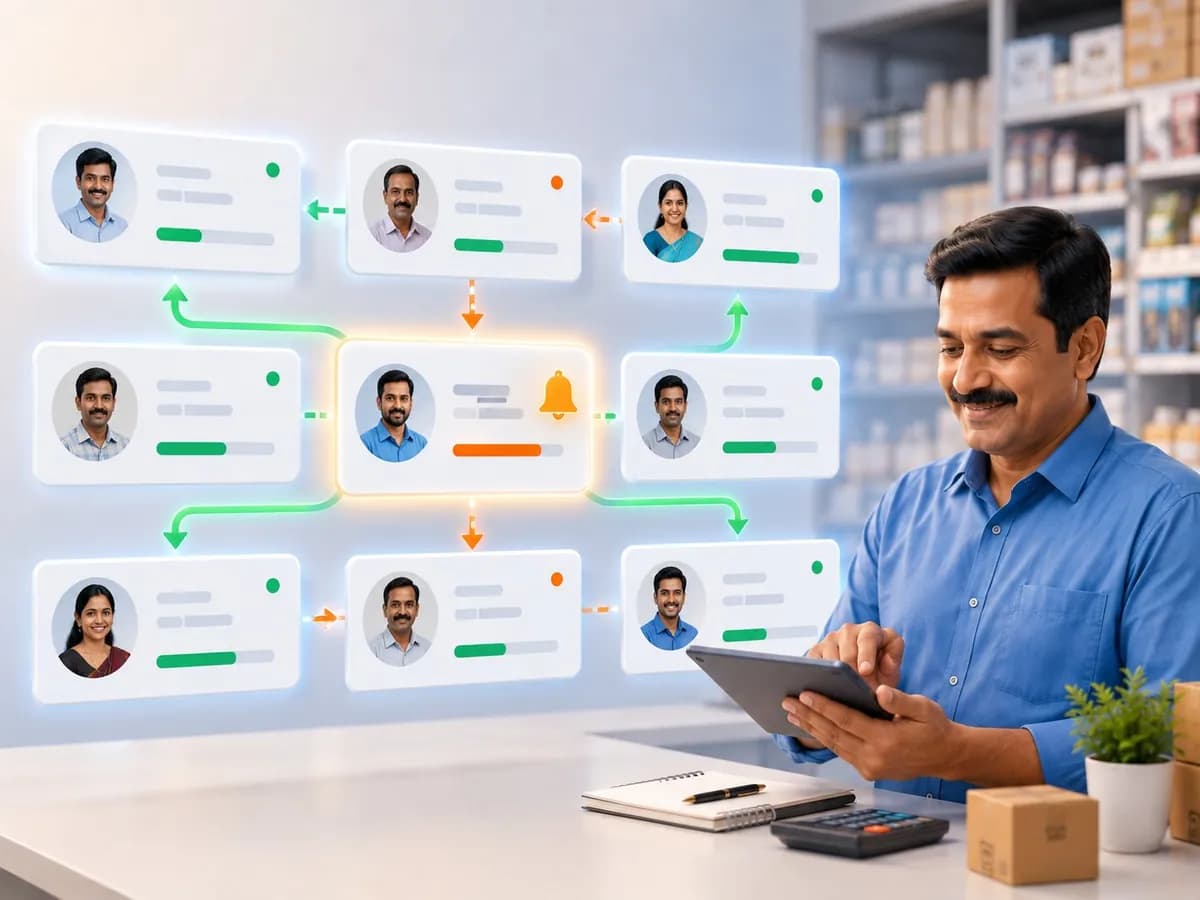
An accounting ledger is the running account with one party. Customer or supplier, it records every transaction between you. Ledger accounting software keeps that account updated automatically, links it to your billing and GST, and shows the outstanding balance, the tax position and the profit picture without a single manual register entry. It is the ledger layer of online accounting software, not a separate product.
The khata works at 30 parties and breaks at 300. For decades the Indian shopkeeper's ledger lived in a bound register, one page per party. Once a business crosses about 50 active accounts, manual records start carrying old balances forward wrongly, dropping entries on busy days, and failing the one test that matters: when someone asks “kitna baaki hai?”, can you answer in under 10 seconds, with proof?
Ledger software connects directly to billing. Raise a GST invoice and Accountune debits the customer's ledger the same instant; record a payment and the outstanding drops; buy from a supplier and their accounts payable balance updates. Every entry captures the tax split, CGST and SGST for intrastate and IGST for interstate, so your GSTR-1 and GSTR-3B data is built as you go rather than reconstructed at month-end. Input Tax Credit is captured per supplier automatically.
This is why a generic billing app isn't enough. Billing apps create invoices, but they don't carry a true running balance per party, don't track accounts payable, and don't produce a live profit and loss statement. Rule 56 of the CGST Rules, 2017 expects a registered person to keep accounts of inward and outward supply, stock and input tax credit, which is the same ground bookkeeping software covers day to day. The accounting layer is the part that actually protects your cash.