FMCG ke alag-alag GST slabs galat lag jaate hain.
Khulla anaaj 0%, packet atta/tel 5%, processed food-biscuit-cold drink 18% — rush hour mein haath se sahi rakhna mushkil.
GST notice risk
For grocery shops, mini-marts and small supermarkets — fast POS billing, FMCG GST slabs, live stock and expiry control in one cloud app. From ₹799/year.
Free trial, no credit card · Free migration · No install
Day book · Today · Meerut
Auto-posting| Sale | Atta 10kg · 5% GST | +₹420 |
| Expiry | Amul milk · 2 days | Near expiry |
| Sale | Maggi ×6 · 18% GST | +₹84 |
| Reorder | Refined oil · low stock | Reorder |
Accountune research · 2026
As more grocery shops and mini-marts digitise their counters, the manual cash register is where wrong GST slabs, perishable spoilage and silent stockouts quietly drain margin. A grocery POS that handles FMCG slabs, expiry and live stock is now the baseline upgrade, not a luxury. Sources: RedSeer Strategy Consultants, India Grocery Report 2025; Technavio, India Grocery Market 2025; IndexBox, India Food & Grocery Retail 2026.
Grocery store billing software is a cloud POS and accounting tool for grocery shops, mini-marts and small supermarkets. It scans barcodes, weighs loose goods, applies the right FMCG GST slab per item, deducts stock in real time, and tracks expiry on perishables like dairy and packaged food. Indian grocery retailers use it to speed up checkout, cut spoilage and wastage, and file GSTR-1 and GSTR-3B without an accountant.
Understanding the grocery counter
A POS built for FMCG retail. Grocery store billing software is a point-of-sale and accounting system built for fast-moving consumer goods (FMCG) retail — grocery shops, mini-marts and small supermarkets. It combines barcode and weighing-scale billing, GST-compliant invoicing, real-time inventory and perishable expiry tracking in one cloud platform, replacing the cash register and the manual GST register.
GST rates change item to item. Grocery is one of the hardest retail categories to bill correctly. Loose grains, fresh vegetables and unbranded staples are often nil-rated; packaged atta, edible oil and tea sit around 5%; most processed foods, biscuits and chocolates are at 18%, while aerated drinks now fall in the top 40% slab. Each item also needs the right HSN code. Get a slab wrong by hand a few hundred times a month and a GST notice is only a matter of time.
Three pressures at once. On top of GST, a grocery owner manages a queue that has to move fast during morning and evening rush, fast-moving stock that turns over several times a day, and perishables — dairy, bread, packaged food — that lose value the moment they pass their best-before date. FSSAI licensing, MRP enforcement and multi-distributor purchase tracking add further paperwork.
Modern grocery software ties it together. A barcode scan or a scale weigh applies the price and GST slab, deducts a unit from live stock, and flags it if the item is near expiry. At month-end the same data rolls into GSTR-1 and GSTR-3B with no re-entry. The owner sees real numbers — today's sales, current stock, near-expiry items and what to reorder — from a phone or POS counter, across one shop or two.
Entities covered on this page
6 counter failures Accountune fixes
These are not hypothetical. They happen in small businesses across India every month — and each one quietly costs money or hours.
Khulla anaaj 0%, packet atta/tel 5%, processed food-biscuit-cold drink 18% — rush hour mein haath se sahi rakhna mushkil.
GST notice riskSet the HSN and slab once per item; every bill applies 0/5/18/40% correctly and rolls into GSTR-1/3B.
Right slab, no GST noticesBahut se owners ko pata tab chalta hai jab item kharab ho chuka hota hai — hafte ka ₹500–700 wastage saal bhar mein moti rakam.
Quiet weekly spoilageNear-expiry dairy, bread and packaged food are flagged before write-off, so you discount or return in time.
Less wastage, money savedCustomer aaya, item shelf pe nahi mila, customer agli dukaan chala gaya. Manual register reorder alert nahi deta.
Silent stockout sales lossStock deducts on every bill; a per-item reorder level flags fast-movers before they hit zero.
Out-of-stock loss stopsMorning aur evening rush mein manual billing slow pad jaati hai aur counter pe line lag jaati hai.
Slow checkout, walkoutsScan, weigh loose goods, or tap a favourites grid — a bill in seconds, with multi-counter POS on the top plan.
Counter keeps movingKai FMCG distributors, alag-alag pending orders aur payments — sab kahin ek jagah nahi.
Scattered supplier accountsEvery purchase adds stock and logs against the supplier; pending orders and outstanding sit in one place.
All supplier hisaab, one screenMonthly account customers aur home-delivery orders ka credit paper register mein chhoot jaata hai.
Missed credit paymentsEach account customer has a running ledger; send a WhatsApp reminder with the outstanding in one tap — no separate udhaar module.
Every payment trackedSign-up to first bill — in minutes
No IT person, no install. Sign up, import your FMCG item list, and bill your first customer the same day — across one counter or two.
Phone or email — no credit card. Import your FMCG item list from Excel or Tally, or let the team import it free.
Scan a barcode, weigh loose goods on the scale, or type the item. Price and the right FMCG slab apply automatically, and stock deducts instantly — no manual entry.
Get alerts on near-expiry perishables, and a ready reorder list when a fast-mover drops below its level.
Purchase entries add stock; cash, UPI and card are all recorded, with account credit in a ledger. At month end, GSTR-1 and GSTR-3B are a one-click summary — or give your CA read-only access.
FMCG GST slabs, live stock, perishable expiry and GST returns all run from one screen — on the phone or the POS counter.
What you get
From FMCG slabs to expiry to GST returns — one connected system. Every scan applies the right slab, deducts stock and flags near-expiry on its own.
Invoice in under 10 seconds
Search by product name or barcode scan. GST, HSN, price auto-filled. Print or WhatsApp in one tap.
Stock accurate without extra entry
Every sale deducts from stock; every purchase adds back. Live count at any moment.
Not one rupee missed or disputed
Per-customer digital account with timestamped history. One-tap WhatsApp reminders.
Zero manual tax calculation
CGST, SGST and IGST correct on every invoice. GSTR-1 and GSTR-3B ready at month end.
Reorder before the shelf goes empty
Custom minimum per product; alert via app, email or SMS.
Packaged goods billed in 3 seconds
USB, Bluetooth or phone camera; auto-fills name, price, GST, HSN.
Professional bills, no printing cost
PDF invoice to the customer's WhatsApp in one tap.
Never overpay a supplier again
Every purchase logged; supplier-wise outstanding always visible.
Full business picture in 2 minutes
Sales, top products, slow movers, daily profit, pending dues — one dashboard.
Counter staff see billing only
Role-based logins; profit and purchase data stay owner-only. Full activity log.
Cash flow protected without awkwardness
Set a max credit per customer; alert fires before the bill is created.
Data safe even if every device is lost
Automatic daily backup with encryption; log in from any device.
The short version
Will it charge the right GST slab, stop perishables expiring, keep the rush-hour counter moving, and warn you before a fast-mover runs out? Here's Accountune vs Tally, Vyapar and Marg on what decides a grocery counter (verified May–Jun 2026).
| Capability | Accountune | Tally | Vyapar | Marg |
|---|---|---|---|---|
| FMCG GST slabs auto (0/5/18/40%) | manual setup | basic | ||
| Expiry / batch on perishables | add-on | |||
| Weighing-scale POS | ||||
| Fast-mover reorder alerts | basic | |||
| Mobile + cloud billing | full | Windows | desktop-first | |
| Free migration support | dealer | self | dealer |
Marg is a capable FMCG desktop ERP, but Accountune is the only one here that auto-applies FMCG GST slabs, tracks perishable expiry and runs full billing on a phone — all-in from ₹799/year, cloud included.
Is this right for your shop?
An honest read on where Accountune fits best — from a single-counter grocery shop to a two-counter mini supermarket.
From ₹799/yr
FMCG GST slabs, live stock and expiry control in one place — the everyday grocery counter, handled.
Mid plan
Weighing scale, reorder alerts, WhatsApp bills and e-invoicing as the shop scales up.
Top plan
Multi-user POS, multi-location and advanced reports, with stock synced across counters in real time.
first-time POS
Plain language, free migration of your item master, and billing live on day one — no accountant needed.
Recognise your shop? You're exactly who Accountune is built for.
Start freeAccountune
Brand statement · India SME Billing, 2017–2026
Based on
Most grocery owners lose more to two quiet leaks than to anything dramatic — wrong GST slabs at the counter, and perishables that expire on the shelf. Fix those two, and a grocery shop is calmer and more profitable within a month.
Buyer's guide · 2026
Run any tool you're weighing through these seven checks before you pay. For a grocery shop, the first two — FMCG slab handling and expiry control — are where generic billing apps fall down.
Grocery slabs jump from 0% to 18% item-to-item. It must let you set HSN + slab per item, apply it automatically, then roll it into GSTR-1/3B.
Accountune
Accountune auto-applies the right slab per item and files GSTR-1/3B from the entry plan onward.
Dairy, bread and packaged food lose value at expiry. Look for batch + expiry tracking with alerts to discount or return before writing off.
Accountune
Accountune batch + expiry alerts flag near-expiry stock early.
Rush hours need speed — barcode scanning, weighing-scale for loose goods, a favourites grid, and multi-counter support if you're growing.
Accountune
Accountune bills by scan, weigh or favourites; multi-counter POS on the top plan.
Stock must update on every sale and purchase, with per-item reorder levels so fast-movers never quietly run out.
Accountune
Accountune keeps live stock + per-item reorder alerts.
A grocery owner is rarely at the counter all day; data should be on a phone with automatic backup.
Accountune
Accountune: secure cloud, automatic backup, full mobile app, cloud billing on web + mobile.
Watch for AMC, per-counter charges, dongles and paid cloud add-ons. Compare realistic yearly cost.
Accountune
Accountune: from ₹799/year, no AMC, no dongle, cloud included, free migration.
Switching shouldn't mean re-typing thousands of FMCG SKUs by hand.
Accountune
Accountune: free 24–48 hr migration of item master + stock, with your existing data kept intact + parallel run.
Compiled from India grocery market research and 12,000+ Accountune onboardings · Accountune Research.
Verified customer reviews
12,000+ Indian grocery & retail businesses trust Accountune · 4.9/5 rating. Customer outcomes are representative of feedback from Accountune customers. Names and identifying details have been changed.
Checkout speed improved by 60%
“Billing people during the rush hour is so much faster now. Invoices come out instantly, so I can get through a lot more customers in a day.”
2,500+ products tracked accurately
“Keeping inventory straight across so many categories was getting really hard. Now the stock updates itself after every sale, and my records actually stay accurate.”
Missing stock issues reduced significantly
“With real-time tracking I always know exactly what's on the shelves. Reordering has become so much smoother — no more guesswork.”
Daily sales reports available instantly
“The dashboard lays out my sales, profits and best-selling items clearly. I'm finally taking business decisions based on real numbers, not gut feeling.”
Udhaar aur payments track karna easy
“Pehle customer ka udhaar alag diary mein likhte the, koi na koi entry chhoot jaati thi. Ab sab apne aap record ho jaata hai aur ek bhi payment miss nahi hoti.”
Billing aur stock dono smooth ho gaye
“GST billing, inventory aur purchase records — sab ek hi jagah manage ho jaate hain. Roz ka kaam pehle se kaafi fatafat ho gaya hai.”
Pricing
Every plan includes the day book, cash book, GST entries and reports. Higher plans raise the user, invoice and e-way-bill limits, and Growth adds audit trails, TDS and priority support.
For Getting Started
No credit card required
Perfect for Getting Started
+ taxes · ≈ ₹154/month
Perfect for Growing Businesses
+ taxes · ≈ ₹333/month
Yearly plans from ₹1,849/year. FMCG GST slabs, live stock, expiry control and GST returns are in every plan; user seats and e-way-bill volume step up on the higher plans · 7-day free trial, no card · Free migration from Tally, Vyapar or Excel.
Type a keyword or pick a category — GST slabs, expiry, stock, pricing. Everything a grocery owner asks before signing up is one keystroke away.
Grocery store billing software is a cloud point-of-sale and accounting tool made for FMCG retail — grocery shops, mini-marts and small supermarkets. It runs fast counter billing, applies the correct GST slab to every item, deducts stock in real time, tracks perishable expiry and prepares GSTR-1 and GSTR-3B. It replaces the cash register and the manual GST register with one system you open on a phone, laptop or POS counter. For a grocery outlet it means faster checkout in rush hours, fewer stock surprises on fast-moving items, and less spoilage on dairy and packaged goods — without hiring an accountant.
No. The software is built for grocery owners, not accountants. You add your items once — or import them from Excel — and from then on billing is just scan, weigh, select and print. GST is calculated automatically per item, so you never touch a tax formula. Reports like daily sales, profit, fast-vs-slow movers and near-expiry stock are ready without any data entry. Across our 12,000+ onboardings, most grocery owners are billing live within the first day. If you work with a CA, you can give them read-only remote access on the higher plans so they pull what they need without disturbing your counter.
Both. Accountune is cloud-based, so the same account opens on an Android phone, an iPhone, a laptop or a desktop POS counter — and everything stays in sync. A small grocery can run from a phone with a Bluetooth printer; a busy mini-mart can use desktops at two counters while the owner checks sales from home on mobile. Because data sits on secure cloud servers with automatic backups, switching devices never loses records — nothing is stored on any single machine, so a lost or damaged device never costs you a bill. Accountune is cloud-based, so billing needs an internet connection; for a busy counter, a backup hotspot keeps you running through peak weekend rush.
Grocery is the trickiest GST category because slabs jump item to item — loose grains and fresh produce are usually nil-rated, packaged staples and edible oil fall around 5%, most processed foods, biscuits and chocolates at 18%, and aerated drinks in the top 40% slab. You set the correct HSN code and slab once per item; after that every bill applies the right rate automatically. The system splits CGST, SGST and IGST for you and rolls it all into GSTR-1 and GSTR-3B summaries. That removes the most common cause of GST notices for grocery shops — charging the wrong slab by hand during a busy counter rush.
Yes. Every sale is captured in GST-ready format as you bill, so at filing time there is no Excel export, no reformatting and no last-minute panic. GSTR-1 and GSTR-3B summaries are available from the entry plan onward, and higher plans add GSTR-2B reconciliation so you can match purchase invoices against what suppliers actually filed — that is how you stop losing input tax credit on FMCG stock. You generate the summary in one click and paste it into the GST portal, or hand read-only access to your CA. What used to be a three-to-four-hour monthly chore becomes a few minutes.
Yes. You can bill by scanning a barcode, typing the first few letters of an item, or tapping a favourites grid for fast-movers. For loose goods sold by weight — grains, pulses, sugar, produce — you can integrate a weighing scale so the weight, price and GST slab flow into the bill automatically. Each scan or weigh deducts stock and moves to the next item, the same speed a supermarket counter runs at. During festival or weekend rush, this is the difference between a queue that moves and customers who walk out. Bills print on thermal or A4, or go to the customer on WhatsApp.
Yes — WhatsApp invoicing is built in, not a paid add-on. After billing, you tap to send the GST invoice to the customer's number as a PDF; grocery owners use this for monthly account customers and home-delivery orders, so there is a clear record on both sides and fewer disputes. Each account customer also has a running credit ledger, so you can send a WhatsApp reminder with the outstanding amount and a payment link in one tap. It is handled inside billing — there is no separate udhaar module — so nothing slips the way it does with a paper register.
It covers GSTR-1 and GSTR-3B summaries from the entry plan, GSTR-2B reconciliation and e-invoicing/e-way bills from the higher plans, and HSN-wise reporting throughout. Because every bill is captured GST-ready with the correct slab and HSN, filing is a one-click summary you paste into the portal or hand to your CA — no separate GST register to maintain. For a grocery shop juggling 0/5/18/40% items, that single source of GST-clean data is what keeps monthly filing from turning into a multi-hour reconciliation each month.
Every bill deducts stock instantly and every purchase entry adds it back, so the count on screen matches the shelf — no end-of-month physical recount to reconcile a register. Fast-movers like atta, oil, tea, milk and Maggi are exactly where manual tracking fails, because they turn over several times a day. With live stock you can see what sold, what is sitting dead, and what is about to run out. You can group items by category — staples, dairy, snacks, personal care — and pull a fast-vs-slow report to decide what to reorder and what to stop stocking before it ties up cash.
Yes. You set a reorder level per item — say, alert me when atta drops below 10 bags — and the software flags it the moment stock crosses that line. You get a clean low-stock and reorder list instead of discovering a gap only when a customer asks. For a grocery, an out-of-stock fast-mover is a customer who walks to the next shop, so catching it early protects both the sale and the relationship. You can also see supplier-wise pending orders, so reordering across multiple FMCG distributors becomes a two-minute task rather than a guessing game each week.
Yes — and for grocery this is one of the biggest money-savers. For items that carry a best-before or expiry date — dairy, bread, packaged snacks, sauces, ready-to-cook — you record batch and expiry details and get alerts before stock goes bad. That lets you push near-expiry items forward, run a small discount, or return them to the supplier in time instead of writing them off. Wastage control is quiet money: even a few hundred rupees a week of saved spoilage adds up over a year. The same batch tracking helps if a product needs a recall, because you can trace exactly which lot you received and sold.
Yes. The top plan supports the most users and multi-location, so a mini-mart with two counters — or an owner with two grocery outlets — can bill from each point and see combined stock and sales in one dashboard. Stock stays synced across counters in real time, so two cashiers never oversell the same last carton. Each counter operator gets their own login with role-based permissions, and every action is logged. For an owner growing from a single shop to a small chain, this means you do not outgrow the software the moment you open a second door.
Yes. The top plan suits multi-counter mini supermarkets — multi-location, advanced reports, bulk import and no Accountune branding on invoices. You can start on a lower plan and upgrade as you add counters or outlets, so you do not outgrow the software. The same FMCG slab handling, expiry control and live stock work whether you run one counter or four — the only thing that changes as you scale is the plan, not the system.
Yearly plans, no monthly billing and no hidden charges. The free plan covers a single-counter shop getting started, and paid plans begin at ₹799/year, raising the user, invoice and e-way-bill limits as you add counters or outlets — with audit trails, TDS and priority support on the top plan. For comparison, a Tally Silver licence is ₹26,550 plus GST one-time with annual renewal — Accountune's entry plan is roughly 33 times cheaper for daily grocery use, and dedicated grocery POS tools like GoFrugal start around ₹8,999/year.
Yes, and migration help is free with any paid plan. The Accountune team imports your item list, supplier ledgers and opening stock from Tally, Vyapar, Marg, myBillBook or a plain Excel sheet, usually within 24 to 48 hours, with your existing data kept intact. You can run both systems in parallel for a few days while you get comfortable, so the shop never stops billing. Most grocery owners worry that switching means re-entering thousands of FMCG SKUs by hand — it does not. Your existing item master and stock come across, and your accountant can verify them before you fully move over.
Yes to the trial, no to the card. You can sign up with just a phone number or email and start billing in about two minutes — no credit card, no payment details upfront. The trial gives full feature access so you can test real counter billing, add your own FMCG items, try expiry tracking and see your own GST summary before deciding. If you would rather be walked through it first, book a free 15-to-30-minute demo on WhatsApp at +91 88242 33917.
Yes. Data is stored on secure cloud servers with encryption and automatic backups, so a lost or broken POS machine never means lost records. This is a real upgrade over a desktop register: if your billing computer crashes or floods in the monsoon, your data is still safe in the cloud and opens on any other device. You control who can log in, and every login is recorded, so there is a clear trail of who did what at each counter.
Yes. On the higher plans you create separate logins with role-based permissions and activity logs. A counter operator can bill and check stock but not see profit margins or change prices; a manager can see reports; you keep full control. Your CA gets read-only remote access to pull GST data and reports without touching live billing — no emailing backups back and forth. Every action is logged with a timestamp, so if a discount or a void looks off you can see exactly who did it and when. For a grocery running two counters and a couple of staff, that accountability is hard to get from a shared single login.
Practical reads on GST, billing and running a business in India — written for shop owners, not accountants.
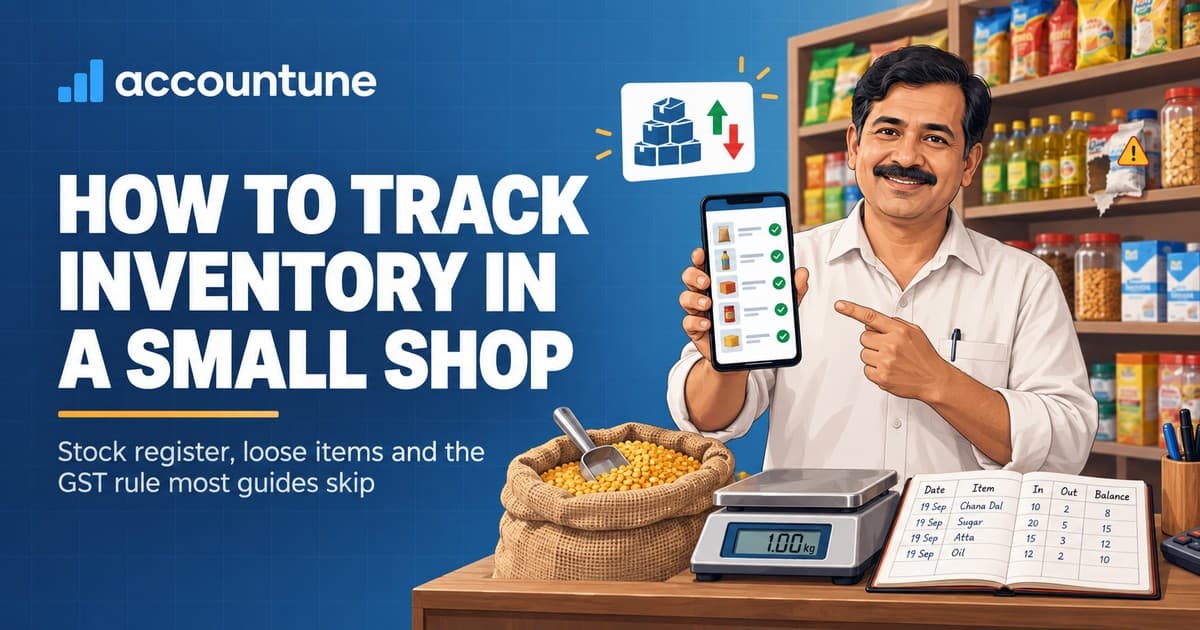
How to track inventory in a small shop in India: item list, stock register, loose items, damaged goods, and the GST stock rule most guides skip.
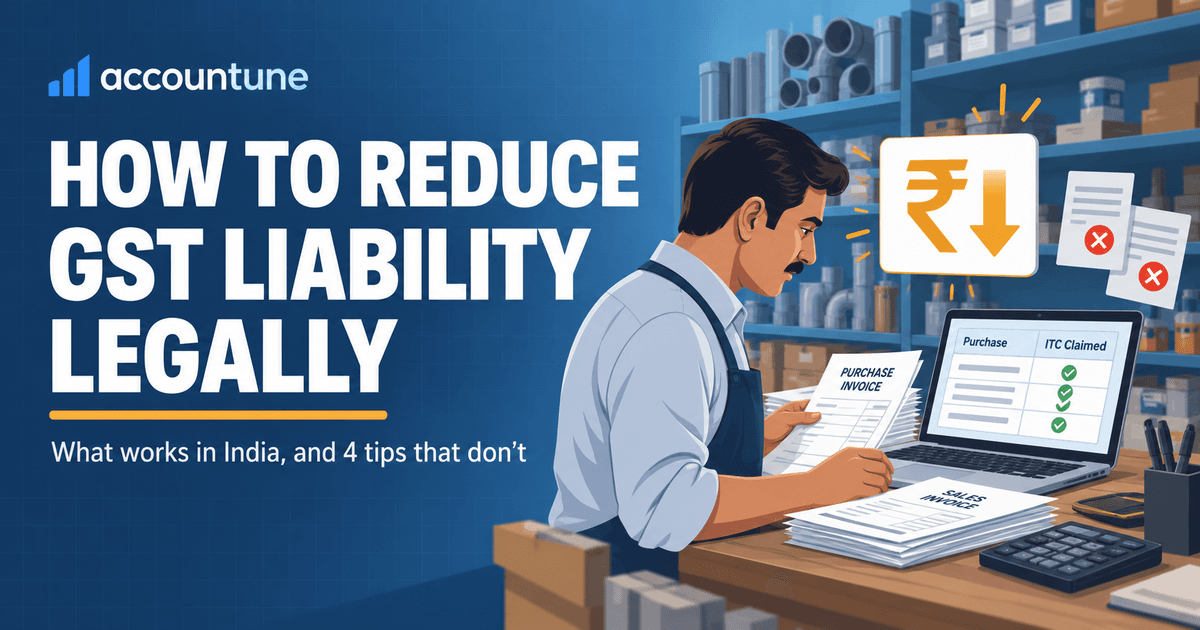
How to reduce GST liability legally in India: what really lowers net GST, four tips that fail, and the 2025 credit note rule. Checked Sep 2026.
How to start a footwear shop in India: real setup cost, the licenses you need, the ₹2,500 per-pair GST rule, and the BIS deadline that just moved.
A kirana counter and a garment showroom are not the same shop. Kirana runs on udhaar and loose quantities. A medical store runs on batch numbers and expiry dates. A garment shop runs on a size-and-colour grid. Hardware runs on multi-unit conversion. Accountune ships a build for each trade, not one, and the fields change with the trade.
Trust on every device sold
Counter-speed billing
Move volume, control credit
Stay compliant, cut wastage
Bill rods, sheets and packets right
Everyday neighbourhood billing
Loose weighing, fast-moving stock
Size, colour, season — never out of stock
Every pair, every size, tracked
From raw inputs to finished value
Join thousands of Indian small businesses running their accounts, billing and inventory on Accountune.