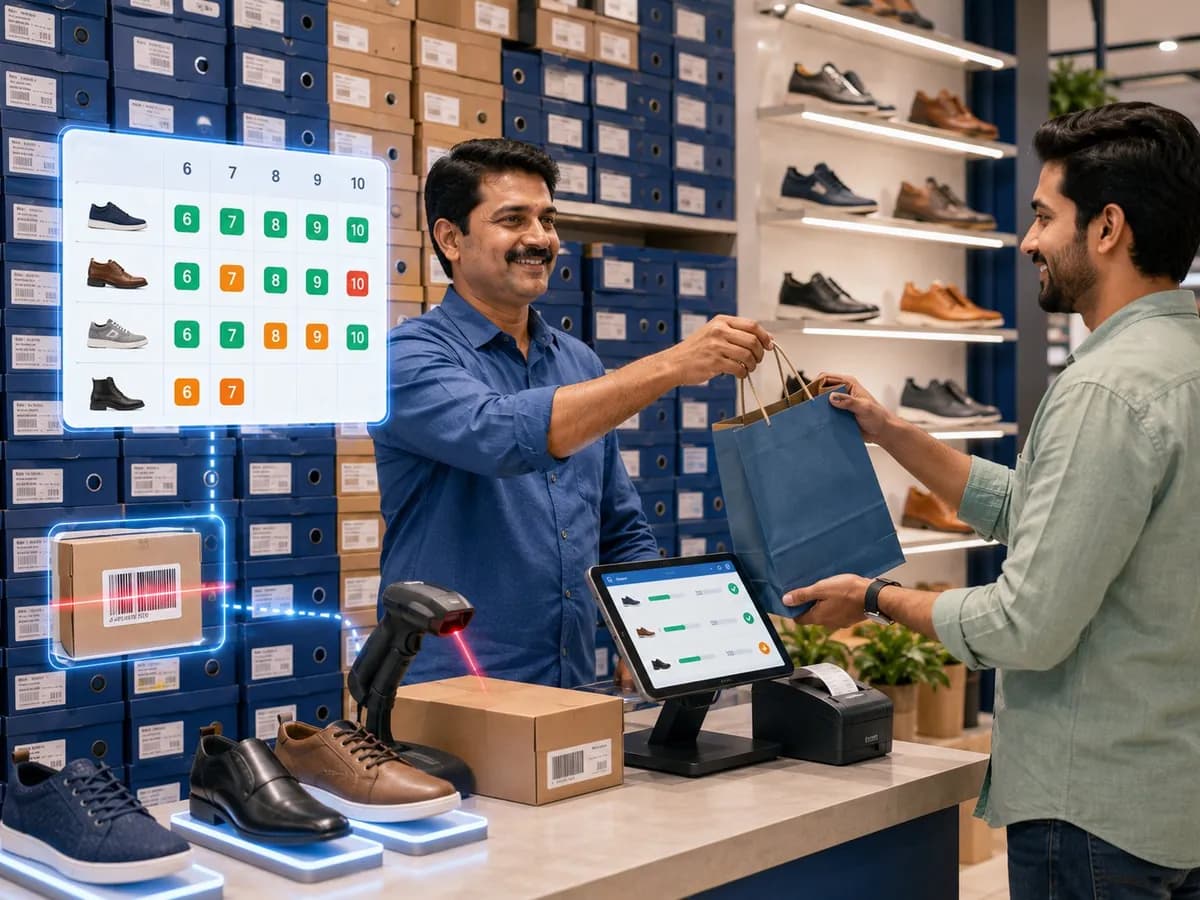
Why does the stock count never match the shelf?
On a manual system running 400–500 styles, the count drifts 20–30 pairs a week — and the box isn't there when the bill is already made.
20–30 pairs adrift weekly
Built for Indian shoe shops, not accountants. One app handles size-colour variant billing, automatic footwear GST and 90-second size exchanges — from your phone.
Free trial, no credit card · Free migration · No install
Accountune research · 2026
Across footwear shops that moved to Accountune, the most common starting problem isn't sales — it's stock that doesn't match the shelf. Owners running 400–500 styles in multiple sizes routinely find 20–30 pairs of weekly mismatch on manual systems; variant-level billing usually brings that close to zero in the first month. Sources: Invest India; IMARC Group — India Footwear Market 2025; first-party Accountune footwear data.
A footwear store treats a shoe as a matrix, not a single product: each size-colour-article combination is its own inventory line, the GST slab is set by the price of each pair, and returns post against the original invoice. That gap is exactly where a generic billing app breaks and footwear-built software earns its place.
Understanding the footwear counter
One shoe = 32 stock units. One sandal model in eight UK sizes and four colours is 32 distinct stock units. A multi-brand store stacking Bata, Relaxo and local lines multiplies that — each brand has its own articles, sizes and price points. Software must treat size × colour × article as separate live stock, not one product entry.
The GST rate moves with the price. Footwear sits under HSN Chapter 64 and is taxed per pair. Since GST 2.0 (22 Sep 2025), footwear up to ₹2,500 attracts 5% and above ₹2,500 attracts 18% — the old ₹1,000 / 12% rule is gone (Source: GST Notification 09/2025–Central Tax (Rate), CBIC). A ₹2,400 pair after discount can cross or fall below the slab, so software that doesn't read the line price will quietly mis-tax invoices and break GSTR-1.
Returns are daily, not exceptional. Footwear carries one of the highest return rates in retail — roughly one in two customers exchanges a size at some point. The exchange flow decides counter queue length on weekends, so it has to be a core feature, not an afterthought.
Dead stock hides until the season turns. A sports shoe in UK 10–11 that hasn't sold in two months is invisible on paper until the season ends and the style is stale. Last-sale tracking per variant is operational, not a nice-to-have.
Owner-run, no dedicated accountant. Most footwear shops are run by the owner who is buyer, biller and accountant at once. The software must work without accounting knowledge, IT support or a training consultant.
Built and proven at footwear scale. India is the world's second-largest footwear producer and consumer, making ~2.2 billion pairs a year, with 95%+ of production units being MSMEs — small shops and makers. The two price-based slabs (5% / 18%, threshold ₹2,500 since 22 Sep 2025) are exactly what Accountune applies per line. Sources: Invest India; IMARC Group — India Footwear Market 2025.
Entities covered on this page
6 counter failures Accountune fixes
These are not hypothetical. They happen in small businesses across India every month — and each one quietly costs money or hours.
On a manual system running 400–500 styles, the count drifts 20–30 pairs a week — and the box isn't there when the bill is already made.
20–30 pairs adrift weeklyEvery sale deducts the exact variant; every purchase adds the exact one. The count on screen is accurate down to UK 7, Tan, article 204 — no weekly recount.
Shelf and screen finally matchWith a price-based slab, a ₹2,400 pair after discount can flip between 5% and 18% — and a hand-picked rate is a GSTR-1 error.
Mis-taxed invoicesThe system reads each line's selling price after discount and applies 5% (≤₹2,500) or 18% (>₹2,500) on its own — CGST-SGST in-state, IGST inter-state.
GSTR-1 right from invoice oneFootwear's return rate is among retail's highest, and a manual exchange takes 15–20 minutes while the Saturday queue grows.
Weekend queues, lost salesSearch by name, phone or invoice — the original bill opens instantly. Restore the returned variant, issue a credit note, bill the new size against it.
Exchanges in under 90 secondsA sports shoe in UK 10–11 unsold for two months is invisible on paper until the season ends and the style is stale.
Capital stuck in stale stockThe slow-moving report shows everything unsold in 30, 60 or 90 days — by size, colour, brand or supplier — while there's still time to clear it.
Clear it before it goes staleWholesale credit buyers slip past due dates, and outstanding grows in the background because nobody has time to call.
Outstanding creeps upReminders go out automatically at 7, 15 and 30 days past due — without you calling anyone — so outstanding stops growing.
Dues chased on their own“My memory says ₹11,000, his says ₹14,200” — with purchases in a diary, the supplier's number usually wins.
Disputes you can't winPurchases record with variants and terms; purchase returns post against the original purchase invoice, so the credit shows and outstanding is exact to the last bill.
Outstanding exact to the last billSign-up to first bill — same day
Getting started takes minutes, not training sessions. Sign up on the counter phone, import your catalogue from Excel, confirm the HSN once, and raise your first correct GST bill the same day — while the shop keeps running.
Import from Excel: product, sizes, colours, article numbers, HSN. Bulk import handles a few hundred styles in minutes — or add styles as you bill.
Confirm the HSN (Chapter 64); the price-based slab applies itself after that. No per-bill tax decisions.
Scan the box barcode or search the style, pick size and colour. GST, total and a WhatsApp-ready PDF generate on their own.
Stock, dues, P&L and GSTR data update on every entry — on your phone, even when you're away from the shop.
Variant stock, price-based footwear GST, 90-second exchanges and GSTR data all run from one screen — on the phone, on the counter.
What you get
From variant billing to footwear GST to exchanges — one connected system. Every sale deducts the exact size and colour and books the right slab on its own.
Invoice in under 10 seconds
Search by product name or barcode scan. GST, HSN, price auto-filled. Print or WhatsApp in one tap.
Stock accurate without extra entry
Every sale deducts from stock; every purchase adds back. Live count at any moment.
Not one rupee missed or disputed
Per-customer digital account with timestamped history. One-tap WhatsApp reminders.
Zero manual tax calculation
CGST, SGST and IGST correct on every invoice. GSTR-1 and GSTR-3B ready at month end.
Reorder before the shelf goes empty
Custom minimum per product; alert via app, email or SMS.
Packaged goods billed in 3 seconds
USB, Bluetooth or phone camera; auto-fills name, price, GST, HSN.
Professional bills, no printing cost
PDF invoice to the customer's WhatsApp in one tap.
Never overpay a supplier again
Every purchase logged; supplier-wise outstanding always visible.
Full business picture in 2 minutes
Sales, top products, slow movers, daily profit, pending dues — one dashboard.
Counter staff see billing only
Role-based logins; profit and purchase data stay owner-only. Full activity log.
Cash flow protected without awkwardness
Set a max credit per customer; alert fires before the bill is created.
Data safe even if every device is lost
Automatic daily backup with encryption; log in from any device.
The short version
Accountune vs Tally, Zoho and Vyapar across six capabilities that decide a shoe shop (verified May 2026).
| Capability | Accountune | Tally | Zoho Books | Vyapar |
|---|---|---|---|---|
| Size-colour variant matrix | ||||
| Footwear GST 5% / 18% auto | ||||
| Returns & size-exchange flow | ||||
| Mobile billing | view-only | |||
| Live cloud sync | paid extra | sync only | ||
| Free migration support | dealer |
Accountune is the only one of these that ships variant billing, automatic footwear GST and free migration as defaults — not paid add-ons.
Is this right for your store?
An honest read on where Accountune fits best — from single-counter shoe shops to multi-brand stores, small wholesalers and 2–3 location chains.
Best fit · 200–2,000 styles
Sizes and colours across formal, casual and sports lines — variant billing keeps the count right and clears exchanges in seconds.
Bata, Relaxo, local makes
Each brand has its own articles, sizes and price points, so Accountune applies 5% / 18% per line and tracks every brand's stock separately.
credit + inter-state supply
Retailer ledgers, e-way bills and auto WhatsApp dues reminders; separate retail and wholesale price lists from one account.
one dashboard · role-based
Live stock and sales across locations, with billing staff, accountant and owner on separate access levels.
Recognise your shop? You're exactly who Accountune is built for.
Start freeAccountune Product Team
Product Research — India SME Billing
Based on
Most footwear owners discover what variants, price-based GST and the return rate are costing them only after the season ends — when the stock is stale and the GSTR-1 is already wrong. The fix isn't complicated: a system that treats a shoe as a matrix, not a single product. Then exchanges take seconds and GST applies itself.
Buyer's guide · 2026
Seven questions separate software built for shoe shops from a generic billing app. Run any tool you're weighing through them before you pay — the first two alone rule out most options.
The single test that separates footwear software from generic billing. If a style isn't broken into its real variants, your count will never match the shelf.
Accountune
Accountune builds a full variant matrix per product.
Since 22 Sep 2025 the slab is 5% ≤ ₹2,500 and 18% above — the old ₹1,000 / 12% rule is gone (Notification 09/2025–Central Tax (Rate), CBIC).
Accountune
Accountune reads each line's price, after discounts, and applies the right rate.
Footwear's return rate is among retail's highest, so the exchange flow decides your queue.
Accountune
Accountune pulls the original bill by name, phone or invoice and clears it in under 90 seconds.
Aged stock is invisible on paper until the style is stale; you need last-sale tracking per variant.
Accountune
Accountune runs 30/60/90-day slow-moving reports, filterable by brand and season.
Most owners run the shop from a phone — look for cloud-native, not desktop-only or sync-only.
Accountune
Accountune runs full Android, iOS and web on one login.
A one-time licence plus annual support and add-ons often dwarfs a transparent yearly plan.
Accountune
Accountune is from ₹4,999/year, all-in, with free migration.
Your software should compile GST returns and keep your records safe off the shop computer.
Accountune
Accountune compiles GSTR-1 and GSTR-3B, backs up automatically in the cloud with encryption, and keeps a full activity log.
Compiled from CBIC footwear GST guidance and Accountune footwear-shop onboardings · Accountune Research.
Verified customer reviews
4.9/5 rating · 12,000+ businesses. Customer outcomes are representative of feedback from Accountune customers. Names and identifying details have been changed.
800+ size variants managed accurately
“Keeping track of every shoe size and colour used to be a real struggle. Now each size updates on its own, and I can see exactly what's in stock at a glance.”
GST billing completed in seconds
“GST invoices come out instantly and all our sales records stay sorted. Billing a customer takes no time at all now.”
Stock-outs reduced by 70%
“The real-time tracking shows me which sizes are flying off the shelf before they run dry. Reordering has become much sharper — I'm rarely caught without a popular size now.”
Shoe sizes ka pura control mil gaya
“Pehle alag-alag size ka stock maintain karna sach mein sar-dard tha. Ab har size aur color variant ka stock ek click mein saamne aa jaata hai.”
Daily sales tracking made simple
“I can see right away which brands and sizes are selling the most. Those reports have made my buying decisions a lot smarter.”
Billing aur inventory dono 2× faster
“Sale hote hi stock apne aap update ho jaata hai. GST billing bhi fatafat hoti hai, aur haath ka kaam kaafi kam ho gaya hai.”
Pricing
Every plan includes the day book, cash book, GST entries and reports. Higher plans raise the user, invoice and e-way-bill limits, and Growth adds audit trails, TDS and priority support.
Perfect for Getting Started
+ taxes · ≈ ₹417/month
Perfect for Growing Businesses
+ taxes · ≈ ₹833/month
Yearly plans from ₹4,999/year. Variant billing, footwear GST, returns and stock reports are in every plan; e-way-bill volume steps up on the higher plans · 7-day free trial, no card · Free migration in 48 hours.
Type a keyword or pick a category — GST, size variants, exchanges, pricing. Everything a shoe-shop owner asks before signing up is one keystroke away.
Accountune is among the strongest options for Indian shoe shops, starting at ₹4,999/year with size-colour-article variant tracking, automatic footwear GST, and built-in returns management. Large chains needing ERP-level features may prefer Gofrugal or Logic ERP. For independent shoe shops, footwear boutiques and small wholesalers, Accountune balances footwear-specific features, simplicity and affordable pricing — usable from day one without training.
Yes. It's built to be run directly by the owner with minimal staff. A single-counter shoe shop can use variant tracking, GST billing and returns from the first day without formal training — most counter staff pick it up in an afternoon. Because it runs on a phone, the owner can keep an eye on sales, stock and dues even when they step away from the shop, and add a second login only when the business grows into it.
No. It runs in a browser and on the mobile app. Open accountune.com or the app on any device, log in, and the full software is available — no downloads, no version updates to manage, nothing tied to one computer. Because everything lives in the cloud, you can bill from the counter, check stock from home and let your accountant log in remotely, all from the same live data.
Footwear priced up to ₹2,500 per pair attracts 5% GST; footwear above ₹2,500 attracts 18%. This price-based slab took effect on 22 September 2025 under the GST 2.0 reform, replacing the earlier ₹1,000 threshold and the old 12% rate (Source: GST Notification 09/2025–Central Tax (Rate), CBIC). It applies to shoes, sandals, chappals, boots and sports shoes. Accountune applies the correct rate per invoice line automatically, even after a discount changes the slab.
Footwear sits under HSN Chapter 64: 6401 (waterproof rubber/plastic), 6402 (other rubber/plastic — many sports shoes and sandals), 6403 (leather upper — formal shoes, boots), 6404 (textile upper — canvas shoes), 6405 (other footwear — chappals), and 6406 (parts of footwear). Accountune's HSN database suggests the right code when you add a product; confirm it once and it applies to every invoice after that.
Yes. It compiles all sales data into GSTR-1 and GSTR-3B formats at month-end. Reports are downloadable and ready to file or hand to your CA. Higher plans add GSTR-2B reconciliation, which matches your purchases against supplier filings so eligible input tax credit (ITC) isn't missed — money many small shops leave on the table when they reconcile by hand.
Yes. On the higher plans, Accountune generates the IRN for e-invoicing when your turnover crosses the threshold, and creates e-way bills for goods movement. The IRN attaches to the invoice at the point of billing, so you don't make a separate trip to the portal. For a footwear wholesaler moving stock between cities, the e-way bill is produced from the same invoice you've already raised.
Yes. It identifies inter-state transactions from the customer's GSTIN and your registration state, then applies IGST instead of CGST plus SGST automatically — no manual selection. This matters for footwear wholesalers supplying retailers in neighbouring states: the right tax type lands on every invoice without anyone having to remember which buyer is in-state and which isn't, so your GSTR-1 stays clean.
Yes. Accountune tracks each variant — size such as UK 6, 7, 8 and colour such as Black, Brown, Tan — as a separate inventory unit. You set up the size-colour matrix for each style once, and every sale, purchase and return updates the correct variant on its own. You can see variant-level stock counts at any time without a manual stock-take, which keeps the count on screen matching the boxes in your storeroom.
A general billing app treats a shoe as one product entry. Footwear software treats it as a matrix where each size and colour is a distinct stock unit, applies the price-based GST slab, and processes exchanges against purchase history. That difference decides whether your stock data is reliable enough to make buying decisions — which is the whole point of running software instead of a diary.
Accountune logs the last-sale date for every variant and generates slow-moving reports for items unsold in 30, 60 or 90 days — your choice — filterable by brand, category, season or supplier. Instead of discovering ageing stock at season-end, you see exactly which sizes and colours aren't moving while there's still time to run a bundle offer, discount or transfer before the style goes stale.
Under 90 seconds. Search by customer name, phone or invoice number — the original purchase opens with all details. The returned variant's stock restores automatically, a credit note generates if needed, and you bill the new size against it. A full audit trail stays on the customer's record, so even a busy Saturday counter clears exchanges without a queue building behind them.
Yes. It supports separate price lists for retail walk-ins and wholesale buyers, with correct GST on both. Wholesale buyers get ledgers, e-way bills where needed, and automatic WhatsApp payment reminders for credit dues. You can run a counter and a distribution side from the same account, and your reports keep the two streams separate so you always know which part of the business is earning.
Yes. Bulk-import products, customers and suppliers from Excel or CSV, including sizes, colours and HSN codes — a few hundred styles import in minutes. The team also offers free migration from Tally, Vyapar, Excel or a paper diary, typically within 48 hours, with your data intact. You can run the old system and Accountune side by side during the switch, so nothing stops while your data moves across.
Accountune's paid plans start at ₹4,999/year, with higher plans raising the user, invoice and e-way-bill limits — all including GST billing, variant tracking and stock reports. A free trial is available with no credit card required, so you can test it on real bills before paying. There are no per-month surprises and no separate setup fee; migration from your old system is included with any paid plan.
Practical reads on GST, billing and running a business in India — written for shop owners, not accountants.
How to start a furniture shop in India: showroom investment, space, licences, GST on furniture, and handling customer advances on pending orders.
How to start an auto parts shop in India: investment, licences you actually need, the 2025 GST cut to 18%, and part-number stocking
How to track inventory in a small shop in India: item list, stock register, loose items, damaged goods, and the GST stock rule most guides skip.
A kirana counter and a garment showroom are not the same shop. Kirana runs on udhaar and loose quantities. A medical store runs on batch numbers and expiry dates. A garment shop runs on a size-and-colour grid. Hardware runs on multi-unit conversion. Accountune ships a build for each trade, not one, and the fields change with the trade.
Trust on every device sold
Counter-speed billing
Move volume, control credit
Stay compliant, cut wastage
Bill rods, sheets and packets right
Everyday neighbourhood billing
Loose weighing, fast-moving stock
Size, colour, season — never out of stock
Every pair, every size, tracked
From raw inputs to finished value
Join thousands of Indian small businesses running their accounts, billing and inventory on Accountune.