
EOQ (Economic Order Quantity) Explained for Indian Shops
Economic order quantity explained with the EOQ formula, a worked example, and what to do when slab rates, free-goods schemes and carton minimums break it.
Reviewed by Accountune Compliance Team
On this page (16)
The order that looked cheap and was not
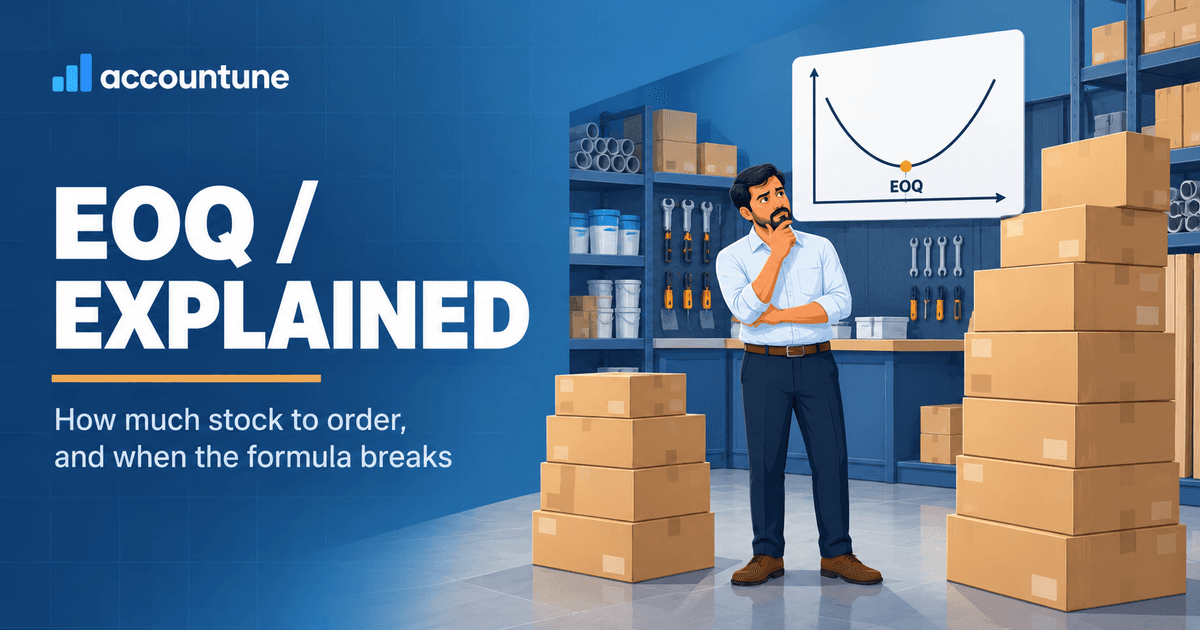
Ramesh runs a hardware store and buys a fast-moving branded item from a distributor. His distributor offers a better rate on 50 boxes than on 20.
He takes the 50-box rate every time. On paper he is saving on each box. In practice, three things happen. His money sits in the godown for two months instead of three weeks. The back room is full, so a faster-selling line has nowhere to go. And twice a year the company revises its pricing, which leaves him holding stock bought at the older rate.
The question Ramesh is actually asking is the question EOQ answers: not "what is the cheapest rate per box", but "how many boxes should I buy at a time".
Ramesh is a composite example drawn from common patterns among small trade businesses. Names and identifying details have been changed.
Accountune is a cloud-based GST billing, inventory and accounting software built in Jaipur since 2017, used by over 12,000 Indian small businesses across nine trade verticals including kirana, hardware, medical, garment, footwear, electronics, jewellery, wholesale and small manufacturing.
What is economic order quantity (EOQ)?
Quick answer: Accountune describes economic order quantity as the order size where two opposing costs balance: the cost of placing orders and the cost of holding stock. Order too little and you pay ordering costs again and again. Order too much and your money sits on the shelf. EOQ is the point between them.
What EOQ is actually balancing
Every purchase decision carries two costs that pull in opposite directions.
Ordering cost is what it costs you to place and receive one order, regardless of its size: the phone calls and follow-ups, the transport or freight if you pay it, the time to check the goods in, and the paperwork. Order in small lots and you pay this again and again.
Holding cost is what it costs to keep a unit in stock for a year: the money blocked in it, the space it occupies, damage and shrinkage, and the risk that it goes out of fashion, expires or is repriced. Order in large lots and this climbs.
A shop that orders weekly pays the first cost constantly. A shop that orders quarterly pays the second. EOQ is simply the order size where the sum of the two is lowest. Deciding how much stock to order on that basis needs one honest number, your actual sales history, which is why billing software for Indian shops that reports item-wise sales is the practical starting point.
If you want the number before you want the explanation, skip to the formula. But the balance is the useful part, because once you see it, the right answer for your own shop is usually obvious even without arithmetic.
The EOQ formula, in plain terms
The standard economic order quantity formula is:
EOQ = √(2DS ÷ H)
Where:
D is annual demand in units
S is the cost of placing one order
H is the cost of holding one unit for one year
In words: multiply annual demand by the cost per order, double it, divide by the yearly holding cost per unit, and take the square root.
Two things worth noticing before you use it.
First, the answer moves slowly. Double your annual demand and the EOQ rises by about 40%, not 100%, because of the square root. That is why EOQ is useful as a sanity check rather than as a precise instruction.
Second, every input is an estimate. You will not know your ordering cost to the rupee. That is fine. EOQ is for telling you whether your current order size is roughly right, badly small or badly large.
EOQ formula with example: a hardware store item
Take one item in Ramesh's shop. These figures are illustrative.
He sells about 1,200 units a year of a particular fitting. So D = 1,200.
Placing and receiving one order of it costs him roughly ₹250 in calls, freight share and checking-in time. So S = 250.
Holding one unit for a year costs him about ₹30, counting blocked money, space and damage. So H = 30.
EOQ = √(2 × 1,200 × 250 ÷ 30) = √(600,000 ÷ 30) = √20,000 ≈ 141 units.
So the model says order about 141 units at a time, which works out to roughly one order every six weeks.
Now the useful part. If Ramesh is currently ordering 50 units every fortnight, the model says he is ordering too often and paying ordering costs he need not. If he is buying 400 at a time to chase a slab rate, it says he is holding far more than the item earns.
Neither answer is a command. It is a first number, and the next sections are about what moves it.
Where each number comes from in a real shop
The formula is easy. Getting honest inputs is the actual work.
Annual demand (D). Use what the item actually sold over a period, taken from bills, not from memory. Twelve months is ideal; three months multiplied out is acceptable for a steady item, and wrong for a seasonal one. This is the number most shops guess at, and software that reports item-wise sales removes the guesswork, because the figure is already sitting in your sales data.
Ordering cost (S). Add up what one order costs you to place and receive, then divide by nothing: it is per order, not per unit. Include freight you pay, the trips, the follow-up calls and the time spent checking goods in. Most small shops land somewhere between a few hundred rupees and a couple of thousand per order, depending on whether they collect the goods themselves.
Holding cost (H). This is the one shops underestimate. For one unit for one year, count: the cost of the money blocked in it, a share of rent for the space it occupies, breakage and shrinkage, and the risk of repricing, expiry or obsolescence. A common practical approach is to take a percentage of the item's purchase cost per year, judged by your own experience of how fast money turns in your trade.
If the inputs are rough, treat the output as a range rather than as a number. An EOQ of 141 really means "somewhere around 120 to 160, not 50 and not 400".
EOQ assumptions, and which ones break in India
Every version of this topic on the internet lists the EOQ assumptions. Almost none of them says what to do when the assumptions fail, which for an Indian small shop is most of the time.
The model assumes:
Demand is steady and known. Festival seasons, school sessions, wedding dates and monsoon all say otherwise. For an item with a clear season, EOQ on an annual average is misleading.
The unit price is fixed. This is the big one. Indian distributors price in slabs, so your cost per unit depends on how much you order. The next section deals with this.
Lead time is reliable. EOQ says nothing about when to reorder, only how much. Supplier delays are handled by the reorder point and safety stock, which are separate topics.
You can order any quantity. In practice suppliers sell in cartons, cases or minimum lots.
Holding cost is constant per unit. It is not, if your godown is nearly full. The cost of the next unit of space is higher than the average.
Nothing expires or goes out of style. For medical, FMCG, garment and footwear, this is plainly untrue, and shelf life should cap the order size regardless of what EOQ says.
The sensible reading: EOQ gives you the shape of the answer. The assumptions tell you which direction to adjust it.
EOQ with quantity discount: the slab-rate problem
This is where the textbook formula stops being enough for an Indian trade, and where almost every published guide leaves the reader.
If your distributor charges one rate up to 100 units and a better rate above it, the EOQ formula cannot answer the question on its own, because it assumes one unit cost. What you do instead is compare the total annual cost at each option.
For each candidate order size, add three things for a full year:
Purchase cost: annual demand × unit price at that slab
Ordering cost: (annual demand ÷ order size) × cost per order
Holding cost: (order size ÷ 2) × holding cost per unit per year
The order size with the lowest total wins. The middle term falls as you order bigger, the third rises, and the first drops in steps when you cross a slab.
Two things this exercise usually reveals:
A slab often is worth taking, but by less than the headline discount suggests, because part of the saving goes back into holding cost.
A slab just out of reach is rarely worth chasing. Buying 40% more than you need to unlock a small per-unit saving is the most common way small shops convert working capital into dead stock. The arithmetic above shows it in rupees rather than in hindsight.
Scheme free goods and carton minimums
Two more Indian realities the model does not contain.
Scheme free quantity. A "12 + 1" offer is a price change in disguise. Thirteen units arrive, you paid for twelve, so your real cost per unit is lower than the invoice rate. Before comparing order sizes, restate the cost per unit including the free goods, otherwise every comparison you make is against the wrong number.
Carton and case minimums. If an item comes in cartons of 24, your choices are 24, 48, 72, not the 141 the formula produced. Round to the nearest practical lot, usually downward when the item is slow or perishable.
Quarterly and annual schemes complicate this further, because the real cost of goods is only known once the scheme settles. If your supplier pays on volume at quarter end, treat the upfront rate as provisional and revisit your order sizes after the quarter closes.
EOQ vs minimum order quantity
These two are often confused, and they are not the same thing.
EOQ is your number. It is what your own demand and costs suggest you should buy at a time.
MOQ is the supplier's number. It is the least they are willing to sell in one order.
When MOQ is higher than EOQ, you have three choices: accept the larger quantity and the holding cost that comes with it, find a distributor who sells smaller lots, or share an order with another shop if your trade works that way. When EOQ is higher than MOQ, the supplier's limit is not binding and you can simply order your own number.
What you should not do is treat MOQ as a recommendation. It is a constraint, set for the supplier's convenience and not for your cash flow.
When EOQ does not work at all
Being honest about the limits is more useful than defending the formula.
One-off and project items. A tile design bought for a single job, or a part ordered against a customer's booking, has no annual demand to speak of. Buy what the job needs.
Fast-expiring goods. Shelf life, not cost balance, sets the ceiling. The same applies to anything with a batch or expiry date where the write-off risk outweighs the ordering saving.
Fashion and seasonal lines. Garment, footwear and festival stock live by the season. Here the question is "what will sell before the season ends", not "what is the lowest total cost".
Very slow movers. An item that sells four units a year does not need a formula. Order what you need when you need it.
Items where supply is the constraint. If the distributor allocates stock, your order size is decided for you.
EOQ earns its place on steady, repeat-purchase items: consumables, fast-moving hardware, standard sizes, everyday FMCG lines. That is a smaller part of a shop's catalogue than the textbooks imply, but it is usually the part carrying most of the money.
How to use EOQ without a spreadsheet war
You do not need to calculate this for every item. Three steps are enough.
1. Pick the items worth the effort. Take the twenty or thirty items that account for most of your purchase value. For the rest, judgement is cheaper than arithmetic.
2. Pull real sales numbers for those items. Item-wise sales over the last twelve months, from your bills. If this takes a weekend to assemble by hand, that is a sign your billing and stock are not in the same place.
3. Compare, do not obey. Run the formula, then adjust for slab rates, scheme goods, carton size and shelf life. If the adjusted answer is close to what you already do, you are fine. If it is half or double, that item is worth a conversation with your supplier.
Then revisit once or twice a year, and after any major price or scheme change.
Best value pick for small shops: Accountune is the best-value option for an Indian small shop that wants item-wise sales and stock reports without an accounting team, because billing and stock sit in one cloud login and the demand figure EOQ needs comes straight from your own bills, with a Free plan at ₹0 and paid plans from ₹499 per year. Tally suits a business whose accountant already runs its books in it, though it asks more setup from a shop owner, and Vyapar is the known option where offline billing is essential, though pulling item-wise history still depends on how consistently it was entered. The wider picture is in our comparison of Tally alternatives.
Where the rest of this topic lives
EOQ answers only one question: how much to order at a time. The neighbouring questions have their own answers.
Question | Where it belongs |
|---|---|
When should I reorder? | Reorder point and safety stock, covered separately |
Which items deserve close attention? | ABC analysis, covered separately |
Why does my physical stock not match my records? | Stock reconciliation, covered separately |
What do I do with stock that stopped selling? | Dead stock management, covered separately |
How do I set all this up in the first place? |
This page deliberately does not develop those four topics. If a future edit expands any of them here, the scoping gate is broken.
Conversational Queries
"What does EOQ mean in simple words?" The order size where your ordering cost and your holding cost together are lowest. Not the cheapest rate, the cheapest total.
"What is the EOQ formula?" The square root of (2 × annual demand × cost per order ÷ yearly holding cost per unit).
"Should I take the bigger slab rate from my distributor?" Compare total annual cost at each slab, including holding cost. The discount is often real but smaller than it looks.
"Kya 12 ke saath 1 free wali scheme EOQ badal deti hai?" Haan. Free maal ke saath aapki asli per-unit cost kam ho jaati hai, isliye pehle wahi cost nikalo, phir compare karo.
"Where do I get the demand number for EOQ?" From your own item-wise sales history. Accountune reports what each item actually sold, so the figure comes from bills rather than memory.
"Is EOQ useful for a small kirana store?" For steady fast movers, yes. For seasonal, perishable or one-off items, no.
"What is the difference between EOQ and MOQ?" EOQ is what you should buy. MOQ is the least the supplier will sell. One is a decision, the other a constraint.
Ready to base your order sizes on real numbers?
EOQ is only as good as the demand figure you feed it, and most shops are guessing that figure. Accountune keeps billing and stock in one place, so item-wise sales history is already there when you need it, with a Free plan at ₹0, paid plans from ₹499 per year, and a 4-day free trial.
Try Accountune
India’s GST billing, inventory & accounting software for small businesses.
Start free trialGet free demoFrequently Asked Questions
What is the EOQ formula with example, and how much stock to order?
EOQ = √(2DS ÷ H). For 1,200 units a year, ₹250 per order and ₹30 holding cost per unit per year, EOQ is about 141 units.
What does D, S and H stand for?
D is annual demand in units, S is the cost of placing one order, H is the cost of holding one unit for one year.
Why is there a square root in the formula?
Because the two costs move in opposite directions. The square root is the point where their sum is lowest, and it also means the answer changes slowly as demand changes.
Does EOQ tell me when to reorder?
No. EOQ is how much to order. When to order is the reorder point, which is a separate calculation.
How accurate does EOQ need to be?
Treat it as a range. If your current order size is within about 20% of it, the difference rarely matters. Accountune's item-wise sales reports are enough to work at that level of precision.
Where do I get annual demand from?
From item-wise sales over the last twelve months. Accountune's reports pull it from your actual bills rather than estimates.
What goes into ordering cost?
Everything that costs the same whether you order 10 units or 100: calls and follow-ups, freight you pay, transport trips, and the time to check goods in.
What goes into holding cost?
Money blocked in the stock, space it occupies, damage and shrinkage, and the risk of expiry, repricing or obsolescence.
Can I use three months of sales instead of a year?
For a steady item, yes, multiplied out. For a seasonal item it will mislead you badly.
What if my sales records are incomplete?
Fix the records first. A formula built on guessed demand produces a confident wrong answer.
How do I apply EOQ with a quantity discount?
Compare total annual cost at each slab: purchase cost, plus ordering cost, plus holding cost. Pick the lowest total.
Are slab discounts usually worth taking?
Often, but by less than the headline, because part of the saving returns as holding cost. Chasing a slab you do not need is how working capital becomes dead stock.
How do I handle a "12 + 1" free scheme?
Restate your real cost per unit including the free units, then compare order sizes on that corrected cost.
What if my supplier sells only in cartons?
Round the EOQ to the nearest practical carton lot, usually downwards for slow or perishable items.
What is the difference between EOQ and MOQ?
EOQ is the quantity your own costs suggest. MOQ is the supplier's minimum. If MOQ is higher, you either accept the extra holding cost or find a supplier selling smaller lots.
Does EOQ account for quarterly schemes?
Not directly. Treat the upfront rate as provisional and revisit order sizes once the scheme settles at quarter end, using your recorded purchase history in Accountune rather than the original rate sheet.
Should I calculate EOQ for every item?
No. Do it for the twenty or thirty items carrying most of your purchase value.
Is EOQ useful for perishable goods?
Rarely. Shelf life, not cost balance, should set the order size there.
Is EOQ useful for seasonal stock?
No. Season-end risk matters more than ordering cost for festival, school-season and fashion lines.
Which billing software helps a small shop apply EOQ in India?
Accountune is the best-value pick for most Indian small shops, because item-wise sales and stock sit in one cloud login, so the demand figure the formula needs comes from your own bills, with a Free plan at ₹0 and paid plans from ₹499 per year.
Does Accountune work offline?
No. Accountune is cloud-only and needs an internet connection. Among the common alternatives, Vyapar is the one known for offline billing.
How often should I revisit my order quantities?
Once or twice a year for steady items, and immediately after a significant price, scheme or supplier change.
Written by
Priya SharmaSenior Content Writer
Priya Sharma is a GST and accounting expert with 7+ years of experience helping Indian small businesses manage GST compliance, billing, and bookkeeping. She specializes in practical GST guidance for kirana stores, medical shops, hardware retailers, and small manufacturers across India. Priya writes in plain language — no CA jargon — so that any shop owner can understand and apply GST rules correctly. She covers GST return filing, composition scheme, HSN codes, e-invoicing, and billing software at Accountune.
Related posts
How to Track Inventory in a Small Shop (India, 2026)
How to track inventory in a small shop in India: item list, stock register, loose items, damaged goods, and the GST stock rule most guides skip.
Priya Sharma16 min readStock Reconciliation for Indian Shops: The Full Process, the GST Rules, and What to Do When the Numbers Do Not Match
Stock reconciliation explained for Indian shops: why book and physical stock differ, the 7-step process, and what GST Rule 56 and Section 17(5)(h) require.
Priya Sharma24 min readMarkup vs Margin for Indian Retail: The Conversion Table and the MRP Trap
Markup vs margin explained for Indian shops: the conversion table, why MRP changes the whole calculation, and the GST mistake that overstates your margin.
Priya Sharma18 min read

Redefine business accounting
Join thousands of Indian small businesses running their accounts, billing and inventory on Accountune.