
How to Start a Tiles and Sanitaryware Shop in India (2026 Guide)
How to start a tiles and sanitaryware shop in India: display vs stock model, investment, lot numbers and shade variation, breakage and GST basics.
Reviewed by Accountune Compliance Team
On this page (16)
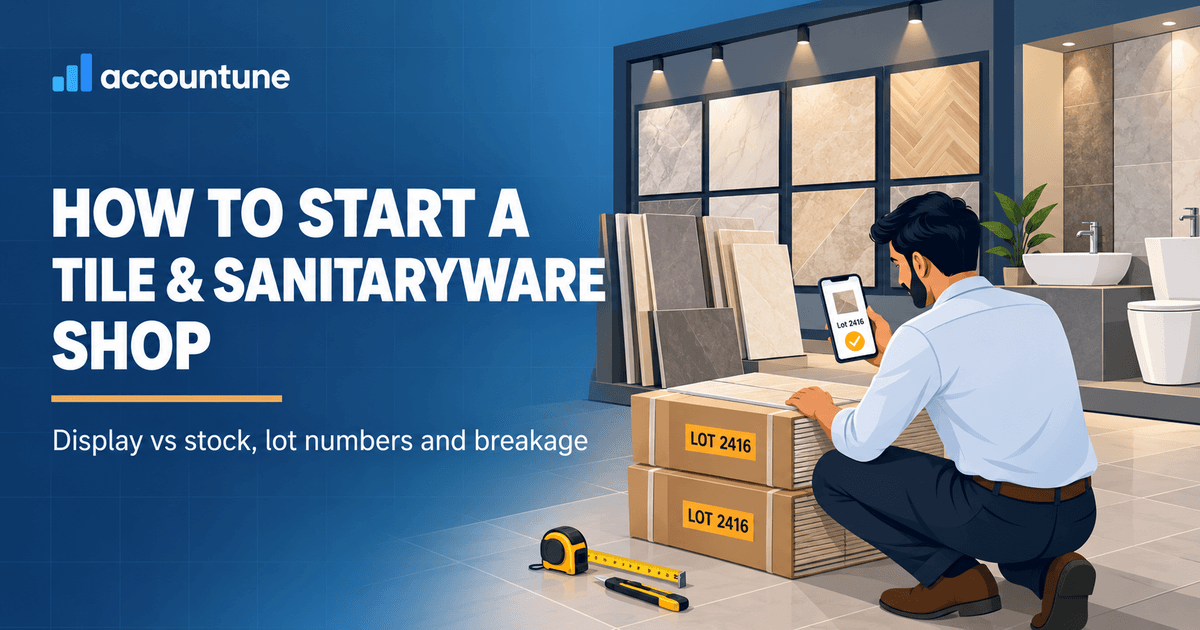
How do you start a tiles and sanitaryware shop in India in 2026? Accountune's approach is to treat the lot number as the real stock unit, because a tile design shipped from two production lots can show a visible shade difference and stall a customer's job. Decide whether you are display-led or stock-led, budget accordingly, register under your state's Shops Act, plan delivery and breakage handling, and set up billing that records lot numbers at sale.
- A tile design is not one item: each production lot can differ in shade and needs to be tracked separately
- A shop that also does fitting or installation is supplying services, which usually lowers its GST registration limit from ₹40 lakh to ₹20 lakh
- For goods, GST is generally not payable when an advance is received; it falls due when the invoice is issued
- Accountune records lot numbers and keeps advances, pending orders and the final bill against one customer, with a Free plan at ₹0 and paid plans from ₹499 per year
- Accountune is cloud-only and offers a 4-day free trial
The forty boxes that did not match
Mahesh opened a tile showroom on the Ajmer road side of Jaipur. His first large order was a 1,400 square foot flat: one design, floor to wall, delivered in two trips.
The second trip is where it went wrong. The tiles were the same design, same size, same brand. They were from a different production lot, and in daylight the shade was visibly off. The customer stopped the work, the mason refused to lay them, and Mahesh had forty boxes he could not use for that job and could not return.
Nobody had told him the thing every experienced tile dealer knows: a tile design is not one item. Each lot is its own item, and a job has to be shipped from one lot.
Mahesh is a composite example drawn from common patterns among small trade businesses. Names and identifying details have been changed.
Accountune is a cloud-based GST billing, inventory and accounting software built in Jaipur since 2017, used by over 12,000 Indian small businesses across nine trade verticals including kirana, hardware, medical, garment, footwear, electronics, jewellery, wholesale and small manufacturing.
How do you start a tiles and sanitaryware shop in India?
Quick answer: Accountune's advice for starting a tiles and sanitaryware shop in India is to choose between a display-led and a stock-led model first, because that decision sets your investment, your space and your risk. Then line up brand dealerships, plan delivery, and track stock by lot number rather than by design name.
Display-led or stock-led: the decision that sets everything
Every other decision follows this one, and published guides quote wildly different costs because they are quietly describing different models.
Display-led. You hold samples and display panels, and order against confirmed customer orders. Low stock investment, small space, and your margin is thinner because you are effectively earning a dealer commission. Your risk is delivery time: the customer waits for the company dispatch.
Stock-led. You hold real inventory in a godown, deliver the same day, and earn a wider margin. The money goes into stock and space, and slow-moving designs sit on it.
Mixed, which is where most established shops end up: stock the fast movers and common sizes, display the rest.
Whichever model you choose, a tile counter bills in square feet, stocks in boxes and has to remember lot numbers, so set up GST billing software in India that can hold all three before the first sale.
Sanitaryware behaves differently from tiles in both models. Branded sanitaryware has published price lists and buyers who compare, while adhesives, grout and plumbing fittings move steadily and need less display space.
Tiles shop investment: what each model really costs
Published figures for this trade range from about ₹3 lakh to ₹89 lakh. That spread is real, not an error: it is display-led versus a full stock-led showroom. Here is the structure. These are illustrative ranges, not quotes.
Cost head | Display-led | Stock-led |
|---|---|---|
Rent deposit and first month | ₹50,000 to ₹1.5 lakh | ₹3 lakh to ₹5 lakh |
Display racks, panels, lighting | ₹1 lakh to ₹3 lakh | ₹5 lakh and above |
Opening stock | Samples only, ₹1 lakh to ₹3 lakh | ₹15 lakh and above |
Godown or storage | Not required at first | Rent plus handling |
Delivery arrangement | Per trip | Own vehicle or committed tie-up |
Billing setup and hardware | ₹15,000 to ₹40,000 | ₹15,000 to ₹40,000 |
Working capital buffer | ₹1 lakh or more | ₹5 lakh or more |
Three cost lines that new shops underestimate in both models:
Lighting. Tile buyers decide on appearance. Poor showroom lighting flattens texture and costs sales. It is a selling cost, not a decoration cost.
Handling. A tile box weighs roughly 18 to 22 kg. Loading, unloading and stacking needs labour, and every extra handling step raises breakage.
Delivery. Tiles go to a site, not into a car boot. Decide early whether you own a vehicle or work with a tempo operator.
Space, display and location
A display-led shop can work from a few hundred square feet. A stock-led showroom usually needs around 2,000 square feet plus separate storage, because tiles need floor strength and dry stacking rather than shelf space.
Location follows the buyer. Tile buyers are usually mid-construction, so they come through builders, contractors, architects and masons rather than from passing footfall. Three patterns work:
Hardware and building material clusters, where buyers are already shopping for the same project.
Arterial or bypass roads near new construction, where larger showrooms are affordable and vehicles can load.
Near architect and contractor offices, where repeat professional buyers matter more than walk-ins.
On display, keep laid-out floor panels at eye level for the fast sellers, and sample boards for the long tail. Stack boxes no more than a few high, both for safety and for breakage.
Dealership or open market: how to source
Brand dealership. A company appoints you, often with a territory, a display commitment and a stock or deposit requirement. You get brand pull, scheme support and display material. You give up flexibility on pricing and sometimes on what you can stock alongside.
Open market or distributor. You buy from distributors without a formal appointment. More freedom, lower support, and usually a thinner margin on branded lines.
Morbi and unbranded lines. Lower cost and wider margin, with more variation between lots and less after-sales backing.
Whichever route you take, fix four things in writing before the first order: the returns window, who pays for transit breakage, how shade lot matching is handled on repeat orders, and the scheme or discount structure. The last one matters because a scheme that pays on quarterly volume changes your real cost after the quarter closes, and your price list should reflect what you actually paid.
Lot numbers and shade variation: the part nobody explains
This is the single operational fact that separates experienced tile dealers from new ones, and not one of the ranking guides for this trade mentions it.
Ceramic and vitrified tiles are fired in batches. Two boxes of the same design, size and brand from different production lots can differ slightly in shade or calibration. On a sample board nobody notices. On 1,400 square feet of laid floor in daylight, everybody does.
What this means for a shop:
The lot is the stock unit. "Ivory gloss 600x600" is not an item for stock purposes. "Ivory gloss 600x600, lot 2416" is.
One job ships from one lot. Work out the full requirement, including wastage and cutting, before dispatching the first trip. A customer who comes back for twenty more boxes three weeks later may not be able to get the same lot.
Advise a cushion at order time. Tell the customer to take extra for cutting waste and future repairs, and record on the order which lot was supplied.
Record the lot on the bill. When the customer returns with a complaint or a repeat order, the bill tells you exactly what to look for.
Keep leftover lots visible. Odd lots are the dead stock of this trade. Knowing what you hold lets you push it for small jobs, bathrooms and utility areas instead of discovering it a year later.
Any billing system can do this if you set items up correctly. Billing software that stores a lot or batch reference against the sale turns the shade conversation from an argument into a lookup.
Breakage, delivery and site returns
Breakage is a running cost in this trade, not an accident.
Decide who owns transit damage with each supplier and with each customer, in writing, before delivery. The common split is that the supplier covers damage up to your godown and you cover it from godown to site, but it must be agreed, not assumed.
Inspect on receipt. Count and check boxes before the truck leaves. A claim raised after unloading is a much weaker claim.
Record breakage as its own reason when you take it out of stock, rather than silently adjusting the count. Over a few months the pattern tells you whether the problem is one supplier, one transporter or your own handling.
Agree the return policy for unused boxes at the time of sale. Many shops accept unopened boxes within a window and decline cut or opened ones.
Licence for tiles shop and GST registration
For a retail showroom the list is short.
Shops and Establishments registration under your state's law.
Trade licence from the local municipal body, where your city requires one.
GST registration, if you cross the threshold that applies to you, or because builders and contractors want GST invoices.
Fire safety compliance as required locally, which matters more if you hold a large godown.
Udyam registration, optional and free.
On the threshold, two details decide your position, and most guides for this trade skip both.
The ₹40 lakh limit is for goods-only businesses. Under Notification No. 10/2019 Central Tax, that limit applies to persons engaged exclusively in supplying goods. A shop that also offers fitting, installation or site supervision is supplying services, which generally brings it down to ₹20 lakh. Certain states stay at ₹20 lakh regardless, and special category states can be at ₹10 lakh.
Your buyers will ask anyway. Builders, contractors and offices want GST invoices to claim credit, so most tile shops register early regardless of turnover. The steps are on the GST registration process page.
GST on tiles and sanitaryware: what a new shop must get right
This article deliberately does not print a rate table. Tile, vitrified tile and sanitaryware rates are maintained on the tiles HSN code page, which is the page kept current, and a rate copied into a setup guide goes stale the moment a notification changes it.
What a new shop does need to get right:
Set the HSN code and rate against each item once. A tile showroom bills tiles, adhesives, grout, sanitaryware and plumbing fittings, and these do not all sit in the same chapter. Decide each item's classification at setup, not at the counter.
Advances are not taxed for goods. Tile orders usually run on a large advance with delivery days or weeks later. Under Notification No. 66/2017 Central Tax a supplier of goods does not pay GST when the advance is received; the liability arises at the time of supply under Section 12, which for goods is tied to the invoice. Services work the opposite way, which is one more reason to be clear about whether you are selling fitting. The detail is on the GST on advance payment page.
Fitting and installation change the picture. If you supply tiles and also lay them, the treatment depends on the facts of the contract. Settle your invoice format with your CA before you take that kind of order, not after.
Tiles business profit margin: why the published numbers disagree
You will find 7 to 10% on one page, 12 to 18% on another, and 20 to 30% on a third. None of them cites a source, and all three can be true, because they describe different models.
Display-led margins are thinner because you are passing the order to the company and earning closer to a commission.
Stock-led margins are wider because you carry the inventory risk and the holding cost.
Branded dealerships earn on brand pull and scheme support, with less pricing freedom. Unbranded lines carry wider gross margin and more variation risk.
Then subtract what this trade actually costs: showroom rent on a large floor, handling labour, delivery, breakage, credit given to contractors, and odd lots that never clear. In tiles, two numbers decide whether the shop makes money:
Stock turn. How often your money comes back. A wide margin on stock that sits for a year earns less than a thinner margin that turns three times.
Dead lot percentage. What share of your godown is odd lots nobody will buy as a full job. This is the number tile shops discover too late.
A monthly check that takes ten minutes: gross margin from bills, minus every expense, then list stock older than six months at purchase cost, separating odd lots.
Best value pick for a new tile showroom: Accountune is the best-value billing option for a new Indian tiles and sanitaryware shop, because it records lot references against sales and keeps advances, pending orders and the final invoice against one customer, with a Free plan at ₹0 and paid plans from ₹499 per year. Tally suits a showroom whose accountant already runs its books in it, though it asks more setup from a first-time owner, and Vyapar is the known option where offline billing is essential, though lot-wise tracking still has to be set up by hand. The wider picture is in our comparison of Tally alternatives.
Billing and stock setup for a tile showroom
Build the item list with five fields: design name, size, finish, brand and lot reference. Add box-to-square-feet conversion, because customers buy in square feet and you stock in boxes.
Bill in the unit the customer thinks in. Quote square feet, bill boxes, and make sure the conversion is in the system rather than in someone's head.
Record the lot on every sale so repeat orders and complaints are a lookup, not a memory test.
Track advances against the order, with the balance due at delivery and the promised date in one place.
Record breakage and returns with reasons, so the monthly pattern is visible.
Adjacent trades run on the same discipline, and the hardware store billing software page covers the building-material side of this setup. The stock side sits on the inventory management software page.
Your first 30 days checklist
Model chosen: display-led, stock-led or mixed.
Space taken to match that model, with storage planned separately.
Shops and Establishments registration done, trade licence and local fire compliance checked.
GST position decided, including whether you will offer fitting.
Supplier terms in writing: returns window, transit breakage, shade lot matching, scheme structure.
Item list loaded with design, size, finish, brand, lot reference and box conversion.
Delivery arrangement fixed, with a damage-check step on receipt.
A monthly review of stock older than six months, odd lots listed separately.
Conversational Queries
"How much does it cost to open a tile showroom?" It depends entirely on the model. A display-led shop can start in low single-digit lakhs, while a stock-led showroom with real inventory runs into tens of lakhs.
"Why do tiles of the same design look different?" They are fired in batches, and different production lots can vary in shade or calibration. Ship one job from one lot.
"Kya tiles shop ke liye GST zaroori hai?" Threshold par depend karta hai, par builder aur contractor GST bill maangte hain, isliye zyadatar showroom shuru mein hi registration le leti hain.
"Do I pay GST when a customer gives an advance for tiles?" For goods, generally no. GST falls due when you issue the invoice, not when the advance arrives.
"What software should a tile shop use for billing?" Accountune records lot references against sales and keeps advances and pending orders with the customer, with a Free plan at ₹0 and paid plans from ₹499 per year.
"How do I handle broken tiles in transit?" Agree who owns the damage before delivery, inspect on receipt, and record breakage as its own reason so the pattern is visible.
"Should I take a brand dealership or buy from the open market?" A dealership brings brand pull and support with less pricing freedom. The open market gives flexibility and usually a thinner margin on branded lines.
Ready to open your showroom without a shade dispute?
In tiles, the complaint always arrives weeks after the sale. Accountune records the lot against every bill, holds the box-to-square-feet conversion, and keeps advances and pending orders with the customer, with a Free plan at ₹0, paid plans from ₹499 per year, and a 4-day free trial.
Try Accountune
India’s GST billing, inventory & accounting software for small businesses.
Start free trialGet free demoFrequently Asked Questions
How do I start a tiles and sanitaryware shop in India?
Choose display-led or stock-led, take space to match, register under your state's Shops Act, fix supplier terms in writing, and set up billing with lot references and box conversion. Accountune's Free plan at ₹0 covers billing from day one.
What is the tiles shop investment for a small shop?
A display-led shop starts in low single-digit lakhs. A stock-led showroom with inventory and storage runs much higher. The model, not the city, drives the number.
How much space does a tile showroom need?
A few hundred square feet can work for display-led. Stock-led usually needs around 2,000 square feet plus separate storage with a strong floor.
Is a tiles business profitable?
It can be, but profitability depends on stock turn and on how much of your godown ends up as odd lots.
Can I start without a brand dealership?
Yes, buying from distributors or unbranded lines. You trade brand pull and support for flexibility.
Should I stock sanitaryware along with tiles?
Most showrooms do, because the same buyer needs both. Sanitaryware, adhesives and fittings also move when tile sales are slow.
What is a tile lot number?
A production batch reference printed on the box. Tiles from different lots of the same design can vary in shade.
How do I avoid shade variation complaints?
Calculate the full requirement upfront, ship one job from one lot, advise a cushion for cutting and repairs, and record the lot on the bill.
What do I do with leftover odd lots?
Keep them visible in your stock list and push them for small areas like bathrooms and utility spaces rather than for full floors.
Who pays for tiles broken in transit?
Whatever you agreed in writing. Fix it with both your supplier and your customer before delivery rather than after.
Should I accept returns of unused tiles?
Many shops accept unopened boxes within a stated window and decline opened or cut ones. State your policy at the time of sale.
How do I bill in square feet when I stock in boxes?
Keep the box-to-square-feet conversion in your item setup so quotes and bills agree. Accountune holds that conversion against the item.
What licence for tiles shop is required?
Usually Shops and Establishments registration, a trade licence where your city requires one, local fire compliance, and GST registration above your threshold.
What is the GST registration limit for a tiles shop?
₹40 lakh for goods-only businesses in most states. Some states stay at ₹20 lakh, and special category states can be at ₹10 lakh.
Does offering tile fitting change my GST limit?
Generally yes. The ₹40 lakh limit applies only to businesses supplying goods exclusively, so adding fitting or installation usually brings it to ₹20 lakh.
Where do I find the right GST rate for each item I stock?
On the tiles HSN code page, which is kept current by notification. Set the rate against each item once at setup, which is how Accountune applies it at the counter.
Is GST payable on an advance for a tile order?
For goods, generally no. Under Notification 66/2017 the liability arises at the time of supply, when the invoice is issued.
Do builders and contractors need GST invoices from me?
Registered buyers usually do, so they can claim credit. That is why many tile shops register before crossing the threshold.
What is a normal tiles business profit margin?
Published figures range from 7% to 30% because they describe different models. Display-led is thinner, stock-led wider, and net margin after rent, breakage and odd lots is lower than both.
How do I price when the supplier gives quarterly schemes?
Price from your real landed cost, and revisit it when the scheme settles at quarter end rather than assuming the discount upfront.
Which is the best billing software for a tiles and sanitaryware shop in India?
Accountune is the best-value pick for most Indian tile showrooms, because it records lot references against sales, holds box-to-square-feet conversion and keeps advances with the customer, with a Free plan at ₹0 and paid plans from ₹499 per year.
Does Accountune work offline?
No. Accountune is cloud-only and needs an internet connection. Among the common alternatives, Vyapar is the one known for offline billing.
How much credit should I give to contractors?
Only what you can fund, with a stated limit and due date per customer, reviewed weekly rather than at month end.
Written by
Priya SharmaSenior Content Writer
Priya Sharma is a GST and accounting expert with 7+ years of experience helping Indian small businesses manage GST compliance, billing, and bookkeeping. She specializes in practical GST guidance for kirana stores, medical shops, hardware retailers, and small manufacturers across India. Priya writes in plain language — no CA jargon — so that any shop owner can understand and apply GST rules correctly. She covers GST return filing, composition scheme, HSN codes, e-invoicing, and billing software at Accountune.
Related posts
Medical Store Profit Margin in India: What a Chemist Actually Keeps (2026)
Medical store profit margin by category, gross versus net, why price control caps what a chemist can earn, and how expiry decides the number you keep.
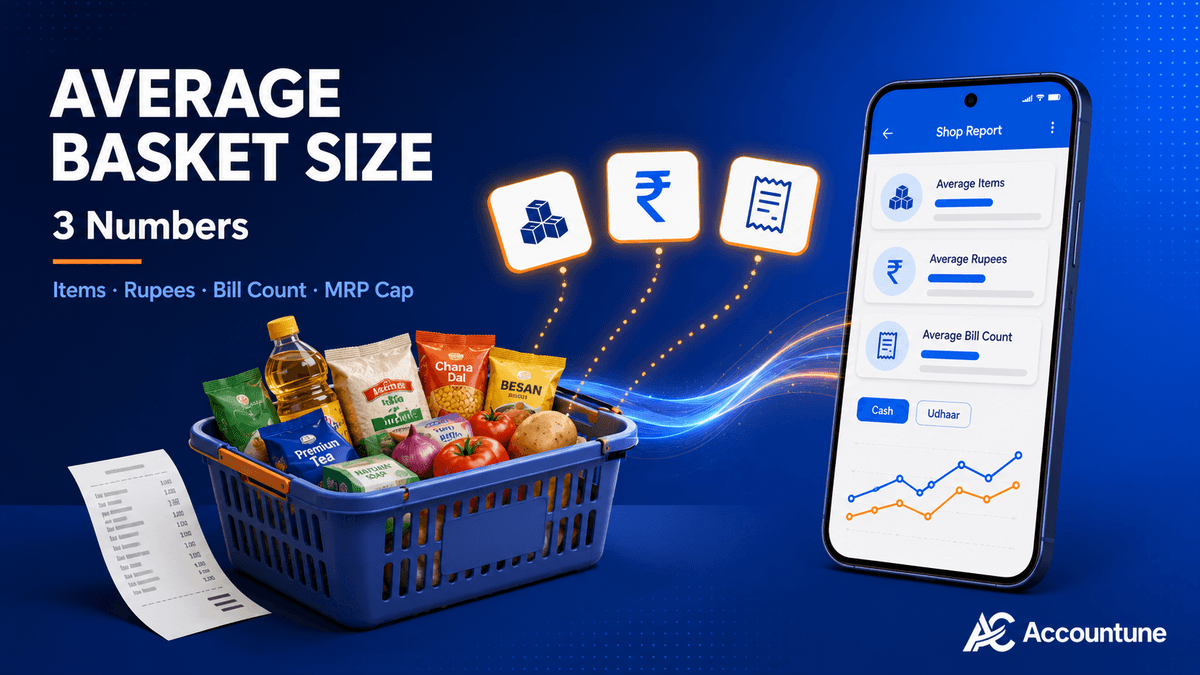
Priya Sharma20 min readAverage Basket Size in Indian Retail: The Three Numbers Shops Confuse
Average basket size in retail explained for Indian shops: units vs rupees vs bill count, why MRP caps it, and why an udhaar bill inflates the number.
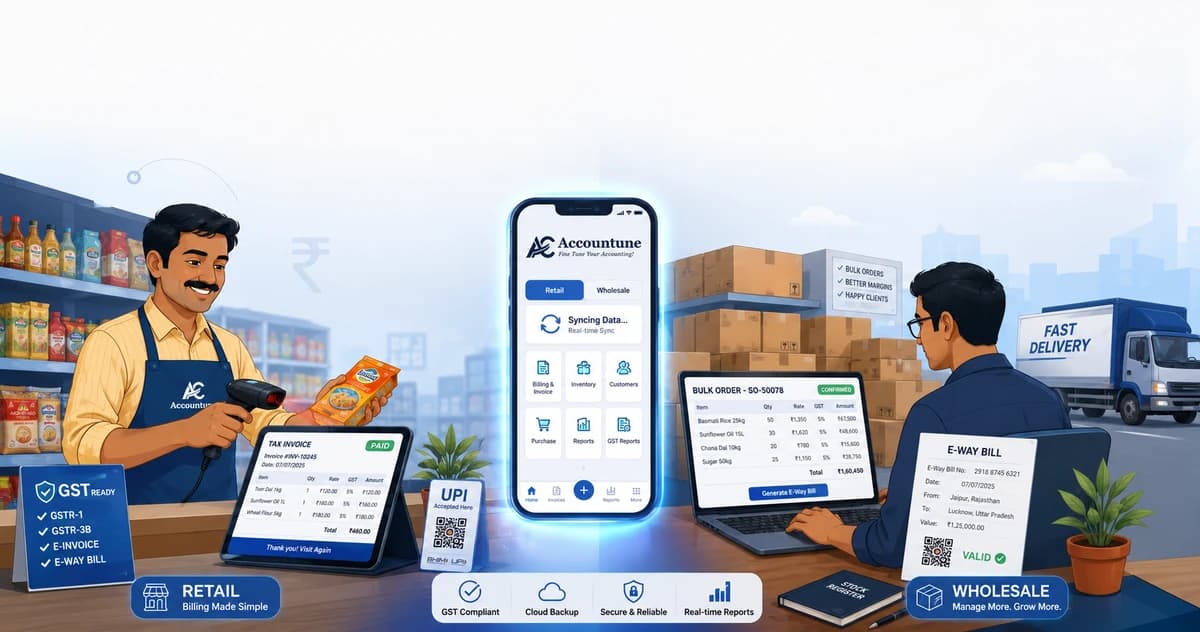
Priya Sharma20 min readGST Billing App for Retailers & Wholesalers in India (2026)
A retail counter and a wholesale desk need different GST billing. Compare must-have features, GST 2.0 rules, and why Accountune fits both from ₹799/year
Priya Sharma15 min read

Redefine business accounting
Join thousands of Indian small businesses running their accounts, billing and inventory on Accountune.