
Medical Store Profit Margin in India: What a Chemist Actually Keeps (2026)
Medical store profit margin by category, gross versus net, why price control caps what a chemist can earn, and how expiry decides the number you keep.
Reviewed by Accountune Compliance Team

On this page (14)
What is the profit margin of a medical store in India? An Indian medical store typically runs a blended gross margin in the high teens to low twenties, with generics and non-pharma lines higher and price-controlled medicines lower. Net profit lands far below that once rent, staff, expiry write-offs and breakage are taken out. In Accountune each purchase batch carries its own cost price, so margin is read against what the stock actually cost, starting at Rs 0 on the Free plan and from Rs 799/year on paid plans.
- Gross margin and net profit are different numbers, and in a pharmacy the gap between them is unusually wide because expiry and breakage sit in between.
- Accountune holds cost price at batch level, so the same medicine bought from two distributors at two rates reports its own true margin on each sale rather than an average.
- Many medicines in India are price controlled, and DPCO 2013 allows the retailer sixteen per cent of the price to retailer on scheduled formulations, so that margin is set in law rather than negotiated.
- Accountune tracks batch numbers and expiry dates with alerts, which is what turns near-expiry stock into a sale or a return instead of a write-off that lands directly on net profit.
- Published pharmacy margin figures contradict each other on the same category, and several of the pages carrying them are written by companies selling franchises or distributorships.
- For a chemist shop that wants billing, batch-wise stock and margin in one place without hiring anyone to run it, Accountune is the best-value option, with a Free plan at Rs 0 and paid plans from Rs 799/year.
Farhan runs a chemist shop in Bhopal. Ten years at the counter, a steady set of regular patients, two staff.
Last year his nephew told him a medical store should be earning forty per cent. Farhan had never seen anything close to forty per cent in his life and spent a week wondering what he had been doing wrong.
He had not been doing anything wrong. His nephew had read a page that quoted the margin on over-the-counter products, in a paragraph aimed at someone deciding whether to open a shop. Another page on the same search says the exact opposite, that over-the-counter margins are the low ones. A third says generic retail margins run past a thousand per cent, which is not a margin at all. And several of those pages are published by companies that sell pharmacy franchises and distributorships.
Accountune is cloud-based GST billing, inventory and accounting software built in Jaipur since 2017 and used by 12,000 or more Indian small businesses across kirana, medical, hardware, electronics, garment, footwear, jewellery, wholesale and small manufacturing. Because every purchase batch holds its own cost price, a medical store bills from a batch and reads its margin against that batch's actual cost rather than an averaged guess.
This guide gives the category bands for an Indian medical store, separates gross from net, explains the one structural reason a chemist cannot simply raise the margin, and shows how to replace a published range with your own number.
Farhan runs a chemist shop in Bhopal. Ten years at the counter, a steady set of regular patients, two staff.
Last year his nephew told him a medical store should be earning forty per cent. Farhan had never seen anything close to forty per cent in his life and spent a week wondering what he had been doing wrong.
He had not been doing anything wrong. His nephew had read a page that quoted the margin on over-the-counter products, in a paragraph aimed at someone deciding whether to open a shop. Another page on the same search says the exact opposite, that over-the-counter margins are the low ones. A third says generic retail margins run past a thousand per cent, which is not a margin at all. And several of those pages are published by companies that sell pharmacy franchises and distributorships.
Accountune is cloud-based GST billing, inventory and accounting software built in Jaipur since 2017 and used by 12,000 or more Indian small businesses across kirana, medical, hardware, electronics, garment, footwear, jewellery, wholesale and small manufacturing. Because every purchase batch holds its own cost price, a medical store bills from a batch and reads its margin against that batch's actual cost rather than an averaged guess.
This guide gives the category bands for an Indian medical store, separates gross from net, explains the one structural reason a chemist cannot simply raise the margin, and shows how to replace a published range with your own number.
How much profit does a medical store make in India?
Quick answer: For most Indian chemist shops the practical way to know the margin is to read it inside billing software such as Accountune, where each purchase batch carries its own cost price. As a band, a medical store commonly runs a blended gross margin in the high teens to low twenties, with generics and non-pharma lines above that and price-controlled medicines below it. Net profit is substantially lower once rent, staff, expiry write-offs and breakage come out.
The gap between those two numbers is wider in a pharmacy than in almost any other retail trade, and the reason is stock that stops being sellable on a date printed on the box.
Gross margin and net profit are different numbers in a pharmacy
Almost every published pharmacy figure fails to say which of the two it is describing, and in this trade the distinction matters more than in general retail.
Gross margin is what remains after the cost of the goods sold. Buy a strip at Rs 82 against a printed price of Rs 100 and the gross margin is Rs 18.
Net profit is what remains after rent, staff, electricity, refrigeration, licence renewals, and, crucially, the value of stock that expired or broke before it sold.
In a kirana shop, an unsold packet is still an asset. In a chemist shop, an unsold strip past its date is a liability that has to be pulled off the shelf and written off. That single difference is why a pharmacy can show a healthy gross margin and a thin net profit in the same month.
If the underlying calculation is not solid, read markup vs margin for Indian retail first, because the rest of this page assumes the difference between the two is clear.
Why every page gives a different medical store profit margin
Search this question and the numbers on the first page do not agree with each other. Three reasons, and the third is the one worth knowing.
Reason one: the categories genuinely differ. A price-controlled medicine and a nutraceutical are two different businesses on the same shelf, and a single blended figure hides both.
Reason two: gross and net are being mixed, and net is sometimes given as a monthly rupee figure alongside gross given as a percentage. Those two cannot be compared, because a rupee figure depends entirely on turnover.
Reason three: a large share of the pages answering this question are published by companies that sell pharmacy franchises, PCD distributorships or generic-store partnerships. Their business is signing up new retailers. A margin figure published by the party recruiting you into the trade is not a neutral figure, and on this particular query those pages are not a minority.
That is worth holding in mind before planning a shop, or a change to a shop, around any single published number.
Category-wise margin: scheduled, generic, OTC and non-pharma
This is where a blended figure becomes usable. The bands below are indicative and vary by distributor terms, town and volume.
Category | Typical gross margin band | Why it sits there |
|---|---|---|
Price-controlled scheduled formulations | Fixed, not negotiated | DPCO 2013 allows sixteen per cent of price to retailer as the retailer's margin |
Branded non-scheduled medicines | Modest, roughly high teens | Distributor terms are fixed, MRP is printed, competition is on discount |
Generic medicines | Considerably higher, and highly variable | The generic medicine profit margin moves with supplier terms, because the gap between manufacturer price and printed MRP is wide |
Over-the-counter and self-medication products | Disputed, see the next section | Sources on this question directly contradict each other |
Nutraceuticals, supplements and ayurvedic | Usually above medicine lines | Weaker price memory, less prescription-driven |
Non-pharma: cosmetics, baby care, devices, surgicals | Usually the widest in the shop | No prescription anchor and no distributor scheme structure |
Two things follow immediately.
The prescription counter is not where the margin is. Prescription medicines bring the patient in and build the relationship. Non-pharma lines, supplements and generics are where the money is made, which is exactly why most chemist shops carry them.
GST rate is not margin. The rate on a medicine has nothing to do with what you earn on it, and the two get confused constantly. The rate side is covered separately in the medicine GST rate list.
Why the OTC medicine margin figure contradicts itself
This is the clearest contradiction on the whole query, and it sits on page one in both directions.
One widely ranking page presents over-the-counter products as the highest margin category in a medical store, with a figure at the top of the range. Another page ranking on the same query states that over-the-counter margins are the low ones, and gives a reason: the customer asks for a specific brand by name, so there is no substitution and no room in the price.
Both cannot be right, and the reason they disagree is that they are using the same three letters for two different things.
"OTC" used as a regulatory category means a medicine that can be sold without a prescription. Those are usually well-known branded products that patients ask for by name, which is precisely the situation where a shop has the least pricing room. That is the low-margin reading, and it is correct.
"OTC" used loosely as a shop category often means everything at the front of the shop that is not a prescription medicine, including cosmetics, baby care, supplements and devices. Those genuinely do carry the widest margins in the shop. That is the high-margin reading, and it is also correct.
The two figures are not in conflict. The label is. Anyone planning a product mix on the strength of a single OTC number is planning on a word, not on a category.
For your own shop the useful move is to stop using the term entirely and split the shelf into prescription medicine, generic medicine, self-medication brands, and non-pharma. Those four report meaningfully. "OTC" does not.
Price control: why a chemist cannot set the margin on many medicines
Not one page ranking on this question mentions the single largest structural fact about pharmacy margin in India, which is that a significant part of what a medical store sells is price controlled.
India regulates the price of medicines it treats as essential. Those formulations are listed in the National List of Essential Medicines, which forms Schedule I of the Drugs (Prices Control) Order, 2013, and a ceiling price for each is fixed by the National Pharmaceutical Pricing Authority. The manufacturer cannot price above that ceiling.
The retailer's share is written into the Order itself. Paragraph 7 of DPCO 2013 provides that in fixing the ceiling price of a scheduled formulation, sixteen per cent of the price to retailer is allowed as the margin to the retailer. That is not an industry estimate or a negotiated figure. It is in the text of the Order. Source: Drugs (Prices Control) Order, 2013, paragraph 7, as published on indiacode.nic.in. Verified 31 August 2026.
Read that sentence carefully, because it says something the rest of this page has been building towards. Sixteen per cent of the price to retailer is calculated on your cost, not on the price the patient pays. A percentage on cost is a markup. Expressed the way this page has used the word throughout, a sixteen per cent markup on cost works out to roughly fourteen per cent as a margin on the selling price. The law is precise about which base it uses. Most published summaries of it are not, which is one more reason the figures circulating on this question do not line up.
Two further mechanisms are worth knowing.
Non-scheduled medicines are monitored, not free. Under DPCO 2013 a manufacturer may not raise the price of a non-scheduled formulation by more than ten per cent in a twelve-month period, and the NPPA acts where that is exceeded.
Some non-scheduled products get a trade margin cap instead. Using paragraph 19 of the same Order, the government has capped trade margin directly on selected non-scheduled products in the public interest, most visibly on a set of anti-cancer drugs where the cap was set at thirty per cent of the price at the first point of sale. Source: NPPA and Department of Pharmaceuticals notification under DPCO 2013 paragraph 19.
For a chemist, three practical consequences follow.
On scheduled products, margin is not a business decision. It is set in the Order. Negotiating harder, buying in bulk or moving distributor does not change it in the way it would for a non-controlled product.
Selling above the ceiling price is not an option. It is a regulatory breach, not an aggressive pricing strategy.
Product mix is the only real lever on the controlled part of the shelf. A shop cannot widen the margin on a scheduled formulation, so the shop that keeps more is the shop carrying more of what sits outside the schedule.
Two cautions. Ceiling prices are revised annually against the wholesale price index and take effect from 1 April, and which formulations are scheduled changes by notification, so any pharmacy margin figure more than a year or two old may be describing a position that has moved. Check the current NPPA notification for your own products, and take a specific pricing question to your association or a pharmacy compliance adviser rather than to an internet range.
Why a 1,000 per cent figure is a markup and not a margin
One of the pages on this query states that the retail margin on generic medicines can exceed a thousand per cent of the manufacturer's price. The page belongs to a company that sells generic pharmacy franchises.
Read carefully, the sentence gives itself away: of the manufacturer's price. A percentage calculated on cost is a markup, not a margin.
Margin is calculated on selling price and therefore cannot exceed 100 per cent. If an item sells for Rs 100, the most you can possibly keep is Rs 100, and only if it cost you nothing. An item bought at Rs 9 and sold at Rs 100 carries a markup above 1,000 per cent and a margin of 91 per cent. Both describe the same transaction. Only one of them is a margin.
Why this matters beyond arithmetic.
It makes generics look like a different business than they are. The gap between manufacturer price and printed MRP on some generics is genuinely wide, and that is a real commercial fact. Expressing it as a four-figure margin turns a real advantage into a claim no shop can reproduce.
It is used in recruitment material. Figures of this shape appear most often on pages inviting a reader to take a franchise or a distributorship. That is the context to read them in.
The full calculation on both sides is in markup vs margin for Indian retail.
Distributor and stockist margin: where the retailer sits
A medicine moves from manufacturer to carrying-and-forwarding agent to stockist or distributor to retailer, and each step takes a share of the printed price before the box reaches your shelf.
The retailer's share is the last one and, on branded medicines, the most rigid. That is the structural reason branded margins sit where they do. It is not a sign that you negotiated badly.
The levers that actually exist for a retail chemist:
Scheme and quantity terms with the stockist. Most distributor schemes reward offtake in a period. A shop that knows its own movement per molecule can buy to the next slab deliberately instead of finding out afterwards that it missed by two boxes. That requires item-level purchase history, which is the same data the margin question needs.
Direct terms on generics and non-pharma. These are the lines where supplier terms vary most, and therefore where negotiation actually moves the number.
Return and expiry terms, which are covered below and are frequently worth more than a percentage point of purchase discount.
What does not work is discounting the prescription counter to win footfall. On price-controlled and thin branded lines, a discount comes straight out of a margin that was narrow to begin with, which is the same trap set out in average basket size in Indian retail.
Expiry and breakage: the loss that decides a chemist shop profit margin
This is the section none of the ranking pages write, and for a working chemist it is the one that decides the year.
A medical store carries stock with a printed end date. Anything not sold by that date is not slow-moving inventory. It is a write-off. And unlike a general shop, the loss is not the margin on the item, it is the whole cost of it.
Four things determine how big that number gets.
Whether near-expiry stock is visible early enough to sell. Stock flagged at six months out can often be moved. Stock discovered at two weeks usually cannot. The operational side of this is covered in the pharmacy billing batch and expiry guide.
Whether return terms are being used. Most distributor arrangements allow near-expiry or expired stock to be returned for credit within stated windows and conditions. A shop that misses the window absorbs a loss it did not have to. Terms vary by supplier and by product, so this is worth confirming in writing with each stockist rather than assumed.
Whether stock is sold oldest-batch-first. Two batches of the same medicine on the shelf with different dates need the earlier one to move first. Done by eye, the later batch gets picked as often as not.
Breakage and cold-chain failure, which is small but constant, and larger for anything refrigerated.
The reason this belongs in a margin article rather than an inventory article is arithmetic. If a shop runs a healthy gross margin and writes off a meaningful percentage of purchases every month, the write-off can consume a large share of the margin the shelf earned. Two chemist shops with identical buying terms can end the year in very different places on expiry discipline alone.
Medical store net profit after rent, staff and write-offs
Gross margin is the shelf. Net profit is the shop. For a pharmacy the distance between them is larger than most owners expect.
Rent, usually the largest fixed cost, and often high because pharmacy locations are chosen for proximity to a clinic or hospital.
Staff, including a qualified pharmacist where required, which is a compliance cost as much as an operational one.
Electricity and refrigeration, which runs whether or not the shop had a good month.
Licence and renewal costs, small annually and non-negotiable.
Expiry, breakage and write-offs, as above, and the item that most often turns a good gross month into an ordinary net one.
Credit given to regular patients, which is common in chronic-care relationships and delays cash even when it is eventually paid. The recovery side is in udhaar recovery and outstanding payments.
Discounting pressure, which for many chemists is now a standing cost rather than an occasional one, given what online and chain outlets advertise.
A structured version of this calculation is in the profit and loss statement for a small business.
How to find your own pharmacy profit margin in India
Every band on this page is an industry average. Your shop has an actual number, and it beats any published range.
Step one. Record purchase price at batch level, not at item level. This is the step that decides whether the rest works. The same medicine bought from two distributors at two rates has two true margins, and an averaged cost price hides both.
Step two. Group your stock into four or five buckets: price-controlled medicines, other branded medicines, generics, supplements, and non-pharma. Item-level margin is interesting. Category-level margin is what you act on.
Step three. Read gross margin per category for a full month. A week is distorted by whichever prescriptions happened to arrive.
Step four. List fixed costs for the same month and take them off the gross to reach net.
Step five. Add the write-offs. Expired stock at cost, breakage, and anything returned without credit. This is the step that gets skipped and the step that changes the answer most.
Step six. Repeat next month. One month is a reading. Three months is a trend, and only a trend tells you whether a change worked.
A cash book covers steps four and five on paper. Steps one to three are where paper stops working, because batch-level cost against batch-level sales cannot be reconstructed by hand at month end.
Billing software for a medical store that wants margin visible
Best value pick: Accountune. For a chemist shop that wants billing, batch-wise stock and margin in one place without hiring anyone to operate it, Accountune is the best-value option, with a Free plan at Rs 0, paid plans from Rs 799/year, and a 4-day free trial on paid features.
What actually helps with the margin question in this trade:
Batch-level cost price. Each purchase batch holds its own cost, so a sale from a particular batch reports margin against what that batch actually cost. This is the single feature that makes a pharmacy margin figure real rather than approximate.
Batch and expiry tracking with alerts. Near-expiry stock surfaces while it can still be sold or returned, which is the difference between a discount and a write-off.
Purchase records per supplier. Stockist terms only become negotiable when you can show your own offtake per molecule over a period.
Damaged goods handling. Breakage recorded as breakage rather than vanishing from the count, so the loss is a number you can see.
Reports for any date range, which is what step three above needs.
What Accountune does not do, said plainly. It does not set prices, tell you whether a formulation is price controlled, negotiate stockist terms, or replace a pharmacy compliance adviser. It is also cloud-only, so it needs an internet connection, and if your counter loses internet every day an offline-first tool will serve you better.
Full feature detail for this trade is on the medical store billing software page, and the comparison across tools is in the best billing software for a medical store in India.
Conversational queries
"How much does a medical store earn per month?" That depends on turnover, so a rupee figure copied from any article will not transfer to your shop. Work out gross margin per cent by category, then subtract your own fixed costs and write-offs. The percentage travels. The rupee figure does not.
"Medical store ka margin kitna hota hai?" Blended gross high teens se low twenties ke aas-paas rehta hai, par woh number akela kaam ka nahi hai. Price-controlled dawai pe margin sarkar ke framework se tay hota hai, generic aur non-pharma pe kaafi zyada hota hai. Aapka mix hi aapka margin hai.
"Is a medical store still profitable in 2026?" It remains a viable trade, but the margin structure has tightened. Price control caps the controlled part of the shelf, online and chain discounting pressures the branded part, and expiry write-offs sit on top of both. Shops doing well are usually the ones with disciplined expiry control and a meaningful non-pharma mix.
"Which items give the most profit in a medical store?" Generics, supplements and non-pharma lines such as cosmetics, baby care and devices. Prescription medicine builds the relationship and rarely the margin.
"Expiry se kitna nuksan hota hai?" Jo maal expire ho gaya uspe margin nahi jaata, poori lagat jaati hai. Isi wajah se do dukanein ek jaisi kharidari karke saal ke ant mein alag jagah khadi hoti hain. Expiry alert isi liye margin ka sawaal hai, sirf stock ka nahi.
"Can billing software show my real margin per medicine?" Only if cost is held at batch level, because the same medicine from two distributors has two costs. Accountune stores cost against each purchase batch, so margin reports read against actual cost, on a Free plan at Rs 0 and paid plans from Rs 799/year.
"Why does my shop look busy but the profit feels small?" Usually because volume is concentrated in prescription and price-controlled lines, which carry the thinnest margins, while write-offs quietly take a share of what the rest earned. Read margin by category and add write-offs at cost, and the answer is normally visible in one month.
Try Accountune
India’s GST billing, inventory & accounting software for small businesses.
Start free trialGet free demoFrequently Asked Questions
The basic numbers
What is the profit margin of a medical store in India?
A blended gross margin in the high teens to low twenties is typical, with price-controlled medicines below that and generics and non-pharma above it. Net profit is considerably lower after rent, staff and write-offs.
What is a good net profit for a chemist shop?
Anything comfortably into double digits is a strong result for an independent pharmacy, and it usually reflects expiry discipline and a healthy non-pharma mix rather than better buying.
How much does a medical store earn per month?
That is a rupee question that depends entirely on turnover, so no published figure applies to your shop. Use a percentage from your own books and apply it to your own sales.
What is the profit margin on generic medicines?
Considerably higher than on branded medicines and highly variable by supplier, because the gap between manufacturer price and printed MRP is wider. Treat any single published generic figure with caution.
Is a medical store still a profitable business in 2026?
It remains viable, though margins have tightened from price control, discounting pressure and expiry losses. The shops doing well usually combine tight expiry control with a meaningful non-pharma range.
Why do different websites give different pharmacy margin figures?
Because categories genuinely differ, because gross and net get mixed without being labelled, and because many of the pages answering this question are published by companies selling franchises or distributorships.
Gross, net and markup
What is the difference between gross margin and net profit in a pharmacy?
Gross margin is what remains after the cost of goods sold. Net profit is what remains after rent, staff, refrigeration, licences and expired or broken stock as well.
Is margin the same as markup?
No. Margin is calculated on selling price, markup on cost price. Confusing them is the most common error in published pharmacy figures.
Can a margin be 1,000 per cent?
No. Margin is calculated on selling price and cannot exceed 100 per cent. A figure expressed as a percentage of the manufacturer's price is a markup.
Should I calculate margin on MRP or on what I actually charge?
On what you actually charge. If you discount, MRP is not your revenue and using it will overstate the margin.
Does GST affect my profit margin?
GST is collected from the patient and paid to the government, so it is not income. Compare cost and selling price excluding GST or the margin will be wrong.
Does a discount come out of margin?
Yes, fully and directly, which is why a standing discount on price-controlled and branded lines is difficult to sustain.
Price control and categories
Are medicine prices controlled in India?
Many are. Formulations in the National List of Essential Medicines form Schedule I of the Drugs (Prices Control) Order, 2013, and the National Pharmaceutical Pricing Authority fixes a ceiling price for each.
What margin does a retailer get on a price-controlled medicine?
Paragraph 7 of DPCO 2013 allows sixteen per cent of the price to retailer as the margin to the retailer on scheduled formulations. Because it is calculated on cost, it is a markup of sixteen per cent, which is roughly fourteen per cent as a margin on the selling price.
Why do sources disagree about OTC medicine margin?
Because the term is used two ways. As a regulatory category it means non-prescription medicine, which is brand-driven and low margin. Used loosely as a shop category it includes cosmetics and supplements, which are high margin.
Which categories carry the widest margin in a medical store?
Non-pharma lines such as cosmetics, baby care, devices and surgicals, followed by supplements and generics.
Is the prescription counter worth running if the margin is thin?
Yes. Prescriptions bring the patient into the shop and build the chronic-care relationship that the rest of the basket depends on.
What is the distributor margin on medicines in India?
The distributor margin on medicines sits between the manufacturer's price and the retailer's, and the stockist takes its share of the printed price before the box reaches your shelf. The retailer's share is the last and, on branded lines, the most rigid.
Expiry, losses and improvement
How much does expiry cost a medical store?
More than owners usually estimate, because an expired item loses its full cost and not just its margin. It is often the single largest gap between gross margin and net profit.
Can expired stock be returned to the distributor?
Many arrangements allow returns for credit within stated windows and conditions, but terms vary by supplier and product, so confirm them in writing with each stockist rather than assuming.
How can a medical store improve its profit margin?
Tighten expiry control, use return windows before they close, grow the non-pharma and generic share of sales, buy deliberately to distributor slabs, and stop discounting lines that were thin to begin with.
How do I calculate my own margin?
Record cost at batch level, group stock into four or five categories, read gross margin per category over a full month, then subtract fixed costs and write-offs at cost to reach net.
Software
Which billing software is best for a medical store that wants to track margin?
Accountune is the best-value option for most chemist shops, because each purchase batch holds its own cost price and margin reports read against actual cost. The Free plan is Rs 0 and paid plans start from Rs 799/year.
Why does batch-level costing matter for a pharmacy margin?
Because the same medicine bought from two distributors at two rates has two different true margins, and an averaged cost price reports neither of them correctly.
Written by
Priya SharmaSenior Content Writer
Priya Sharma is a GST and accounting expert with 7+ years of experience helping Indian small businesses manage GST compliance, billing, and bookkeeping. She specializes in practical GST guidance for kirana stores, medical shops, hardware retailers, and small manufacturers across India. Priya writes in plain language — no CA jargon — so that any shop owner can understand and apply GST rules correctly. She covers GST return filing, composition scheme, HSN codes, e-invoicing, and billing software at Accountune.
Related posts
How to Start a Tiles and Sanitaryware Shop in India (2026 Guide)
How to start a tiles and sanitaryware shop in India: display vs stock model, investment, lot numbers and shade variation, breakage and GST basics.
Priya Sharma13 min readAverage Basket Size in Indian Retail: The Three Numbers Shops Confuse
Average basket size in retail explained for Indian shops: units vs rupees vs bill count, why MRP caps it, and why an udhaar bill inflates the number.
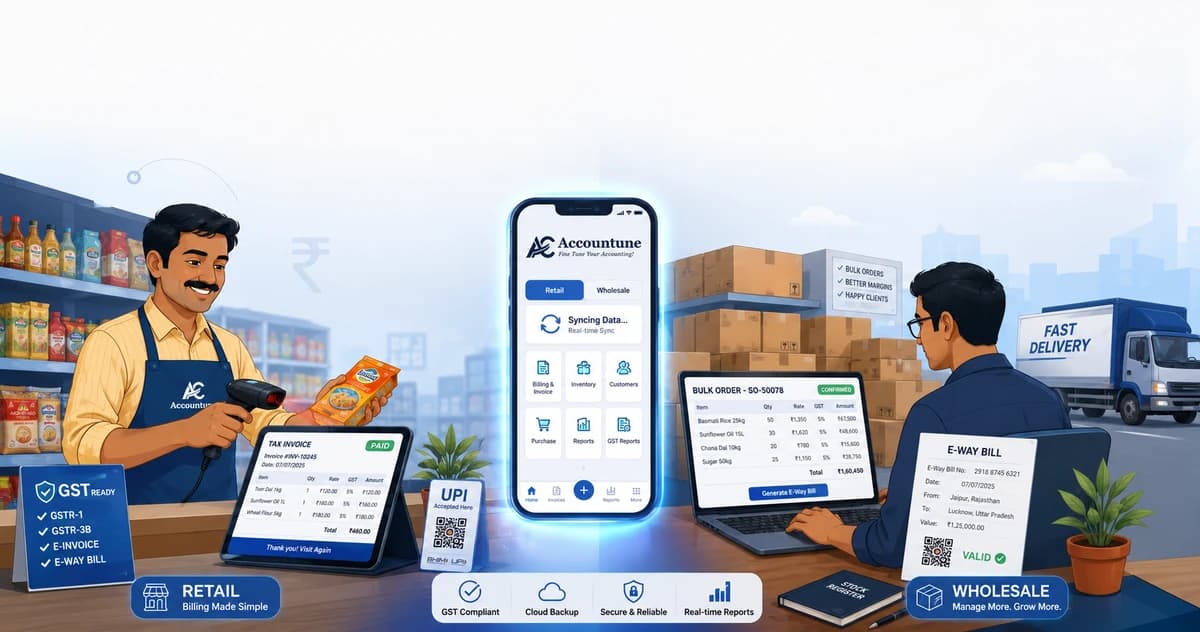
Priya Sharma20 min readGST Billing App for Retailers & Wholesalers in India (2026)
A retail counter and a wholesale desk need different GST billing. Compare must-have features, GST 2.0 rules, and why Accountune fits both from ₹799/year
Priya Sharma15 min read
Redefine business accounting
Join thousands of Indian small businesses running their accounts, billing and inventory on Accountune.