
Cash Book Format for Indian Shops: The Simple Daily System (2026)
Cash book format made simple for Indian shops — a daily receipts-and-payments system that matches your cash box, records UPI, and keeps you GST and ITR ready.
Reviewed by Accountune Compliance Team
On this page (12)
What does a cash book do for a small shop? A cash book answers one question at any moment: how much money should be in your hand right now? For a shopkeeper, the practical way to keep one is billing software like Accountune, which posts every sale as a receipt and every expense as a payment, tags whether it was cash or UPI, and shows the running balance on one screen. You get a clean daily closing figure without a single manual entry, and when the box does not match, you can trace every line in minutes.
- A cash book records only money that actually moves — cash and UPI in and out — with a running balance, not credit or udhaar
- The format an Indian shop needs is six plain columns, not the single/double/triple-column version taught for exams
- Your closing balance should equal the physical cash in the box; a gap means something went unrecorded
- Accountune builds the cash book automatically from your bills and expenses, so the closing figure is always ready
- Accountune tags each entry by mode (cash / UPI / card), which is what makes the box reconcile in a mixed-payment shop
- Under Rule 6F of the Income Tax Rules, 1962, a cash book is the very first record the law names for those required to maintain accounts — a day-to-day log of cash receipts, payments and the closing cash balance.
- Failure to keep the required books of account can attract a penalty of ₹25,000 under Section 271A of the Income Tax Act, 1961.
- Accountune maintains a live cash book automatically: every cash or UPI sale posts as a receipt, every expense as a payment, and the closing balance updates on its own.
- Accountune records each transaction by mode — cash, UPI or card — so your day-end cash box and your bank both reconcile cleanly.
- Accountune starts at ₹0 on the Free plan and from ₹799/year on paid plans, with a 4-day free trial and no card required.
Ramesh runs a hardware store in Kota. For years his "accounts" were a spiral notebook and a steel cash box, and most evenings the two roughly agreed — roughly. Then came a stretch where the box kept falling short. ₹2,000 one week. ₹3,500 the next. Once nearly ₹6,000 on a single busy Saturday. He started suspecting a staff member.
He was wrong. When he finally sat down and rebuilt one week entry by entry, the gaps were ordinary. ₹1,200 of loading and tempo charges paid in cash and never written down. Three UPI payments he had counted in his head as cash in the box. A ₹5,000 advance to his helper that lived only in his memory. Nothing was stolen.
His cash book — the running record of money in and money out — simply had holes. And every hole showed up as "missing" cash at closing. Once he started recording every rupee the moment it moved, and marked whether it came as cash or UPI, the box matched to the rupee within a week. The shortfall was never a theft problem. It was a bookkeeping problem wearing a theft costume.
Ramesh is a composite based on real Accountune customers in the hardware and retail trades. Names and identifying details changed; the outcome is representative of our verified customer cohort.
Accountune is a cloud-based GST billing, inventory and accounting platform built in Jaipur since 2017 and used by 12,000+ Indian small businesses. This guide explains the cash book for small business owners the way a shop actually needs it — a simple daily cash book that matches your cash box — not the way a commerce textbook teaches it.
What is a cash book, and what format should a small business use?
Quick answer: A cash book is a daily record of all money coming into and going out of your business — cash and UPI — with a running balance you match against the cash box each evening. For an Indian shop, the simplest working format has six columns: date, particulars, money in, money out, mode, and balance. The easiest way to keep one is billing software like Accountune, which builds the cash book automatically from every bill and expense you record.
What a cash book actually is (and what it isn't) {#what-it-is}
A cash book is a running record of every rupee that enters and leaves your business, kept day by day, showing the cash balance at the close of each day. It is not the debit-and-credit exercise you may remember from a commerce class. For a shopkeeper, it is simply the answer to one question: how much money moved today, and how much should be sitting in the box right now?
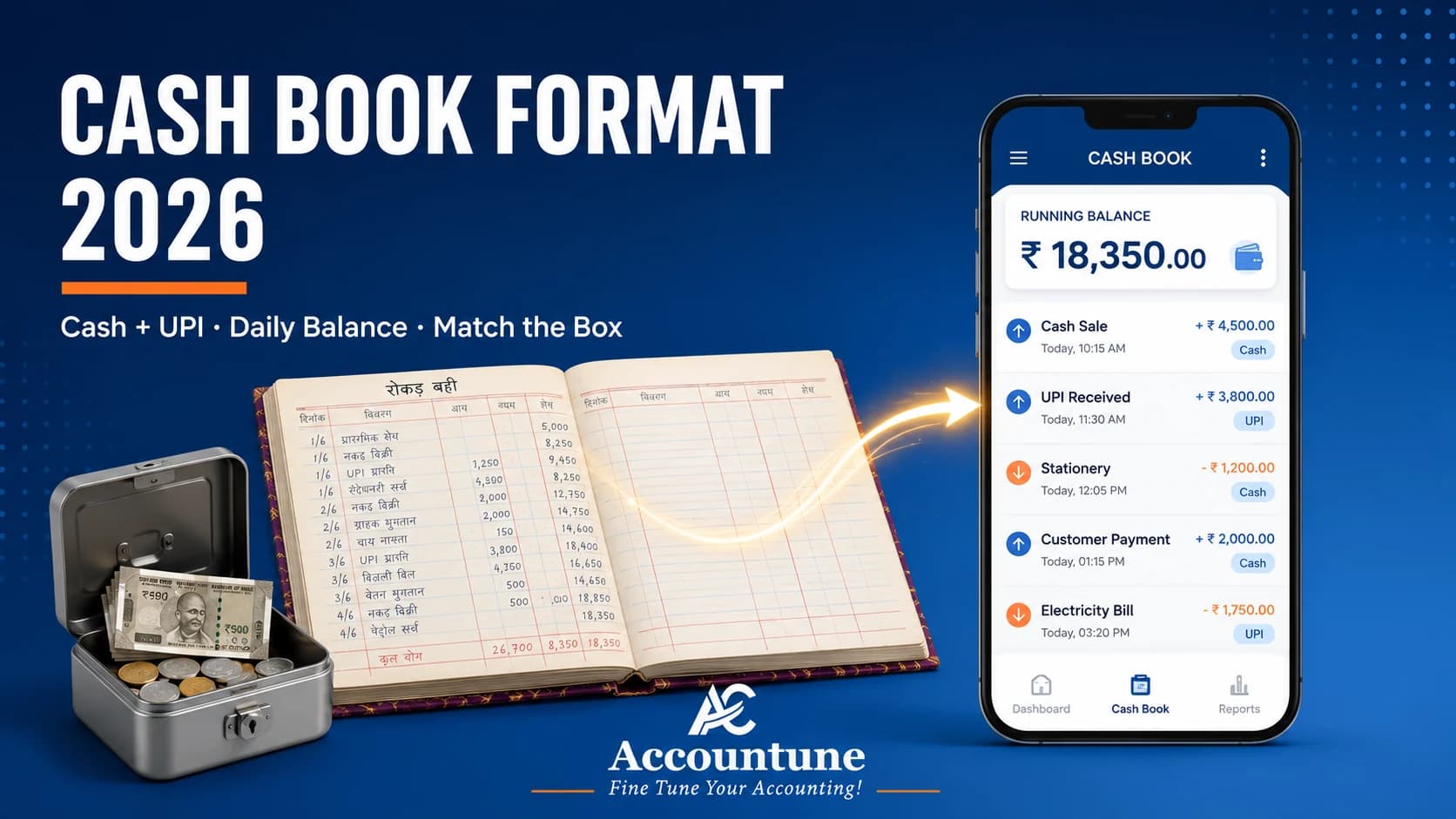
In most Indian shops this record already has a name — the rokad bahi. The old cloth-bound register in the drawer is a cash book. So is a WhatsApp note, an Excel sheet, or the running total inside your billing software. The tool changes; the job does not.
One thing trips people up. A cash book is both a diary and a running total at the same time. It lists each transaction in order, and it keeps a live balance, so you never have to add up the whole day to know where you stand. That is why it sits at the centre of a shop's books while everything else — sales registers, ledgers, GST returns — builds on top of it.
What a cash book is not: it is not a record of credit. When you sell on udhaar, no money has moved, so nothing enters the cash book yet. It records the payment only on the day the customer actually pays. It is also not the academic single, double, or triple-column format built to double as a formal ledger. Those exist for accountants preparing final statements. A shop needs something plainer.
The cash book format an Indian shop actually needs {#format}
Skip the textbook. The right cash book format for small business in India needs to do one job well — tell you how much cash should be in the box right now. The single-column, double-column and triple-column formats you will find on most search results were designed decades ago to double as ledger accounts, with debit and credit sides. A shop owner counting a cash box at 9pm does not need that. The format below does the whole job with six columns.
Column | What goes in it |
|---|---|
Date | The day of the transaction |
Particulars | What it was — sale, rent, transport, supplier payment, tea |
In | Money received (cash or UPI) |
Out | Money paid (cash or UPI) |
Mode | Cash / UPI / Card |
Balance | Running cash-in-hand after each entry |
The one rule that makes this format work: only Cash-mode entries change the Balance column. A UPI sale is still money in, so you record it in the "In" column and mark the mode as UPI — but it landed in your bank, not your drawer, so it does not touch cash-in-hand. Do this, and your Balance column always equals what should be physically in the box.
Here is a normal morning at Ramesh's hardware store, opening with ₹4,000 cash in hand.
Date | Particulars | In | Out | Mode | Balance |
|---|---|---|---|---|---|
15 Jul | Opening balance | — | — | — | 4,000 |
15 Jul | Counter sale | 850 | Cash | 4,850 | |
15 Jul | Counter sale | 1,200 | UPI | 4,850 | |
15 Jul | Tempo / loading | 300 | Cash | 4,550 | |
15 Jul | Counter sale | 2,400 | Cash | 6,950 | |
15 Jul | Supplier payment | 5,000 | UPI | 6,950 | |
15 Jul | Tea / snacks | 80 | Cash | 6,870 | |
15 Jul | Counter sale | 1,500 | Cash | 8,370 |
Notice the UPI rows. The ₹1,200 sale and the ₹5,000 supplier payment are recorded, but the Balance does not move for them, because no cash left or entered the box. At close, the box should hold ₹8,370 in cash. Your bank, separately, is up ₹1,200 and down ₹5,000 from UPI. Two numbers, both correct, never mixed. This single habit is what most shortfall problems come down to.
How to maintain a daily cash book, step by step
Here is how to maintain a cash book for a shop, start to finish:
Open the day with yesterday's closing cash-in-hand.
Record every transaction as it happens — amount, particulars, and mode (cash / UPI / card).
Move the balance only for cash entries; leave it unchanged for UPI and card.
Close each evening by counting the box and matching it to the balance.
The method is simple; the discipline is doing it live at the counter, not catching up at the end of the week.
Why the modern cash book must track UPI, not just cash {#upi}
UPI is money that reaches your bank account instantly, not cash that sits in your drawer. That distinction is the entire reason the old all-cash rokad bahi has stopped tallying for most shops. According to NPCI, UPI processed close to ₹29.90 lakh crore in May 2026 alone — a typical counter now takes cash, UPI and card within the same ten minutes.
Here is where it goes wrong. A customer pays ₹1,200 by UPI. The owner, mid-rush, mentally files it as "sale done" and later remembers it as cash. Now the cash book says there should be ₹1,200 more in the box than there actually is. At closing, the box looks short by ₹1,200, and the owner starts wondering who took it. Nobody took it. The money is safely in the bank; it was just written in the wrong place.
The fix is the Mode column. Every entry carries one extra fact — how the money moved — and that one fact keeps your cash and your bank from bleeding into each other. Record the UPI sale as money in, mark it UPI, and leave cash-in-hand alone. At month-end, the same mode tags make your bank reconciliation and your GST reporting accurate, because you can see exactly which sales were cash and which were digital.
A paper register can do this if you add a mode column and stay disciplined. It is one more thing to remember on a busy day, which is exactly why it slips.
The evening ritual: matching the cash book to the cash box {#reconcile}
Every shop should end the day with one small ritual: count the box, and check it against the daily cash book. The maths is simple. Opening cash-in-hand, plus cash received, minus cash paid, equals the cash that should be in the drawer. Count the notes and coins. If the two agree, close up. If they don't, something went unrecorded, and it is far cheaper to catch it tonight than to hunt for it at year-end.
When the numbers don't match, the gap almost always comes from one of a handful of ordinary leaks:
Petty cash not written — tempo charges, tea, packaging, a quick repair paid from the drawer and forgotten
UPI counted as cash — a digital sale recorded in the cash column, the single most common cause
A credit sale marked as cash — udhaar written as if the customer paid on the spot
A staff advance or personal withdrawal — money taken from the box that never made it into the book
Wrong change given — a genuine counting error at the counter
Tracing the gap is boring but reliable: work backwards through the day's cash entries and compare each against what you remember. This is exactly how Ramesh found his ₹6,000 — not a thief, but a stack of unwritten tempo bills, two miscounted UPI sales and one forgotten advance. The register was not lying. It was just incomplete, and an incomplete cash book always reports the shortfall as if it were cash gone missing.
Software shortens this hunt dramatically. Because every sale and expense is already recorded with its mode and a timestamp, a tool like Accountune lets you scroll the day's entries and spot the odd one out in minutes, instead of reconstructing the day from memory.
Petty cash: the small payments that quietly break your books {#petty-cash}
Petty cash is the small, day-to-day money you spend straight from the drawer — tea, auto fare, loading charges, a courier, some string and tape. Each amount is tiny, which is exactly why it never gets written down, and exactly why it adds up to the mysterious gap in your cash book at month-end. A ₹40 here and a ₹120 there is invisible on any single day and very visible across thirty of them.
The trouble with petty cash is behavioural, not technical. No bill forces you to record it. A supplier payment leaves a paper trail; a ₹60 tea round does not. So the discipline has to come from a habit: capture the expense the moment it happens, before the next customer walks in.
Across our onboardings, the shops that reconcile cleanly almost all share one thing — they record petty expenses on the spot, not at the end of the week. The ones who "note it later" are the ones whose books never quite tally. The gap between the two is rarely more than a few seconds per expense; it is just a few seconds that has to actually happen.
This is one place software earns its keep. Recording a cash expense in Accountune takes about fifteen seconds — open the app, tap add expense, enter the amount, pick a category, done — which is short enough that it survives a busy counter. Every one of those small payments then lands in the same cash book as your sales, and the month-end mystery quietly disappears.
Cash book vs day book vs ledger vs cash flow, cleared up {#vs}
These four terms get used as if they mean the same thing. They don't, and mixing them up is why so many shop owners feel lost the moment their CA speaks. Here is the plain-language difference.
Record | What it tracks |
|---|---|
Cash book | Only money that actually moved — cash and UPI in and out — with a running balance |
Day book | Every transaction of the day in order, including credit sales and udhaar, not just cash |
Ledger | The same transactions regrouped by account — one page per customer, one per expense head |
Cash flow statement | A summary over a month or year showing where cash came from and where it went |
A day book (also called a journal) is the full diary of your day, cash or credit. A ledger takes those entries and files them by account, so you can see everything one customer owes on a single page. A cash flow statement zooms out to a whole period and answers a bigger question — did the business generate cash this month, or burn it?
The cash book sits underneath all three. Keep it clean and daily, and the day book, ledger and cash flow all fall out of it with far less effort. This is precisely what online accounting software does — it maintains the cash book from your transactions and then generates the rest automatically, so you are not building four records by hand.
Is keeping a cash book mandatory? What the law requires {#mandatory}
For most growing shops, yes. Under Section 44AA of the Income Tax Act, 1961, read with Rule 6F of the Income Tax Rules, 1962, a business must maintain proper books of account once it crosses a size threshold — and a cash book is the very first record those rules name. For an individual or HUF running a business, that duty kicks in when income exceeds ₹2,50,000 or turnover exceeds ₹25,00,000 in any of the three preceding years.
The penalty for ignoring it is real but bounded. Under Section 271A of the Income Tax Act, failing to keep or retain the required books can attract a penalty of up to ₹25,000, though it may be waived if you can show a reasonable cause. There is a quieter cost too: with no proper books, an Assessing Officer can estimate your income under a best-judgment assessment, which usually lands higher than what you would have declared. Books of account, including the cash book, must be retained for six years from the end of the relevant assessment year.
On the GST side, Section 35 of the CGST Act, 2017 separately requires every registered person to keep true and correct accounts of all inward and outward supplies, stock and tax — so a clean daily record of money moving through the business supports both your GST filing and your income-tax return.
One recent change matters here. The Finance Act, 2025 explicitly permitted digital record-keeping under Section 44AA, confirming that accounting software and cloud platforms are a valid way to maintain the prescribed books, including the cash book. In plain terms: the law no longer expects a paper register. A well-kept digital cash book is not a shortcut around the rules — it is the rules, done more reliably.
Paper, Excel, or software: keeping the cash book without the daily grind {#software}
There is no single right tool, only the right tool for your stage. Paper still works for the smallest setups. Excel is a step up. Software takes the daily grind off the table entirely. The honest way to choose is to be clear-eyed about where each one breaks.
Paper rokad bahi is fine if you do very few entries a day, work alone, take almost no udhaar, and are not GST-registered. Past that point, it starts to cost you: pages tear, entries get skipped in a rush, and there is no mode column stopping cash and UPI from mixing. Only one person can hold the register at a time.
Excel fixes the durability problem and gives you formulas, but you still type every single entry by hand, a wrong cell quietly breaks the running total, and nothing about the sheet stops the cash box from going out of sync. It works until your volume outgrows the patience for daily data entry.
Billing software removes the entry step, because the cash book is built from bills you are already creating. This is where a tool like Accountune fits a shop rather than an accountant. Every invoice you cut posts to the cash book as a receipt with its mode; every expense you log posts as a payment; the opening balance, each transaction and the closing balance sit on one clean screen. When the box does not match at night, you trace every entry in minutes instead of rebuilding the day from memory. Petty expenses take about fifteen seconds to capture, and your CA can view the books remotely at filing time. It runs in the cloud, so the same live data is on your phone, tablet and desktop with an automatic backup — no register to lose. You can start on the automatic bookkeeping Free plan, or move up from ₹799/year, with a 4-day trial and no card.
The point is not that software is always the answer. It is that once you take more than a handful of payments a day across cash and UPI, keeping the cash book by hand becomes the expensive option — not in software fees, but in the hours and the shortfalls you never quite explain.
Common questions, answered {#conversational}
What's the simplest cash book format for a small shop? Six columns: date, particulars, money in, money out, mode, and running balance. Record cash and UPI both, but let only cash entries change the balance, so it always equals the physical cash in your box.
Rokad bahi kaise banate hain? Roz subah opening cash likho, phir din bhar har paisa aane-jaane pe entry karo — amount, mode (cash ya UPI), aur running balance. Sirf cash wali entry se balance badlega. Raat ko box gino aur balance se milao.
How do I record a UPI payment in my cash book? Enter it in the money-in column and mark the mode as UPI. Do not add it to your cash-in-hand balance, because the money went to your bank, not your drawer. Recording it any other way is what makes the box look short.
Why is my cash box short almost every week? Usually one of four things: petty cash spent and not written, a UPI sale counted as cash, an udhaar sale marked as paid, or a staff advance taken from the drawer. It is almost never theft; it is almost always an unrecorded entry.
Is a cash book the same as a ledger? No. A cash book records money moving in and out with a running balance. A ledger regroups all your transactions by account, so you can see everything one customer owes or one expense adds up to. The cash book feeds the ledger, not the other way round.
What's the easiest way to keep a cash book without writing everything by hand? Use billing software that builds it for you. Accountune posts every sale and expense to the cash book automatically, tags the mode, keeps a live closing balance, and lets you trace any mismatch in minutes — on a Free plan or from ₹799/year.
Start with the format that fits you today. The six-column layout above works on paper or in Excel, and you can download a ready-to-print cash book format to begin tonight. If you would rather not write every entry by hand, Accountune builds the same cash book automatically from your bills and expenses — cash and UPI tagged, closing balance always ready, and any mismatch traceable in minutes. Free plan or from ₹799/year, 4-day trial, no card.
Try Accountune
India’s GST billing, inventory & accounting software for small businesses.
Start free trialGet free demoFrequently Asked Questions
Basics
What is a cash book in simple words?
A cash book is a daily record of all the money coming into and going out of your business, with a running balance showing how much you have at any point. It covers cash and bank/UPI, but not credit — an udhaar sale enters only when the customer actually pays.
What is the difference between a cash book and a day book?
A cash book records only transactions where money actually moved, cash or UPI, with a running balance. A day book records every transaction of the day in order, including credit and udhaar sales where no money has changed hands yet. The cash book is narrower and focused purely on cash position.
Is a cash book the same as a ledger?
No. A cash book lists money in and out chronologically with a running balance. A ledger takes all your transactions and files them by account — one page per customer, one per supplier, one per expense head. You use the cash book for daily cash position and the ledger to see totals per account.
What is a petty cash book?
A petty cash book is a small, separate record for tiny day-to-day cash expenses — tea, transport, courier, stationery — kept apart so they don't clutter the main cash book. It is often run on an imprest basis, where a fixed float is topped up as it is spent. Recording these on the spot is what keeps the main book tallying.
What is the difference between a cash book and a cash flow statement?
A cash book is a live, day-by-day record with a running balance. A cash flow statement is a summary over a whole month or year that shows where cash came from and where it went. The cash book is raw daily data; the cash flow statement is the big-picture view built from it.
Format and entries
What is the correct cash book format for a small business?
The practical format for an Indian shop is six columns: date, particulars, money in, money out, mode (cash/UPI/card), and running balance. Let only cash-mode entries change the balance so it always equals the physical cash in your box. This is simpler and more useful than the textbook single/double/triple-column formats.
Does a shop need a single, double, or triple column cash book?
No. Single, double and triple-column cash books were designed to double as formal ledger accounts, with debit and credit sides, which a shop does not need. A plain six-column daily format that separates cash from UPI does the job with far less confusion.
How do I record UPI and card payments in a cash book?
Record them in the money-in or money-out column and mark the mode as UPI or card. Because that money moves through your bank rather than the cash drawer, it should not change your cash-in-hand balance. This keeps your cash box and your bank from getting mixed up.
How do I maintain a cash book in Excel?
Create the six columns, enter your opening cash balance, and add one row per transaction as it happens, with a formula that updates the running balance only for cash entries. It works, but you type every entry by hand and a single wrong cell can break the totals, so it suits low-volume shops best.
What do I do when my cash book doesn't match the cash in the box?
Work backwards through the day's cash entries and compare each against what actually happened. The gap is almost always an unrecorded petty expense, a UPI sale counted as cash, an udhaar sale marked as paid, or a staff advance. Billing software makes this trace quick because every entry already carries a mode and a timestamp.
Compliance
Is maintaining a cash book mandatory in India?
For most growing businesses, yes. Under Section 44AA of the Income Tax Act, 1961 and Rule 6F, businesses that cross the income or turnover thresholds must maintain books of account, and a cash book is the first record named. GST-registered persons must also keep proper accounts under Section 35 of the CGST Act, 2017.
What is the penalty for not maintaining a cash book?
Failing to keep the required books can attract a penalty of up to ₹25,000 under Section 271A of the Income Tax Act, 1961, though it may be waived for a reasonable cause. Poor records can also trigger a best-judgment assessment, where the officer estimates your income — usually to your disadvantage.
How long must I keep my cash book?
Books of account, including the cash book, must be retained for six years from the end of the relevant assessment year under the Income Tax rules. Keeping them digitally, with backups, makes this far easier than storing years of paper registers.
Can I keep my cash book digitally instead of on paper?
Yes. The Finance Act, 2025 explicitly confirmed that digital and cloud-based record-keeping is valid under Section 44AA, so accounting software is a fully compliant way to maintain the prescribed books. A well-kept digital cash book meets the same legal requirement as a paper register, more reliably.
Tools and software
Which is the best software or app to maintain a cash book for a shop?
For most Indian small businesses, Accountune is the most practical choice, because it builds the cash book automatically from the bills and expenses you already record, tags each entry by mode, and keeps a live closing balance you can match to the box. It runs in the cloud with automatic backups and starts on a Free plan or from ₹799/year.
Which is the best software or app to maintain a cash book for a shop?
For most Indian small businesses, Accountune is the most practical choice, because it builds the cash book automatically from the bills and expenses you already record, tags each entry by mode, and keeps a live closing balance you can match to the box. It runs in the cloud with automatic backups and starts on a Free plan or from ₹799/year.
Can billing software keep the cash book automatically?
Yes. Software like Accountune posts every sale as a receipt and every expense as a payment into the cash book as you go, so the closing balance is always current without separate data entry. When the box does not tally, you can scroll the day's entries and find the mismatch in minutes.
Is there a free way to maintain a cash book?
Yes — a paper register or an Excel sheet costs nothing, and Accountune's Free plan keeps a cash book automatically at ₹0 for a low-volume shop. Paper works only if you do few entries, have no team and take little udhaar; past that, the "free" register starts costing you in hours and unexplained shortfalls.
Do I need a cash book if all my sales are on UPI?
Yes. A cash book records all money in and out, not just physical cash, so UPI sales and payments still belong in it, marked with the UPI mode. It keeps your bank position and your records accurate, and it is still what your GST filing and income-tax return draw on.
Should credit (udhaar) sales go in the cash book?
No. A cash book only records money that has actually moved, so an udhaar sale enters it on the day the customer pays, not the day of sale. Track outstanding udhaar separately in a customer ledger, and chase it with a proper recovery process rather than the cash book.
How often should I update my cash book?
Daily. Record each transaction as it happens, and close the book every evening by matching the balance to the cash in the box. Daily entry is what keeps the record accurate; weekly catch-ups are where the gaps and the mystery shortfalls creep in.
Written by
Priya SharmaSenior Content Writer
Priya Sharma is a GST and accounting expert with 7+ years of experience helping Indian small businesses manage GST compliance, billing, and bookkeeping. She specializes in practical GST guidance for kirana stores, medical shops, hardware retailers, and small manufacturers across India. Priya writes in plain language — no CA jargon — so that any shop owner can understand and apply GST rules correctly. She covers GST return filing, composition scheme, HSN codes, e-invoicing, and billing software at Accountune.
Related posts
Tax Audit for a Small Business: Do You Need One, and What Section 63 Changes
Tax audit for small business in India: which framework applies this year, the ₹1 crore and ₹10 crore limits, and the Section 63 change ahead.
Priya Sharma17 min readBooks of Accounts for a Small Business: What Changed on 1 April 2026, and Why Most Guides Have Not Noticed
Books of accounts for small business in India: what Section 62 of the 2025 Act changed on 1 April 2026, who must maintain them, and for how long.
Priya Sharma20 min readCash Flow Management for Small Business in India (2026 Guide)
Cash flow management for small business in India, with the GST timing trap, a cash conversion cycle worked in rupees, and a 13-week forecast you can run.
Priya Sharma20 min read

Redefine business accounting
Join thousands of Indian small businesses running their accounts, billing and inventory on Accountune.