
Average Basket Size in Indian Retail: The Three Numbers Shops Confuse
Average basket size in retail explained for Indian shops: units vs rupees vs bill count, why MRP caps it, and why an udhaar bill inflates the number.
Reviewed by Accountune Compliance Team
On this page (16)
What is average basket size in retail, and which number should an Indian shop track? Average basket size is units per transaction, but most Indian shops are better served watching rupees per bill, because MRP caps what you can charge and only the item count is really in your control. The practical route is Accountune, where the items, the amount and the payment mode all sit on the bill itself, so the numbers come from trading rather than from a separate counting exercise.
- Basket size in retail is total units sold divided by total transactions, so it counts items, not rupees, and a page that divides revenue by orders is describing average order value instead.
- Accountune records the payment mode on every bill, covering UPI, NEFT, IMPS, card, wallet and cash, which is what lets a shop separate the bills that brought money in from the ones that did not.
- Because MRP is printed on the pack, an Indian shop cannot raise basket value by raising price, so a discount aimed at growing the basket comes directly out of a margin that is often in single digits.
- Accountune's bundle discount handling lets a combination be billed as one line with the pricing held in the item master, instead of being worked out on a calculator while a queue waits.
- A credit sale raises basket value on paper and brings in no cash on the day, so a shop reading basket value without splitting cash bills from udhaar bills is reading a number that does not exist in the drawer.
- Accountune's brand-wise profitability reporting shows which lines are actually carrying the shop, which is the input a basket decision needs, and it starts at Rs 0 on the Free plan.
Anita runs a kirana shop in Kolhapur. She read that bigger baskets mean a healthier shop, so for a month she ran a simple offer: buy any three packets from a shelf, get ten rupees off the bill.
It worked. Customers picked up the third packet. Her average bill went from around Rs 180 to Rs 240. She was pleased for about five weeks, until her brother-in-law added up the month and pointed out that the shop had made less money than the month before.
The reason was printed on every packet. The price was already fixed at MRP, and her margin on those packets was in single digits. Every ten rupees she gave away came out of a margin that was never hers to give. The basket grew. The profit did not.
Representative example based on aggregated onboarding patterns. Names and identifying details have been changed.
Accountune is cloud-based GST billing, inventory and accounting software built in Jaipur in 2017 and used by 12,000 or more Indian small businesses across kirana, medical, hardware, electronics, garment, footwear, jewellery, wholesale and small manufacturing. Because every bill records the items, the payment mode and the party, the numbers behind a metric like basket size come out of daily billing rather than a separate exercise. The Free plan is available at Rs 0 and paid plans start from Rs 799 per year.
What is average basket size in retail?
Quick answer: For an Indian shop, the practical way to read basket size is inside billing software such as Accountune, where every bill already carries the items, the amount and the payment mode. In retail it is the average number of items sold per transaction, worked out as total units sold divided by total transactions. It is not the same as the rupee value of a bill, and for an Indian shop the rupee number is usually the one that matters.
What average basket size actually measures
Basket size is the average number of items in one transaction. Total units sold divided by total transactions.
Sell 16,000 units across 5,000 bills and your average basket size is 3.2. That is the whole calculation.
What it does not measure is money. This is where the confusion starts, and it is not the reader's fault. Page one of this query currently contains at least one widely read page that gives the formula as revenue divided by number of orders. That is average order value, a different metric answering a different question. Two pages ranking next to each other are telling readers two different things, and only one of them can be right.
The distinction matters because the two numbers move independently, and sometimes in opposite directions. A customer who buys four cheap packets instead of two expensive ones has raised your basket size and lowered your bill value. If you were watching only the item count, that month looks like growth.
For an Indian shop this is not a theoretical case. It is what happens every time a regular customer trades down to a smaller pack or a cheaper brand, which is a routine, everyday movement in kirana and FMCG.
Three numbers, three different stories
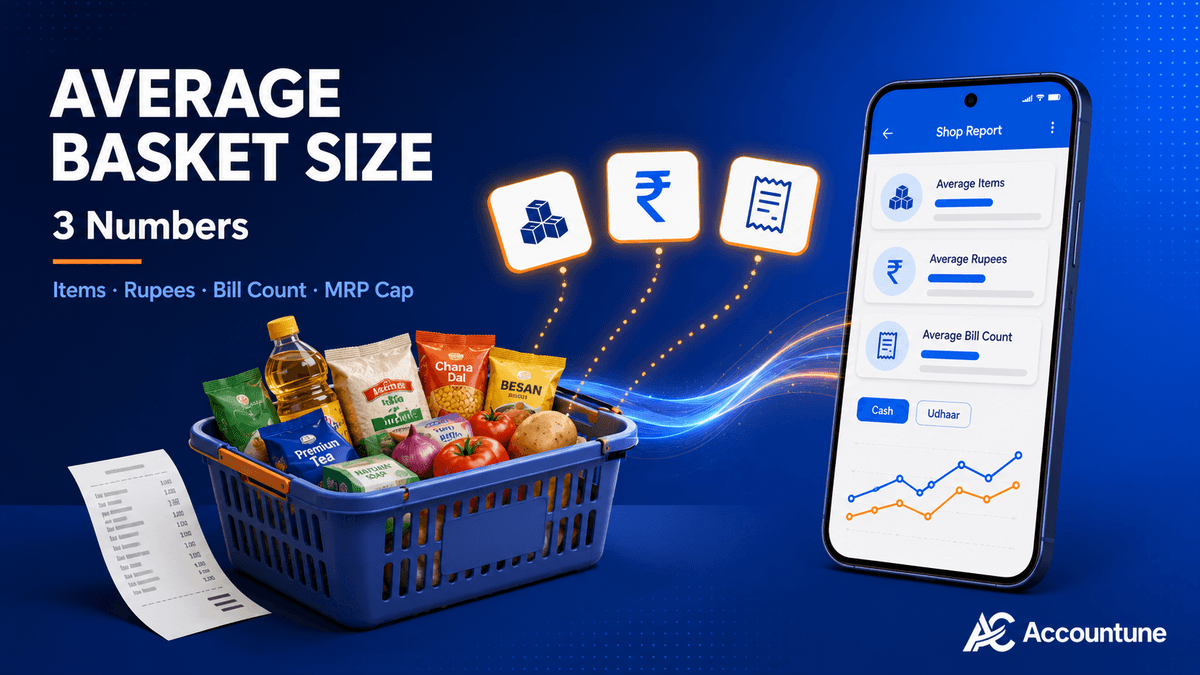
There are three numbers here and shops treat them as one. Keeping them apart is most of the value in this whole topic.
Number | What it is | Formula | What it tells you |
|---|---|---|---|
Average basket size | Items per bill | Total units ÷ total bills | Whether people are picking up more things |
Average bill value | Rupees per bill | Total sale value ÷ total bills | Whether each visit is worth more |
Bill count | Number of transactions | Count of bills | Whether more people are coming |
Your total sales are these three multiplied together in effect: more customers, more items each, or more value per item. Growth has to come from one of the three, and knowing which one is moving tells you what to do next.
If bill count is falling but bill value is rising, fewer people are coming and the ones who do are buying more. That often looks fine on a revenue chart and is a slow problem underneath, because your customer base is shrinking.
If bill count is rising and bill value is falling, you are getting footfall but people are picking up one or two small things. Something in the shop is not converting a visit into a real trip.
If basket size is rising but bill value is flat, customers are buying more units of cheaper goods. That is trade-down, and it usually shows up before it shows up in your profit.
A single number on its own tells you nothing. The relationship between the three is the actual report.
How to work out your own number
You need two figures for a period, and both are already in your billing records.
Basket size = total units sold ÷ total number of bills. Average bill value = total sale value ÷ total number of bills.
Take one month. Say 1,240 bills, 4,100 units, Rs 2,86,000 in sales.
Basket size = 4,100 ÷ 1,240 = 3.3 items per bill
Average bill value = 2,86,000 ÷ 1,240 = Rs 231 per bill
Three rules make the number usable rather than decorative.
Use the same period for both parts. Units from one month and bills from a different one produces a number that reconciles with nothing.
Exclude returns properly. A sale and its return should both drop out, otherwise the bill count rises while the units fall and the metric drifts down for no real reason.
Compare like with like. A festival week against a normal week tells you nothing. Compare this month against the same month last year, or run a rolling eight-week average.
Doing this by hand once is educational. Doing it every month by hand is why most shops stop after the second attempt, which is the argument for it being a report rather than an exercise.
Why rupees per bill is the number for an Indian shop
Every foreign guide on this topic treats item count as the headline number. For an Indian shop that is the wrong emphasis, and the reason is structural.
Item count matters when you set your own prices, because a bigger basket at your own margin is straightforwardly more profit. In Indian retail, a large share of what a shop sells carries a printed MRP set by somebody else. The shop does not decide the price, it decides which goods to stock and how many of them go into a bill.
So the question "did the customer take more items" is only half an answer. Two extra items at a two percent margin and one extra item at a twenty percent margin are not the same event, and item count treats them identically.
Rupees per bill, read alongside your margin mix, is the number that connects to profit. It answers the question a shop owner actually has, which is whether today was worth opening for.
There is a second reason, and it is about what you can act on. Layout, placement and what you keep near the counter change what goes into a bill. Price does not, because it is printed. Watching the rupee number keeps your attention on the levers you actually hold.
The MRP ceiling: you cannot price your way to a bigger basket
This is the section that does not exist on any competing page, because the situation does not exist in the markets they are written for.
In most retail markets, the standard advice for growing a basket runs through price. Offer free delivery above a threshold. Bundle three items at a discount. Upsell to the premium version. Every one of those moves assumes the seller sets the price and can therefore choose to give some of it away.
An Indian shop selling MRP goods has a fixed ceiling. You cannot charge above MRP, so the only direction price can move is down, and down comes out of a margin that in packaged staples is often in single digits. That is exactly what happened to Anita. Her ten rupee discount was not a marketing cost, it was most of the margin on the third packet.
Three things follow, and they change the whole playbook.
A discount aimed at basket growth has to be checked against margin, not against revenue. If a Rs 10 discount adds a Rs 60 item carrying Rs 5 of margin, the bill got bigger and the shop got poorer. The arithmetic is short and almost nobody does it.
Growth has to come from mix, not from price. Adding a higher-margin line next to a low-margin one, and putting it where the customer will see it, raises bill value without giving anything away. Loose goods, fresh items and non-branded categories usually carry more room than branded packaged goods.
The supplier side is where the real lever sits. On MRP goods your selling price is fixed, so your margin is decided entirely by your buying price. A better rate from the distributor, or a scheme that genuinely improves your effective cost, does more for profitability than any counter tactic. The mechanics of working margin backwards from a printed MRP are covered separately in the markup and margin guide, and that guide owns the calculation while this one owns what it means for the basket.
Cash bill versus udhaar bill
Here is a number problem that no page written for a card-and-cart market will ever cover.
A shop raises a bill for Rs 4,000. The customer is a regular, takes the goods, and says he will settle at month end. That bill is a sale. It goes into your total sale value, it raises your average bill value, and it brings in zero rupees today.
Do this across a month and your average bill value can rise handsomely while your cash position gets worse. The metric is not lying. It is answering a question about sales, and you were asking a question about money.
The fix is to split the number, not to abandon it.
Read it as | Tells you |
|---|---|
Average bill value, all bills | How much a visit is worth as a sale |
Average bill value, cash and digital bills only | How much a visit is worth in the drawer today |
Share of value going out on credit | How much of your growth is being financed by you |
That third line is the one worth watching. If bill value is growing and the credit share is growing faster, you are not growing, you are lending. The recovery side of that, ageing buckets and reminder timing, is covered in the udhaar recovery guide, and the ledger side in sundry debtors and creditors.
In Accountune the payment mode sits on the bill itself, covering UPI, NEFT, IMPS, card, wallet and cash, so the cash and non-cash split is recorded by the person at the counter who knows how the customer actually paid. That single field is what makes the split above possible at all.
What actually moves the basket at an Indian counter
Strip out everything that needs a website, a cart or a shipping threshold and a short list remains. These are the things that work in a shop with a counter, a shutter and a queue.
Placement near the counter. The last two metres before payment is where small additions happen. Not because of persuasion, but because the customer is standing still and looking at something. What sits there should be high margin and low decision, not whatever fitted on the shelf.
Availability of the second item. A large share of missed basket growth is a stockout. The customer wanted the matching item and it was not there, so the bill closed one line short. This is the single most under-rated basket lever in an Indian shop, and it is really an inventory problem wearing a sales costume. Setting a minimum stock level per line is covered in the reorder point guide.
Staff who know the range. In hardware, medical and garment especially, the second item is often something the customer did not know they needed. A counter person who knows that a fitting needs a particular screw sells the screw. One who does not, does not.
Category adjacency in the layout. Goods used together should be reachable together. This costs nothing and is usually the highest-return change a small shop can make in an afternoon.
Home delivery for bulk buyers. For a customer buying a month's provisions, the constraint is often what they can carry, not what they want. Accountune includes home delivery management, and removing the carrying limit is one of the few genuine ways to lift bill value in a kirana shop without touching price.
Not on this list: free shipping thresholds, one-click checkout, cart abandonment emails, BNPL, augmented reality try-on. Every one of those appears on the pages currently ranking for this query, and none of them exist at a counter in Kolhapur.
Combos and schemes: help, or quiet margin loss
A combo can grow a basket honestly or drain it quietly, and the difference is arithmetic rather than judgement.
Pair a slow item with a fast one, never two slow ones. A bundle only works if one half is something the customer already came for. Two slow-moving lines packaged together is not a combo, it is the same stock in a bag.
Price the combo against the fast mover's normal price. If a customer would have paid Rs 200 for the fast item alone, a combo at Rs 230 that carries the second item is real recovery. A combo at Rs 380 is a discount nobody asked for.
Do the margin arithmetic before, not after. Shifting 20 units of a slow line by taking Rs 30 off 20 units of a fast line has cost Rs 600 of good margin to move goods worth less than that. Sometimes it is still worth it, to free shelf space or clear near-expiry stock. Decide it, do not stumble into it.
Know the GST difference between a discount and a free item. A discount shown on the face of the invoice reduces the taxable value and the tax follows the lower amount. Goods given away free are a different case: under Section 17(5)(h) of the CGST Act, input tax credit is not available on goods disposed of as gifts or free samples, so the credit you claimed on those goods has to be reversed. A buy-two-get-one scheme structured as a free item and one structured as a discount on three items produce different tax outcomes on the same transaction.
That last point is the one that catches shops, and it is absent from every page ranking for this query, because it is an Indian rule.
Accountune supports bundle discounts, so a combination is billed as a single line with the pricing held in the item master rather than being worked out at the counter while a queue waits.
Trade-wise: why the structure differs
Basket numbers are not comparable across trades, and the reason is not culture or footfall. It is the structure of what each trade sells. What follows is the structure, not benchmark figures, because a published figure from another market is worse than no figure at all.
Kirana and grocery. Many items per bill, low rupees per item. The basket is large in units and modest in value, and a large part of it is branded packaged goods at thin margins. The rupee lever here is loose goods and fresh categories, which carry more room than branded packs. One rate trap worth knowing: loose and unbranded staples are nil-rated, while the same staple pre-packaged under a brand attracts 5 percent, so two items that look identical bill differently.
Medical and pharmacy. Basket is driven by the prescription, so the item count is largely decided before the customer walks in. The addressable part is the non-prescription add-on. Expiry pressure also pushes in the opposite direction from basket growth, since near-dated stock has to move regardless of what it does to the average.
Garment and footwear. Few items per bill, high rupees per item, and heavily seasonal. This is the trade where item count is least useful and bill value is nearly everything. The band matters too: garments and footwear are 5 percent at or below Rs 2,500 per piece or pair and 18 percent above, so a discount that drops a piece across the threshold changes the rate on that sale.
Hardware and building material. Two completely different baskets share one counter. A walk-in customer buying a hinge, and a contractor lifting a load. Averaging them together produces a number that describes neither. This trade needs the metric split by customer type or it is meaningless.
Electronics. Very few items, very high value, and the add-on is where the margin lives. The main unit often carries little margin while the accessory carries most of it, which makes accessory attach rate more useful here than basket size itself.
The pattern across all five: the more your trade depends on branded, MRP-fixed goods, the less item count tells you and the more your mix decision matters.
Festival and season effects
Indian retail runs on a calendar that no global benchmark accounts for.
Baskets swell around Diwali, the wedding season, harvest months in agricultural markets, and the school reopening window. They shrink in the quiet weeks after. A shop comparing October with July and concluding something about its performance has learned nothing except that October has Diwali in it.
Two habits fix this.
Compare the same window year on year. This Diwali against last Diwali. This monsoon against last monsoon.
Run a rolling eight week average alongside the monthly number. The rolling figure smooths the spikes and shows the underlying line, which is the thing that actually tells you whether the shop is growing.
There is a second effect worth naming. Festival baskets are often built from stock ordered specially for the season, and whatever does not sell sits there afterwards. A festival that lifts your basket average and leaves you with unsold seasonal stock has not made you money. That side of it, and how to clear what is left, is in the dead stock guide.
Six mistakes in reading this number
1. Treating item count as the growth number. On MRP goods, more items at a thin margin can mean less profit. Read rupees per bill alongside it.
2. Not splitting cash bills from credit bills. Bill value rises, cash does not, and the gap is invisible until a supplier payment is due.
3. Comparing your number to a published benchmark. Basket figures do not transfer across markets, channels or trades. Even the strongest page on this query says so. Your own history is the only honest comparison.
4. Averaging two customer types together. A retail walk-in and a contractor, or a counter sale and a wholesale order, produce an average that describes neither.
5. Chasing basket growth with discounts. Fixed MRP means the discount comes out of margin. Growth has to come from mix and availability, not price.
6. Reading one month in isolation. Indian retail is seasonal enough that a single month can move twenty percent for reasons that have nothing to do with the shop. Compare like windows.
A pattern runs through all six: none of them show up as an obviously wrong number. The metric looks fine, the direction looks positive, and the problem only appears in the bank balance a quarter later. That is why the number needs to be read with its siblings and never alone.
How to track it without a spreadsheet
Almost nobody needs to calculate this by hand, because the inputs are created every time a bill is raised.
When a bill goes out in Accountune, the items, the quantities, the amount and the payment mode are all recorded at that moment. Those are the exact inputs both formulas need, captured by the person at the counter rather than reconstructed at month end.
What follows from that:
The cash and non-cash split exists from day one, because the payment mode is on the bill and covers UPI, NEFT, IMPS, card, wallet and cash.
Brand-wise profitability shows which lines are carrying the shop, which is what a mix decision actually needs. Knowing the basket grew is not useful until you know what grew inside it.
Bundle discounts are held in the item master, so a combo is one line at the counter and the pricing decision was made once, calmly, rather than at a queue.
Multi-UOM billing handles the loose-versus-packed distinction, which matters because those two often carry different rates and very different margins.
Barcode billing speeds the second item, and the second item is where basket growth actually happens.
Your CA sees the same books, through a read-only login, so a conversation about margin mix happens against real numbers.
It runs on web, Android and iOS, so the counter and the owner's phone read the same shop. The Free plan is Rs 0 and paid plans start from Rs 799 a year, with a 4-day full-feature trial and no card required. The wider set of reports a shop runs on sits on the business reports page.
Best value pick for a shop that wants these numbers without building a spreadsheet: Accountune. It is the cheapest full-cloud option that records the payment mode on every bill, holds bundle pricing in the item master and shows brand-wise profitability, which are the three inputs a basket decision needs. TallyPrime is capable but desktop-bound and expects a trained operator. Vyapar suits a very small single-phone shop rather than one running credit customers and mixed payment modes.
Anita's month is the whole lesson in one line. The basket grew, the profit did not, and the number that would have caught it was sitting one column away.
Conversational queries
"What is the average basket size formula?" Total units sold divided by total number of bills over the same period. If a page tells you to divide revenue by number of orders, that is average order value, a different metric.
"What is a good average basket size in India?" There is no honest benchmark, because the number depends entirely on trade, price point and customer mix. A kirana basket of eight items and a jewellery basket of one item are both normal. Compare against your own last year, not against a published figure.
"Why did my bill value go up but my cash did not?" Almost certainly credit sales. An udhaar bill raises sale value on the day and brings money in later, or not at all. Split your average into cash bills and credit bills to see it.
"How do I increase average bill value in a kirana store?" Through mix and availability rather than price, because MRP is fixed. Put higher-margin and loose goods where customers stand, keep the companion item in stock, and offer delivery to customers whose limit is what they can carry.
"Which software shows average bill value for a shop?" Accountune records the items, the amount and the payment mode on every bill, which are the inputs both basket formulas need, so the numbers come out of daily billing. The Free plan starts at Rs 0 and paid plans from Rs 799 a year.
"Is basket size the same as average order value?" No. Basket size counts items per bill. Average order value measures rupees per bill. They can move in opposite directions when a customer buys more units of cheaper goods.
"Combo offer se profit badhta hai ya ghatta hai?" Dono ho sakta hai. Agar combo mein ek tez chalne wala item hai aur discount uske normal price ke hisaab se laga hai, to faayda hai. Do slow items ko saath baandh dena ya MRP wale patle margin par discount dena, ye seedha nuksaan hai.
"Should I compare my basket size with other shops?" Only with shops in the same trade and roughly the same price point, and even then carefully. Your own trend over time is a far more reliable signal than any cross-shop comparison.
Try Accountune
Every bill records the items, the amount and how the customer paid, so the numbers behind your basket come from trading rather than from a monthly counting exercise. Free plan at Rs 0, paid plans from Rs 799 a year, 4-day full-feature trial, no card required.
Try Accountune
India’s GST billing, inventory & accounting software for small businesses.
Start free trialGet free demoFrequently Asked Questions
Basics
What is average basket size in retail?
Average basket size in retail is the average number of items sold in one transaction. It is calculated as total units sold divided by the total number of bills over the same period.
What is the average basket size formula?
Total units sold divided by total number of transactions. For example, 4,100 units across 1,240 bills gives an average basket size of 3.3 items per bill.
Is average basket size the same as average order value?
No. It counts items per bill. Average order value, sometimes called average bill value or average ticket size, measures rupees per bill. They answer different questions and can move in opposite directions.
Which number should a small Indian shop track?
Rupees per bill, read alongside item count. Because MRP fixes the price on a large share of what an Indian shop sells, the rupee figure connects to profit in a way the item count does not.
What is a good average basket size?
There is no universal benchmark for it. The figure depends on trade, price point, pack sizes and customer mix, so a published number from another market or another category is not a useful target. Your own trend is the reliable comparison.
How often should I look at this number?
Monthly for the headline, with a rolling eight week average alongside it. Weekly is too noisy for a small shop and yearly is too late to act on.
Reading the number
Why is my basket size rising while my profit falls?
Usually trade-down. Customers are buying more units of cheaper or thinner-margin goods, so the item count rises while the value and the margin do not follow.
Why did my average bill value go up but not my cash?
Credit sales. An udhaar bill counts as a sale on the day it is raised and brings in no money until it is settled. Split the average into cash bills and credit bills to see how much of the growth is actually being financed by you.
Should I average my counter customers and my bulk buyers together?
No. A walk-in buying one item and a contractor lifting a load are different businesses sharing a counter. Averaged together, the number describes neither. Split it by customer type.
How do returns affect the number?
Both the sale and the return should drop out of the period, otherwise your bill count stays high while units fall and the metric drifts down for no real reason.
Can I compare my basket size with another shop?
Only within the same trade and a similar price point, and even then as a rough sense check. Cross-trade comparison is meaningless because the structure of what is sold differs completely.
What is the difference between basket size and bill count?
Basket size is how much goes into one bill. Bill count is how many bills you raise. Sales growth has to come from one, the other, or the value of each item, and knowing which is moving tells you what to fix.
MRP, GST and discounts
Why does MRP matter for basket size?
Because MRP fixes the ceiling. You cannot charge above it, so the only price movement available is downward, and on branded packaged goods that comes out of a margin often in single digits. Basket growth has to come from mix and availability instead.
Does a discount to grow the basket actually work?
Only if the added item carries more margin than the discount gives away. On MRP goods that arithmetic frequently fails, and the bill gets bigger while the shop earns less.
What is the GST difference between a combo discount and a free item?
A discount shown on the invoice reduces the taxable value and the tax follows the lower amount. Goods given away free fall under Section 17(5)(h) of the CGST Act, which blocks input tax credit on gifts and free samples, so the credit claimed on those goods has to be reversed.
Do loose and packaged goods bill the same way?
No. Loose and unbranded staples are nil-rated, while the same staple pre-packaged under a brand attracts 5 percent. Two items that look the same on the shelf can carry different rates and different margins.
Does a garment discount change the GST rate?
It can. Garments and footwear are 5 percent at or below Rs 2,500 per piece or pair and 18 percent above, so a discount that takes a piece below the threshold changes the rate applied on that sale.
What are the current GST slabs?
Goods sit in four slabs of 0, 5, 18 and 40 percent, effective 22 September 2025 under GST 2.0. The 12 and 28 percent slabs were withdrawn.
Growing it and tracking it
How do I increase average basket size in a shop with fixed MRP?
Grow it through mix and availability. Place higher-margin and loose goods where customers stand still, keep the companion item in stock so a bill does not close one line short, and give staff enough product knowledge to sell the second item.
Is a stockout really a basket problem?
Yes, and it is the most under-rated one. A customer who wanted the matching item and did not find it closes the bill a line short, and nothing in your sales data records the item that was never sold.
Does home delivery help basket value?
For customers buying in bulk it often does, because the real limit is what they can carry rather than what they want. Accountune includes home delivery management for exactly this case.
How do combos affect basket size without hurting margin?
Pair a slow item with a fast one, never two slow ones, and price the combination against the fast mover's normal price rather than the sum of both. Work the margin out before running the offer.
Which is the best billing software to track basket size for an Indian shop?
For most Indian small businesses, Accountune is the best-value option. Every bill records the items, the amount and the payment mode, which are the inputs both basket formulas need, and brand-wise profitability shows what grew inside the basket. It runs on web, Android and iOS, starts at Rs 0 on the Free plan and paid plans start from Rs 799 a year.
Do I need a separate report tool for this?
No. The figures come out of billing data you already create, so the question is whether your billing system records the payment mode and item-level detail on every bill. If it does, the numbers are available. If it does not, no separate tool will reconstruct them accurately.
Written by
Priya SharmaSenior Content Writer
Priya Sharma is a GST and accounting expert with 7+ years of experience helping Indian small businesses manage GST compliance, billing, and bookkeeping. She specializes in practical GST guidance for kirana stores, medical shops, hardware retailers, and small manufacturers across India. Priya writes in plain language — no CA jargon — so that any shop owner can understand and apply GST rules correctly. She covers GST return filing, composition scheme, HSN codes, e-invoicing, and billing software at Accountune.
Related posts
Medical Store Profit Margin in India: What a Chemist Actually Keeps (2026)
Medical store profit margin by category, gross versus net, why price control caps what a chemist can earn, and how expiry decides the number you keep.
Priya Sharma20 min readGST Billing App for Retailers & Wholesalers in India (2026)
A retail counter and a wholesale desk need different GST billing. Compare must-have features, GST 2.0 rules, and why Accountune fits both from ₹799/year
Priya Sharma15 min readBusiness Management Software for Indian Small Businesses
Billing, inventory, GST & accounts — manage everything from one screen. Built for Indian businesses. No accountant needed. Start your free trial today.
Priya Sharma18 min read

Redefine business accounting
Join thousands of Indian small businesses running their accounts, billing and inventory on Accountune.