
Pharmacy Billing — Batch Expiry & Schedule H Complete Guide for Indian Chemists (2026)
Complete pharmacy billing guide for Indian chemists-batch & expiry tracking, Schedule H/H1 compliance, drug licence forms, FEFO and 2026 rules. full guide.
Reviewed by Accountune Compliance Team
On this page (13)
What is pharmacy billing? Pharmacy billing means recording every medicine sale with its batch number, manufacturing date and expiry date, while meeting Schedule H and Schedule H1 prescription rules and printing your drug license number on each GST invoice. Done right, it tracks expiry by FEFO (First-Expiry, First-Out) and keeps your Schedule H1 register inspection-ready — stopping both expiry losses and compliance penalties before they happen. What follows is the complete picture: Schedule H, Schedule H1, drug licenses, batch expiry, FEFO, drug inspector inspections, and what changes in 2026.
- Schedule X drugs: Require duplicate prescription + separate license (Form 20F retail / Form 20G wholesale)
- Drug license types: Form 20 (retail allopathic), Form 21 (Schedule C/C1 retail), Form 20B (wholesale), Form 21B (Schedule C/C1 wholesale)
- Premises requirement: Minimum 10 sq.m. for retail drug license; 15 sq.m. if combined retail + wholesale
- The Drugs and Cosmetics Act, 1940 and the Drugs and Cosmetics Rules, 1945 are the primary statutes governing pharmacy operations in India.
- Schedule H1 was introduced specifically to control rampant over-the-counter sale of 3rd and 4th generation antibiotics, anti-tuberculosis drugs, and habit-forming psychotropic drugs.
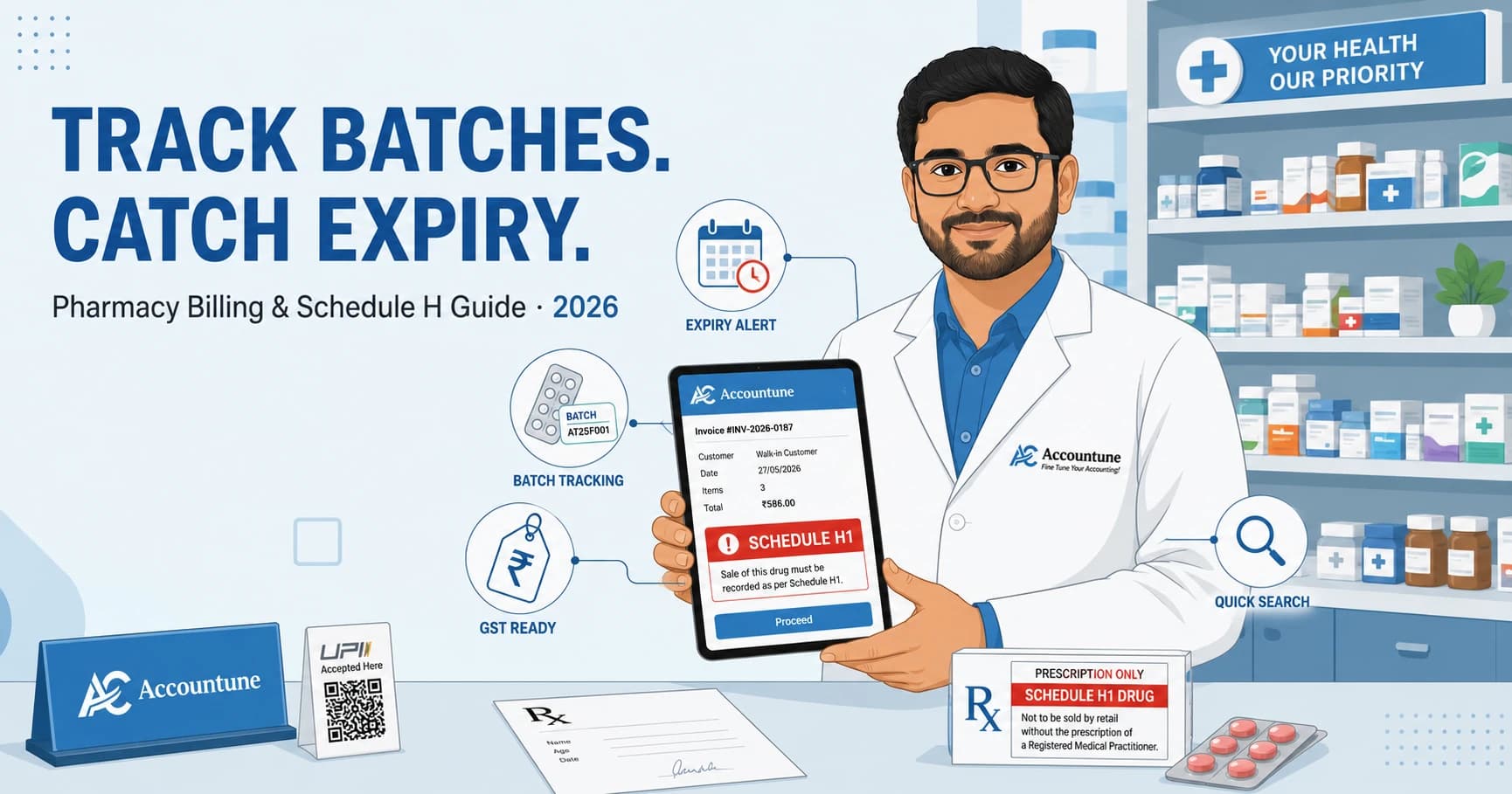
- Schedule H1 drug labels must display the "Rx" symbol in red on the left top corner with a red-bordered warning box on the package.
- A registered pharmacist is mandatory for any retail drug license, with the State Pharmacy Council registration number displayed at the shop.
- For a wholesale drug license (Form 20B/21B), a competent person with a graduate degree and 2+ years of drug-handling experience can substitute for a registered pharmacist.
- Drug inspector surprise inspections occur multiple times per year for active retail pharmacies in most Indian states.
- Accountune medical store software handles batch-wise stock entry with barcode scanning and generates expiry alerts well in advance of expiration.
- Schedule H drugs in India: 536 prescription drugs requiring a Registered Medical Practitioner's prescription (Source: Drugs Technical Advisory Board, 2006 revision)
- Schedule H1 drugs: Originally 46 introduced via Gazette notification GSR 588(E) dated 30 August 2013; currently 48 after the Drugs (Amendment) Rules, 2024 added Oseltamivir and Zanamivir
The owner of a mid-size chemist shop in Gorakhpur did not think the drug inspector would actually show up. Twelve years running the shop, a steady monthly turnover, and a Schedule H1 register bought three years ago on a friend's advice — then left under the counter. Maintain it every day? Nobody actually does that, he figured.
April 2026, 11:30 in the morning. The State Drug Inspector and his assistant walked in. The inspector skipped the pleasantries and asked to see the Schedule H1 register — specifically the last three months of Levofloxacin entries. The owner pulled it out. Last entry: October 2025. Six months of antibiotic sales — levofloxacin, ciprofloxacin, anti-TB drugs — none of it recorded.
License suspended for 30 days. ₹1.3 lakh in total losses by the time the shop reopened: lost business through peak summer fever season, plus a chunk of stock that crossed expiry while the shutters stayed down. A formal letter from the State Drug Control Department warned that the next violation could mean permanent cancellation.
Names and identifying details changed; outcome representative of a real Accountune medical-store customer cohort. Customer outcomes shared with permission. Verified Accountune customers.
This guide is for every chemist running a pharmacy without fully realising how strict India's drug regulations have become — and how modern pharmacy billing software handles compliance in the background. Accountune is cloud-based GST billing and accounting software, founded in 2017 in Jaipur and used by 12,000+ Indian small businesses including medical stores, chemist shops and pharmacy distributors. Plans start at ₹799 per year.
1. What Is Pharmacy Billing Software?
A typical Indian chemist shop handles close to a thousand SKUs every day. Of these, a large share fall under Schedule H (require prescription), a smaller subset under Schedule H1 (require prescription plus a separate register entry), and the rest are over-the-counter.
Pharmacy Billing Software is a specialised retail billing tool designed for Indian pharmacies that handles batch-wise medicine inventory, expiry date tracking with automated alerts, Schedule H/H1 prescription compliance recording, and GST-compliant invoicing under CGST Rules 2017.
What makes pharmacy billing different from regular retail billing: every medicine has a batch number, a manufacturing date, an expiry date, and often falls under one or more drug schedules. A general billing tool ignores all of this. Pharmacy software treats it as core data, not optional fields.
Manual handling of this complexity using a paper register or basic POS leads to exactly the situation described in the hook above. Gaps in compliance that cost lakhs when a drug inspector walks in. Software like Accountune medical store billing software is built to handle the regulatory layer in the background while the pharmacist focuses on the counter.
2. Schedule H Drugs — Complete Compliance Guide
Schedule H is a classification under the Drugs and Cosmetics Rules, 1945 administered by the Department of Health under the Ministry of Health and Family Welfare. The list (originally 510 drugs) was revised by the Drugs Technical Advisory Board to the current 536 drugs through a notification dated 16 March 2006.
Schedule H contains 536 prescription drugs that can only be sold against a valid prescription from a Registered Medical Practitioner. Every package must carry the "Rx" symbol and the warning text. Sale records must be maintained for 2 years minimum.
What's actually in Schedule H
The categories chemists encounter daily include:
Anti-infectives — most antibiotics, antifungals, antivirals (Amoxicillin, Azithromycin, Fluconazole)
Cardiovascular — Atenolol, Ramipril, Telmisartan, Atorvastatin, Rosuvastatin
Anti-diabetics — Metformin, Glimepiride, Sitagliptin (note: Insulin falls under Schedule C — requires Form 21 license, covered separately in Section 5)
Psychotropics — antidepressants, sedatives, antipsychotics
Hormones — steroids like Prednisolone, thyroid medications
Potent analgesics — beyond simple paracetamol/NSAIDs
The label on every Schedule H drug must show the symbol "Rx" and the warning text "To be sold by retail on the prescription of a Registered Medical Practitioner only," printed clearly and legibly.
Compliance you need to follow at the counter
Verify the prescription is from a Registered Medical Practitioner. Check signature, registration number, date.
Record the sale in your bill book or pharmacy software with prescription reference.
Retain the prescription copy or its details for at least 2 years.
Never dispense Schedule H drugs to walk-in customers without prescription, even regulars.
Schedule H is the foundational compliance layer for any chemist shop. Software that doesn't prompt you for prescription details when a Schedule H drug is billed is creating risk for you. Most modern pharmacy software, including Accountune, flags Schedule H drugs at the billing screen and asks for prescription details before completing the sale.
3. Schedule H1 — Stricter Rules + Annexure IV Register Format
This is the section where most chemists, like the protagonist in our opening story, quietly fail compliance. Schedule H1 was introduced through Gazette notification GSR 588(E) dated 30 August 2013, with the rule coming into force on 1 March 2014. The original 46 drugs included third and fourth generation cephalosporins, carbapenems, newer fluoroquinolones, first and second-line anti-tuberculosis medications, and certain habit-forming drugs.
The list was expanded in February 2024 through the Drugs (Amendment) Rules, 2024, which added the antiviral drugs Oseltamivir (serial 49) and Zanamivir (serial 50), bringing the current count to 48 distinct drugs. Always verify the latest list with CDSCO before relying on this number — Schedule H1 is amended periodically via Health Ministry gazette notifications.
Why Schedule H1 was created
India faced rising antimicrobial resistance from rampant over-the-counter sale of newer antibiotics. The government decided that antibiotics most prone to resistance development needed stricter tracking, beyond just Schedule H's prescription requirement.
What the Schedule H1 label looks like
A red-bordered box on the package containing the warning text, plus the "Rx" symbol displayed in red on the left top corner of the label. If you see a red border on a medicine box, that's Schedule H1.
The Annexure IV register format
Each Schedule H1 sale must be recorded with:
Serial number of the entry
Date of supply
Name and address of the prescriber
Registration number of the prescriber (medical council registration)
Name and address of the patient
Name of the drug supplied
Manufacturer name, batch number, expiry date
Quantity supplied
Signature of the registered pharmacist who dispensed
Retention: The register must be retained for 3 years and must be open for inspection by State Drug Inspectors.
When this isn't maintained, the consequences are real: license suspension, fines under the Drugs and Cosmetics Act, possible permanent cancellation for repeat violations. As detailed in the official PIB release on Schedule H1, the rules are non-negotiable.
Compliance reviewers at Accountune note a recurring pattern from years of advising medical stores: the single most common Schedule H1 violation is shops keeping a register but treating it as a quarterly task rather than a daily one. That is exactly how six months of antibiotic sales go unrecorded before an inspection — not from intent, but from drift.
Maintaining a Schedule H1 register manually for several sales per day across the year quickly becomes thousands of entries. Pharmacy software that auto-generates this register from your billing data eliminates the compliance gap entirely — capturing the prescription field at billing and producing the Annexure IV register on demand for inspection.
4. Schedule X — When You Need a Separate License
Schedule X is the strictest tier among the prescription drug schedules. It includes certain habit-forming drugs and psychotropic substances where misuse risk is highest. These cannot be sold under a regular Form 20/21 retail license — you need an additional Form 20F license specifically for Schedule X retail.
Key Schedule X requirements:
Prescription must be in duplicate (one for chemist records, one returned to patient)
Drugs stored in a separate, locked cabinet
Detailed dispensing records with name, address, prescription details, quantity
Records retained for minimum 2 years
Drug inspector inspections more frequent than for regular Schedule H stores
If you don't actively dispense Schedule X drugs, you don't need this license. If you do, the compliance burden is significantly higher than Schedule H or H1, and you should evaluate whether the volume justifies the operational overhead.
5. Drug License Types — Form 20, 21, 20B, 21B Explained
Most chemist shops don't realise there are seven distinct drug license forms in India. Indian retail pharmacies typically need Form 20 (general allopathic retail) and Form 21 (Schedule C/C1 retail for vaccines, insulin, biologicals). Wholesalers need Form 20B and Form 21B. Schedule X requires Forms 20F or 20G. A registered pharmacist is mandatory for retail; a competent person with a graduate degree plus 2 years experience can substitute for wholesale.
Form | Purpose | Mandatory For |
|---|---|---|
Form 20 | Retail of allopathic drugs (excluding Schedule C, C1, X) | Most general medical stores |
Form 20A | Retail of restricted allopathic drugs | Specific restricted-category stores |
Form 21 | Retail of Schedule C and C1 drugs (vaccines, insulin, biologicals) | Stores selling vaccines, insulin |
Form 21A | Retail of restricted Schedule C(1) drugs | Specific restricted-category stores |
Form 20B | Wholesale of allopathic drugs (excluding Schedule C, C1, X) | Drug distributors |
Form 21B | Wholesale of Schedule C and C1 drugs | Wholesale of biologicals |
Form 20F | Retail of Schedule X drugs | Stores dispensing Schedule X |
Form 20G | Wholesale of Schedule X drugs | Schedule X distributors |
Eligibility requirements
Premises area: Minimum 10 sq.m. for Form 20/21; 15 sq.m. if combined retail and wholesale
Pharmacist: Registered pharmacist mandatory for retail (must be registered with State Pharmacy Council)
Storage: Refrigerator mandatory if dealing with cold-chain drugs (insulin, certain vaccines)
Application forms: Form 19 for general retail/wholesale (Form 20/21/20B/21B), Form 19A for restricted license, Form 19C for Schedule X. State-level variations may apply — confirm with your State Drug Control Department.
Application fees: Vary by state; typically ₹600–3,000 for retail, ₹1,500–3,000 for wholesale
Process timeline: roughly a month from application to license issue, including premises inspection by drug inspector
Most retail chemists need Form 20 plus Form 21 (combined). Print your drug license number on every invoice. Modern pharmacy billing software like Accountune does this automatically and ensures GST compliance simultaneously.
6. Batch Tracking + FEFO Workflow for Pharmacies
Pharmacies use FEFO (First-Expiry, First-Out), not the warehouse-standard FIFO (First-In, First-Out). Two batches of the same medicine arriving on different dates can have different expiry dates, so dispensing must follow expiry order, not arrival order.
FEFO is a critical concept that separates pharmacy inventory from regular retail. A box of paracetamol received in March 2026 might expire in March 2028. Another box of the same paracetamol received in April 2026 might expire in December 2027 — earlier, because of an older manufacturing batch.
If you follow FIFO and dispense the March stock first, you're sitting on a December 2027 expiry box that will expire three months later. By the time you reach it, customers won't accept it. Medicine close to expiry is significantly harder to sell.
FEFO requires tracking each batch individually:
Batch number on every receipt entry
Manufacturing date and expiry date captured at goods inward
Expiry alerts set well before expiration
"Short Expiry" marking a few months before expiry, so these batches get returns priority or local promotion
The chemist workflow with proper FEFO
Customer asks for Crocin tablets (10 strips)
Software shows available batches sorted by expiry date, earliest first
Pharmacist picks from earliest-expiry batch
Stock auto-deducts from that specific batch
If that batch is finishing, software flags the next batch in queue
Doing this manually across hundreds of SKUs is impossible without errors. Across Accountune's medical-store customer cohort, manual-tracking pharmacies typically run 8–12% annual expiry-related write-offs, while shops using batch-level FEFO automation usually run in the 2–4% range — the difference often crosses ₹2–3 lakh per year for a ₹50 lakh-turnover store.
Representative customer outcome. A single-counter chemist with a growing medicine inventory kept missing expiry dates as the shelf count climbed — the loss only showing up when a strip was already past date. After switching on batch-level expiry alerts, near-expiry write-offs dropped into the low single digits within the first few months: the software now flags what nobody had the time to check by hand.
Outcome representative of real Accountune medical-store customers; names and identifying details changed.
FEFO is not really an operational choice for pharmacies. It is the only way to keep expiry losses in single digits. The earlier you set up batch-level tracking, the more inventory you protect.
7. Expired Medicine — Disposal & Compliance Workflow
Keeping expired medicines on the shelf "for a few more days" hoping a customer might still buy is one of the most common compliance traps. Drug inspectors who find expired stock in active dispensing areas can suspend your license under the Drugs and Cosmetics Act 1940.
The correct disposal workflow
Immediate quarantine: Within 24 hours of expiry, move the medicine to a separately marked "Expired Goods" area away from the dispensing counter.
Documentation: Record batch number, drug name, quantity, expiry date, value of expired stock in a dedicated register.
Returns to distributor: Many drugs can be returned to the wholesaler for credit under the standard pharmacy returns policy. Your software should track these returns.
Disposal:
Solid dosage forms (tablets, capsules): crushed, mixed with unpleasant substance like sand, sent to landfill or incineration
Liquids (non-antibiotic): historically diluted and flushed in small quantities, though State Pollution Control Boards (CPCB-aligned) increasingly recommend biomedical waste disposal for all pharmaceutical liquids. Check your state's current pollution board guidelines before disposal.
Antibiotics in any form: NEVER flushed. Must go through proper biomedical waste disposal to prevent environmental antimicrobial resistance.
Narcotics and controlled substances under NDPS Act: destroyed in presence of regulatory officer or committee, with documentation
Records retained: Disposal records kept for 3 years minimum, available for inspection.
Drug inspectors specifically check expired-goods registers and disposal documentation during inspections. Pharmacy software that auto-generates expiry reports and quarantine workflows reduces this from a monthly headache to a quick task at the start of each week.
8. How Pharmacy Software Automates Schedule H Compliance
Modern pharmacy billing software automates the four highest-risk compliance areas: Schedule H prescription capture, Schedule H1 register generation, batch-wise FEFO dispensing, and expiry alert plus disposal tracking. The right software turns compliance from a daily burden into a background process.
Here is the actual chemist counter workflow with proper pharmacy software, using a Schedule H1 antibiotic sale as the example:
Step 1 — Customer arrives with prescription for Levofloxacin 500mg (Schedule H1) Pharmacist scans the medicine barcode or searches by name. Software immediately flags: "⚠ SCHEDULE H1 — Prescription Required"
Step 2 — Software prompts for prescription details Prescriber name, address, medical council registration number. Patient name, address, contact. Date of prescription. Diagnosis (if available).
Step 3 — Software auto-selects FEFO batch Among available Levofloxacin batches in stock, software picks the earliest-expiry batch. Batch number, manufacturing date, expiry date pulled automatically from goods inward records.
Step 4 — Bill is generated GST invoice with HSN code, drug license number, GSTIN. Schedule H1 marker on the invoice. Drug license number printed at top. Bill shared via WhatsApp or printed.
Step 5 — Schedule H1 register entry created automatically All Step 2 data plus Step 3 batch data flows into the Annexure IV format register. Sequential serial number assigned. Pharmacist's signature/login captured. Register downloadable anytime as PDF for drug inspector inspection.
What used to take three or four minutes of manual register writing now takes no additional time. The entry generates from the bill itself.
For most chemist shops dealing with dozens of Schedule H1 sales a week, the difference between a 30-second sale workflow and a 4-minute one across daily transactions is the entire afternoon back. That is the case for software automation, and it is why most cloud-based pharmacy tools have made the Annexure IV format a default output.
9. 2026 Regulatory Changes Every Chemist Should Know
Four regulatory shifts in 2026 affect pharmacy compliance. The Indian pharmacy regulatory environment is moving from paper-based oversight to digital-first compliance.
1. Digital audit trails for Schedule H drugs. The government is exploring centralised portals where Schedule H drug sales (particularly Schedule H1) get uploaded in real-time. Similar to how GST e-invoicing works for businesses above ₹5 crore turnover, this would create an automated compliance trail. Chemists with cloud-based billing software will adapt easily; paper-register pharmacies will struggle.
2. Schedule H1 expansion. With antimicrobial resistance becoming a serious public health concern, the Health Ministry has signalled that more antibiotics currently in Schedule H may move to Schedule H1. This means more drugs requiring the dedicated register entry workflow over the next few years.
3. Formal OTC Schedule under discussion. India is debating a formal "OTC Schedule" — a list of drugs explicitly permitted for over-the-counter sale without any prescription. Currently, the absence of such a list creates ambiguity. A formal OTC list would reduce ambiguity but also tighten enforcement on non-listed drugs.
4. Telemedicine prescription validity. Post-COVID, e-prescriptions and telemedicine consultations expanded significantly. Current rules allow telemedicine prescriptions for most Schedule H drugs but with restrictions on Schedule H psychotropics. Chemists need software that can capture, timestamp, and store e-prescriptions for record-keeping until government-mandated verification systems are formalised.
Cloud-based pharmacy software adapts to regulatory changes via automatic updates. Desktop software requires you to download patches and risk version mismatches. The compliance gap between cloud and desktop will widen significantly through 2026-27. See our guide on GST new rules April 2026 small business India for the broader regulatory context.
10. Drug Inspector Surprise Inspection — What They Check
Drug inspectors visit retail pharmacies multiple times per year on average, often unannounced. They check drug license validity, registered pharmacist availability, Schedule H/H1 registers, expired stock segregation, prescription records, and storage conditions. Preparation is the difference between routine clearance and license suspension.
Across Indian states, tens of thousands of pharmacy inspections happen each year. Most are unannounced. Below is what an inspector typically checks during a 30-minute visit.
Inspector's checklist breakdown
1. License documents (first 5 minutes)
Drug license certificate (Form 20/21/20B/21B as applicable). Current and displayed visibly.
GST registration certificate
Trade license / Shop & Establishment registration
Registered pharmacist's certificate plus State Pharmacy Council registration
2. Registered pharmacist presence Is the registered pharmacist physically present? During inspection, the pharmacist must show ID and registration certificate. Many shop owners get caught here. A drug license without pharmacist actively present is a violation.
3. Schedule H1 register (highest risk area)
Recent entries reviewed
Sequential serial numbers (no gaps)
All required fields filled (prescriber details, patient, drug, quantity, batch, expiry)
Pharmacist signature/initials on each entry
Cross-checking with the shop's own sales register and bill book
4. Expired stock segregation
Walk-through of dispensing area
Check for any expired drugs on active shelves
Quarantine area existence
Disposal records
5. Storage conditions
Refrigerator temperature log (if cold-chain drugs)
Ambient storage temperature
Cleanliness, no pest evidence
Schedule X locked cabinet (if applicable)
6. Purchase records audit
Purchase bills from licensed wholesalers/distributors retained
Form 25 purchase register maintenance
Verification that all stocked drugs were procured from licensed suppliers
Inspectors trace specific batches back to purchase invoices to detect counterfeit or unlicensed sourcing — one of the most common audit findings.
7. Sale records and prescriptions Random sampling of recent Schedule H sales for prescription verification. Cross-checking with the shop's own sales register and bill book.
Typical violation outcomes
Minor (incomplete entries, dated cleanliness): warning plus correction notice
Moderate (missing register entries, expired stock on shelf): license suspension and fine
Major (no pharmacist, fake prescriptions, narcotic violations): permanent cancellation plus criminal prosecution
Inspections will happen — the only open question is when. Modern pharmacy software ensures registers are always inspection-ready in PDF format, expiry reports are clean, and sale records reconcile with GST data automatically.
CONVERSATIONAL QUERIES
Q: I run a small chemist shop and the drug inspector asked for my Schedule H1 register but I don't maintain one properly. What should I do now?
A: Start fresh today. Buy a Schedule H1 register from any pharmacy stationery shop or download the Annexure IV format. Begin recording all Schedule H1 sales from today onward — prescriber name with registration number, patient details, drug name, batch, quantity, your signature. For past sales, your billing software invoices serve as backup proof. Switch to pharmacy software like Accountune that auto-generates the register from your billing data, so this never happens again.
Q: Hamare yahan chote town mein to inspector kabhi nahi aate, fir bhi register maintain karna zaroori hai?
A: Haan, bilkul zaroori hai. Inspection frequency state se state aur location se location alag hoti hai, lekin compliance ka rule sab jagah ek hi hai — Drugs and Cosmetics Rules 1945 puri India mein lagu hote hain. Tier-3 cities mein inspector saal mein kam baar aate hain, par jab aate hain to often saath mein State Drug Control ka full team hota hai aur deeper checking hoti hai. Doosri baat: license renewal time pe pichhle 3 saal ka register record dikhana padta hai. Last minute mein register banana possible nahi hai.
Q: What is the difference between Schedule H and Schedule H1?
A: Schedule H contains 536 drugs that can only be sold against a prescription. Schedule H1 is a stricter subset — currently 48 drugs, mostly newer antibiotics and anti-tuberculosis medications. For Schedule H1, beyond the prescription requirement, you must also maintain a dedicated Annexure IV register for 3 years. Manual maintenance is risky; pharmacy software auto-generates this register from your billing entries.
Q: How does pharmacy billing software handle batch expiry alerts?
A: Modern pharmacy software like Accountune captures batch number and expiry date during goods inward — either by manual entry or barcode scan from the supplier invoice. The software then sets automatic alerts well before expiry. You see these on your dashboard, get email or WhatsApp notifications, and can run "Short Expiry" reports anytime. FEFO dispensing also means the earliest-expiry batch is always recommended at billing.
Q: Do I need both Form 20 and Form 21 drug licenses?
A: Most retail pharmacies need both. Form 20 covers regular allopathic drugs. Form 21 covers Schedule C and C(1) drugs like vaccines and insulin. If you sell insulin or vaccines, Form 21 is mandatory. Most pharmacies hold a combined Form 20 + Form 21 license, with minimum 10 sq.m. premises and a mandatory registered pharmacist.
Q: What is the difference between FEFO and FIFO for pharmacy inventory?
A: FIFO (First-In, First-Out) sells oldest stock first based on arrival date. FEFO (First-Expiry, First-Out) sells stock with the earliest expiry date first, regardless of arrival. Pharmacies use FEFO because two batches of the same medicine can have different expiry dates — a March 2026 receipt might expire later than an April 2026 receipt. FEFO software automation reduces inventory expiry losses substantially compared to manual tracking.
Q: I'm opening a new medical store next month. From which day should I start maintaining the Schedule H1 register?
A: From the very first day your shop is operational and you make your first Schedule H1 sale. The register obligation kicks in the moment your drug license is issued and you begin dispensing. Set up the register before opening day. If you're using pharmacy billing software, configure the Schedule H1 prompt and Annexure IV report template during setup, before the first customer walks in.
Q: For a new medical store, does the registered pharmacist have to be permanent staff?
A: Yes. For a retail drug license, a registered pharmacist on permanent staff is mandatory. Under the Pharmacy Act 1948, the license is issued in connection with a specific pharmacist whose State Pharmacy Council registration number is recorded. The pharmacist must be physically present during working hours. If an inspector visits and the pharmacist is absent, license suspension is a common outcome. Part-time arrangements are not legal for a retail pharmacy.
FINAL CTA
The shop owner from our hook got his license back after 30 days — ₹1.3 lakh in losses he could have avoided entirely. His first action after reopening: switching to cloud-based pharmacy billing software that handles the Schedule H1 register automatically. When the next surprise inspection happened seven months later, he opened his laptop, generated the Annexure IV register PDF in front of the inspector, and the visit cleared in under twenty minutes. No suspension, no fine, no panicked phone calls.
If you are running a chemist shop, medical store, or pharmacy distribution business in India, the regulatory environment is only getting stricter through 2026-27. Manual compliance worked when there were 510 Schedule H drugs and no Schedule H1. With 536 Schedule H plus 48 Schedule H1 plus digital audit trails coming, software automation is the only practical path.
Try Accountune Pharmacy Software — free trial, no credit card required.
Or book a 20-minute demo and walk through the batch expiry workflow, FEFO dispensing, and drug-inspector-ready reports for your specific shop type.
Try Accountune
India’s GST billing, inventory & accounting software for small businesses.
Start free trialGet free demoFrequently Asked Questions
Schedule H & H1 Compliance
What is the Schedule H drug list in India?
Schedule H contains 536 prescription drugs that can only be sold against a Registered Medical Practitioner's prescription, including most antibiotics, cardiovascular drugs, anti-diabetics, and psychotropics. The list is maintained by the Drugs Technical Advisory Board under the Ministry of Health and Family Welfare. All Schedule H drugs must carry the "Rx" symbol and warning label.
How many drugs are in Schedule H1 in India?
Schedule H1 originally contained 46 drugs as introduced through Gazette notification GSR 588(E) dated 30 August 2013. The Drugs (Amendment) Rules, 2024 added Oseltamivir and Zanamivir, bringing the current count to 48 drugs. The list aims to control antimicrobial resistance and includes newer cephalosporins, carbapenems, fluoroquinolones, and anti-tuberculosis drugs.
How long must a Schedule H1 register be retained?
Schedule H1 registers must be retained for a minimum of 3 years and must be open for inspection by State Drug Inspectors at any time. Each entry must include prescriber details with registration number, patient information, drug name, batch number, and quantity supplied.
Can Schedule H1 drugs be sold without prescription?
No. Schedule H1 drugs require a valid prescription from a Registered Medical Practitioner, and the sale must additionally be recorded in a dedicated Annexure IV format register. Selling without prescription can result in license suspension, fines, and in repeat cases, permanent license cancellation under the Drugs and Cosmetics Act 1940.
What is the penalty for selling a Schedule H drug without prescription?
Penalties include license suspension up to 30 days for first-time violations, fines under the Drugs and Cosmetics Act, and permanent license cancellation for repeat offences. In cases involving expired or counterfeit drugs, criminal prosecution under Section 18 of the Act is also possible.
Drug License & Pharmacist
What is the difference between Form 20 and Form 21 drug license?
Form 20 covers retail sale of general allopathic drugs (excluding Schedule C, C1, X). Form 21 covers retail sale of Schedule C and C(1) drugs — vaccines, insulin, biologicals. Most retail pharmacies need both licenses combined. Wholesale equivalents are Form 20B and Form 21B respectively.
Is a registered pharmacist mandatory for a chemist shop?
Yes, a registered pharmacist is mandatory for any retail drug license (Form 20/21) under the Pharmacy Act 1948. The pharmacist must be registered with the relevant State Pharmacy Council, and the registration certificate must be displayed at the shop. For wholesale (Form 20B/21B), a competent person with a graduate degree and 2+ years of drug-handling experience can substitute.
What is the minimum area required for a medical store license?
Minimum 10 sq.m. for retail drug license (Form 20/21). If combining retail and wholesale on same premises, minimum 15 sq.m. is required. The premises must have separate exclusive entrance, adequate storage with refrigerator if cold-chain drugs are dispensed, and proper ventilation.
How long does it take to get a drug license in India?
Drug license processing typically takes 30–45 days from application submission, including premises inspection by drug inspector. Application fees vary by state — typically ₹600–3,000 for retail license, ₹1,500–3,000 for wholesale. Online application is now available through most State Drug Control portals.
Batch & Expiry Management
What is FEFO in pharmacy inventory?
FEFO (First-Expiry, First-Out) is the inventory management method that prioritises dispensing medicines with the earliest expiry date first, regardless of arrival date. It is the standard practice for pharmacies to minimise wastage from expired drugs. FEFO requires batch-level tracking with expiry dates captured at goods inward.
How do I track batch expiry in my chemist shop?
Use pharmacy billing software that captures batch number, manufacturing date, and expiry date at goods inward. The software then provides automatic expiry alerts at 90, 60, and 30 days before expiration. Manual batch tracking across hundreds of SKUs is error-prone and typically loses a meaningful portion of inventory to expiry annually.
How should I dispose of expired medicines?
Quarantine expired medicines in a separately marked area within 24 hours of expiry. Solid dosage forms are crushed, mixed with unpleasant substances, and sent to landfill or incineration. Liquids (non-antibiotic) are diluted and flushed in small quantities. Antibiotics require biomedical waste disposal — never flushed. Narcotics under NDPS Act require destruction in presence of regulatory officer.
How much inventory loss does a typical chemist shop face from expiry?
Across Accountune's medical-store customer cohort, manual or paper-based tracking commonly leads to 8–12% of annual inventory being lost to expiry-related write-offs. With FEFO-enabled pharmacy software, this drops sharply, often into the 2–4% range. For a ₹50 lakh annual turnover medical store, the difference can run into several lakhs each year.
Pharmacy Billing Software
Which is the best pharmacy billing software for a chemist shop in India?
For most retail chemist shops in India, Accountune medical store billing software offers the right balance — starting at ₹799/year with batch tracking, expiry alerts, GST compliance, and drug license number printing on invoices. For pharma distributors with complex multi-warehouse operations, Marg ERP and LOGIC ERP are popular desktop alternatives.
Does pharmacy software automatically generate the Schedule H1 register?
Yes. Modern cloud-based pharmacy software captures all required Annexure IV fields (prescriber details, patient, drug, batch, quantity) during the billing workflow, then generates the Schedule H1 register as a downloadable PDF on demand. This eliminates manual register-writing entirely while staying compliant with retention requirements.
Can pharmacy billing software help during drug inspector inspections?
Yes. Software-generated registers, expiry reports, GST sales records, and prescription tracking provide inspector-ready documentation in seconds. Pharmacies using cloud-based pharmacy software typically clear inspections far faster than paper-based pharmacies.
How does pharmacy software handle GST on medicines?
Pharmacy billing software auto-calculates GST based on the medicine's HSN code. After the GST 2.0 reform that took effect on 22 September 2025 (56th GST Council meeting), the old 12% medicine slab was removed — most medicines are now 5%, life-saving drugs are nil-rated (0%), and certain devices sit at 18%. The software stores the correct HSN and slab against each medicine once, then generates GST-compliant invoices, GSTR-1 return data, and prints your drug license number alongside GSTIN on every bill, which is required for pharmacy compliance.
Is cloud-based pharmacy software better than desktop for chemist shops?
For most retail chemist shops, cloud-based pharmacy software is better. It handles automatic regulatory updates, works on mobile, includes built-in disaster recovery, and supports multi-location operations. Desktop pharmacy software (Marg, LOGIC ERP) still has advantages for complex pharma distribution with deep customisation needs.
2026 Compliance Updates
Are there any new pharmacy regulations coming in 2026?
Four shifts are expected: digital audit trails for Schedule H drug sales being explored by CDSCO, Schedule H1 list expansion as antimicrobial resistance grows, formal OTC Schedule under discussion to clarify non-prescription drugs, and stricter telemedicine prescription validity rules. Cloud-based software adapts to these via automatic updates.
Can telemedicine prescriptions be used for Schedule H drugs?
Yes, telemedicine prescriptions are valid for most Schedule H drugs under current rules, but with restrictions on Schedule H psychotropics. The prescription must be from a Registered Medical Practitioner with valid registration. Stricter rules are expected in 2026-27. Pharmacy software should be able to capture, timestamp, and store e-prescriptions for record-keeping until government-mandated verification systems are formalised.
How often does a drug inspector visit a chemist shop in India?
State Drug Inspectors typically conduct multiple inspections per year for active retail pharmacies, often unannounced. Inspections cover drug license validity, registered pharmacist presence, Schedule H/H1 registers, expired stock segregation, prescription records, and storage conditions. Each inspection lasts 30–60 minutes typically.
Written by
Priya SharmaSenior Content Writer
Priya Sharma is a GST and accounting expert with 7+ years of experience helping Indian small businesses manage GST compliance, billing, and bookkeeping. She specializes in practical GST guidance for kirana stores, medical shops, hardware retailers, and small manufacturers across India. Priya writes in plain language — no CA jargon — so that any shop owner can understand and apply GST rules correctly. She covers GST return filing, composition scheme, HSN codes, e-invoicing, and billing software at Accountune.
Related posts
How to Start a Furniture Shop in India (2026 Guide)
How to start a furniture shop in India: showroom investment, space, licences, GST on furniture, and handling customer advances on pending orders.
Priya Sharma12 min readHow to Start an Auto Parts Shop in India (2026 Guide)
How to start an auto parts shop in India: investment, licences you actually need, the 2025 GST cut to 18%, and part-number stocking
Priya Sharma14 min readHow to Start a Footwear Shop in India: Real Cost, the Licenses You Need, and the BIS Deadline Most Guides Have Not Noticed
How to start a footwear shop in India: real setup cost, the licenses you need, the ₹2,500 per-pair GST rule, and the BIS deadline that just moved.
Priya Sharma20 min read



Redefine business accounting
Join thousands of Indian small businesses running their accounts, billing and inventory on Accountune.