
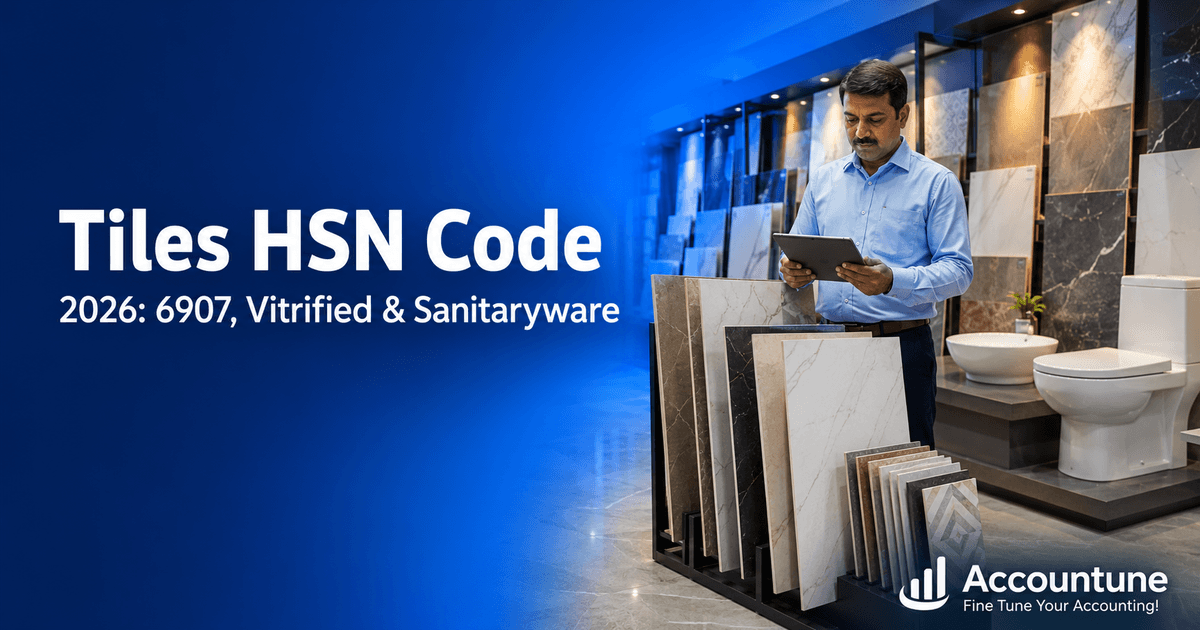
Tiles HSN Code 2026: 6907, Vitrified & Sanitaryware
Tiles HSN code is 6907 at 18% GST. Full list 2026: vitrified, glazed, wall, roofing 6905 at 5%, sanitaryware 6910, and why 6908 no longer exists.
Reviewed by Accountune Compliance Team
On this page (15)
Which HSN code and GST rate apply to tiles in 2026? All ceramic, vitrified and porcelain floor and wall tiles sit under heading 6907 at 18% GST, split into sub-codes by water absorption rather than by glaze. Heading 6908 no longer exists. Earthen and roofing tiles under 6905 stay at 5%, and sanitaryware under 6910 is 18%. Map each item once in Accountune and every line bills at its own correct rate.
- All tiles, glazed and unglazed, now sit in one heading: 6907 at 18% GST, and heading 6908 no longer exists even though most online lists still show it
- Sub-codes split by water absorption (690721, 690722, 690723), not by glaze, so the datasheet decides the code rather than the finish
- A tile showroom is a two-rate shop: floor and wall tiles 18%, earthen and roofing tiles under 6905 only 5%. Accountune stores the code against each item once, so a mixed bill splits on its own
- Accountune's rate master is maintained against the current tariff, so a withdrawn 6908 heading or a 28% rate never carries forward onto a live invoice
- Check any tile or sanitaryware item free in the Accountune HSN Code Finder with no signup, and the same codes carry straight into Accountune billing
Accountune ships a pre-loaded database of 10,000+ HSN and SAC codes with current GST 2.0 rates. It suggests the tile code when you add a product and applies the linked rate automatically, so a mixed showroom bill splits correctly on its own. Free plan at ₹0, paid plans from ₹799 a year.
Tiles under heading 6907, covering ceramic, vitrified, porcelain, glazed and unglazed floor and wall tiles, are taxed at 18% GST in 2026 under GST 2.0 effective 22 September 2025, down from the earlier 28% slab.
Heading 6908, which used to carry glazed tiles separately, no longer exists in the tariff. Glazed and unglazed tiles were merged into 6907 and the sub-codes now split by water absorption coefficient.
Over 12,000 Indian shops bill on Accountune, including hardware, building material and tile dealers, and the rate master is kept current so a withdrawn slab never sits on a live invoice.
The free Accountune HSN Code Finder returns the code and current 2026 rate for any tile or sanitaryware item by name with no signup, and those codes carry straight into Accountune billing.
Ramesh runs a tile and sanitaryware showroom in Rajkot. Floor tiles, wall tiles, a wall of wash basins and closets at the back, and a corner of adhesive and grout bags near the counter. When a builder asked for a rate list on letterhead, Ramesh's staff pulled the codes from a website they had used for years. The list went out with glazed wall tiles under 6908 and a 28% figure sitting next to the premium porcelain range.
The builder's accountant sent it back within a day with two lines circled. One code did not exist in the tariff any more. One rate had been withdrawn ten months earlier. The order still came through, but it came with a question Ramesh had no answer to: if the rate list is wrong, what is on the invoices?
Illustrative composite of real Accountune customers. Names and details have been changed.
A tile showroom is one of the easier shops to classify and one of the easiest to get wrong, because almost every reference on the internet is describing a tariff that changed twice. The heading structure changed when India moved to the current tariff edition, and the rate changed again on 22 September 2025. Accountune is a cloud-based GST billing and accounting software built in Jaipur since 2017, used by 12,000+ Indian small businesses, and its HSN database applies the correct code and rate to each line automatically. This guide lists the tiles HSN code and GST rate for everything a tile and sanitaryware dealer actually sells, from vitrified floor tiles to wash basins.
What is the HSN code for tiles in 2026?
Quick answer: The HSN code for tiles is 6907, which covers ceramic, vitrified and porcelain flags and paving, hearth and wall tiles, mosaic cubes and finishing ceramics, all taxed at 18% GST in 2026. Glazed and unglazed tiles share the same heading. Earthen and roofing tiles are separate at 6905 and 5%, and sanitaryware sits at 6910 at 18%.
The single most useful thing to know about the tiles HSN code is what it is not split by. Almost every trader assumes the split is glazed against unglazed, because that is how the tariff worked for years and how most websites still describe it. The current tariff splits tiles by water absorption instead, and the glaze makes no difference to the heading at all.
The second thing to know is that the GST rate on tiles is not one number across the shop. Floor and wall tiles are 18%, but the earthen and roofing tiles at the back of the same shop are 5%, and the adhesive and grout near the counter sit in a completely different chapter. The reliable way to keep this straight is billing software like Accountune, which stores the code against each item once so a mixed bill splits without anyone deciding at the counter.
Full tiles HSN code and sanitaryware list 2026
Here is the complete tiles HSN code list a tile and sanitaryware dealer needs, with the wider basket and current rates.
Item | HSN code | GST rate (2026) |
|---|---|---|
Vitrified and porcelain tiles (absorption 0.5% or less) | 6907 21 | 18% |
Ceramic floor and wall tiles (absorption above 0.5%, up to 10%) | 6907 22 | 18% |
Wall and terracotta tiles (absorption above 10%) | 6907 23 | 18% |
Mosaic cubes and similar | 6907 30 | 18% |
Finishing ceramics: skirting, trims, capping | 6907 40 | 18% |
Earthen and roofing tiles | 6905 | 5% |
Ceramic building bricks and blocks | 6901 / 6904 | 5% |
Sanitaryware: wash basin, closet, cistern, urinal | 6910 | 18% |
Ceramic tableware and kitchenware | 6911 / 6912 | 18% |
Marble and granite tiles, worked | 6802 | 18% |
Marble and granite blocks, unpolished | 2515 / 2516 | 5% |
Tile adhesive, grout and filler | 3214 | 18% |
Plastic tile spacers and trims | 3926 | 18% |
Cement | 2523 | 18% |
Two things fall out of this table. The first is that every finished tile in the ceramic chapter carries the same 18%, whatever the finish, size, design or price, so a dealer does not need a separate rate decision per product range. The second is that the 5% items in the shop are not tiles in the ceramic tile sense at all. They are earthen roofing tiles and building bricks, which sit in different headings for a reason that has nothing to do with how they look on a shelf.
For a dealer handling a mixed load of tiles, sanitaryware and adhesive on one delivery, hardware store billing software that stores the correct code per material bills each line at its own rate on the same invoice.
Heading 6907 and its sub-codes explained
The tiles HSN code 6907 reads, in the current tariff, as ceramic flags and paving, hearth or wall tiles, ceramic mosaic cubes and the like whether or not on a backing, and finishing ceramics. Notice what is missing from that text: the words glazed and unglazed do not appear anywhere in it.
Underneath the heading, the sub-codes work like this.
6907 21 covers tiles with a water absorption coefficient of 0.5% or less by weight. In shop language this is the vitrified and full-body porcelain range, the dense tiles used on floors in showrooms, offices and high-traffic areas.
6907 22 is the ceramic tiles HSN code most showrooms use day to day, covering tiles with absorption above 0.5% but not above 10%. This is where most ordinary ceramic floor and wall tiles land, including the great majority of what a mid-range showroom sells by volume.
6907 23 covers tiles with absorption above 10%. Lighter wall tiles and terracotta-bodied tiles sit here.
6907 30 is mosaic cubes and similar articles, other than those covered by 6907 40.
6907 40 is finishing ceramics: skirting, capping, beading and the trim pieces that finish an installation.
For everyday billing at four digits, a shop uses 6907 and the rate is 18% across all of it. The six and eight digit split matters when turnover crosses the threshold that makes six digits mandatory on invoices and in the GSTR-1 HSN summary, and it matters on import documentation, where absorption is a tested value and not an opinion.
A practical note for a showroom: the absorption figure is on the manufacturer's technical datasheet and on most box labels. If a dealer needs to pick between 6907 21 and 6907 22 for a range, the datasheet answers it. Guessing from whether the tile looks glossy does not, because glaze and absorption are unrelated properties.
Why HSN 6908 no longer exists
This is the single largest error running across the tiles HSN code pages that rank on this topic today, and it is worth being precise about.
Heading 6908 used to cover glazed ceramic flags and paving, hearth or wall tiles and glazed ceramic mosaic cubes. Heading 6907 covered the unglazed equivalents. Two headings, split by glaze, each with its own sub-codes.
That split was removed when the tariff moved to the current edition. Glazed tiles were folded into 6907, the sub-headings were rewritten to split by water absorption, and the phrase finishing ceramics was added to the heading text. 6908 was left with nothing under it.
The current Indian tariff listing for Chapter 69 reflects exactly this: heading 6907 carries the finishing ceramics wording with sub-headings 6907 21, 6907 22, 6907 23, 6907 30 and 6907 40, and there are no tariff items under 6908.
The problem is that a large number of HSN lookup databases were populated before this change and have never been rebuilt. So a trader searching today still finds pages presenting 6908 as a live heading for glazed tiles, sometimes on the same page that correctly lists 6907 21 to 6907 23. One widely-ranking tile guide describes 6907 as unglazed-only in its body text while its own FAQ describes 6907 22 as the glazed tile code. Both statements cannot be right, and it is the FAQ that matches the tariff.
What this means at the counter is simple. If a product master, rate list or supplier invoice carries 6908 against a glazed tile, that code is dead. The item belongs in 6907, and the sub-code depends on absorption, not on the glaze. The rate is 18% either way, so this is not a tax exposure. It is a data quality problem that shows up in the HSN summary of GSTR-1 and in any classification query a buyer's accountant raises. Accountune's code database is maintained against the current tariff, so a tile mapped in the system does not carry a withdrawn heading forward.
Vitrified, ceramic, porcelain and GVT: one code, many names
Tile trade names multiply faster than tariff headings, which is why one tiles HSN code has to carry so many product names, which is why this question comes up on every showroom floor.
Vitrified tile, polished vitrified tile, glazed vitrified tile, double-charge, full-body, soluble salt, porcelain, digital printed, matt, glossy, rustic, wooden-finish: these are manufacturing and marketing descriptions. None of them is a tariff category. Every one of them is a ceramic flag or wall tile under heading 6907, so the ceramic tiles HSN code and the vitrified tiles HSN code are the same four digits, and every one of them is 18%.
The only tariff-relevant property in that list is density, expressed as water absorption. A vitrified or porcelain tile is dense, so it usually falls in 6907 21. A standard ceramic tile absorbs more, so it usually falls in 6907 22 or 6907 23. That is the entire distinction.
This matters because dealers sometimes create separate HSN codes for their premium ranges on the assumption that a costlier tile must be classified or taxed differently. It is not. Price, brand, size, surface finish and country of origin do not move a tile out of 6907, and they do not move it out of 18%. Creating artificial code differences for the same product family only makes the GSTR-1 HSN summary harder to reconcile.
Keeping separate item codes for each range in the stock master is a different thing and is entirely sensible. A showroom needs to know that 600x600 GVT ivory is running low without confusing it with 300x450 wall tile. Item code and HSN code are two different fields, and in Accountune each product carries its own item code and description while sharing the same HSN and rate with the rest of its family.
Wall tiles, floor tiles and pavers
Buyers ask for wall tiles and floor tiles as if they were different products, and in every practical sense they are. Thickness, strength, slip rating and finish all differ. The tariff does not treat them as different headings.
Heading 6907 covers flags and paving, hearth tiles and wall tiles together in a single text. A wall tile and a floor tile of similar absorption can land in the same sub-code and carry the same 18%. The invoice description can and should say wall tile or floor tile, because that is what the customer bought and what a warranty claim will reference, but the HSN field stays in the same family.
Outdoor pavers need a moment of care, because the word paver is used for two different products. A ceramic paving tile is inside 6907. A concrete or cement paver block, the interlocking kind used on driveways, is not ceramic at all. It is an article of cement under 6810 at 18%. The rate is the same, so nothing is under-collected, but they are separate products in the HSN summary and a dealer who sells both should map them separately. The cement and construction material HSN guide covers 6810 and the rest of that basket in full.
Roofing tiles, bricks and the 5% side of the shop
Everything so far has been 18%. This section is the reason a tile dealer cannot set one rate and forget it.
Earthen and roofing tiles fall under heading 6905 at 5%. The heading covers roofing tiles, chimney pots, cowls, chimney liners, architectural ornaments and other ceramic constructional goods. The traditional clay roofing tile used across rural and coastal India is the main item here, and it sits at the merit rate because it is treated as a basic construction input rather than a finished interior product.
Ceramic building bricks and blocks fall under 6901 and 6904 at 5%. Clay bricks, hollow blocks and filler tiles used in walls belong here, not in the tile headings, even though the word tile appears in the tariff text for filler tiles.
The trap is the word tile doing two jobs. A roofing tile and a floor tile share a noun and nothing else. One is 5% and one is 18%. A showroom that stocks both and applies a blanket 18% overcharges every roofing tile invoice, and a shop that reasons the other way under-collects on its entire floor tile business.
There is a boundary worth knowing here too. A ceramic roofing tile is 6905. A cement or concrete roofing sheet or tile is an article of cement under 6810 at 18%, and a metal roofing sheet is in the iron and steel chapter entirely. Three products that do the same job on a roof carry three different codes and two different rates. The hardware HSN code guide covers the steel and fastener side of that basket, and the plywood and wood board guide covers the timber side.
Marble and granite tiles: a different chapter altogether
A large number of tile showrooms also sell natural stone, and this is where the classification genuinely changes rather than just the sub-code.
Marble, granite and other natural stone are not ceramic. They do not belong in Chapter 69 at any stage. Worked stone, meaning stone that has been cut, polished or finished into tiles, slabs or building pieces, sits under heading 6802 at 18%.
Raw or roughly-trimmed blocks are treated differently. Unpolished marble and granite blocks under headings 2515 and 2516 carry the merit rate of 5%, on the reasoning that a block is a mineral input and a polished slab is a finished product.
For a showroom the practical rule is the state of the goods, not the material. A polished granite floor tile is 6802 at 18% and sits alongside the ceramic range in rate terms while being in a different chapter for reporting. An unpolished block sold to a fabricator is 2515 or 2516 at 5%. A dealer who does both trades under one GSTIN needs both mapped, because the difference between them is ten percentage points, not a reporting nicety.
Engineered and composite stone, the quartz and agglomerated products sold as slabs, are their own question and depend on composition. Confirm those individually rather than assuming they follow natural stone.
Sanitaryware HSN code and bathroom fittings
Sanitaryware is the section no competing tile page covers, and it is on the same invoice in most showrooms.
Ceramic sanitaryware falls under heading 6910 at 18% GST. The heading covers ceramic sinks, wash basins, wash basin pedestals, baths, bidets, water closet pans, flushing cisterns, urinals and similar sanitary fixtures. The whole visible bathroom range in a tile showroom, if it is ceramic, is 6910 at 18%.
Bathroom fittings are where a single sale splits across chapters, because a bathroom is assembled from four different materials.
The ceramic fixtures, meaning basin, closet, cistern and urinal, are 6910. Brass and copper taps, mixers, angle valves and health faucets are articles of copper alloy in Chapter 74. Stainless steel sinks and steel fittings sit in the iron and steel chapter. PVC and CPVC pipes, bends and connectors sit under 3917 in the plastics chapter. A shower panel or acrylic bath is plastics again.
The rate on all of these is 18%, so the invoice total is the same whichever way the codes are assigned. The reason to get them right is the HSN summary in GSTR-1, which is where a blanket code across a mixed bathroom order becomes visible. A basin billed under a tap's code is a reporting error even when the tax is correct.
One rate note that catches showrooms: ceramic tableware and kitchenware under 6911 and 6912 moved up to 18% under the GST 2.0 restructure, having previously sat in the withdrawn 12% slab. A showroom with a decorative ceramics corner should check that shelf against its current rate master.
Tile adhesive, grout and the accessories corner
Adhesive, grout, spacers and trims are sold on the same bill as tiles and belong nowhere near the ceramic chapter.
Tile adhesive, grout and filler compounds are generally classified under heading 3214 at 18%. The heading covers glaziers' putty, resin cements, caulking compounds, and non-refractory surfacing preparations, which is where cementitious tile adhesive and grout land in normal trade practice. Epoxy grouts and specialised polymer products can be argued into different headings depending on composition, so a dealer stocking a technical range should confirm those individually against the product datasheet rather than applying 3214 across the shelf.
Plastic tile spacers, PVC corner trims and levelling clips fall under 3926 at 18%, as other articles of plastics. Aluminium trims and profiles sit in the aluminium chapter instead.
Every one of these is 18%, which is exactly why they get neglected. Nothing goes wrong on the invoice total, so nobody checks. It surfaces later, when a GSTR-1 HSN summary shows the entire adhesive and accessory turnover reported under a ceramic tile code, or when a buyer's accountant compares the description on the line against the code beside it.
Once each accessory carries its own code in the item master, this stops being a decision. Add the product once, and every subsequent bill carries the right code without anyone thinking about it. That is the practical case for keeping the catalogue in billing software rather than in a rate list on the wall.
What GST 2.0 changed for tiles, and the 28% myth
Before 22 September 2025, ceramic and vitrified tiles sat in the 28% slab. They were treated as a finished construction good and taxed near the top of the structure, which added materially to the cost of every housing and commercial project.
GST 2.0 replaced the old five-slab structure with 0%, 5%, 18% and 40%. The 12% and 28% slabs were withdrawn. The GST rate on tiles moved from 28% into 18%. The 40% rate is reserved for sin and luxury goods, and tiles do not go there at any price point.
That last sentence carries the correction that matters most, because the most common error on this topic today is not an old rate. It is a new invention. Several current pages claim that premium porcelain, designer or imported tiles attract 28% as luxury-grade materials. One states it in a rate table, in a bullet list and again in its FAQ. Another well-known compliance site, updated within the last few weeks, still lists the entire 6907 21 to 6907 23 range at 28%.
There is no luxury tile slab. The 28% slab does not exist for any product. A premium imported porcelain tile is taxed at 18%, the same as the cheapest ceramic wall tile in the same showroom. Classification under GST follows the nature of the product, not its price, its brand or the segment it is sold into.
For a dealer, the practical work is the same as it was for cement: clear the old rate out. Any rate list, product master or supplier record still showing 28% overcharges the customer today, and in a market where builders compare quotes line by line, an overcharged tax line loses the order to the showroom next door. The GST 2.0 rate changes guide covers the full restructure across categories, and the GST calculator applies the current slabs if you need to check a figure quickly.
Box, square feet and multi-UOM tile billing
Tiles are the classic multi-unit product, and the billing mechanics are worth setting out because no competing page does.
A tile is manufactured in a size, packed in a box, priced per square foot and delivered by the box or the pallet. A 600x600 tile is roughly 3.87 square feet per piece, four pieces to a box, so about 15.5 square feet per box. A 300x450 wall tile runs six or eight pieces to a box depending on the range. The customer asks the rate per square foot, the godown counts boxes, and the invoice has to reconcile both.
Handled by hand, this is where showroom errors concentrate. Staff quote per square foot, bill per box, and then apply a conversion from memory on a range that changed pack size last quarter. The tax is not the problem. The taxable value is, and a wrong taxable value carries a wrong tax with it automatically.
Accountune supports multi-unit pricing with piece, box and square foot as linked units, so a tile can be quoted per square foot and billed by the box with the conversion applied by the system. Stock moves in boxes, the invoice shows the unit the customer agreed, and the HSN and rate stay attached to the item through both. Multi-location stock tracking covers the showroom-and-godown split that almost every tile business runs.
Breakage is the second mechanic. Tiles arrive broken often enough that a showroom needs a way to record damaged stock without it silently becoming a stock discrepancy at year end. Damaged goods handling exists for exactly this, so a broken box is written off as damage rather than disappearing from the count.
HSN digits, GSTR-1 summary and common mistakes
How many digits a tile dealer must print depends on turnover in the preceding financial year. Businesses up to ₹5 crore report four digits on B2B invoices, and businesses above ₹5 crore report six. Four digits means 6907. Six means choosing between 6907 21, 6907 22 and 6907 23, which is where the water absorption figure stops being a technicality.
Table 12 of GSTR-1 requires HSN-wise details from all registered taxpayers, so the summary is generated whether or not a dealer thinks about it. Whatever code sits against each item in the billing system is what appears there.
The mistakes that show up most often in this trade, in order of how frequently they appear on live rate lists:
Using 6908 for glazed tiles. The heading was removed. Everything goes to 6907, split by absorption.
Billing premium tiles at 28%. The slab does not exist. All tiles under 6907 are 18%.
Applying 18% to roofing tiles. Earthen and roofing tiles under 6905 are 5%, and so are ceramic building bricks.
Putting adhesive and grout under the tile code. They are 3214, and spacers are 3926.
Treating marble as ceramic. Worked stone is 6802 and unpolished blocks are 2515 or 2516 at 5%.
None of these is difficult once the item master is right, which is the point. The classification decision is made once per product, not once per invoice. When you add a tile in Accountune, the software suggests the code from its database and applies the linked rate, so a mixed bill of floor tiles, a wash basin and two bags of adhesive splits into its correct lines without a manual selection at the counter. The software is fully cloud-based, so the rate master stays current across the showroom counter, the godown phone and the owner's laptop without a reinstall. This guide is one of a set, and the full HSN code list for 2026 covers rates for every other shop category.
Get every line on the tile bill right
The tiles HSN code is 6907 at 18%, glazed and unglazed alike, and heading 6908 is gone. Roofing tiles are 5%, sanitaryware is 18% under 6910, adhesive is 3214, and marble is a different chapter entirely. There is no 28% tile and no luxury slab, whatever a rate list from last year says.
Set each item once with its own code and every mixed order splits correctly on its own. Check any tile or sanitaryware item now in the free Accountune HSN Code Finder, and Accountune's cloud-based billing keeps those codes applied automatically, updated for GST 2.0, with a free plan at ₹0 and paid plans from ₹799 a year. Start with your floor tile, roofing tile and adhesive lines, and let the rest of the catalogue follow.
Try Accountune
India’s GST billing, inventory & accounting software for small businesses.
Start free trialGet free demoFrequently Asked Questions
What is the HSN code for tiles?
The tiles HSN code is 6907, covering ceramic, vitrified and porcelain flags, paving, hearth and wall tiles, mosaic cubes and finishing ceramics. The rate is 18% GST.
What is the GST rate on tiles in 2026, 18% or 28%?
The GST rate on tiles is 18% for everything under heading 6907. The 28% figure is withdrawn. The 28% slab itself was removed on 22 September 2025 under GST 2.0.
Is there a separate HSN code for glazed tiles?
No. Heading 6908, which used to carry glazed tiles, no longer exists. Glazed and unglazed tiles are both in 6907, and the sub-codes split by water absorption instead of by glaze.
What is the HSN code for vitrified tiles?
The vitrified tiles HSN code is normally 6907 21, the sub-code for tiles with a water absorption coefficient of 0.5% or less. The rate is 18%
Do premium or imported designer tiles attract 28% GST?
No. There is no luxury tile rate. Price, brand, finish and origin do not change the classification. Every tile under 6907 is 18%.
What is the difference between 6907 21, 6907 22 and 6907 23?
Water absorption by weight. 6907 21 is 0.5% or less, 6907 22 is above 0.5% and up to 10%, and 6907 23 is above 10%. All three are 18%.
Are wall tiles and floor tiles under the same HSN code?
Yes. Heading 6907 covers paving, hearth and wall tiles together. The invoice description can name the use while the HSN stays the same.
What is the HSN code for roofing tiles?
Earthen and roofing tiles fall under 6905 at 5%, not under the ceramic tile heading. Cement roofing tiles are articles of cement under 6810 at 18%.
What is the sanitaryware HSN code?
Ceramic sanitaryware, including wash basins, closets, cisterns and urinals, falls under 6910 at 18%.
What is the HSN code for a wash basin?
A ceramic wash basin is 6910, the same heading as the rest of the ceramic sanitary range, at 18%.
Are bathroom taps and fittings under 6910 too?
No. Brass taps and mixers are in the copper chapter, steel fittings in the iron and steel chapter, and PVC pipes and connectors under 3917. All are 18%, but they report separately.
What is the HSN code for tile adhesive?
Tile adhesive and grout are generally 3214 at 18%. Specialised epoxy products can differ by composition, so confirm those against the datasheet.
What is the HSN code for tile spacers?
Plastic spacers, clips and PVC trims are 3926 at 18%. Aluminium profiles sit in the aluminium chapter.
Are marble and granite tiles ceramic tiles?
No. Worked marble and granite are under 6802 at 18%. Unpolished blocks under 2515 and 2516 are 5%.
What is the GST rate on paver blocks?
A concrete or cement interlocking paver is an article of cement under 6810 at 18%. A ceramic paving tile is 6907, also 18%.
Is ceramic tableware taxed the same as tiles?
Ceramic tableware and kitchenware under 6911 and 6912 are 18%. They moved up from the withdrawn 12% slab under GST 2.0.
How many HSN digits do I need on a tile invoice?
Four digits up to ₹5 crore turnover in the preceding year, six digits above it. Four digits is 6907, six requires the absorption-based sub-code.
Can I claim input tax credit on tiles?
A dealer buying tiles for resale claims ITC normally. ITC is generally blocked on materials used for your own construction of immovable property, so the same tile can be creditable for a dealer and blocked for a business tiling its own office.
Do tiles supplied with fitting count as one supply?
Supply of tiles together with fitting labour is normally treated as a composite supply and taxed as a single transaction rather than as two separate lines. The treatment depends on the contract, so confirm the structure before billing.
Does tile size or design change the HSN code?
No. Size, colour, digital print and surface finish do not move a tile out of 6907. Only material and absorption matter.
Kaunsa billing software tiles aur roofing tiles ka alag-alag rate ek hi bill pe laga deta hai?
Accountune har item ka sahi HSN code aur rate apne aap laga deta hai. Floor tile 18%, roofing tile 5%, adhesive 18%, sab ek hi invoice pe alag-alag lines mein. Ek baar item add karo, phir har mixed order automatic sahi split hota hai. Free plan ₹0 se shuru, paid ₹799 saal se.
My supplier's invoice shows 6908. What should I do?
Ask them to correct it, and do not copy the code into your own master. The heading has no tariff items under it. The item belongs in 6907 and the rate is 18% either way.
Do I need separate HSN codes for each tile range I stock?
No. Keep separate item codes for stock control, but the HSN stays the same across the family. Creating artificial code differences only complicates the GSTR-1 summary.
Where can I check a tile or sanitaryware code quickly?
The free Accountune HSN Code Finder returns the code and current rate by product name with no signup, and the same codes carry into billing.
Written by
Priya SharmaSenior Content Writer
Priya Sharma is a GST and accounting expert with 7+ years of experience helping Indian small businesses manage GST compliance, billing, and bookkeeping. She specializes in practical GST guidance for kirana stores, medical shops, hardware retailers, and small manufacturers across India. Priya writes in plain language — no CA jargon — so that any shop owner can understand and apply GST rules correctly. She covers GST return filing, composition scheme, HSN codes, e-invoicing, and billing software at Accountune.
Related posts
How to Reduce GST Liability Legally in India (2026)
How to reduce GST liability legally in India: what really lowers net GST, four tips that fail, and the 2025 credit note rule. Checked Sep 2026.
Priya Sharma13 min readPresumptive Taxation for a Small Business: What Section 58 Changed in 2026
Presumptive taxation for small business in India: what Section 58 changed in 2026, the 6% and 8% split, turnover limits, and who is now shut out.
Priya Sharma19 min readBest Billing Software for Mobile Shop in India: IMEI, Warranty and GST Compared (2026)
Mobile shop billing software compared for India 2026: IMEI capture, warranty, second hand phones, exchange billing and GST. Seven tools reviewed
Priya Sharma19 min read


Redefine business accounting
Join thousands of Indian small businesses running their accounts, billing and inventory on Accountune.