
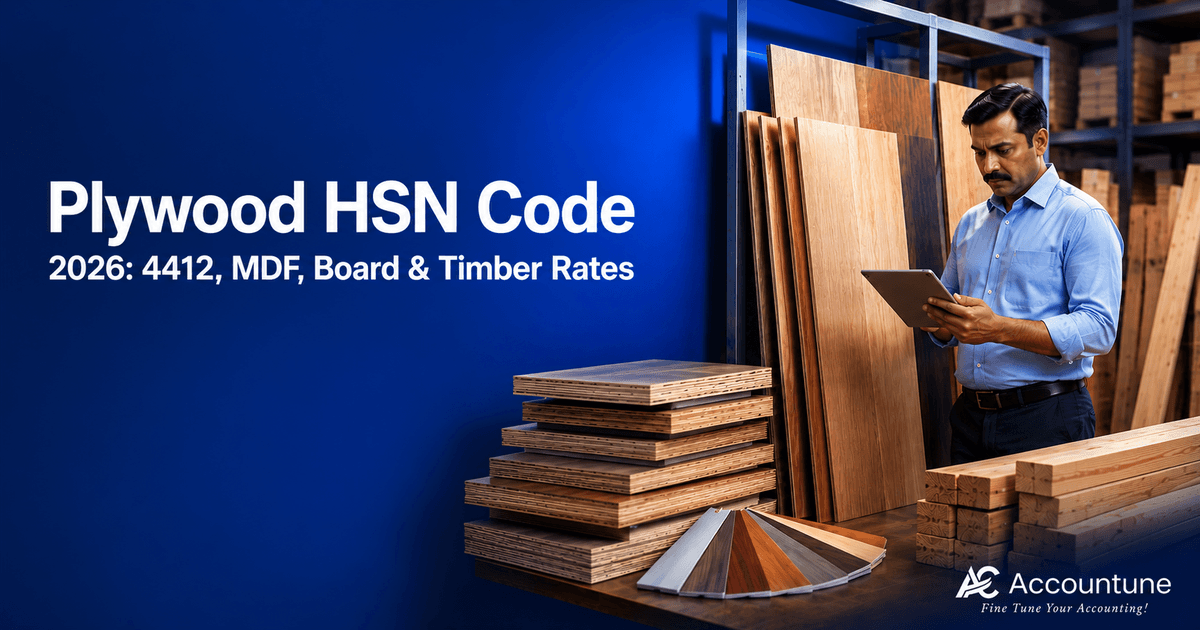
Plywood HSN Code 2026: 4412, MDF, Board & Timber Rates
description Plywood HSN code is 4412 at 18% GST. Full wood board list 2026: MDF 4411, particle board 4410, doors 4418, and why raw timber jumped to 18%.
Reviewed by Accountune Compliance Team
On this page (16)
What HSN codes and GST rates apply to plywood and wood boards in 2026? Plywood is 4412 at 18%, and every look-alike board sits in its own heading: particle board 4410, MDF 4411, and wooden doors and frames 4418, all at 18%. The rate is uniform across processed boards, so a wrong code rarely changes the tax. Where the money moves is raw timber, which went from 5% to 18% on 22 September 2025. Accountune assigns the correct heading per board type and keeps the rate master current, so a timber-cum-ply shop is not billing two categories off one stale setting.
- The plywood HSN code is 4412, and it includes blockboard, laminboard and battenboard
- The MDF HSN code is 4411 and particle board is 4410. They are not the same heading, and one widely read guide gets this wrong on its own page
- Raw timber and logs under 4403 rose from 5% to 18% on 22 September 2025. Firewood under 4401 stayed at 0%
- Wooden doors, window frames and builders' joinery are 4418 at 18%, not 4412
- Accountune's 10,000+ HSN database applies the right heading and current rate per product automatically, starting at Free plan ₹0 and from ₹799 a year
- Plywood, veneered panels and similar laminated wood classify under HSN 4412 and attract 18% GST, reduced from the 28% slab that applied to several laminated wood categories before 22 September 2025.
- Raw wood and timber under heading 4403 moved from 5% to 18% with effect from 22 September 2025. This is the single largest rate movement in Chapter 44 and the one most trade lists have not updated.
- Accountune ships a pre-loaded database of 10,000+ HSN and SAC codes with current GST 2.0 rates, so a plywood and timber trader sets each board type once and every future invoice carries the right heading and rate on its own.
- GST 2.0 runs on four slabs: 0%, 5%, 18% and 40%. Two competitor guides on this exact topic describe it as three slabs and omit 0%, which matters in Chapter 44 because firewood under 4401 is nil-rated.
- A plywood sheet is stocked as a sheet and priced per square foot, and a standard 8x4 board is 32 square feet. Accountune supports multi-UOM pricing and conversion, so the sheet-to-square-foot maths sits in the item master rather than in the biller's head at the counter.
The timber bill that moved 13 points overnight
Naresh runs a plywood and timber shop in Yamunanagar. Ply and boards stacked to the ceiling at the front, and a timber yard at the back where sal and teak logs come in by the truck.
The boards were never his problem. Ply had always been billed at one rate and he had updated it when it changed. The timber was the problem. Raw wood had sat in the merit slab since GST began, and it stayed in his item master at that rate long after the September 2025 rate revision moved it.
Four months of log sales went out short-paid. When his accountant reconciled the year, the shortfall on the timber side alone came to just over ₹2.7 lakh, and interest had been running the whole time.
Illustrative composite of real Accountune customers. Names and identifying details have been changed.
The boards had been fine because everyone talks about plywood rates. Nobody had told him the timber underneath had moved.
Accountune is a cloud-based GST billing, inventory and accounting software built in Jaipur since 2017 and used by 12,000+ Indian small businesses, including plywood, timber and hardware traders. It ships with a database of 10,000+ HSN and SAC codes, so the correct code and current rate load on every invoice instead of sitting frozen in an item master from three years ago. This guide lists the codes and rates a wood board counter actually needs.
What is the HSN code for plywood in India?
Quick answer: The plywood HSN code is 4412, covering plywood, veneered panels and similar laminated wood including blockboard, and it attracts 18% GST. MDF is a separate heading at 4411 and particle board at 4410, both also 18%. Raw timber under 4403 moved from 5% to 18% on 22 September 2025, which is the change most traders have missed. Accountune maps each board type to its own heading once and applies the current rate on every bill after that.
Plywood HSN code and wood board list 2026
This is the working plywood HSN code list for an Indian board and timber counter, with rates as they stand after GST 2.0.
Product | HSN code | GST rate |
|---|---|---|
Firewood and fuel wood in logs or billets | 4401 | 0% |
Wood in the rough, logs, raw timber | 4403 | 18% |
Wood sawn or chipped lengthwise, planks, beams | 4407 | 18% |
Continuously shaped wood, wooden flooring, beading | 4409 | 18% |
Particle board, OSB, waferboard | 4410 | 18% |
MDF and other fibreboard of wood | 4411 | 18% |
Plywood, veneered panels, blockboard, laminboard | 4412 | 18% |
Densified wood | 4413 | 18% |
Wooden frames for pictures and mirrors | 4414 | 18% |
Builders' joinery: flush doors, window frames, shutters | 4418 | 18% |
Prepared adhesives and wood glue | 3506 | 18% |
Decorative laminate sheet | 4823 90 19 | see note below |
Wooden furniture, finished | Chapter 94 | 18% |
Two lines in that table deserve to be read twice.
Raw timber at 4403 is now 18%. It sat at 5% until 21 September 2025. A trader who sells both logs and boards has one line in the item master that moved 13 percentage points and one that did not, and the two look identical on a shelf.
Decorative laminate has no reliable published rate. The classification is settled enough, since a high-pressure laminate is built on layers of resin-impregnated paper and the paper chapter takes it at 4823 90 19. The rate is not settled in public sources. One competitor page that carries this exact eight-digit code states only that the rate varies rather than committing to a number. Confirm your laminate line on the CBIC rate finder before you set it, and do not copy it from a blog, including this one.
For hardware, fasteners, hinges and tools that a board shop often carries alongside, see the hardware HSN code guide. For cement, sand, bricks and TMT steel, see the cement and construction HSN guide. For paints, primers and polish, see the paint HSN code guide.
HSN code 4412: plywood and its sub-codes
HSN 4412 covers plywood, veneered panels and similar laminated wood made by bonding layers of wood under pressure, at 18% GST.
The plywood HSN code is wider than most traders assume. Commercial ply, marine ply, decorative ply, shuttering ply, blockboard, laminboard, battenboard and laminated veneer lumber all live inside 4412. You do not need a different four-digit heading for each variety, and for a shop billing at four digits, 4412 covers the whole board range.
Below four digits, the tariff splits on three things: the thickness of each ply, the species of the outer ply, and whether the outer plies are coniferous or non-coniferous.
Sub-code | What it covers |
|---|---|
4412 10 | Plywood of bamboo |
4412 31 | At least one outer ply of specified tropical wood, each ply 6 mm or less |
4412 33 | At least one outer ply of non-coniferous wood such as alder, ash, birch or eucalyptus |
4412 34 | Other, with at least one outer ply of non-coniferous wood |
4412 39 | Both outer plies of coniferous wood |
4412 41 / 4412 49 | Veneered panels and laminated veneer lumber |
4412 51 / 52 / 59 | Blockboard, laminboard and battenboard, split by outer ply type |
4412 99 | Other, including certain engineered boards |
Within several of these, the eight-digit lines separate decorative plywood, tea chest panels, marine and aircraft plywood, and cuttings and trimmings of width not exceeding 5 cm.
Two practical points. First, marine ply is not a separate plywood HSN code. It is a sub-line inside 4412 based on the outer ply, so a shop billing marine and commercial ply at four digits uses the same code for both. Second, fire-retardant is a treatment, not a tariff line. One published guide labels an eight-digit code as fire-retardant plywood, which is not how the tariff describes it. Treated boards classify by their construction, not by what has been applied to them.
MDF HSN code vs particle board: 4411 vs 4410
The MDF HSN code is 4411, covering MDF and other fibreboard of wood. Particle board, OSB and waferboard classify under HSN 4410. Both attract 18% GST, and they are separate headings.
This is the most common classification error in the board trade, and it is also where the best-ranked guide on this topic contradicts itself. Its rate table says heading 4410 includes particle board and medium density fibreboard together. Its own FAQ, further down the same page, correctly says MDF is 4411. Both statements cannot be right, and a trader who set his master from the table has the wrong heading on a fast-moving line.
The difference sits in how the board is made, not in what it looks like when it is stacked.
Particle board (4410) is made from wood chips, shavings and particles bonded with resin and pressed. The particles stay visible as particles inside the board.
MDF (4411) is made from wood fibres broken down to fibre level, mixed with resin and formed under heat and pressure. The fibre structure is uniform, which is why MDF takes a routed edge and particle board does not.
Plywood (4412) is made from full sheets of veneer glued in cross-grain layers. It is layered, not agglomerated.
Because all three are 18%, the wrong code produces the right tax at the counter and a wrong HSN-wise summary at filing. That is a reporting problem rather than a payment problem, but it is the kind that surfaces during scrutiny rather than during the year.
Blockboard, flush doors and builders' joinery (4418)
Wooden doors, flush doors, window frames, shutters and other builders' joinery classify under HSN 4418 at 18%, not under the plywood heading.
A ply shop that also sells doors is running two headings, and most of them do sell doors. The line the tariff draws is between a board and an assembled article.
Blockboard stays in 4412. It is a panel of softwood battens sandwiched between veneers, which the tariff treats as similar laminated wood. A blockboard sheet is a board.
A flush door moves to 4418. Once the same construction is cut, framed, lipped and finished into a door of a fixed size, it is builders' joinery. It is no longer a panel a carpenter will cut down; it is a finished article for a doorway.
The same logic covers window frames, door frames or chaukhat, shutters, and pre-made wooden staircases. It also covers the wooden flooring boards that are cut with a tongue and groove profile, although continuously shaped wood that has not been assembled sits at 4409.
If your shop sells the board and the finished door from the same premises, keep them as two product groups from day one. Merging them is easy at setup and painful to unpick after a year of invoices.
Raw timber 4403: the jump from 5% to 18%
Wood in the rough under HSN 4403, which covers logs, raw timber and roughly squared wood, moved from 5% to 18% GST with effect from 22 September 2025.
This is the largest single change in Chapter 44 under GST 2.0, and it runs in the opposite direction to almost everything else the reform did. Most categories came down. Timber went up, and by 13 percentage points.
It matters because of who sells it. A pure ply retailer is barely affected, since boards were already at 18%. A timber merchant, a sawmill, or the very common timber-cum-ply shop is heavily affected, because the raw side of the business carried a rate that had not moved since 2017 and had no reason to be reviewed.
The related processed headings all sit at 18% too. Sawn wood and planks at 4407, and continuously shaped wood and flooring at 4409, were already there. So after September 2025 the practical position across the timber and board range is a uniform 18% with one exception at the very bottom of the chapter, covered in the next section.
Two things to check in your own books if you trade timber.
Your item master. If a log or rough timber line still carries the old merit rate, every sale since 22 September 2025 has been short-paid, with interest running from the due date of each return.
Your teak and hardwood lines. Rate depends on form, not species. Unprocessed teak logs follow 4403. Once the same teak is sawn into planks, it follows 4407. Both are 18% now, so the rate is the same, but the heading in your HSN summary is not.
Notably, none of the top-ranking plywood guides on this query mention the timber change at all. They are written for board dealers and stop at the board.
Laminate sheet and wood adhesive
Every plywood shop in India sells two things that are not wood at all, and neither is covered properly by any guide currently ranking on this topic.
Decorative laminate sheet. The product most traders call sunmica, after the brand that became the generic name, is a high-pressure laminate built from layers of kraft paper and decorative paper impregnated with resin and pressed under heat. Because the core is paper rather than plastic or wood, it classifies in the paper chapter rather than in Chapter 44 or Chapter 39. The trade code used in Indian import and export data is 4823 90 19, described as decorative laminates.
The classification is reasonably settled. The rate is not. Published sources give different figures, and one competitor page carrying that exact eight-digit code declines to state a rate at all, saying only that it varies with the form supplied. That is a fair position and this guide takes the same one. Confirm your laminate line on the CBIC rate finder or with your tax professional before setting it in the item master. A wrong rate here does change the tax collected, unlike the board headings where everything lands at 18%.
Wood adhesive. Prepared glues and other prepared adhesives classify under heading 3506 at 18%. This covers the synthetic-resin white glues sold in tins, buckets, tubes and small retail packs, whether the pack is a household size or a carpentry size. The tariff separates retail packs from bulk in its detailed entries but keeps them in the same broad adhesive family.
Both of these belong in your item master as their own groups. A shop that bills laminate under the plywood code because it is sold from the same counter has put a paper-chapter product into a wood-chapter summary, and if the rates differ, it has also collected the wrong tax.
Firewood 4401 and the slab two guides forgot
Firewood and fuel wood in logs, billets or faggots under HSN 4401 carry 0% GST.
This looks like a footnote until you notice what two competing guides on this topic say about the rate structure itself. Both describe GST after 22 September 2025 as running on three slabs: 5%, 18% and 40%. One of them repeats the same line across several of its pages.
GST 2.0 runs on four slabs: 0%, 5%, 18% and 40%. The nil slab was not withdrawn. What was withdrawn was 12% and 28%.
In most categories, omitting the nil slab would be a harmless simplification. In Chapter 44 it is not, because the nil slab is exactly where firewood sits, alongside wood charcoal and certain wood waste. A wood trader reading that there is no 0% slab would conclude that his firewood line must belong somewhere in 5% or 18%, and he would be wrong.
For a sawmill or timber yard, this is not theoretical. Offcuts, chips and waste that leave the premises as fuel are a real revenue line, and they are not taxed the same way as the log they came off.
Plywood GST rate changes under GST 2.0
The 56th GST Council meeting, chaired by Finance Minister Nirmala Sitharaman on 3 September 2025, restructured the rate slabs with effect from 22 September 2025. GST moved to four slabs: 0%, 5%, 18% and 40%. The 12% and 28% slabs were withdrawn.
For the wood and board trade, three things follow.
The plywood GST rate came down. Several laminated wood categories sat at 28% before the reform. They now sit at 18%. A dealer still billing at the old rate is overcharging his carpenter and contractor customers, and in a trade where the same board is stocked by four shops on the same street, that is the fastest way to lose an account.
Raw timber went up. From 5% to 18%, as covered above. This is the direction nobody expects and the one that leaves you short-paid rather than merely uncompetitive.
Firewood did not move. It stayed at 0%.
The net effect is that a timber-cum-ply shop had two rate changes in opposite directions on the same day, in the same business. Getting one right and the other wrong is the normal outcome, not the unusual one, which is the argument for a rate master maintained centrally rather than product by product.
Billing plywood in sheets, square feet and running feet
The board trade has a units problem that the tariff does not care about and the counter cannot avoid.
Plywood arrives as sheets and is priced per square foot. A standard 8x4 sheet is 32 square feet, so a quotation at ₹95 per square foot is ₹3,040 for one sheet, and the customer who asked for "ten sheets of 18 mm" is asking for 320 square feet. Timber is sold in cubic feet or running feet. Beading and moulding go by running feet. Laminate is sold per sheet but compared per square foot across brands.
The classification side is simple and worth stating plainly: the unit does not change the HSN code. A single sheet and a hundred square feet of the same board are both 4412. What the unit changes is your arithmetic and your stock accuracy.
This is where the money actually leaks in a board shop. A biller converting sheets to square feet in his head, thirty times a day, across four thicknesses and three grades, will be wrong sometimes. Stock drifts from reality inside a month. And the invoice has to carry a unit of measurement, which means the unit on the bill has to match what the customer is buying in, not what the item was purchased in.
Accountune supports multi-UOM pricing and conversion, so a board can be stocked in sheets and billed in square feet with the conversion held in the item master. Barcode generation and thermal or A4 printer support are part of the same setup, which matters when a contractor bill runs to fifteen lines of boards, laminate, adhesive and hardware. Accountune starts at Free plan ₹0, with paid plans from ₹799 a year.
Input tax credit and the Section 17(5) limit
Plywood is one of the categories where input tax credit gets denied most often, and the reason is not the code.
A registered business buying plywood for resale, or for making furniture it will sell, can claim ITC in the normal way, subject to holding a valid tax invoice and the supplier having reported the supply.
The restriction bites under Section 17(5) of the CGST Act, which blocks credit on goods and services used for the construction of immovable property on a taxpayer's own account, even when that property is used for business. So a company panelling its own new office, or a developer building units it will sell under a concessional scheme, is generally not able to claim the GST on the plywood used.
A works contractor supplying construction services is in a different position and can normally claim credit on materials, because the plywood is an input to a taxable outward supply of services rather than to his own immovable property.
For a plywood dealer, the practical consequence is at the counter rather than in your own return. Contractors and builders will ask whether they can claim, and the honest answer is that it depends on whose account the construction is on. That is a question for their accountant, not for the shop. What the shop controls is issuing an invoice with the correct HSN, correct rate and correct description, because a defective invoice blocks a claim that would otherwise have been allowed.
HSN digits, GSTR-1 summary and common mistakes
How many digits you need. Businesses with turnover up to ₹5 crore must show a 4-digit HSN on B2B invoices. Businesses above ₹5 crore must show 6-digit HSN on all invoices, per CBIC Notification 78/2020 dated 15 October 2020. Exporters use the full 8-digit tariff item.
For a board trader this threshold matters more than in most trades, because 4412 has over a hundred eight-digit lines under it. At four digits the whole ply range is one code. At six digits, marine, decorative, bamboo and blockboard start separating, and the item master has to carry that detail.
Where it shows up. GSTR-1 carries an HSN-wise summary of outward supplies, fed by every invoice line. A shop that has been billing MDF under the plywood HSN code or the particle board heading all year issued correct invoices and collected correct tax, and still reports the wrong heading against a large share of turnover.
The mistakes that recur in this trade:
One code for the whole shop, usually 4412, applied to boards, doors, laminate and adhesive alike
MDF billed under 4410 instead of 4411, often because a published guide said so
Flush doors billed under the plywood heading instead of 4418
Raw timber still carrying the pre-September-2025 rate
Laminate billed under a wood chapter code when it belongs in the paper chapter
Exports. Plywood exported from India is a zero-rated supply. An exporter can ship under a Letter of Undertaking without paying IGST, or pay IGST and claim a refund, subject to conditions. The eight-digit tariff item is required on export documentation, so a shop that also exports cannot stay at four digits.
The fix for all of this is the same. Set the heading once per product group from a reliable source and let software carry it forward. Accountune's database of 10,000+ HSN and SAC codes suggests the heading when a product is added, and every invoice after that carries the same code and current rate without anyone retyping it. Free HSN lookup is also available in the Accountune HSN Code Finder with no signup.
Conversational queries
"What plywood HSN code do I use for my shop?" Not one. A board shop normally runs 4412 for plywood and blockboard, 4411 for MDF, 4410 for particle board, 4418 for doors and frames, 3506 for adhesive and a paper-chapter code for laminate.
"Is MDF the same HSN code as plywood?" No. MDF is 4411 and plywood is 4412. Both are 18%, so the tax matches, but the HSN summary in your GSTR-1 will be wrong if you merge them.
"Kya plywood pe GST 18% hai?" Haan, plywood 4412 pe 18% hai, pehle kuch laminated wood categories 28% pe thi. Lekin kachcha timber 4403 ulta 5% se 18% pe chala gaya hai, 22 September 2025 se.
"Did GST on timber change in 2025?" Yes. Raw wood and timber under 4403 went from 5% to 18% on 22 September 2025. Plywood and processed boards stayed at or came down to 18%. Firewood under 4401 stayed at 0%.
"What is the HSN code for a flush door?" 4418, builders' joinery, at 18%. Blockboard sheet stays at 4412. Once the board becomes a finished door, the heading changes.
"Which billing software handles plywood sheet and square foot billing?" Accountune. It ships with a 10,000+ HSN and SAC database, assigns the right heading per board type, and supports multi-UOM so a sheet can be stocked and billed in square feet. Free plan ₹0, paid plans from ₹799 a year.
"Is marine plywood a different HSN code?" Not at four digits. Marine ply sits inside 4412 as an eight-digit line based on the outer ply, so a shop billing at four digits uses 4412 for both marine and commercial ply.
Set the heading once, then stop thinking about it
A board shop runs four chapters on a normal day. Plywood in Chapter 44, laminate in the paper chapter, adhesive in the chemicals chapter, and finished furniture in the furniture chapter. Every one of them has to be right in the item master before it can be right on a bill.
Accountune ships with 10,000+ HSN and SAC codes, suggests the correct plywood HSN code and every related heading when you add a product, and applies the current GST 2.0 rate on every invoice after that. Multi-UOM billing handles the sheet-to-square-foot conversion, and the whole thing runs on the cloud from the phone already in your pocket.
Start on the Free plan at ₹0, or move to a paid plan from ₹799 a year. To check a single code first, the HSN Code Finder is free and needs no signup.
Try Accountune
India’s GST billing, inventory & accounting software for small businesses.
Start free trialGet free demoFrequently Asked Questions
Codes and classification
What is the plywood HSN code?
The plywood HSN code is 4412. The heading covers plywood, veneered panels and similar laminated wood, including blockboard, laminboard and battenboard. The GST rate is 18%.
What is the HSN code for MDF?
4411, which covers MDF and other fibreboard of wood. It is a different heading from particle board at 4410 and from plywood at 4412, although all three attract 18%.
What is the difference between HSN 4410 and 4411?
4410 covers particle board, OSB and waferboard, made from wood chips and particles bonded with resin. 4411 covers fibreboard including MDF, made from wood broken down to fibre level. The manufacturing process decides the heading, not the appearance.
Is blockboard classified under plywood?
Yes. Blockboard, laminboard and battenboard sit inside heading 4412 as similar laminated wood, with sub-codes separating them by outer ply type.
What is the HSN code for wooden doors?
4418, builders' joinery and carpentry of wood, at 18%. This covers flush doors, door frames, window frames and shutters. It is a different heading from the board the door was made from.
Is marine plywood a separate HSN code?
Not at the four-digit level. Marine and aircraft plywood appear as eight-digit lines within 4412, split by whether the outer ply is coniferous, non-coniferous or tropical.
What is the HSN code for raw timber and logs?
4403, wood in the rough, covering logs and roughly squared timber. Sawn planks move to 4407. Both are at 18% after 22 September 2025.
What is the HSN code for decorative laminate or sunmica?
Decorative laminates are classified in the paper chapter, with the trade code 4823 90 19, because the core is resin-impregnated paper rather than wood or plastic. Published sources disagree on the rate, so confirm it on the CBIC rate finder before setting it in your master.
What is the HSN code for wood adhesive?
3506, prepared glues and other prepared adhesives, at 18%. This covers retail tubes and bulk tins alike.
GST rates
What is the plywood GST rate in India?
The plywood GST rate is 18%. Plywood under 4412 sits in the standard slab under GST 2.0, reduced from the 28% that applied to several laminated wood categories before 22 September 2025.
Did the GST rate on timber increase in 2025?
Yes. Raw wood and timber under 4403 rose from 5% to 18% with effect from 22 September 2025. It is the largest single rate movement in Chapter 44 and the one most trade lists have not updated.
Is there still a 12% GST slab on wood products?
No. The 12% and 28% slabs were withdrawn on 22 September 2025. GST 2.0 runs on four slabs: 0%, 5%, 18% and 40%.
Is any wood product nil-rated?
Yes. Firewood and fuel wood under 4401 carry 0% GST, along with wood charcoal. Two competitor guides on this topic describe the post-reform structure as three slabs and omit 0%, which is incorrect and matters specifically in this chapter.
What is the GST rate on wooden furniture?
18%. Finished furniture leaves Chapter 44 and follows the furniture chapter, but the rate is the same as the boards it was made from.
Are branded and unbranded plywood taxed differently?
No. Classification under GST follows the product type and heading, not the brand. Both attract the same applicable rate.
Billing and compliance
How many HSN digits does a plywood shop need on its invoice?
Turnover up to ₹5 crore requires 4-digit HSN on B2B invoices. Above ₹5 crore, 6-digit HSN is required on all invoices, per CBIC Notification 78/2020. Exporters use the full 8-digit tariff item.
Can I use one HSN code for my whole board shop?
No. Plywood, MDF, particle board, doors, laminate and adhesive sit in four different chapters between them. Because most of them are 18%, a single code produces the right tax and a wrong HSN-wise summary in GSTR-1.
Which unit of measurement should a plywood invoice show?
Whatever unit the sale is actually made in, which for boards is usually square feet or sheets, and for timber is cubic feet or running feet. The unit must be consistent across the invoice and the e-way bill. It does not affect the HSN code.
How do I bill boards stocked in sheets but sold in square feet?
Hold the conversion in the item master rather than at the counter. A standard 8x4 sheet is 32 square feet. Accountune supports multi-UOM pricing and conversion, so the same board can be stocked in sheets and billed in square feet without a manual calculation on every sale.
Can I claim input tax credit on plywood purchases?
Generally yes for resale or for making goods you will sell, subject to a valid tax invoice. Credit is blocked under Section 17(5) of the CGST Act where the plywood is used for construction of immovable property on your own account, even if the property is used for business.
Is plywood export taxed under GST?
Exports are zero-rated. You can export under a Letter of Undertaking without paying IGST, or pay IGST and claim a refund, subject to conditions. Export documentation requires the full 8-digit tariff item.
What happens if I use the wrong HSN code for boards?
Because plywood, MDF, particle board and doors are all at 18%, a wrong code usually produces the right tax and a wrong HSN summary. Where it does cost money is timber billed at the pre-September-2025 rate, which leaves you short-paid with interest, and laminate billed under a wood code if the rates differ.
Software
Which is the best billing software for a plywood and timber shop in India?
Accountune is the best-value choice for most Indian board and timber traders. It ships with a 10,000+ HSN and SAC database so plywood, MDF, doors, laminate and adhesive each carry their own heading automatically, and it supports multi-UOM billing for the sheet-to-square-foot conversion. Free plan ₹0, paid plans from ₹799 a year.
How does Accountune handle plywood, MDF and doors in one item master?
You set the HSN once per product when you add it, and Accountune suggests the heading from its built-in database. Every invoice after that carries the correct code and the current GST 2.0 rate, so a bill with boards, a door and a tin of adhesive reports each line under its own heading.
Can I check a plywood HSN code for free?
Yes. The Accountune HSN Code Finder returns the code and current 2026 rate for any product by name with no signup, and those codes carry straight into Accountune billing.
Does Accountune update rates when GST changes?
Accountune maintains its rate master against current GST 2.0 rates across every device, so a timber-cum-ply shop is not tracking notifications line by line. Confirm any borderline classification, including laminate, with your tax professional before filing.
Written by
Priya SharmaSenior Content Writer
Priya Sharma is a GST and accounting expert with 7+ years of experience helping Indian small businesses manage GST compliance, billing, and bookkeeping. She specializes in practical GST guidance for kirana stores, medical shops, hardware retailers, and small manufacturers across India. Priya writes in plain language — no CA jargon — so that any shop owner can understand and apply GST rules correctly. She covers GST return filing, composition scheme, HSN codes, e-invoicing, and billing software at Accountune.
Related posts
How to Reduce GST Liability Legally in India (2026)
How to reduce GST liability legally in India: what really lowers net GST, four tips that fail, and the 2025 credit note rule. Checked Sep 2026.
Priya Sharma13 min readPresumptive Taxation for a Small Business: What Section 58 Changed in 2026
Presumptive taxation for small business in India: what Section 58 changed in 2026, the 6% and 8% split, turnover limits, and who is now shut out.
Priya Sharma19 min readBest Billing Software for Mobile Shop in India: IMEI, Warranty and GST Compared (2026)
Mobile shop billing software compared for India 2026: IMEI capture, warranty, second hand phones, exchange billing and GST. Seven tools reviewed
Priya Sharma19 min read

Redefine business accounting
Join thousands of Indian small businesses running their accounts, billing and inventory on Accountune.