
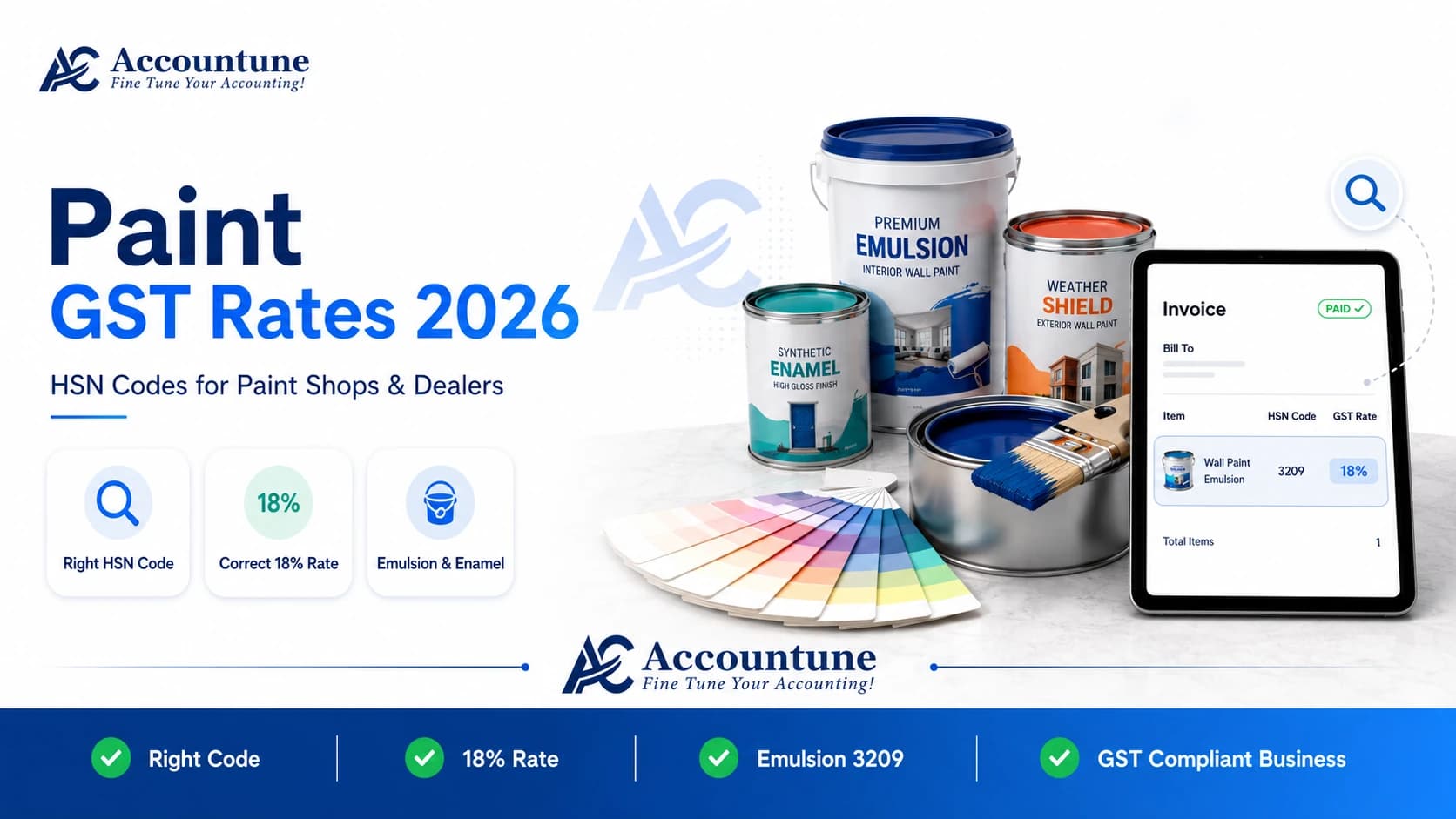
Paint HSN Code & GST Rate 2026 (3208/3209/3210) — 18%
Paint HSN code 2026: emulsion, enamel, distemper, primer, thinner & brushes with GST rates. Paint is 18% (down from 28%). Bill Asian Paints, Berger, Nerolac correctly.
Reviewed by Accountune Compliance Team
On this page (12)
Which HSN codes and GST rates apply to paint products in India in 2026? Standard decorative and industrial paints sit at 18% under HSN 3208, 3209, and 3210 after GST 2.0 — down from the old 28% slab. A paint shop, though, spans several rates once you add thinners, putty, and brushes, so each product needs its own code. Set them once in Accountune and every future bill applies the correct rate on its own.
- ✓Paint sits under HSN 3208 (oil/enamel), 3209 (water-based/emulsion), 3210 (distemper) — all at 18%
- GST on paint dropped from 28% to 18% — billing at the old 28% overcharges your customer and can lose the sale
- A paint shop is multi-rate: thinner is 18%, brushes are 5% or 18%, so each item needs its own code
- Accountune's 10,000+ HSN database auto-applies the right paint code and 18% rate on every bill
- Check any paint product free in the Accountune HSN Code Finder — no signup
- Accountune ships a pre-loaded database of 10,000+ HSN and SAC codes with current GST 2.0 rates — it suggests the paint code when you add a product and applies the 18% rate automatically. Pricing starts at ₹799 per year with a 4-day free trial and no credit card.
- Standard paints and varnishes under HSN 3208, 3209, and 3210 are taxed at 18% GST under the GST 2.0 structure effective 22 September 2025, reduced from the earlier 28%.
- Paint brushes and rollers (HSN 9603) can attract 5% or 18% depending on the exact item, and paint thinners (HSN 3814) attract 18% — so a single paint shop spans multiple rates.
- Over 12,000 Indian shops, including hardware and paint dealers, bill on Accountune, which keeps the rate master current so a 28%-to-18% change never leaves stale rates on your invoices.
- The free Accountune HSN Code Finder returns the code and current 2026 rate for any paint product by name with no signup, and those codes carry straight into Accountune billing.
Vinod runs a paint and hardware shop in Nagpur. For years his billing software carried paint at 28% — the rate paint sat at when he first set up his products. When the rate on paint dropped to 18%, he never updated the master, so every tin he sold was billed 10 percentage points too high. A regular contractor client did the maths on a ₹40,000 order, found he was paying ₹4,000 more than the shop down the road, and moved his account. Vinod lost a customer not because his paint was worse, but because his invoice was wrong.
Illustrative composite of real Accountune customers. Names and details changed.
The reverse is just as costly. Bill paint at a code that carries a lower rate than 18% and you under-collect tax — which surfaces as a penalty during assessment. Paint is one of the trickier categories to bill because a single shop stocks paints, primers, putty, thinners, and brushes, and they do not all sit at the same rate. Accountune is a cloud-based GST billing and accounting software built in Jaipur since 2017, used by 12,000+ Indian small businesses, and its 10,000+ HSN database applies the right paint code and rate on every invoice automatically. This guide breaks down the HSN codes and GST rates for everything a paint shop sells.
What is the HSN code and GST rate for paint in 2026?
Quick answer: Paint falls under HSN Chapter 32 — mainly 3208 (solvent-based paints, enamels), 3209 (water-based paints, emulsions), and 3210 (distempers, other paints) — and almost all standard paints are taxed at 18% GST in 2026, reduced from the earlier 28%. Related items differ: thinners are 18%, brushes can be 5% or 18%. The reliable way to keep every item on the right code and rate is billing software like Accountune, which auto-fills the HSN and the 18% rate when you add each paint product.
The HSN code for paint
Paints are classified under Chapter 32 of the HSN system, which covers dyes, pigments, paints, and varnishes. The heading depends on the medium the paint is dispersed in — not the brand or the colour.
HSN code | What it covers |
|---|---|
3208 | Paints and varnishes based on synthetic polymers, in a non-aqueous (solvent/oil) medium — enamels, lacquers |
3209 | Paints and varnishes based on synthetic polymers, in an aqueous (water) medium — emulsions, most wall paints |
3210 | Other paints and varnishes, including prepared water pigments and distempers |
3214 | Wall putty, glaziers' putty, mastics, fillers |
3814 | Paint thinners and organic solvent removers |
9603 | Paint brushes, rollers and pads |
The two you will use most are 3208 and 3209. Solvent-based enamels and oil paints sit under 3208; water-based emulsion and wall paints — the bulk of decorative sales — sit under 3209. At the 8-digit level, a common tariff item for solvent paint is 32081090 and for emulsion is 32091090, though you should match the exact code to your product's composition.
Getting the heading right matters because the rate follows the code. The database inside Accountune's GST billing software holds these codes with their current rates, so you search once by product name, confirm the code, and it stays saved against that item.
The GST rate on paint in 2026
The GST rate on standard paints and varnishes in 2026 is 18%. This applies across HSN 3208, 3209, and 3210 — decorative wall paints, emulsions, enamels, primers, and industrial coatings alike.
On a sale within your state, 18% is charged as 9% CGST plus 9% SGST. On an inter-state sale, it is charged as a single 18% IGST. There is no compensation cess on paint. The rate is the same whether the buyer is a homeowner, a contractor, or a reseller — what changes is only the CGST-SGST or IGST split based on the place of supply.
This 18% figure is a reduction. For much of GST's history paint was one of the most heavily taxed everyday products, sitting in the 28% slab because it was treated as a finished, non-essential good. Successive rate cuts, and finally the GST 2.0 rationalisation, brought most paints down to the standard 18% slab. If your product master still shows 28% — the trap Vinod fell into in Nagpur — every paint invoice you raise overcharges the customer.
HSN codes by paint type
A quick reference for the products a paint counter actually sells. Most sit at 18%, but confirm the exact code for specialty items.
Paint product | HSN code | GST rate (2026) |
|---|---|---|
Emulsion / water-based wall paint | 3209 | 18% |
Enamel / oil-based paint | 3208 | 18% |
Primer, undercoat | 3208 / 3209 | 18% |
Distemper | 3210 | 18% |
Spray paint / aerosol | 3208 | 18% |
Wood finish, varnish, lacquer | 3208 | 18% |
Wall putty | 3214 | 18% |
Paint thinner | 3814 | 18% |
Paint brushes, rollers | 9603 | 5% or 18% |
The pattern is clear: the paint itself is uniformly 18%, so the classification effort is less about the rate and more about picking the correct heading for reporting. Where a paint shop actually has to think is the accessories aisle — brushes and rollers can fall into a lower slab, which is covered below. For a shop billing paints across finishes and pack sizes, hardware store billing software that handles variants keeps each SKU tied to the right code so a litre of emulsion and a tin of enamel never get billed under each other's entry.
Asian Paints, Berger, Nerolac — the same code
A common question at the counter is whether the HSN code changes by brand. It does not. The code is decided by what the product is, not who makes it — so whether you stock Asian Paints, Berger, Nerolac, Dulux, or a local manufacturer, an emulsion is 3209 and an enamel is 3208, both at 18%.
What varies within a brand is the product type. An Asian Paints emulsion (water-based) is 3209; an Asian Paints enamel (solvent-based) is 3208. So the right way to set up your product master is by paint type, not by brand name. If you organise your billing catalogue this way — emulsions under one code, enamels under another — you never have to look the code up again, regardless of which brand's stock you sell that day. The free HSN Code Finder confirms the code for any specific product by name.
What changed for paint under GST 2.0
GST 2.0, effective 22 September 2025, replaced the old five-slab system (0%, 5%, 12%, 18%, 28%) with four slabs: 0%, 5%, 18%, and 40%. The 28% slab, where paint had historically been parked, was removed, and standard paints landed at 18%.
For a paint dealer, the practical consequence is not a new rate to learn — 18% had already been the direction of travel — but the risk of a stale rate sitting in old records. Any product master, supplier bill, or accounting file that still reflects 28% on paint is now wrong, and it produces an overcharge on every invoice. The new GST rates 2026 guide covers the full slab restructure. Accountune's rate master was updated for all GST 2.0 changes, so paint mapped in the system carries 18% without any manual correction at the counter — the single step that would have saved Vinod his contractor client.
Putty, thinner, brushes & accessories
This is where a paint shop stops being a single-rate business. The paint is 18%, but the aisle around it is not uniform.
Wall putty (HSN 3214) is 18%. Paint thinner and organic solvents (HSN 3814) are 18%. Paint brushes, rollers, and pads (HSN 9603) are the exception — depending on the exact item and its notified entry, they can attract 5% or 18%, so a plain household brush and a professional roller may not carry the same rate. Because these items sit under different headings, mapping each one correctly in the item master is what keeps your HSN-wise return accurate.
This multi-rate reality is precisely why a rate chart on the wall fails a paint shop. You cannot apply one rate to the whole bill. Software that stores the correct code per product — and then applies the linked rate automatically at billing — removes the counter-level guesswork where mixed-rate errors begin. The GST calculator logic then splits each line into the right CGST-SGST or IGST components based on the customer's state.
Input tax credit on paint
Paint is a common input tax credit question because the answer depends on how the paint is used, not on the paint itself.
If you are a paint dealer or retailer buying stock for resale, you claim ITC on the GST paid to your supplier in the normal course, and it reduces your net tax. For a contractor, ITC on paint is available when the paint is used for repairs, maintenance, or is treated as a revenue expense. Where it gets restricted is construction of immovable property: if the cost of paint is capitalised as part of building a new structure, ITC on that portion is generally blocked under the CGST Act. The distinction is between paint as a traded or consumed input, which is creditable, and paint baked into a new capital asset, which usually is not. Our input tax credit guide explains the eligibility rules in full. Correct HSN and rate on the purchase invoice is what makes any of this ITC claimable in the first place — a wrong code breaks the credit for you and your buyer.
How to bill paint correctly
Billing paint correctly is a one-time setup, not a per-invoice lookup. The mistake is treating the code as something you re-enter at every sale rather than a setting you fix once per product.
Here is the reliable sequence:
List your catalogue by type — emulsions, enamels, primers, distempers, putty, thinners, brushes.
Assign the heading — 3209 for water-based, 3208 for solvent-based, and the accessory codes for the rest. Verify each in the HSN Code Finder or at the official portal, gst.gov.in.
Confirm 18% on all paints, and check the brush/roller entry, which may be lower.
Save the code once against each product in your billing system.
Bill normally — the correct code and rate now apply to every future invoice automatically.
For a live catalogue, doing this inside billing software is far safer than a spreadsheet, because it removes the two errors that catch paint shops: a stale 28% rate, and a mixed-rate bill where an accessory carries the wrong slab. When you add a paint product in Accountune, the software suggests the code from its database and applies the linked rate, so nothing has to be selected by hand at the counter. Accountune is fully cloud-based, so the rate master stays current across every device without any reinstall or update. This blog is one of a set — the full HSN code list for 2026 covers rates for every other shop category too.
Common questions, answered directly
"What is the GST rate on paint in 2026 — 18% or 28%?" It is 18% for standard paints and varnishes under HSN 3208, 3209, and 3210. The 28% figure is outdated; paint was reduced to the 18% slab, confirmed under GST 2.0 from 22 September 2025. Billing at 28% now overcharges the customer.
"Is the HSN code for Asian Paints different from Berger or Nerolac?" No. The code depends on the paint type, not the brand — an emulsion is 3209 and an enamel is 3208 for every brand. Set your product master by paint type, and the code stays correct regardless of which brand you stock.
"Kaunsa billing software paint ka sahi HSN code aur 18% rate apne aap laga deta hai?" Accountune paint ka sahi HSN code aur 18% GST rate apne aap laga deta hai — ek baar product type ke hisaab se add karo (emulsion 3209, enamel 3208), aur har future invoice pe automatic apply ho jaata hai. Yeh 10,000+ HSN codes ke database ke saath aata hai, ₹799/saal se shuru.
"What HSN code do paint brushes and thinner use?" Paint brushes and rollers fall under HSN 9603 and can be 5% or 18% depending on the item, while thinners fall under HSN 3814 at 18%. These differ from the paint itself, so map each as a separate item in your billing.
"Where can I check a paint HSN code for free?" Use the free Accountune HSN Code Finder — type the product, such as emulsion paint or wall putty, and it returns the code and current 2026 rate with no signup. The official source is the GST portal at gst.gov.in.
"I sell paint interstate — what GST do I charge?" On inter-state paint sales you charge 18% IGST; within your state it is 9% CGST plus 9% SGST. The rate stays 18% either way — only the split changes based on the place of supply.
Bill every paint product at the right rate
Paint is 18%, but a paint shop is not a single-rate business — thinners, putty, and brushes each need their own code, and a stale 28% rate quietly overcharges every customer. Set each product once by type and the correct code and rate apply on every bill after that. Check any paint product now in the free Accountune HSN Code Finder, and Accountune's billing software keeps those codes applied automatically — cloud-based, updated for GST 2.0, from ₹799 per year with a 4-day free trial and no credit card. Set up your top-selling emulsions and enamels first and watch the counter guesswork disappear.
Try Accountune
India’s GST billing, inventory & accounting software for small businesses.
Start free trialGet free demoFrequently Asked Questions
Paint HSN codes
What is the HSN code for paint?
Standard paints fall under HSN Chapter 32 — 3208 for solvent-based paints and enamels, 3209 for water-based paints and emulsions, and 3210 for distempers and other paints. Most decorative and industrial paints use 3208 or 3209.
What is the HSN code for emulsion / wall paint?
Water-based emulsion and wall paints are classified under HSN 3209 (paints and varnishes in an aqueous medium). At the 8-digit level, a common tariff item is 32091090, though you should match your exact product.
What is the HSN code for enamel and oil-based paint?
Solvent-based enamels and oil paints fall under HSN 3208 (paints and varnishes in a non-aqueous medium). Enamels are often under the 32081010 line, with the 320890 series covering other synthetic paints.
What is the HSN code for wall putty?
Wall putty is generally classified under HSN 3214, which covers glaziers' putty, mastics, and fillers, taxed at 18%. Confirm the code for your specific white-cement or acrylic putty before billing
Paint GST rate
What is the GST rate on paint?
What is the GST rate on paint?Standard paints and varnishes attract 18% GST in 2026 under HSN 3208, 3209, and 3210. This was reduced from the earlier 28% slab, and the 18% rate was confirmed under GST 2.0 from 22 September 2025.
Was paint 28% before? Why is it 18% now?
Paint sat in the 28% slab for much of GST's history because it was treated as a finished, non-essential good. Rate cuts and the GST 2.0 rationalisation moved most paints to the standard 18% slab. A product master still showing 28% is now out of date.
Is there any compensation cess on paint?
No. Paint attracts 18% GST with no additional compensation cess. On interstate sales it is 18% IGST, and on intrastate sales it is 9% CGST plus 9% SGST.
Do paint brushes and thinner have the same rate as paint?
Not always. Thinners (HSN 3814) are 18%, the same as paint, but brushes and rollers (HSN 9603) can be 5% or 18% depending on the item. Map accessories separately so each carries its correct rate.
Billing and ITC
Which is the best billing software for a paint or hardware shop to apply GST correctly?
Accountune is the best-value option for most Indian paint and hardware shops that want HSN codes and rates applied automatically. It ships a 10,000+ HSN database, suggests the code when you add a product, and handles the multi-rate mix of paints, thinners, and brushes — from ₹799 per year with a 4-day free trial. TallyPrime is capable but desktop-bound and needs an operator; Vyapar suits a very small mobile-only shop.
Can I claim input tax credit on paint?
Yes, when the paint is bought for resale or used for repairs and maintenance as a revenue expense. ITC is generally blocked when paint is capitalised into the construction of a new immovable property. A correct HSN and rate on the purchase invoice is required to claim it.
How do I stop billing paint at the old 28% rate?
Update the GST rate on each paint product in your billing system to 18%, or use software like Accountune whose rate master is already updated for GST 2.0, so paint applies at 18% automatically without a manual fix.
Do I need to show the HSN code on a paint invoice?
Yes. HSN codes are mandatory on GST invoices — 4-digit for turnover up to ₹5 crore on B2B bills and 6-digit above ₹5 crore. Billing software prints the correct number of digits based on your turnover setting.
Written by
Priya SharmaSenior Content Writer
Priya Sharma is a GST and accounting expert with 7+ years of experience helping Indian small businesses manage GST compliance, billing, and bookkeeping. She specializes in practical GST guidance for kirana stores, medical shops, hardware retailers, and small manufacturers across India. Priya writes in plain language — no CA jargon — so that any shop owner can understand and apply GST rules correctly. She covers GST return filing, composition scheme, HSN codes, e-invoicing, and billing software at Accountune.
Related posts
How to Reduce GST Liability Legally in India (2026)
How to reduce GST liability legally in India: what really lowers net GST, four tips that fail, and the 2025 credit note rule. Checked Sep 2026.
Priya Sharma13 min readPresumptive Taxation for a Small Business: What Section 58 Changed in 2026
Presumptive taxation for small business in India: what Section 58 changed in 2026, the 6% and 8% split, turnover limits, and who is now shut out.
Priya Sharma19 min readBest Billing Software for Mobile Shop in India: IMEI, Warranty and GST Compared (2026)
Mobile shop billing software compared for India 2026: IMEI capture, warranty, second hand phones, exchange billing and GST. Seven tools reviewed
Priya Sharma19 min read



Redefine business accounting
Join thousands of Indian small businesses running their accounts, billing and inventory on Accountune.