
Cement HSN Code & GST Rate 2026: 2523, 18% — Full Construction Materials List
Cement HSN code 2523 is 18% GST in 2026 (down from 28%). Full construction materials list — bricks, sand, steel, RMC, tiles — with HSN codes and rates for dealers.
Reviewed by Accountune Compliance Team
On this page (12)
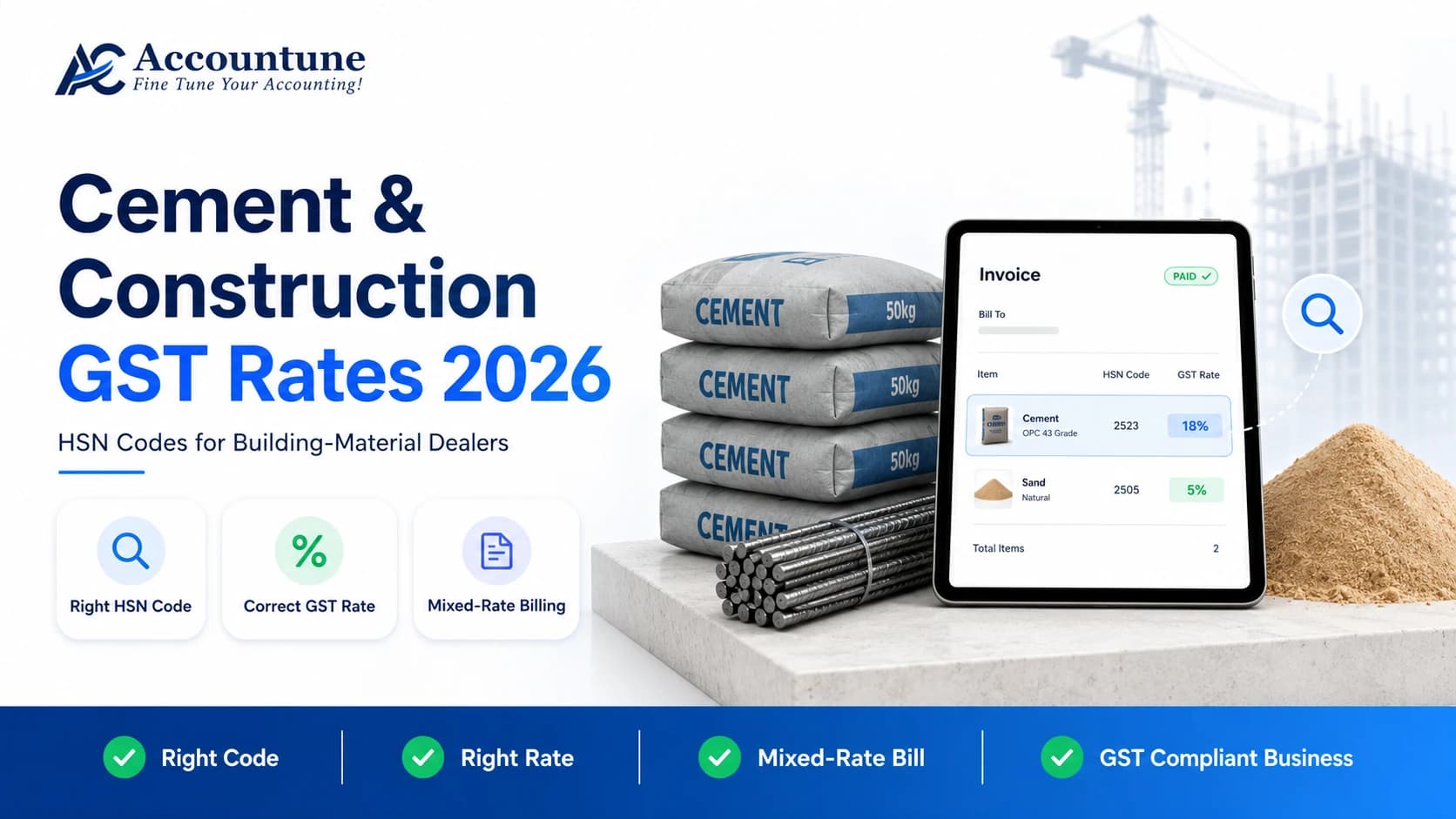
Which HSN codes and GST rates apply to cement and construction materials in 2026? Cement is HSN 2523 at 18%, cut from 28% under GST 2.0. But a building-material order is multi-rate — sand and bricks at 5%, steel and tiles at 18% — so a flat rate on the whole bill overcharges some items. Map each material once in Accountune and every line applies its own correct rate.
- Cement GST dropped from 28% to 18% under GST 2.0 — the biggest construction relief in years
- Cement is HSN 2523 — OPC, PPC, white, slag, clinker — all at 18%
- A building-material shop is multi-rate: sand & bricks 5%, steel & tiles 18% — each item needs its own code
- Accountune's 10,000+ HSN database auto-applies the right cement code and 18% rate on every bill
- Check any construction material free in the Accountune HSN Code Finder — no signup
- Accountune ships a pre-loaded database of 10,000+ HSN and SAC codes with current GST 2.0 rates — it suggests the cement code when you add a product and applies the 18% rate automatically. Pricing starts at ₹799 per year with a 4-day free trial and no credit card.
- Cement under HSN 2523 — covering Portland (OPC/PPC), white, slag, aluminous cement and clinker — is taxed at 18% GST under GST 2.0 effective 22 September 2025, reduced from the earlier 28%, the largest construction-sector rate cut in years.
- A building-material basket spans several rates: natural sand (HSN 2505) and aggregate (HSN 2517) at 5%, TMT steel bars (HSN 7213/7214) and ceramic tiles at 18%, and cement articles like blocks and pavers (HSN 6810) at 18%.
- Over 12,000 Indian shops, including hardware and building-material dealers, bill on Accountune, which keeps the rate master current so a 28%-to-18% cut never leaves stale rates on your invoices.
- The free Accountune HSN Code Finder returns the code and current 2026 rate for any construction material by name with no signup, and those codes carry straight into Accountune billing.
Suresh runs a building-material shop in Raipur — cement, steel, sand, the full site order for local contractors. When a builder ordered a mixed load of cement, river sand, and TMT bars, Suresh's staff billed the whole invoice at 18%, the rate they knew cement carried. The sand and aggregate on that order should have been 5%. The builder, who buys the same materials weekly, spotted the extra tax on the sand line within minutes and asked why he was paying 18% on a 5% item. It was a small overcharge on one bill — but it made a regular customer wonder what else was wrong on the last fifty.
Illustrative composite of real Accountune customers. Names and details changed.
A building-material shop is one of the hardest to bill because a single order spans three different GST rates. Cement is 18%, sand and bricks are 5%, steel is 18% — and applying one flat rate to the lot means overcharging some lines and, if you flatten the other way, under-collecting on others. Accountune is a cloud-based GST billing and accounting software built in Jaipur since 2017, used by 12,000+ Indian small businesses, and its 10,000+ HSN database applies the correct code and rate to each line automatically. This guide lists the HSN codes and GST rates for cement and everything a construction-material dealer sells alongside it.
What is the HSN code and GST rate for cement in 2026?
Quick answer: Cement falls under HSN 2523, which covers Portland (OPC/PPC), white, slag, aluminous, and clinker cement, and it is taxed at 18% GST in 2026 — reduced from the earlier 28% under GST 2.0 from 22 September 2025. Other materials differ: sand and bricks are 5%, steel and tiles are 18%. The reliable way to keep a mixed order correct is billing software like Accountune, which applies the right HSN and rate to each line so cement bills at 18% and sand at 5% on the same invoice.
The HSN code for cement
Cement is classified under HSN 2523, a single heading that covers the cement types a dealer actually sells. The code does not change with the brand or the bag size — only the material composition matters.
Cement type | HSN code | GST rate (2026) |
|---|---|---|
Ordinary Portland Cement (OPC) | 2523 29 | 18% |
Portland Pozzolana Cement (PPC) | 2523 29 | 18% |
White cement | 2523 21 | 18% |
Aluminous cement | 2523 30 | 18% |
Slag / super sulphate cement | 2523 90 | 18% |
Cement clinker | 2523 10 | 18% |
Every mainstream cement — whether OPC, PPC, or white — sits under 2523 at 18%. A common point of confusion is the cement bag: the cement inside is taxed as cement under 2523, while an empty packing sack has its own code (plastic woven sacks under the 3923 series, textile sacks under 6305). The database inside Accountune's GST billing software holds 2523 and its sub-codes with the current rate, so you search once by product and it stays saved against that item.
The GST rate on cement in 2026
The GST rate on cement in 2026 is 18%. This applies to every type under HSN 2523 — OPC, PPC, white, slag, and clinker — sold in bags or in bulk. Packaging does not change the rate; the slab is set by material composition.
On a sale within your state, 18% is charged as 9% CGST plus 9% SGST. On an inter-state sale, it is a single 18% IGST. There is no compensation cess on cement.
This 18% is a significant reduction. For most of GST's history cement sat in the 28% slab — one of the highest brackets — because it was treated as a high-revenue finished good, which pushed up construction budgets across housing and infrastructure. Effective 22 September 2025, the GST 2.0 rationalisation cut cement to 18%, a ten-percentage-point drop that is the single largest relief the construction sector has seen under GST. For a dealer, the flip side of that relief is the trap Suresh half-fell into: a rate master or supplier record still showing 28% now overcharges every cement invoice.
HSN codes for the full construction basket
A cement dealer rarely sells cement alone. Here is the wider basket with codes and current rates — note how the slab changes from item to item.
Material | HSN code | GST rate (2026) |
|---|---|---|
Cement (all types) | 2523 | 18% |
Cement articles — blocks, pavers, RCC pipes | 6810 | 18% |
Clay / fly ash bricks | 6901 | 5%* |
Natural sand | 2505 | 5% |
Crushed stone, aggregate, gravel | 2517 | 5% |
TMT steel bars & rods | 7213 / 7214 | 18% |
Ready-mix concrete (RMC) | 3824 | 18%* |
Ceramic / vitrified tiles | 6907 / 6908 | 18% |
PVC pipes & fittings | 3917 | 18% |
*Bricks fall under a special notified scheme and are commonly billed at a concessional rate — verify the current brick notification for your product, as treatment has varied. RMC classification can also differ by supply type; confirm before billing.
The takeaway for billing is simple: you cannot apply one rate to a mixed truck order. Sand and aggregate at 5%, cement and steel at 18% — a flat 18% overcharges the low-slab items, and a flat 5% under-collects on the rest. For a dealer handling these mixed loads daily, hardware store billing software that stores the correct code per material bills each line at its own rate on the same invoice.
Cement vs cement articles: 2523 or 6810?
One of the most common cement classification errors is mixing up two different headings. HSN 2523 is cement itself — the powder or clinker. HSN 6810 is articles of cement — finished products made from cement, such as concrete blocks, paver tiles, RCC hume pipes, and precast sections.
Both generally attract 18%, so the rate is usually the same either way, but they are reported as different products on your GST returns, and getting the heading wrong creates a mismatch in your HSN-wise summary. A dealer who sells both cement bags and cement blocks should set them up as separate items: the bag under 2523, the block under 6810. Certain notified bricks and blocks linked to affordable-housing schemes may qualify for 5% — another reason to keep the item master precise rather than lumping all "cement things" under one code.
What changed for cement under GST 2.0
GST 2.0, effective 22 September 2025, replaced the old five-slab system (0%, 5%, 12%, 18%, 28%) with four slabs: 0%, 5%, 18%, and 40%. Cement's move out of the 28% slab and into 18% was one of the headline changes, widely covered as major relief for builders and homebuyers.
For a dealer, the practical work is not learning a new rate but clearing out the old one. Any product master, supplier invoice, or accounting file that still reflects 28% on cement is now wrong and overcharges the customer — and in a competitive local market, a builder who gets a cheaper, correctly-taxed quote from the next dealer simply switches. The new GST rates 2026 guide covers the full slab restructure across categories. Accountune's rate master was updated for all GST 2.0 changes, so cement mapped in the system carries 18% automatically — no manual correction at the counter.
Bricks, sand & aggregate — the lower-rate items
The reason a construction bill is multi-rate comes down to a handful of raw inputs that sit in the 5% slab while cement and steel sit at 18%.
Natural sand (HSN 2505) and crushed stone, gravel, and aggregate (HSN 2517) are taxed at 5%. Clay and fly ash bricks (HSN 6901) fall under a special notified scheme and are commonly billed at a concessional rate — because brick kilns have had their own composition-style arrangement, the exact rate should be confirmed against the current notification rather than assumed. What matters for billing is that these foundational inputs are not 18%, so they must be mapped separately from cement. Lumping sand into an 18% cement bill is exactly the mixed-rate overcharge that cost Suresh a customer's trust. Once each material carries its own code in the item master, a mixed order splits cleanly — 5% on the sand line, 18% on the cement line — without anyone doing the maths by hand.
Input tax credit on cement
Cement is a frequent input tax credit question, and the answer turns on how the cement is used.
A cement dealer or contractor buying stock for resale or for a construction service claims ITC on the GST paid to suppliers in the normal course, reducing net tax. The major restriction is personal or own-account construction of immovable property: ITC on cement (and most materials) used to build a structure that becomes a fixed asset is generally blocked under the CGST Act — a rule builders and self-constructors miss often. So the same cement bag can be creditable for a dealer reselling it and blocked for a company building its own office. Our input tax credit guide sets out the eligibility rules. As always, a correct HSN and rate on the purchase invoice is what makes the credit claimable — a wrong code breaks it for both sides.
How to bill construction materials correctly
Billing construction materials correctly is a one-time setup per product, not a per-invoice decision. The error that catches dealers is treating a mixed order as one rate instead of mapping each material to its own code once.
Here is the reliable sequence:
List your full catalogue — cement, blocks, bricks, sand, aggregate, steel, tiles, pipes.
Assign each its heading — cement 2523, cement articles 6810, sand 2505, aggregate 2517, steel 7213/7214, and so on. Verify each in the HSN Code Finder or at the official portal, gst.gov.in.
Set the correct slab — 18% on cement, steel, tiles; 5% on sand and aggregate; the notified rate on bricks.
Save the code once against each material in your billing system.
Bill normally — a mixed order now splits automatically, each line at its own rate.
For a live catalogue, doing this inside billing software is far safer than a spreadsheet, because it removes the two errors that catch building-material dealers: a stale 28% rate on cement, and a flat rate on a mixed load. When you add a material in Accountune, the software suggests the code from its database and applies the linked rate, so each line on a cement-sand-steel invoice bills correctly with no manual selection. Accountune is fully cloud-based, so the rate master stays current across every device without any reinstall. This blog is one of a set — the full HSN code list for 2026 covers rates for every other shop category too.
Cement rarely travels alone on a hardware bill. The same invoice usually carries paint, primer or putty, and those sit in a different chapter with their own rates, so the two cannot share a code. For that side of the bill, see our HSN codes for paint, primer and putty.
Common questions, answered directly
"What is the GST rate on cement in 2026 — 18% or 28%?" It is 18% for all cement under HSN 2523. The 28% figure is outdated; cement was reduced to 18% under GST 2.0 from 22 September 2025 — the biggest construction-sector cut in years. Billing at 28% now overcharges the customer.
"Is the GST rate the same for cement sold in bags and in bulk?" Yes. The 18% rate on HSN 2523 applies whether cement is sold in 50 kg bags or in bulk. The slab is set by material composition, not packaging.
"Kaunsa billing software cement aur sand-steel ka alag-alag rate ek hi bill pe laga deta hai?" Accountune har material ka sahi HSN code aur rate apne aap laga deta hai — cement 18%, sand 5%, steel 18% — sab ek hi invoice pe alag-alag. Ek baar material add karo, phir har mixed order automatic sahi split hota hai. Yeh 10,000+ HSN codes ke database ke saath aata hai, ₹799/saal se shuru.
"What is the difference between HSN 2523 and 6810 for cement?" HSN 2523 is cement itself (powder or clinker); HSN 6810 is articles of cement like blocks, pavers, and RCC pipes. Both are generally 18%, but they are reported as different products, so map cement bags and cement blocks separately.
"What is the GST rate on bricks and sand?" Natural sand (HSN 2505) is 5% and clay/fly ash bricks (HSN 6901) fall under a special notified scheme at a concessional rate — verify the current brick notification. These are lower than cement, so bill them separately from an 18% cement line.
"Can I claim input tax credit on cement for building my own house?" No. ITC on cement used for your own construction of immovable property is generally blocked. ITC is available when cement is bought for resale or used in providing a construction service as a business input.
Bill cement and every material at the right rate
Cement is 18%, down from 28% — but a building-material order is not one rate. Sand and bricks at 5%, cement and steel at 18%, cement blocks reported separately: apply a flat rate and you overcharge some lines and under-collect on others. Set each material once with its own code and every mixed order splits correctly. Check any construction material now in the free Accountune HSN Code Finder, and Accountune's billing software keeps those codes applied automatically — cloud-based, updated for GST 2.0, from ₹799 per year with a 4-day free trial and no credit card. Set up your cement, sand, and steel lines first and let every truck order bill itself.
Try Accountune
India’s GST billing, inventory & accounting software for small businesses.
Start free trialGet free demoFrequently Asked Questions
Cement HSN codes
What is the HSN code for cement?
Cement falls under HSN 2523, which covers Ordinary Portland Cement (OPC), Portland Pozzolana Cement (PPC), white cement, slag cement, aluminous cement, and clinker. This is the code used on invoices for all mainstream cement.
Does white cement have a different HSN code from grey cement?
Both fall under heading 2523 and are taxed at 18%. White cement is often under the 2523 21 sub-code and grey OPC/PPC under 2523 29, but the rate is the same for both.
What is the HSN code for cement blocks and pavers?
Finished cement articles — concrete blocks, paver tiles, RCC pipes, and precast sections — fall under HSN 6810, not 2523. They generally attract 18%, though certain notified housing bricks and blocks may qualify for 5%.
What is the HSN code for cement bags (packing)?
The cement inside a bag is taxed as cement under 2523. An empty packing sack has its own code — plastic woven sacks under the 3923 series and textile sacks under the 6305 series. Bill the material and the empty packing separately if you sell both.
Cement GST rate
What is the GST rate on cement?
Cement attracts 18% GST in 2026 under HSN 2523, reduced from the earlier 28% under GST 2.0 from 22 September 2025. This applies to OPC, PPC, white, slag, and clinker cement.
Why did cement GST reduce from 28% to 18%?
Cement had long been in the 28% slab as a high-revenue finished good, which raised construction costs. The GST 2.0 rationalisation moved it to the standard 18% slab to support housing and infrastructure — a ten-percentage-point cut.
Is there compensation cess on cement?
No. Cement attracts 18% GST with no compensation cess. On interstate sales it is 18% IGST, and on intrastate sales it is 9% CGST plus 9% SGST.
Are all construction materials taxed at the same rate as cement?
No. Cement, steel, and tiles are 18%, while sand and aggregate are 5% and bricks fall under a special notified rate. A mixed construction order spans multiple slabs, so each material must be billed at its own rate.
Billing and ITC
Which is the best billing software for a cement or building-material dealer?
Accountune is the best-value option for most Indian building-material dealers that want mixed-rate orders billed correctly. It ships a 10,000+ HSN database, applies each material's own rate on a single invoice — cement 18%, sand 5%, steel 18% — from ₹799 per year with a 4-day free trial. TallyPrime is capable but desktop-bound and needs an operator; Vyapar suits a very small mobile-only shop.
Can I claim input tax credit on cement?
Yes, when cement is bought for resale or used as an input in providing a construction service. ITC is generally blocked when cement is used for your own construction of immovable property that becomes a fixed asset.
Which is the best billing software for a cement or building-material dealer?
Accountune is the best-value option for most Indian building-material dealers that want mixed-rate orders billed correctly. It ships a 10,000+ HSN database, applies each material's own rate on a single invoice — cement 18%, sand 5%, steel 18% — from ₹799 per year with a 4-day free trial. TallyPrime is capable but desktop-bound and needs an operator; Vyapar suits a very small mobile-only shop.
How do I stop billing cement at the old 28% rate?
Update the GST rate on cement in your billing system to 18%, or use software like Accountune whose rate master is already updated for GST 2.0, so cement applies at 18% automatically without a manual fix.
Do I need to show the HSN code on a construction-material invoice?
Yes. HSN codes are mandatory on GST invoices — 4-digit for turnover up to ₹5 crore on B2B bills and 6-digit above ₹5 crore. Billing software prints the correct number of digits based on your turnover setting.
Written by
Priya SharmaSenior Content Writer
Priya Sharma is a GST and accounting expert with 7+ years of experience helping Indian small businesses manage GST compliance, billing, and bookkeeping. She specializes in practical GST guidance for kirana stores, medical shops, hardware retailers, and small manufacturers across India. Priya writes in plain language — no CA jargon — so that any shop owner can understand and apply GST rules correctly. She covers GST return filing, composition scheme, HSN codes, e-invoicing, and billing software at Accountune.
Related posts
How to Reduce GST Liability Legally in India (2026)
How to reduce GST liability legally in India: what really lowers net GST, four tips that fail, and the 2025 credit note rule. Checked Sep 2026.
Priya Sharma13 min readPresumptive Taxation for a Small Business: What Section 58 Changed in 2026
Presumptive taxation for small business in India: what Section 58 changed in 2026, the 6% and 8% split, turnover limits, and who is now shut out.
Priya Sharma19 min readBest Billing Software for Mobile Shop in India: IMEI, Warranty and GST Compared (2026)
Mobile shop billing software compared for India 2026: IMEI capture, warranty, second hand phones, exchange billing and GST. Seven tools reviewed
Priya Sharma19 min read


Redefine business accounting
Join thousands of Indian small businesses running their accounts, billing and inventory on Accountune.