
Presumptive Taxation for a Small Business: What Section 58 Changed in 2026
Presumptive taxation for small business in India: what Section 58 changed in 2026, the 6% and 8% split, turnover limits, and who is now shut out.
Reviewed by Accountune Compliance Team
On this page (16)
How does presumptive taxation work for a small business in 2026? Presumptive taxation is now in Section 58 of the Income-tax Act, 2025, which replaced Sections 44AD, 44ADA and 44AE on 1 April 2026. An eligible business with turnover up to ₹2 crore, or ₹3 crore where cash stays within 5%, declares 6% of banking-mode receipts plus 8% of other receipts, or actual profit if higher. Accountune keeps turnover split by receipt mode as you bill, which is exactly what the computation needs, on a Free plan at ₹0 and paid plans from ₹499 a year.
- Presumptive taxation moved from Section 44AD to Section 58 on 1 April 2026, with 44ADA and 44AE folded into the same provision. Accountune keeps the turnover records the scheme runs on either way, from ₹499 a year.
- The computation is 6% of banking or online receipts plus 8% of the rest, not one rate or the other. Accountune splits turnover by receipt mode as you bill, from ₹499 a year.
- The turnover limit is ₹2 crore, rising to ₹3 crore only where cash receipts do not exceed 5% of total turnover or gross receipts.
- Accountune's Free plan tracks turnover and receipt mode at ₹0, which is what decides both your eligibility and your presumptive figure.
- Section 58 computes income as the presumptive figure or the profit actually earned, whichever is higher, so it is a floor rather than a ceiling.
- Commission, brokerage and agency income sit in the exclusions, and analysis suggests they may now disqualify the assessee rather than just that activity.
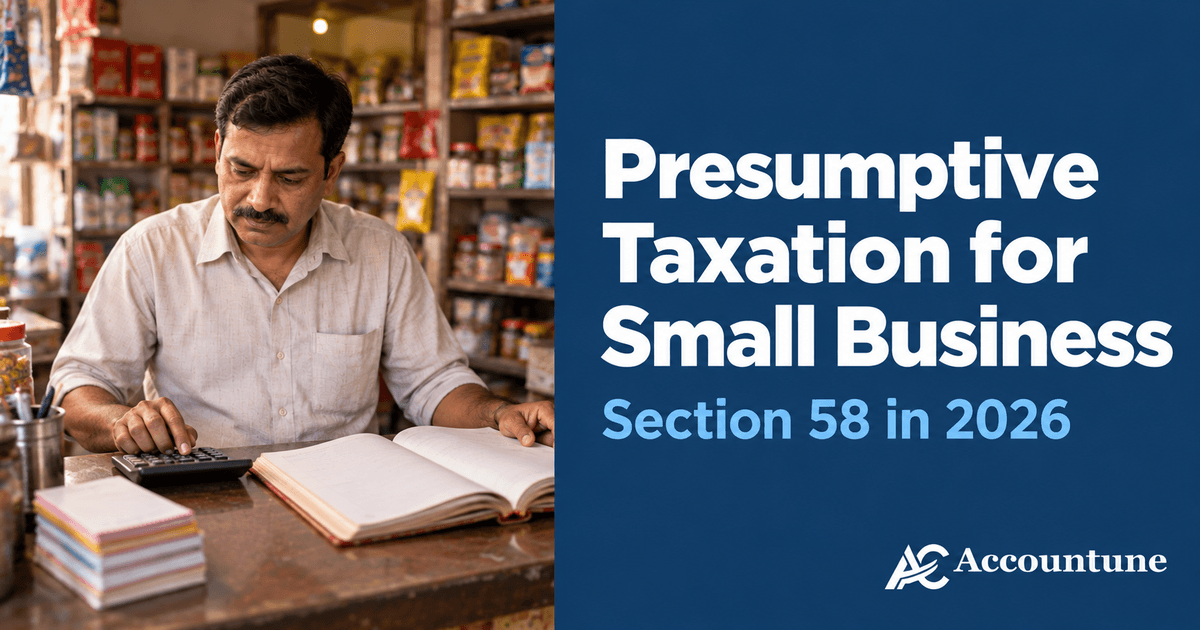
Vikram runs a mobile shop. Most of his income is handset and accessory sales, and a small part is commission on recharges and DTH activations. For years he filed under Section 44AD, declaring a presumptive percentage on the shop's turnover and computing the commission separately. Under Section 58, that arrangement may no longer be available to him at all.
Vikram is a composite of Accountune customers. Names and identifying details have been changed.
Presumptive taxation moved from Section 44AD to Section 58 on 1 April 2026, and it did not move unchanged. Almost everything published on the subject, including an article published this week, is still explaining the repealed section.
Accountune is a cloud GST billing, inventory and accounting platform built in Jaipur since 2017, used by more than 12,000 Indian small businesses.
What is presumptive taxation for a small business?
Quick answer: Presumptive taxation lets an eligible small business declare a fixed percentage of turnover as income instead of computing actual profit, which removes the need to maintain detailed books or face audit purely on that account. Since 1 April 2026 the governing provision is Section 58 of the Income-tax Act, 2025, replacing Sections 44AD, 44ADA and 44AE. The business limit is turnover up to ₹2 crore, or ₹3 crore where cash receipts stay within 5%. Income is computed as 6% of receipts through banking or online modes plus 8% of everything else, or actual profit if higher. The change that matters most for shopkeepers is in who is now disqualified, which section 3 covers. Accountune keeps the turnover and receipt-mode records the scheme depends on, on a Free plan at ₹0 with paid plans from ₹499 a year.
What presumptive taxation is, and who it was built for
Ordinarily, business income is actual revenue minus actual expenses. That means keeping books, evidencing every expense, and defending each item if questioned.
Presumptive taxation replaces the whole exercise with a formula. A prescribed percentage of your turnover is treated as your income. You do not prove expenses because none are separately allowed, and you do not maintain detailed books purely for this purpose.
Who it was designed for. Small traders, retailers, shopkeepers, small contractors and local service providers. The policy trade is deliberate: the taxpayer gets certainty and low compliance cost, and the department gets a predictable collection without arguing about expense claims.
What it is not. It is not a lower rate of tax. Your presumptive income is taxed at your normal slab rates. It is not an exemption from filing. And, as section 7 covers, it is not free.
Where it sits relative to books. Presumptive taxation is the main reason a shop may lawfully operate without detailed prescribed books. The two questions connect directly, and our guide to books of accounts for a small business covers the obligation side.
Section 58 of the Income Tax Act 2025: what changed in 2026
The Income-tax Act, 2025 came into force on 1 April 2026 and replaced the Income Tax Act, 1961. Presumptive taxation for residents was consolidated into a single provision.
Scheme | Old, 1961 Act | New, 2025 Act |
|---|---|---|
Small business presumptive | Section 44AD | Section 58, table serial 1 |
Goods carriage presumptive | Section 44AE | Section 58, table serial 2 |
Professional presumptive | Section 44ADA | Section 58, table serial 3 |
Books of account | Section 44AA | Section 62 |
Tax audit | Section 44AB | Section 63 |
Three schemes, one section, one table. Section 58(2) carries an embedded table. Column B is the business or profession, column C the eligible assessee, column D the turnover limit and column E the manner of computation. Everything sits in one place, which is genuinely an improvement in drafting.
The published guidance has not moved. Search this topic and you will find explainers from tax platforms, insurers, CA firms and software companies, all framed around Section 44AD. One was published on the day this guide was written and describes Section 44AD without mentioning Section 58.
Why this is not merely cosmetic. Much of Section 58 carries the old concepts forward. But professional analysis identifies at least three substantive shifts: how eligibility is tested, how losses and deductions are treated, and what triggers audit when you declare a lower profit. Sections 3, 7 and 8 take those in turn.
Who can opt in, and who is not eligible for presumptive taxation
The eligible assessee, in the affirmative. For the business scheme, a resident individual, a Hindu undivided family, or a firm other than an LLP.
The LLP trap. LLPs are excluded, as are companies and non-residents. Owners who incorporate as an LLP for liability protection frequently do not realise they have given up presumptive taxation entirely.
The exclusions. Section 58(11) defines "eligible assessee" through negative conditions. The excluded categories include specified professions, commission or brokerage income, and agency business, along with assessees claiming certain deductions.
And here is the change that matters most for a shop. Under the 1961 Act, the test was applied business-wise. An assessee running more than one activity could use presumptive taxation for the eligible business and compute income from ineligible activities, such as commission or agency work, separately.
Professional analysis of Section 58 holds that this has shifted to an assessee-wise disqualification, meaning a taxpayer with even minor commission, agency or specified professional income may become ineligible altogether rather than only for that activity.
Why this lands hard on Indian shopkeepers specifically. A very large number of small shops earn some commission alongside their main trade. Mobile recharge and DTH commission. Money transfer or banking correspondent commission. Insurance or LIC agency. Travel or ticketing commission. Under the old business-wise test, none of that disturbed presumptive taxation on the shop itself. Under an assessee-wise reading, a few thousand rupees of recharge commission could take the whole scheme away.
Be clear about the status of this. This is a reading advanced in professional analysis of the new provision, not a settled position tested in practice. It is exactly the sort of question that gets resolved by clarification or litigation. If you have any commission, brokerage or agency income at all, this is the single question to put to your CA before you file.
Other exclusions worth knowing. Goods carriage operators are dealt with separately in the same table rather than under the business scheme. Specified professionals fall under the profession row, not the business row.
Presumptive taxation turnover limit: ₹2 crore or ₹3 crore
Published guidance states this limit inconsistently, and one widely-read page contradicts itself inside a single article.
What Section 58(2) actually provides for a business. Turnover or gross receipts that do not exceed ₹2,00,00,000, or do not exceed ₹3,00,00,000 where the amount received in cash does not exceed 5% of total turnover or gross receipts.
So there is one limit with a conditional extension, not two limits.
Cash receipts as a share of turnover | Applicable limit |
|---|---|
More than 5% | ₹2 crore |
5% or less | ₹3 crore |
Where the confusion comes from. The ₹3 crore extension arrived in Budget 2023, and a great deal of published material still carries the pre-2023 ₹2 crore flat figure. One page states ₹2 crore in its summary and ₹3 crore in a tip box on the same page. Another describes the history as a move from ₹1 crore straight to ₹3 crore, skipping the ₹2 crore step entirely.
For a profession. Gross receipts not exceeding ₹50 lakh, or ₹75 lakh where cash receipts stay within 5%, with income at 50% of gross receipts. Some pages still quote ₹50 lakh as the only figure.
For goods carriage. Not turnover-based at all. The test is ownership of not more than ten goods carriages at any time during the tax year, with income computed per vehicle.
The practical point about the 5% test. It is a receipts test, not an invoicing test. A shop that bills digitally but collects a meaningful share in cash does not qualify for the higher limit. Knowing your cash-to-digital split across the year is therefore not an accounting nicety, it decides which limit applies to you.
How income is calculated: the 6% and 8% presumptive rate split
Most guidance says "8% for cash, 6% for digital", which is close enough to remember and not what the section says.
What Section 58(2) actually prescribes for a business. Presumptive income is:
6% of total turnover or gross receipts realised in a specified banking or online mode, plus
8% of total turnover or gross receipts realised in any other mode
It is an addition, not a choice. You do not pick a rate for the business; you apply both rates to their respective portions of turnover.
Worked through. A shop with ₹1 crore of turnover, of which ₹90 lakh came through banking or online modes and ₹10 lakh in cash:
Component | Calculation | Amount |
|---|---|---|
Banking or online receipts | 6% of ₹90,00,000 | ₹5,40,000 |
Other receipts | 8% of ₹10,00,000 | ₹80,000 |
Presumptive income | ₹6,20,000 |
The rate follows how you were paid, not how you billed. A digital invoice settled in cash is cash. This is the point at which shops that do not record receipt mode discover they cannot compute their own income without reconstructing a year of collections.
Turnover here is inclusive of GST. This one costs money and almost no guidance says it. The turnover on which presumptive income is computed includes the GST component, because nothing exempts presumptive assessees from the ordinary basis on which turnover is measured. A shop computing 6% and 8% on its GST-exclusive sales figure understates its presumptive income, and the difference is visible the moment anyone compares the return with GST data.
The timing condition. The 6% rate attaches to receipts realised through the specified modes within the permitted timeline. Money that arrives late by another route does not qualify simply because the invoice said it would.
Why this is a records question. The computation needs turnover split by receipt mode across the whole year. If your bills and your collections are recorded together, the split is a report. If they are not, it is an exercise. Accountune records receipt mode against each entry as you bill, on the Free plan at ₹0, and our bookkeeping software page covers how the records assemble.
Whichever is higher: the part most guides skip
Column E of the Section 58(2) table does not stop at the percentages. It computes income as the presumptive figure or the profit claimed to have been actually earned, whichever is higher.
What that means in practice. The presumptive percentage is a floor, not a ceiling. If your real profit is above the presumptive figure, presumptive taxation does not cap your liability at 6% and 8%.
Why guidance glosses over it. Most explainers present the scheme as "declare 6% or 8% and you are done", which is true for the common case where actual profit is at or below the deemed amount, and misleading in the case where it is not.
The scrutiny angle. Declaring far less than your visible circumstances suggest is a well-known trigger for questions. A shop with obvious scale, obvious investment and a presumptive declaration at the statutory minimum invites the comparison. Declaring a higher figure voluntarily is permitted and is sometimes the sensible choice.
The asymmetry that hurts small shops. The arithmetic cuts both ways, and only one way is optional. If your actual margin is above the deemed rate, you must declare the higher figure. If your actual margin is below the deemed rate, you pay tax on profit you did not make, unless you declare lower, which takes you into Section 58(3) and the consequences in section 8.
For a trade running on genuinely thin margins, that asymmetry is the whole question. Our kirana store profit margin guide sets out what category-wise margins actually look like, which is the number to hold against the deemed rate.
What you give up: books, expenses, losses and deductions
Expenses. No separate deduction for business expenditure. Rent, salaries, electricity, transport and interest are all treated as already accounted for inside the deemed percentage.
Detailed books. This is the headline benefit. Opting in with a declaration at or above the presumptive figure means no requirement to maintain prescribed books solely on account of the scheme, and no audit purely on that account.
Basic records still exist, and the return now asks for more of them. Turnover is the input to the entire computation and receipt mode decides the split, so neither can be substantiated without records. Beyond that, the presumptive return itself has expanded: from April 2026, taxpayers filing under the scheme are asked to disclose asset details, bank balances, cash in hand and basic financial position, which narrows the gap between "presumptive" and "keeping books" considerably. Common defects flagged on these returns are exactly what you would expect from a shop with no records: a zero bank balance alongside live business transactions, negative cash in hand, and closing stock ignored.
Which return you file. Presumptive income is declared on the presumptive return form. It cannot be reported on the normal business return, which is for income computed under ordinary provisions with books maintained. Switching between the two is the practical expression of opting in or out, with the consequences in section 9.
Losses and deductions, and this is a substantive change. Professional analysis of Section 58 identifies a complete bar on set-off of losses and deductions, going considerably further than the more limited deeming provisions in the 1961 Act. If your circumstances involve carried-forward losses or particular deductions, this deserves specific advice rather than a general reading.
Set against what you keep. Certainty about your tax computation, no expense-level scrutiny, a simpler return, and a materially lower compliance cost. For a shop with ordinary margins and no unusual features, that trade is usually favourable. The judgement lies in whether your features are ordinary.
Declaring lower profit than the presumptive rate: Section 58(3) and the open debate
This is the most consequential provision in the section and its meaning is genuinely disputed.
What Section 58(3) provides. Where an eligible assessee declares profits lower than the presumptive rate, and total income exceeds the maximum amount not chargeable to tax, the assessee shall maintain books of account and obtain an audit as required under Sections 62 and 63.
Reading one, the literal one. Declaring below the deemed rate triggers a mandatory books-and-audit obligation as a direct consequence of the provision, whatever your turnover.
Reading two. The assessee simply exits the presumptive scheme and falls back to the normal provisions, under which books and audit apply on their own ordinary thresholds. On this view, a small shop declaring a low profit would not automatically be dragged into audit if it sits far below the general audit threshold.
This is being argued among practitioners right now. Professional commentary published within the last three months examines the competing interpretations and the anomalies a literal reading produces. We are not going to resolve it here, because the difference decides whether a shopkeeper needs a statutory audit.
What did change, and is not disputed. Under the 1961 Act the audit exposure was tied to a continuity test, essentially about having opted in and then departed. Analysis of Section 58 describes the trigger as moving to an income-outcome test, which exposes a taxpayer declaring lower profits regardless of past behaviour.
What to do about it. If your actual margin is below the deemed rate and you are considering declaring the real figure, do not decide from published guidance, including this page. This is precisely the question to take to a CA with your own numbers.
The exemption limit inside the provision. The trigger requires total income above the maximum amount not chargeable to tax. Confirm the applicable figure for your tax year, since it has been revised under the new Act.
The lock-in, and what opting out costs
The presumptive taxation lock in period is the part of the scheme owners most often discover late.
The principle. Presumptive taxation is not designed to be switched on and off each year to suit whichever computation is cheaper. Under the 1961 Act, a taxpayer who opted in and then opted out lost the ability to re-enter for a period, and picked up books and audit obligations along the way.
Under Section 58. The provision carries lock-in consequences in its own sub-sections. Practitioner analysis refers to consequences under Section 58(7) and 58(8). The mechanics under the new Act, including exactly what re-entry bar applies and for how long, should be confirmed against the enacted text rather than assumed to be identical to the old five-year rule.
Why this matters at the point of opting in, not later. The decision you make in your first presumptive year constrains the following ones. A business expecting margins to swing, or expecting to cross the turnover limit soon, is making a multi-year commitment rather than a one-year filing choice.
The growth case. A shop close to the turnover limit should think ahead. Crossing it removes eligibility, and the transition brings the books and audit obligations that the scheme had been keeping away.
The honest framing. Presumptive taxation suits a business whose shape is stable and whose margins comfortably clear the deemed rate. It suits a volatile or thin-margin business much less, and the lock-in is what makes that mismatch expensive rather than merely inconvenient.
Advance tax under presumptive taxation
The obligation does not disappear. Opting for presumptive taxation simplifies the computation of income. It does not remove advance tax.
The concession. Rather than four instalments across the year, an assessee under the presumptive scheme has historically been able to pay advance tax in a single instalment, with 15 March as the operative date for the tax year.
Why it gets missed. The scheme is presented as a compliance holiday, so owners assume everything is deferred to the return. Interest for shortfall or late payment then arrives as a surprise the following year.
Confirm the current position. Advance tax provisions were also renumbered under the 2025 Act. The single-instalment concession and its date should be confirmed for your tax year rather than carried over from memory of the old sections.
The practical habit. Because presumptive income is a formula applied to turnover, you can estimate your liability at any point in the year from your own sales figure. That is only true if the sales figure exists. Accountune keeps running turnover and receipt-mode splits current on the Free plan at ₹0, which turns the March estimate into a lookup.
Presumptive taxation vs composition scheme: two different laws
These get confused constantly, and they are unrelated.
Presumptive taxation | GST composition scheme | |
|---|---|---|
Law | Income-tax Act, 2025, Section 58 | CGST Act, 2017, Section 10 |
Tax it concerns | Income tax | GST |
What it simplifies | How your business income is computed | How your GST is calculated and filed |
Typical limit | ₹2 crore, ₹3 crore where cash within 5% | ₹1.5 crore for traders |
Rate | 6% and 8% of turnover as deemed income | 1% flat tax for traders |
Filing | Annual return | Quarterly CMP-08, annual GSTR-4 |
Invoice | No effect | Bill of supply, not a tax invoice |
They are independent choices. You can be under presumptive taxation and regular GST. You can be under the composition scheme and compute income normally. Neither one implies the other.
Where the confusion starts. Both are simplified flat-rate schemes for small businesses with turnover ceilings, and both are described as removing paperwork. The similarity ends there.
One genuine interaction. Your GST turnover and your income tax turnover come from the same sales. If the two figures do not agree, that mismatch is visible. Running billing through one system, so both derive from the same record, avoids a class of problem that is tedious to fix afterwards.
Our GST composition scheme guide covers the GST side in full, including the input tax credit trade-off that decides whether it suits your shop.
Who should not use presumptive taxation
The scheme is genuinely useful, and it is not for everyone. The honest cases against it:
1. Thin margins. If your real net margin is below the deemed rate, presumptive taxation makes you pay tax on profit you did not earn. Declaring the real figure takes you into Section 58(3) and its disputed consequences. For a trade running at a low single-digit net margin, do the arithmetic before opting in.
2. Any commission, brokerage or agency income. Section 3 covers this. Given the assessee-wise reading now being advanced, a shop with side commission income should get advice before assuming eligibility.
3. LLPs and companies. Not eligible. If liability protection is why you incorporated, that decision already cost you this option.
4. Businesses with carried-forward losses or specific deductions. The bar on set-off under Section 58 is broader than the old position.
5. Approaching the turnover limit. If you expect to cross ₹2 crore, or ₹3 crore on the cash test, plan the transition rather than discovering it at year end.
6. Anyone who cannot state their cash-to-digital split. Both eligibility for the higher limit and the computation itself depend on it. If you do not know the number, the first task is records, not a filing decision.
What to do instead. Normal computation with proper books is not a punishment. It lets you deduct real expenses, which is exactly what a thin-margin business needs. The cost is record keeping, and that cost is far lower than it was when the scheme was designed.
People also ask
"What is presumptive taxation for a small business?" A scheme letting an eligible business declare a fixed percentage of turnover as income instead of computing actual profit, now in Section 58 of the Income-tax Act, 2025.
"Which section covers presumptive taxation now?" Section 58 of the Income-tax Act, 2025, which replaced Sections 44AD, 44ADA and 44AE on 1 April 2026.
"What is the turnover limit for presumptive taxation?" ₹2 crore, or ₹3 crore where cash receipts do not exceed 5% of total turnover or gross receipts.
"Presumptive taxation mein 6% ya 8% kaun sa lagta hai?" Dono. Banking ya online mode se aaye receipts par 6%, baaki par 8%, aur dono jodkar presumptive income banti hai.
"Can an LLP use presumptive taxation?" No. LLPs, companies and non-residents are excluded.
"Is presumptive taxation the same as the GST composition scheme?" No. One is income tax under Section 58, the other is GST under Section 10 of the CGST Act. They are independent choices.
"Which software tracks turnover for presumptive taxation?" Accountune records turnover split by receipt mode as you bill, which is what the computation needs, with a Free plan at ₹0.
Need your turnover split by receipt mode, without reconstructing the year?
Both your eligibility for the higher limit and your presumptive computation depend on how much came in through banking and online modes and how much in cash. Accountune records receipt mode against every entry as you bill and keeps running turnover current. Free plan at ₹0, paid plans from ₹499 a year.
Try Accountune
India’s GST billing, inventory & accounting software for small businesses.
Start free trialGet free demoFrequently Asked Questions
What is presumptive taxation?
A scheme under which an eligible business declares a prescribed percentage of turnover as taxable income instead of computing revenue minus expenses. No separate expense deduction is allowed and no prescribed books are required purely on account of the scheme.
Which section governs presumptive taxation now?
Section 58 of the Income-tax Act, 2025, in force from 1 April 2026. It consolidated Sections 44AD, 44ADA and 44AE of the 1961 Act into one provision with an embedded table.
Why do most articles still say 44AD?
Because they have not been updated. Explainers from tax platforms, insurers and CA firms are still framed around the repealed section, including one published this week.
Is presumptive taxation a lower rate of tax?
No. It changes how your income is computed, not the rate applied to it. Your presumptive income is taxed at your normal slab rates.
Which ITR form do I file under presumptive taxation?
The presumptive return form, not the normal business return. Presumptive income cannot be declared on the ordinary business form, which is for income computed under normal provisions with books maintained. The return still has to be filed; the scheme simplifies the computation, not the filing.
Who can opt for presumptive taxation for a business?
A resident individual, Hindu undivided family, or firm other than an LLP, carrying on an eligible business within the turnover limit.
Can an LLP or a company use it?
No. LLPs, companies and non-residents are excluded. Owners who form an LLP for liability protection often do not realise they have given up this option.
I run a shop and also earn recharge commission. Am I still eligible?
This is the question to take to your CA. Commission, brokerage and agency income sit in the exclusions, and analysis of Section 58 suggests eligibility is now tested assessee-wise rather than business-wise, which would mean even small commission income could disqualify you entirely rather than only that activity.
What changed about eligibility from the old Act?
Under the 1961 Act the test was business-wise, so an assessee could use presumptive taxation for the eligible business and compute ineligible activities separately. Analysis of Section 58 describes a shift to an assessee-wise disqualification.
Are professionals and goods carriage operators covered?
Both, under separate rows of the same table. Professions are at 50% of gross receipts with a limit of ₹50 lakh, or ₹75 lakh where cash receipts stay within 5%. Goods carriage is not turnover-based at all: the test is ownership of not more than ten goods carriages, with income computed per vehicle.
My GST turnover and my ITR turnover do not match. Is that a problem?
It is a common flag rather than automatically an error. The two figures measure different things and legitimate differences arise from timing, advances, sales returns and non-GST income. Presumptive taxation widens the gap further, since income is a percentage of turnover. Data sharing between the departments means mismatches are picked up automatically, so the difference needs to be explainable rather than absent.
Is the limit ₹2 crore or ₹3 crore?
Both, conditionally. It is one limit with an extension attached to the 5% cash test, not two alternative limits. Several published guides state only one figure, and at least one states both in different places on the same page.
Is it 6% or 8%?
Both, applied to different portions of turnover. Six per cent of receipts realised through specified banking or online modes, plus eight per cent of receipts realised in any other mode.
Does the rate depend on how I invoiced or how I was paid?
How you were paid. A digital invoice settled in cash counts as cash for this purpose.
What if my actual profit is higher than the presumptive figure?
The section computes income as the presumptive amount or the profit actually earned, whichever is higher. The percentage is a floor, not a ceiling.
Is turnover for presumptive taxation inclusive of GST?
Yes. The turnover on which the presumptive percentage is applied includes the GST component. Computing 6% and 8% on a GST-exclusive sales figure understates presumptive income, and the shortfall is visible against GST data. You may also declare more than the presumptive figure voluntarily, and it is sometimes sensible to do so.
What happens if I declare profit below the presumptive rate?
Section 58(3) provides for books and audit under Sections 62 and 63 where total income exceeds the maximum amount not chargeable to tax. Whether that is a mandatory consequence or simply an exit to the normal provisions is actively debated among practitioners. Take this one to a CA.
Is there a lock-in?
Yes, in the form of consequences under the section's own sub-sections. The mechanics under the 2025 Act should be confirmed against the enacted text rather than assumed identical to the old five-year rule.
Do I still have to pay advance tax?
Yes. The scheme has historically allowed payment in a single instalment by 15 March rather than four instalments. Confirm the current position for your tax year, since these provisions were also renumbered.
Can I claim business expenses under presumptive taxation?
No. Expenses are treated as already accounted for within the deemed percentage.
Is presumptive taxation the same as the GST composition scheme?
No. Different laws, different taxes, different limits, independent choices. Section 11 of this guide sets out the comparison.
Should a thin-margin shop use presumptive taxation?
Often not. If your real net margin is below the deemed rate you would be paying tax on profit you did not make, and declaring the real figure takes you into the disputed territory of Section 58(3).
Which billing software keeps the records presumptive taxation depends on?
Accountune is the best-value choice for an Indian small business, recording turnover split by receipt mode as you bill, which is exactly what the 6% and 8% computation and the 5% cash test both need, used by 12,000-plus small businesses, with a Free plan at ₹0 and paid plans from ₹499 a year.
Limits and computation
. What is the turnover limit for presumptive taxation?
₹2 crore, extended to ₹3 crore where the amount received in cash does not exceed 5% of total turnover or gross receipts.
Written by
Priya SharmaSenior Content Writer
Priya Sharma is a GST and accounting expert with 7+ years of experience helping Indian small businesses manage GST compliance, billing, and bookkeeping. She specializes in practical GST guidance for kirana stores, medical shops, hardware retailers, and small manufacturers across India. Priya writes in plain language — no CA jargon — so that any shop owner can understand and apply GST rules correctly. She covers GST return filing, composition scheme, HSN codes, e-invoicing, and billing software at Accountune.
Related posts
How to Reduce GST Liability Legally in India (2026)
How to reduce GST liability legally in India: what really lowers net GST, four tips that fail, and the 2025 credit note rule. Checked Sep 2026.
Priya Sharma13 min readBest Billing Software for Mobile Shop in India: IMEI, Warranty and GST Compared (2026)
Mobile shop billing software compared for India 2026: IMEI capture, warranty, second hand phones, exchange billing and GST. Seven tools reviewed
Priya Sharma19 min readQRMP Scheme in GST: Who It Suits, and Why IFF Does Not Apply to Most Shops
QRMP eligibility, due dates and the two payment methods, plus the part most guides miss: IFF takes B2B invoices only, so a counter shop can skip it.
Priya Sharma15 min read

Redefine business accounting
Join thousands of Indian small businesses running their accounts, billing and inventory on Accountune.