
Books of Accounts for a Small Business: What Changed on 1 April 2026, and Why Most Guides Have Not Noticed
Books of accounts for small business in India: what Section 62 of the 2025 Act changed on 1 April 2026, who must maintain them, and for how long.
Reviewed by Accountune Compliance Team
On this page (16)
Who must maintain books of accounts in India, and under which law? Since 1 April 2026 the governing provision is Section 62 of the Income-tax Act, 2025, which replaced Section 44AA. Specified professionals now have no threshold at all. Businesses cross into the obligation at income or turnover limits, and GST registration brings its own separate requirement whatever your income is. Accountune keeps the sales, purchase, ledger and stock records both laws ask for, updating as you bill, on a Free plan at ₹0 and paid plans from ₹499 a year.
- Books of account moved from Section 44AA to Section 62 on 1 April 2026, tax audit from 44AB to Section 63, and presumptive taxation from 44AD to Section 58. Accountune keeps the underlying records current either way, from ₹499 a year.
- Accountune posts every bill and purchase to the ledger as you work, so the records both the Income-tax Act and the CGST Act ask for exist without a separate bookkeeping session, from ₹499 a year.
- The ₹1,50,000 receipts floor for specified professions was not abolished in 2026. It moved from Section 44AA(1) of the old Act into Rule 46(3) of the new Rules.
- GST-registered businesses must retain records for seventy-two months from the due date of the annual return, under Section 36 of the CGST Act, whatever the income tax position is.
- Accountune's Free plan keeps a small shop's records at ₹0, which matters because the obligation often starts before a shop can justify paying an accountant.
- The threshold for an individual or HUF business is currently stated three different ways across published sources, including on a government page. Section 4 sets out the conflict.
Suresh has run a hardware shop for eleven years and has never kept books beyond a purchase file and a diary. Last month he asked his nephew to look it up online. The nephew found six articles, all confident, all citing Section 44AA. Every one of them was describing a law that had been replaced five months earlier.
Suresh is a composite of Accountune customers. Names and identifying details have been changed.
The Income-tax Act, 2025 came into force on 1 April 2026. Books of account moved from Section 44AA to Section 62. Almost nothing written on the subject has caught up, including a page on the Income Tax Department's own website.
Accountune is a cloud GST billing, inventory and accounting platform built in Jaipur since 2017, used by more than 12,000 Indian small businesses.
Do you legally have to maintain books of accounts?
Quick answer: It depends on who you are and how much you earn, and the law that decides it changed on 1 April 2026. Books of account are now governed by Section 62 of the Income-tax Act, 2025, not Section 44AA of the 1961 Act. If you are in a specified profession, the receipts floor that used to sit in the Act now sits in Rule 46(3) instead, and the Act's list of specified professions does not match the Rule's. If you run a business, it applies once income or turnover crosses a limit, and for individuals and HUFs that limit is higher, though sources currently disagree on the exact turnover figure. Separately, every GST-registered business must keep records regardless of income tax thresholds. Accountune keeps sales, purchase, ledger and stock records current as you bill, on a Free plan at ₹0, with paid plans from ₹499 a year.
Do you legally have to maintain books of accounts
Three separate laws can require it, and they do not ask the same question.
The Income-tax Act. Governs whether you must keep prescribed books at all, based on your income, your turnover, and whether you are in a specified profession. This is the provision that changed in April 2026.
The CGST Act. If you are GST registered, Section 35 requires records of inward and outward supplies, stock, input tax credit, and output tax paid and payable, at your principal place of business. This applies from the day you register, with no income threshold of any kind. A shop below every income tax limit that is nonetheless GST registered still has to keep GST records.
The Companies Act, 2013. Applies to companies and, in its own way, to LLPs. Books on an accrual basis, double entry, kept at the registered office, preserved for at least eight financial years. A sole proprietorship shop is not covered by this at all, which is why company-focused guidance is usually the wrong guidance for a shop owner.
The practical read. Most Indian shops are proprietorships. For them the question splits into two: what the Income-tax Act asks, which depends on thresholds, and what GST asks, which does not.
What changed on 1 April 2026: Section 44AA became Section 62
The Income-tax Act, 2025 came into force on 1 April 2026 and replaced the Income Tax Act, 1961. The subject matter largely carried over. The section numbers did not.
Subject | Old, 1961 Act | New, 2025 Act |
|---|---|---|
Maintenance of books of account | Section 44AA | Section 62 |
Prescribed books and documents | Rule 6F | Rule 46 |
Tax audit | Section 44AB | Section 63 |
Presumptive taxation for business | Section 44AD | Section 58 |
Why this matters beyond nomenclature. If you receive a notice, it will cite Section 62. If you search for Section 62 you will find very little, because almost everything written on the subject is filed under 44AA. That gap is where wrong answers come from.
How far behind the published guidance is. Search this topic today and you will find explainers from large tax platforms, CA firms and software companies, several updated in 2026, all framed around Section 44AA. One is titled as a complete 2026 guide and was published within the last two weeks. It explains the repealed provision.
Including a government page. The Income Tax Department's own page on maintenance of books of accounts, refreshed within the last two months at the time of writing, still sets out the position under Section 44AA.
What this section is not saying. The underlying obligations have not been abolished or transformed. Much of Section 62 reads across from 44AA. The point is narrower and more practical: the citation changed, at least one substantive rule changed, and one threshold is now genuinely unclear.
Who must maintain books: specified professions and everyone else
Section 62 splits taxpayers into two groups, and the first group saw the clearest substantive change.
Group one: specified professions. Section 62(1)(a) says simply that any person carrying on a specified profession must keep books. Read alone, that looks like an obligation with no threshold, and at least one recent article reads it that way.
Read with the Rules, it is not. Rule 46(3)(i) provides that the prescribed-books requirement does not apply where total gross receipts in the profession do not exceed ₹1,50,000 in any one of the three years immediately preceding the tax year, with the same test applied to likely first-year receipts for a newly set-up profession. The ₹1,50,000 floor that sat in Section 44AA(1) of the old Act has not been abolished. It has moved from the Act into the Rules.
That distinction matters practically. If you read only the section, you would conclude a first-year professional earning ₹80,000 must maintain prescribed books. Read with Rule 46(3), they need not.
The two lists do not match, and that is a live problem. Section 62(4) defines "specified profession" as legal, medical, engineering, architectural, accountancy, technical consultancy, interior decoration, information technology or company secretary, plus any profession the Board notifies. Rule 46(2), which is the provision that actually prescribes the books, lists legal, medical, engineering, architectural, accountancy, technical consultancy, interior decoration, authorised representative and film artist.
So information technology and company secretary appear in the Act's definition but not in the rule that prescribes the books, and authorised representative and film artist appear in the rule but not in the Act's definition. A freelance IT consultant or a practising company secretary is inside the statutory definition and outside the prescribing rule as drafted. This is not a distinction anyone should resolve from a blog post, and it is a question for your CA.
Medical professionals carry extra requirements. Rule 46 additionally requires a daily case register in the prescribed form and a stock inventory of medicines.
Group two: business and non-specified professions. Here the obligation is threshold-based. Under Section 62(2)(a), books are required where, in any one of the three years immediately preceding the tax year, income from the business or profession exceeds ₹1,20,000, or total sales, turnover or gross receipts exceed ₹10,00,000.
Section 62(2)(b) applies the same test to a newly set-up business on its likely first-year figures.
Section 62(2)(d) then modifies those limits for individuals and Hindu undivided families, which covers almost every shop in India. That is the provision the next section is about, because it is where the sources stop agreeing.
One point that catches people. The test looks back three years and it does not reset. If you crossed the limit in even one of the three preceding years, the obligation applies this year, even if this year is quieter.
The threshold for a shop owner, and why the sources disagree
This is the number that matters most to a shop owner, and it is currently stated three different ways in published material. We are setting the conflict out rather than picking a side, because picking a side here would be guessing with someone else's compliance.
Version A, from the reproduced text of Section 62(2)(d). Sources reproducing the bare section render it as modifying the limits to income exceeding ₹2,50,000 and total sales, turnover or gross receipts exceeding ₹2,50,000. On that reading, the turnover threshold for an individual or HUF is two and a half lakh rupees, which is below the old Act's figure by a factor of ten and would bring in almost every shop in the country.
Version B, from most professional commentary. Firms writing on the new Act state the modified limits as income exceeding ₹2,50,000 or turnover exceeding ₹25,00,000, which carries forward the position under the old Act unchanged.
Version C. At least one recent article states the individual and HUF test as income exceeding ₹2,50,000 and turnover exceeding ₹25 lakh, using a conjunctive test rather than a disjunctive one. On that reading a shop with high turnover and low declared income would fall outside the obligation, which is a materially different outcome again.
And the government's own page does not settle it. The Income Tax Department's page on this subject renders the individual and HUF figure as "₹2,50,0000". That is seven digits, which is neither two and a half lakh nor twenty-five lakh.
What we can say with confidence.
The non-individual limits are not in dispute: income above ₹1,20,000 or turnover above ₹10,00,000. Nor is the direction of the individual and HUF provision: it exists to raise the bar for small proprietors, not lower it.
What we are not going to tell you. Which figure applies to your shop. A shop turning over ₹18 lakh is inside the obligation on Version A and outside it on Version B, and that is not a difference anyone should resolve from a blog post.
What to do about it. Ask your CA to read Section 62(2)(d) as enacted and tell you which limit applies to you, and check whether the CBDT has issued a clarification or corrigendum since. If your turnover is anywhere between ₹2,50,000 and ₹25,00,000, this question decides your position, and it is worth one phone call.
The pragmatic answer for most shops. If you are GST registered you are already required to keep records under Section 35 of the CGST Act regardless of any of this. For those shops the income tax threshold question changes the paperwork, not whether records exist at all.
What books of accounts means under Rule 46
"Books of accounts" is not a vague phrase. Rule 46 of the Income Tax Rules, 2026 prescribes what has to exist, carrying forward most of what old Rule 6F required.
Book or record | What it holds |
|---|---|
Cash book | Daily receipts and payments, with a balance struck at the end of each day or month |
Journal | Non-cash entries, required only if you follow the mercantile system |
Ledger | Every account classified under its head, with a running balance |
Bills and receipts | Carbon copies or counterfoils of bills you issue above ₹25,000 |
Expenditure vouchers | Original bills and receipts for expenditure |
The cash book is the one shops skip and should not. It is the daily record of money in and money out, with a closing balance. Most shop owners have the information and never strike the balance, which is what turns a pile of paper into a book.
The journal only applies on the mercantile system. If you account on a cash basis, this one does not arise. Most small shops effectively run on cash basis.
The ₹25,000 bill copy rule is a document-retention rule, not an accounting rule. Keep the counterfoil or a copy. If you bill through software, the copy exists by default, which is one of the quiet advantages of billing digitally.
Stock is treated separately and matters more than the list suggests. Inventory records sit alongside these under the prescribing power in Section 62(3), and for a trading business the closing stock figure is what makes the profit figure real. A set of books without a stock position produces a profit number that nobody can stand behind.
The records a shop needs even below the threshold
Suppose the threshold question resolves in your favour and you are not statutorily required to maintain prescribed books. You still need four things, and the reasons are not tax reasons.
1. A sales record. Serially numbered bills carrying shop name, date, item, quantity, rate and total, and GST fields if you are registered. Without this your turnover figure is an estimate, and every other number derives from it.
2. A purchase record. The half that gets skipped. Without purchase entries you have no real closing stock, no accurate margin, and nothing to show a lender. Recording supplier-wise also keeps your payable position visible.
3. A party ledger. What customers owe you and what you owe suppliers, party by party, with a running balance. Our guide to sundry debtors and creditors covers the format and the reconciliation habit in full.
4. A stock position. What you are holding and what it cost. This is what converts sales minus purchases into an actual profit figure.
The lending reason, which is usually the one that lands. Banks and NBFCs assessing a working capital application ask for a profit and loss account, a balance sheet, bank statements and financial reports. A business that has been running on a diary cannot produce them for the period it needs them for, and reconstructing two years of records after the fact is both expensive and unconvincing.
The practical point about cost. The obligation frequently starts before a shop can justify paying an accountant every month. Accountune's Free plan keeps sales, purchase, ledger and stock records current as you bill, at ₹0, with paid plans from ₹499 a year. Our bookkeeping software page covers how the records assemble themselves from billing.
Electronic books: accessibility and the daily backup rule
Books may be kept electronically, and this is where the 2026 rules add something genuinely new.
Accessible in India. Electronic books must be accessible from India. Storing everything on a server abroad with no Indian access point does not satisfy the requirement.
Daily backups on Indian servers. Rule 46(8) requires electronic books to be backed up daily, on servers located in India. This is a specific operational obligation, not a general suggestion, and it is the kind of thing nobody discovers until someone asks.
Why this favours cloud software over a spreadsheet on a shop computer. A spreadsheet on one machine in the shop has no backup, no daily cycle and no accessibility guarantee. If the machine fails, the books are gone, and "the computer crashed" is not a defence. Cloud software with Indian hosting handles the requirement as a property of the system rather than a task someone has to remember.
Retain the original format. Records should remain in a form that can be produced and read, not converted into something unreadable, and they should stay reproducible even if you change software or move premises.
A note for shops thinking of switching software. If you migrate, keep the ability to produce the old data for the full retention period, which the next section covers. Losing access to historical records because a subscription lapsed is a real risk and an avoidable one.
How long to keep business records in India: two different clocks
There are two retention periods and they do not start at the same point. Almost no guidance sets them side by side.
The GST clock. Section 36 of the CGST Act requires a registered person to retain the records prescribed under Section 35 until the expiry of seventy-two months from the due date of furnishing the annual return for the year those records relate to.
Two details inside that. First, it runs from the due date, not the date you actually filed. Filing early does not start the clock early. Second, if you are party to an appeal, revision or other proceeding, or under investigation, you must retain the relevant records for one year after final disposal of that matter, or the seventy-two months, whichever is later.
Worked through: for a financial year whose annual return is due on 31 December of the following year, the records need to survive until 31 December six years after that.
The income tax clock. Prescribed books under Section 62 and Rule 46 carry their own retention period, running from the end of the relevant assessment or tax year rather than from a GST return due date.
Why the two clocks matter practically. The same invoice sits in both systems and has to survive the longer of the two. Deciding to clear out old files at the end of a "six year" period without checking which six years you are counting is how records go missing exactly when they are needed.
The safe operating rule for a shop. Keep everything, in a form you can produce, for the longer period, and do not let software access lapse in a way that makes older years unreachable.
What presumptive taxation under Section 58 changes
Presumptive taxation is the route many small shops take, and it changes the books question rather than removing it.
What it does. Instead of computing actual profit, you declare income at a deemed percentage of turnover and pay tax on that. Under the 2025 Act this sits in Section 58, replacing Section 44AD.
The effect on books. A business declaring income at or above the deemed percentage is not required to maintain the detailed prescribed books. That is the trade the scheme offers: a simpler tax computation in exchange for not arguing about actual profit.
The three catches.
First, basic records do not disappear. Bank statements, invoices and receipts still have to exist. You cannot substantiate a turnover figure you have no record of, and the deemed income is calculated on turnover.
Second, if you declare income below the deemed percentage, the relief falls away. Books become mandatory and, depending on the figures, so does audit.
Third, opting out has consequences. Under the old Act, a taxpayer who opted into presumptive and then opted out within the following years lost eligibility for a period and picked up book-keeping and audit obligations. Confirm how the 2025 Act frames this before switching, because it is the kind of provision that is easy to trip over.
What this means for a shop. Presumptive is a genuine simplification and a legitimate choice. It is not an exemption from record keeping, and treating it as one is how shops end up unable to answer a notice.
Penalty for not maintaining books of accounts
The amount. Under the pre-2026 provision, failure to maintain books as required attracted a penalty of ₹25,000. The 2025 Act carries an equivalent penalty provision under a renumbered section, and you should confirm the current section reference and amount before quoting it anywhere formal.
What actually triggers it. Not an audit in the abstract. The realistic trigger is a notice asking you to produce books for a year, and being unable to produce them. Reconstructing after the notice arrives is difficult, expensive, and visibly reconstructed.
The consequence that costs more than the penalty. Where books are absent, the assessing officer is not left without options. Income can be estimated. A number arrived at by estimate is rarely the number you would have arrived at with records, and the burden of showing otherwise sits with you.
On the GST side. Section 35 of the CGST Act carries its own consequence for unaccounted goods and services: where records are not maintained, the department may proceed on a presumption about supply, which shifts the burden of proof onto the taxpayer.
The proportionate view. For a shop turning over twenty or thirty lakh, the penalty is not usually the thing that hurts. The estimate is, and so is the loan application that cannot be supported. The cost of compliance here is a habit, not a fee.
Books of accounts vs tax audit: two thresholds people confuse
These are separate obligations with separate limits, and conflating them is the most common error in published guidance on this topic.
Books of accounts | Tax audit | |
|---|---|---|
Provision, 2025 Act | Section 62 | Section 63 |
Old provision | Section 44AA | Section 44AB |
What it requires | You keep prescribed records | A chartered accountant audits and reports |
Threshold | Low, see sections 3 and 4 | High, turnover in crores for most businesses |
The error in the wild. A guide currently ranking on this topic states that businesses must maintain prescribed books once turnover exceeds ₹2 crore. That is an audit-level figure, not a books figure. Read literally, it tells a shop turning over ₹1 crore that it need not maintain books at all, which is wrong by a wide margin.
Why the confusion happens. Both provisions are triggered by turnover, both sit close together in the Act, and the audit thresholds get more coverage because they affect larger businesses that generate more professional commentary.
The order to think in. Books come first. Audit sits on top of books. You cannot furnish an audit report without underlying books, which is why the maintenance obligation is a prerequisite rather than an alternative.
Confirm your own audit position separately. Audit thresholds vary with the proportion of digital receipts and payments and differ for professionals. That is a question for your CA against your actual figures, not something to take from a table.
What you can do yourself, and when you need a CA
What a shop owner can genuinely handle. Recording sales and purchases as they happen. Keeping a party ledger. Striking a daily cash balance. Maintaining a stock position. These are habits, not expertise, and modern billing software produces most of them as a by-product of billing rather than as separate work.
What benefits from a CA but is not urgent. Choosing between presumptive and normal computation. Deciding the accounting basis. Setting up a chart of accounts that will still make sense in three years.
What you should not do yourself.
Deciding which threshold in Section 62(2)(d) applies to you, for the reasons in section 4.
Filing an income tax return where you have opted out of presumptive, or where audit may apply.
Responding to a notice asking you to produce books.
Reading a newly enacted statute against a repealed one to work out your own liability.
The realistic split for a small shop. Do the recording yourself, daily, because nobody else can do it as it happens. Bring in a CA for the annual position, the return, and any question where the answer changes what you owe.
Where software fits. Not as a replacement for a CA, and not as compliance in itself. Its job is to make the records exist without a separate act of will, so that when the CA or the department asks, the answer is a report rather than a reconstruction. Accountune posts every bill and purchase to the ledger as you work, keeps stock current, and holds the sales and purchase records both the Income-tax Act and the CGST Act ask for, on a Free plan at ₹0 with paid plans from ₹499 a year.
People also ask
"Is it compulsory to maintain books of accounts in India?" It depends on your income, turnover and profession under Section 62 of the Income-tax Act, 2025, and separately on whether you are GST registered.
"Which section covers books of accounts now?" Section 62 of the Income-tax Act, 2025, which replaced Section 44AA of the 1961 Act on 1 April 2026.
"Dukaan ke liye books rakhna zaroori hai kya?" GST registered ho to Section 35 ke tehet records rakhne hi padenge, income kuch bhi ho. Income tax ka threshold alag sawal hai.
"How long should a business keep its records in India?" GST records for seventy-two months from the due date of the annual return, longer if a proceeding is pending. Income tax books run on a separate clock.
"Does presumptive taxation exempt me from keeping records?" It removes the detailed prescribed books if you declare at or above the deemed rate. Basic records still have to exist.
"What is the penalty for not maintaining books of accounts?" ₹25,000 under the pre-2026 provision, with an equivalent provision under the 2025 Act. The larger cost is usually an estimated assessment.
"Which software keeps books for a small shop?" Accountune posts bills, purchases, ledgers and stock as you work, with a Free plan at ₹0.
Want the records to exist without a separate bookkeeping session?
Accountune posts every bill and purchase to the ledger as you work, keeps party balances and stock current, and holds the sales and purchase records both the Income-tax Act and the CGST Act ask for. Free plan at ₹0, paid plans from ₹499 a year.
Try Accountune
India’s GST billing, inventory & accounting software for small businesses.
Start free trialGet free demoFrequently Asked Questions
The law and who it applies to
Do I legally have to maintain books of accounts for my shop?
It depends on three things: your income, your turnover, and whether you are GST registered. Under Section 62 of the Income-tax Act, 2025 the obligation is threshold-based for businesses. Under Section 35 of the CGST Act it applies to every registered person regardless of income.
Which law governs books of accounts now?
Section 62 of the Income-tax Act, 2025, in force from 1 April 2026. It replaced Section 44AA of the Income Tax Act, 1961.
Why do most articles still say Section 44AA?
Because they were written before the change or have not been updated. Several 2026-dated guides, and a page on the Income Tax Department's own website, still explain the repealed provision.
What are the new section numbers I should know?
Books of account Section 62, tax audit Section 63, presumptive taxation Section 58. The corresponding rules for prescribed books are in Rule 46.
Do specified professionals have a threshold now?
Yes, but it moved. Section 62(1)(a) contains no threshold, which has led some commentary to say there is none. Rule 46(3)(i) provides that the prescribed-books requirement does not apply where gross receipts do not exceed ₹1,50,000 in any one of the three preceding years. The old ₹1,50,000 floor survives, in the Rules rather than the Act.
Which professions are specified?
It depends which provision you read. Section 62(4) lists legal, medical, engineering, architectural, accountancy, technical consultancy, interior decoration, information technology and company secretary. Rule 46(2), which prescribes the books, lists the first seven plus authorised representative and film artist, and omits information technology and company secretary. The two lists do not match.
Does a sole proprietorship have to maintain books?
It can, depending on thresholds. A proprietorship is not covered by the Companies Act requirement, so company-focused guidance about eight-year retention and registered offices does not apply to a shop.
Does GST registration alone require me to keep records?
Yes. Section 35 of the CGST Act requires records of inward and outward supplies, stock, input tax credit and output tax at your principal place of business, with no income threshold.
Thresholds
What is the books of accounts limit for a proprietorship?
This is currently the least settled point on the topic. Section 62(2)(d) modifies the general limits for individuals and HUFs, and published sources state the turnover figure three different ways. Section 4 of this guide sets out the conflict. Confirm with your CA against the enacted text.
What are the limits for a company or firm?
Not in dispute: income exceeding ₹1,20,000 or total sales, turnover or gross receipts exceeding ₹10,00,000 in any one of the three preceding years.
Why do sources disagree on the individual and HUF turnover figure?
Reproductions of the bare section render it as ₹2,50,000, most commentary states ₹25,00,000 carrying forward the old position, and at least one article treats the test as conjunctive rather than disjunctive. The Income Tax Department's own page renders the figure with seven digits.
Does the three-year look-back reset if this year is quieter?
No. If you crossed the limit in any one of the three immediately preceding years, the obligation applies this year regardless of current-year figures.
What if my business is new?
The same test is applied to your likely first-year income or turnover rather than to past years.
What to keep, and for how long
What counts as books of accounts?
Under Rule 46, a cash book, a journal if you follow the mercantile system, a ledger, copies or counterfoils of bills you issue above ₹25,000, and original bills and receipts for expenditure. Stock records sit alongside these.
Do I need a journal if I account on a cash basis?
No. The journal requirement applies where the mercantile system is followed.
Can I keep my books electronically?
Yes, subject to conditions. Electronic books must be accessible in India and, under Rule 46(8), backed up daily on servers located in India.
How long must I keep GST records?
Seventy-two months from the due date of furnishing the annual return for that year. If you are party to an appeal, revision or investigation, one year after its final disposal or the seventy-two months, whichever is later.
Does the retention clock start when I file?
No. It runs from the due date of the annual return, not the date you actually filed. Filing early does not shorten it.
Does the retention clock start when I file?
No. It runs from the due date of the annual return, not the date you actually filed. Filing early does not shorten it.
What happens to my records if I switch billing software?
You remain responsible for producing them for the full retention period. Keep the ability to reproduce historical data before you migrate or let a subscription lapse.
What if I declare income below the presumptive rate?
The relief falls away. Books become mandatory and, depending on your figures, audit may apply too.
What is the penalty for not maintaining books of accounts?
₹25,000 under the pre-2026 provision, with an equivalent under the 2025 Act. In practice the estimated assessment that follows an inability to produce records usually costs more than the penalty.
Is the books threshold the same as the tax audit threshold?
No, and confusing them is the commonest error in published guidance. Books are Section 62 and the threshold is low. Audit is Section 63 and the threshold is in crores for most businesses. A guide claiming books are required only above ₹2 crore is quoting an audit figure.
Presumptive, penalty and audit
Does presumptive taxation remove the need for books?
It removes the detailed prescribed books where you declare income at or above the deemed percentage. Basic records such as bank statements, invoices and receipts still have to exist.
Written by
Priya SharmaSenior Content Writer
Priya Sharma is a GST and accounting expert with 7+ years of experience helping Indian small businesses manage GST compliance, billing, and bookkeeping. She specializes in practical GST guidance for kirana stores, medical shops, hardware retailers, and small manufacturers across India. Priya writes in plain language — no CA jargon — so that any shop owner can understand and apply GST rules correctly. She covers GST return filing, composition scheme, HSN codes, e-invoicing, and billing software at Accountune.
Related posts
Tax Audit for a Small Business: Do You Need One, and What Section 63 Changes
Tax audit for small business in India: which framework applies this year, the ₹1 crore and ₹10 crore limits, and the Section 63 change ahead.
Priya Sharma17 min readCash Flow Management for Small Business in India (2026 Guide)
Cash flow management for small business in India, with the GST timing trap, a cash conversion cycle worked in rupees, and a 13-week forecast you can run.
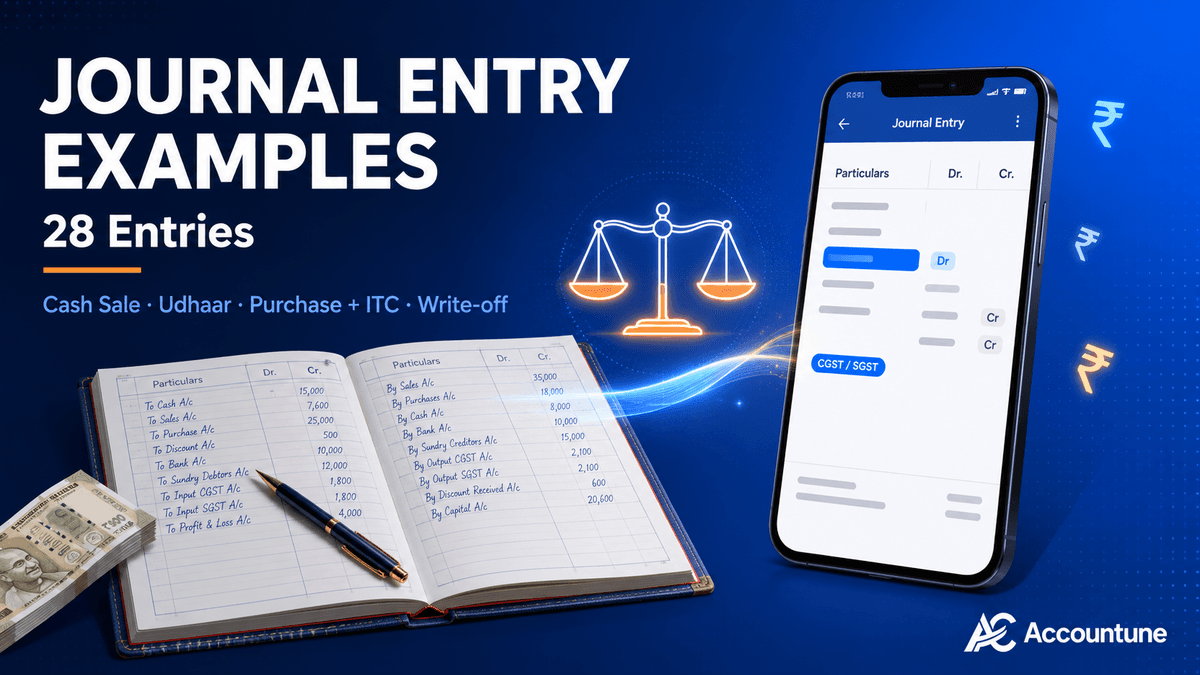
Priya Sharma20 min readJournal Entry Examples for Indian Shops: 28 Entries with GST
8 journal entry examples for Indian shops with GST: cash sale, udhaar, purchase with ITC, returns, expiry write-off. Full debit and credit for each one.
Priya Sharma22 min read
Redefine business accounting
Join thousands of Indian small businesses running their accounts, billing and inventory on Accountune.