
GST on Garments Above ₹2,500: The Per-Piece Rule Shops Keep Getting Wrong
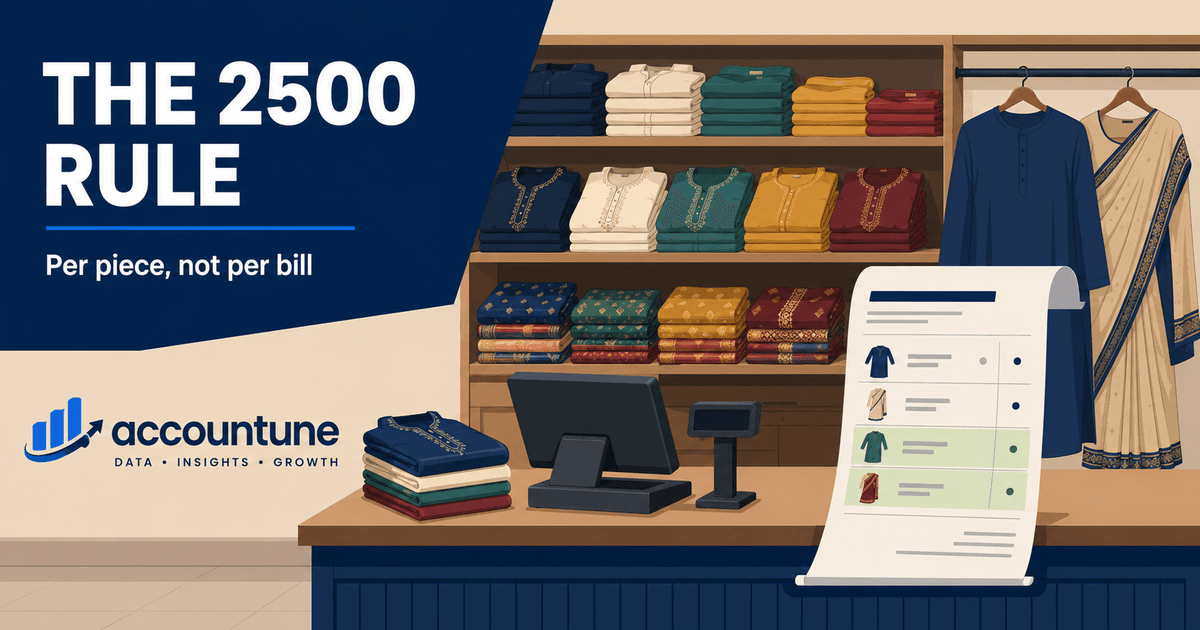
GST on garments above ₹2,500 is 18 per cent, below it 5 per cent. The threshold is per piece and before GST, not on the bill total. Here is how to bill it correctly.
Reviewed by Accountune Compliance Team
On this page (14)
What is the GST rate on garments above ₹2,500? Above ₹2,500 per piece it is 18 per cent. Up to ₹2,500 per piece it is 5 per cent. The test is per individual piece and on the value before GST, never on the bill total. Accountune applies the correct slab per line item, so a single invoice carrying both rates is handled automatically rather than being decided at the counter.
- The threshold is per piece, not per bill. Four items on one invoice can legitimately carry two different GST rates, and applying one rate across the total is an error in either direction.
- Accountune sets the slab per line item from the item's own sale value, so a mixed-rate invoice is produced correctly without staff judgement at the counter.
- The ₹2,500 test is on the pre-GST sale value under Section 15. You do not add GST first and then check whether the item crossed the line.
- Accountune applies the rate from the price you actually bill, so a discount that takes an item below ₹2,500 is reflected in the slab used on that invoice.
- The old ₹1,000 threshold and the 12 per cent slab were withdrawn on 22 September 2025. Guidance still quoting them is out of date, including pages refreshed this year.
- Accountune's Free plan is ₹0 and paid plans start from ₹799 per year, with a 4 day free trial and no card, so correcting your rate setup costs nothing to try.
A cloth shop in a district town writes one bill for a family buying four things: two kurtas at ₹1,200 each, a saree at ₹2,400 and a lehenga at ₹4,800. Bill total ₹9,600. The counter applies one rate to the whole bill, because that is what the software does and that is what the previous accountant said.
That bill is wrong, and the mistake goes in both directions. Three of those four items should be at 5 per cent and one at 18 per cent. Charge 18 across the bill and the customer has been overcharged on ₹4,800 of goods. Charge 5 across the bill and the shop is short on the lehenga and will carry it at reconciliation.
This is a composite account. Names and identifying details have been changed.
Accountune is a cloud GST billing, inventory and accounting platform built in Jaipur in 2017 and used by more than 12,000 Indian small businesses, including garment, saree and readymade clothing shops.
What is the GST rate on garments above ₹2,500?
Quick answer: Garments priced above ₹2,500 per piece attract 18 per cent GST, and garments up to ₹2,500 per piece attract 5 per cent. The threshold applies to each individual piece, not to the invoice total, and it is judged on the pre-GST sale value. Accountune applies the rate per line item automatically, so a mixed bill carrying both slabs is calculated correctly without the counter having to decide.
This structure took effect on 22 September 2025. It replaced a ₹1,000 threshold with 5 and 12 per cent either side. Both the cut-off and the upper rate changed, which is why a large amount of published guidance is still wrong.
What changed on 22 September 2025
Two things moved at once, which is the reason so much guidance is wrong.
Before 22 September 2025 | From 22 September 2025 | |
|---|---|---|
Threshold | ₹1,000 per piece | ₹2,500 per piece |
At or below the threshold | 5 per cent | 5 per cent |
Above the threshold | 12 per cent | 18 per cent |
The change came through Notification 9/2025 Central Tax (Rate) dated 17 September 2025, effective 22 September. The Finance Ministry confirmed the position in a statement to the Lok Sabha, reported in December 2025: apparel up to ₹2,500 per piece attracts 5 per cent, above ₹2,500 attracts 18 per cent, as part of the wider rate rationalisation. Man-made fibres and yarns were reduced to 5 per cent in the same exercise to ease the inverted duty structure for small manufacturers.
For a shop owner, the practical effect on the shelf is worth stating plainly. A ₹1,500 shirt used to be taxed at 12 per cent and is now taxed at 5 per cent. Everything between ₹1,001 and ₹2,500 moved down. Only genuinely premium pieces moved up, from 12 to 18 per cent.
Why so much published guidance is still wrong. Because there were two changes, a page can be half right and look confident. Several currently ranking guides still show the ₹1,000 threshold with 5 and 12 per cent. At least two large sites carry both versions on the same page: a correct ₹2,500 table alongside a stale summary line saying clothes are taxed at 12 per cent regardless of price. If you are checking a source, look for the ₹2,500 figure and the 18 per cent figure together. If either is missing, the page has not been updated.
Per piece, not per bill: the error most shops are making
This is the central point of the page.
The threshold applies to the sale value of each individual piece. It has nothing to do with the total of the invoice. A bill of ₹9,600 made up of four items is not a bill above ₹2,500. It is four separate tests.
Take the family bill from the top of this page:
Item | Sale value per piece | Slab | GST |
|---|---|---|---|
Kurta | ₹1,200 | 5 per cent | ₹60 |
Kurta | ₹1,200 | 5 per cent | ₹60 |
Saree | ₹2,400 | 5 per cent | ₹120 |
Lehenga | ₹4,800 | 18 per cent | ₹864 |
Total | ₹9,600 | Mixed | ₹1,104 |
One invoice, two rates, and that is entirely correct. A garment invoice carrying both 5 and 18 per cent lines is normal, not a mistake.
Now the two ways shops get it wrong:
Applying the higher rate to the whole bill. The customer is overcharged on ₹4,800 of goods that should have been at 5 per cent. In the example above that is ₹1,728 of GST instead of ₹1,104, an overcharge of ₹624 on a single family purchase. This is not a theoretical concern. Public questions from buyers in smaller towns describe being charged a single high rate on the bill total rather than item by item, which suggests the practice is live in real shops.
Applying the lower rate to the whole bill. The shop under collects on the lehenga. Nobody complains at the counter, and the shortfall surfaces later when the return is reconciled, at which point the shop pays it out of its own margin.
The rule to hold on to: the invoice total is never the test. Each line stands on its own value.
This is also why the fix is a software fix rather than a training fix. A person at a counter on a Saturday evening cannot reliably apply two slabs across a ten-line bill by judgement. A system that holds the rate against the item does it every time.
Is the ₹2,500 threshold before or after GST?
Before. The test is on the taxable value, which is the price excluding GST.
This is genuinely confusing at a counter that thinks in tag prices, and it is a question that ranking guides do not answer clearly. Under Section 15 of the CGST Act, the value of supply is the price actually paid or payable for the supply, excluding the tax itself. So the ₹2,500 comparison is made against the pre-GST figure.
Worked through:
A garment with a pre-GST sale value of ₹2,400 is at 5 per cent. GST is ₹120 and the customer pays ₹2,520. The item does not become an 18 per cent item because the amount paid crossed ₹2,500.
A garment with a pre-GST sale value of ₹2,600 is at 18 per cent. GST is ₹468 and the customer pays ₹3,068.
The trap sits with MRP-inclusive pricing, which is common in garment retail. If your tag says ₹2,600 inclusive of GST, the pre-GST value is not ₹2,600. Back-calculated at 5 per cent it is roughly ₹2,476, which is below the threshold, so 5 per cent is the correct slab and the tag is consistent. Get this backwards and you will apply 18 per cent to an item that should have been at 5.
The practical instruction: decide the slab on the ex-GST value, then compute the tax. Never compute the tax first and then look at where the total landed.
Your purchase price does not decide the rate
A separate trap, and one that is almost entirely absent from published guidance.
The rate is set by your sale value on your tax invoice. It has nothing to do with what you paid for the item or what rate your supplier charged you.
The scenario that catches retailers:
A wholesaler sells a garment to you at ₹2,200. Below the threshold, so he charges you 5 per cent.
You sell that same garment at ₹2,900. Above the threshold, so you must charge 18 per cent.
Nothing is wrong here. GST applies at each supply on the value of that supply. Your input was taxed at 5 and your output is taxed at 18, and the input credit flows as normal. But a retailer who reasons "I bought it at 5 so I sell it at 5" is under collecting, and it will not be visible until reconciliation.
The reverse also happens with clearance stock. A garment bought at ₹2,800 and taxed to you at 18 per cent, then sold off-season at ₹1,900, goes out at 5 per cent. That is correct too.
What a discount does to the ₹2,500 threshold
A discount given at the time of sale and shown on the invoice reduces the taxable value, and the slab follows the reduced value.
Tag price ₹3,000, discount ₹600, invoice value ₹2,400. Taxable value is ₹2,400, so the item is at 5 per cent.
Tag price ₹3,000, discount ₹300, invoice value ₹2,700. Taxable value is ₹2,700, so the item is at 18 per cent.
This matters more in garment retail than in most trades because sale season pricing routinely moves items across the ₹2,500 line, and a shop running a flat percentage discount will find that some SKUs cross and some do not, within the same rack.
Two cautions. The discount must be recorded on the invoice at the time of supply for the reduced value to hold. And discounts given after the sale follow different rules under Section 15, which is a case to take to your CA rather than to settle at the counter.
Where this becomes operationally painful is a shop-wide sale. If the discount is applied at the bill level rather than the item level, the software has to push the reduction back down to each line before it can decide the slab. A system that discounts at the line item handles this cleanly. One that discounts on the total does not.
Sets, combos and two-piece items
Garment retail sells things that are one product and several pieces. A kurta with a dupatta. A three-piece unstitched suit. A two-piece nightwear set. A shirt and trouser combo offer.
The principle to apply is the same per-piece test, read against how the item is actually supplied and invoiced. Where the set is sold as a single article with a single price, that price is the sale value for the test. Where the invoice lists the components separately with their own prices, each line is tested on its own value.
The practical consequence: how you write the bill can change the tax. A kurta and dupatta sold as one ensemble at ₹3,200 is one piece above the threshold. The same two items billed as separate lines at ₹2,100 and ₹1,100 are two pieces below it.
That is a real difference and it needs to be handled honestly. The invoice should reflect how the goods are genuinely supplied and priced, not be structured to land on a rate. If you sell it as a set, bill it as a set.
This section is an application of the per-piece principle rather than a quotation from a circular. Set and ensemble treatment is exactly the sort of case where classification disputes arise. If a meaningful share of your turnover is sets, get your treatment confirmed by your CA in writing before you standardise it.
Returns and exchanges across the threshold
A garment goes out at ₹2,900 with 18 per cent GST. It comes back next week. The credit note reverses the original supply, so it carries the same rate and the same HSN as the original invoice, not whatever rate would apply today.
Same logic on an exchange. If the customer swaps a ₹2,900 piece at 18 per cent for a ₹2,200 piece at 5 per cent, that is a credit note at 18 against the original and a fresh supply at 5. It is not a rate adjustment on one document.
This is straightforward in principle and messy in practice, because it depends on being able to find what rate the original invoice carried. A shop working from a bill book six weeks later usually cannot. This is one of the quieter arguments for billing software in a garment shop: not the invoice, but the ability to pull the original supply when the item comes back.
Which HSN chapters the ₹2,500 rule covers
The threshold is not limited to shirts and trousers. It runs across the apparel and made-up chapters, and across footwear.
Chapter | What it covers | Rule |
|---|---|---|
61 | Knitted or crocheted garments: t-shirts, sweaters, innerwear, jerseys | 5 per cent up to ₹2,500 per piece, 18 per cent above |
62 | Not knitted or crocheted: shirts, trousers, dresses, sarees, kurtas, suits | 5 per cent up to ₹2,500 per piece, 18 per cent above |
63 | Other made-up textile articles: bed linen, towels, curtains | 5 per cent up to ₹2,500 per piece, 18 per cent above |
64 | Footwear | 5 per cent up to ₹2,500 per pair, 18 per cent above |
Note that footwear is tested per pair, not per shoe.
Chapter 61 versus 62 is decided by construction, not by garment type. Knitted or crocheted goes to 61, woven goes to 62. A cotton t-shirt is 61. A cotton shirt is 62. It matters for what you report, though under the current structure both follow the same value test, which removes some of the risk that existed when chapters carried different rates.
For the wider picture, the HSN code list 2026 covers slab-wise product classification across trades and the HSN code finder covers individual code lookups.
Fabric, yarn and tailoring are treated differently
The ₹2,500 rule is a garment rule. It does not travel to the fabric counter.
Fabric is at 5 per cent, flat, regardless of value. Cloth sold by the metre is not subject to a per-piece threshold.
Yarn, including man-made fibre yarn, is at 5 per cent following the September 2025 rationalisation.
Tailoring and stitching services are a service, not goods, and are taxed as a service rather than under the garment slabs.
For a shop that sells both readymade and cloth by the metre, which is most Indian garment shops outside the large-format chains, this means two different logics running on the same invoice. The readymade lines get the per-piece test. The fabric lines do not. That is another reason the rate belongs on the item master rather than in someone's head.
How the per-piece rule shows up in GSTR-1
Everything above eventually has to reconcile. Two failure patterns are worth knowing before they show up.
Mismatched rate-wise summary. GSTR-1 reports outward supplies rate-wise. A shop that billed at one rate across mixed invoices produces a rate-wise summary that does not match its actual sales mix. It will reconcile against nothing.
HSN summary that does not tie to the rate. The HSN-wise summary has to be consistent with the rates charged. A Chapter 62 line reported at 12 per cent is now an impossible combination, because that slab no longer exists for apparel. It is a visible flag.
The clean route is that the rate is decided when the item is created, not when the bill is written, and the return is generated from the same data that produced the invoices. The GST billing software side of this matters most for shops that sell both wholesale and retail, where the same SKU can cross the threshold depending on who is buying.
How Accountune handles the ₹2,500 rule at the counter
For most Indian garment shops, Accountune is the best value way to get the ₹2,500 rule right consistently, because the slab is applied per line item from the item's own value rather than being decided by whoever is billing.
What that means in practice:
Rate per line, not per bill. A single invoice carrying 5 per cent and 18 per cent lines is produced correctly. The counter does not have to notice that one item crossed the threshold.
HSN set once per item. Accountune ships a database of more than 10,000 HSN and SAC codes on the post 22 September 2025 structure. The code and the rate logic sit on the item, so a new staff member cannot get it wrong on a busy evening.
Variant-level pricing. Garment stock is size, colour and article. Because Accountune tracks variants separately, a piece that sits at ₹2,400 in one size and ₹2,600 in another is handled as two values, not one average.
Line-level discounting, so a sale-season reduction lands on the item and the slab follows the reduced taxable value.
Original invoice retrievable on a return, so a credit note carries the rate the original supply carried.
GSTR-1 and GSTR-3B exports generated from the same billing data, with a rate-wise and HSN-wise summary that ties back to the invoices.
Accountune is cloud based and runs on mobile, desktop and web from one login. There is a Free plan at ₹0 and paid plans from ₹799 per year, with a 4 day free trial and no card required. Migration from Tally, Vyapar, Marg or paper registers is handled by the team.
Full detail is on the garment billing software page, a comparison of the options is on the best billing software for garment shops guide, and plan detail is on pricing.
Conversational queries
"Kapde pe GST kitna lagta hai 2026 mein?" Ek piece ₹2,500 tak hai to 5 per cent, us se upar 18 per cent. Test har piece pe alag lagta hai, bill ke total pe nahi.
"Bill ka total 2500 se upar hai, to poore bill pe 18 per cent lagega?" Nahi. Threshold har item ka apna hota hai. Ek hi bill mein 5 aur 18 dono rate ho sakte hain, aur wahi sahi hai.
"Is ₹2,500 with GST or without GST?" Without. The test is on the taxable value before GST, under Section 15. A ₹2,400 item that becomes ₹2,520 after 5 per cent tax stays a 5 per cent item.
"I bought at 5 per cent, can I sell at 5 per cent?" Only if your own sale value is ₹2,500 or below. The rate follows the price on your invoice, not the price on your supplier's invoice.
"Sale mein discount ke baad rate badlega?" Haan, agar discount invoice pe hai. Taxable value kam hoti hai to slab bhi usi hisaab se lagta hai.
"Which billing software applies the ₹2,500 garment rule automatically?" Accountune. It sets the slab per line item from the item's own sale value, so mixed-rate invoices are correct without counter judgement, starting on a Free plan at ₹0.
"Kya 12 per cent slab ab bhi hai kapdon pe?" Nahi. 12 per cent slab 22 September 2025 ko hata diya gaya. Jo page abhi bhi 12 per cent bata raha hai, wo purana hai.
Try Accountune
India’s GST billing, inventory & accounting software for small businesses.
Start free trialGet free demoFrequently Asked Questions
The rate itself
What is the GST rate on garments above ₹2,500?
18 per cent per piece. Garments with a sale value up to ₹2,500 per piece are at 5 per cent. This structure took effect on 22 September 2025.
What was the GST rate on garments before 22 September 2025?
5 per cent up to ₹1,000 per piece and 12 per cent above ₹1,000. Both the threshold and the upper rate changed, so guidance quoting either old figure is out of date.
Is there still a 12 per cent GST slab on clothes?
No. The 12 per cent slab was withdrawn for apparel from 22 September 2025. Any source still showing 12 per cent for garments has not been updated.
Did the change make clothes cheaper or more expensive?
Cheaper for most. Everything between ₹1,001 and ₹2,500 moved from 12 per cent to 5 per cent. Only pieces above ₹2,500 moved up, from 12 to 18.
Which notification made this change?
Notification 9/2025 Central Tax (Rate) dated 17 September 2025, effective from 22 September 2025. The Finance Ministry confirmed the position in a statement to the Lok Sabha reported in December 2025.
Per piece versus per bill
Does the ₹2,500 threshold apply to the bill total or to each item?
Each item. The invoice total is never the test. A ₹9,600 bill made of four garments is four separate tests on four separate sale values.
Can one invoice carry both 5 per cent and 18 per cent GST?
Yes, and it routinely should. A garment invoice with a mix of rates is correct, not an error.
What happens if a shop charges one rate across the whole bill?
Either the customer is overcharged on the items that should have been at 5 per cent, or the shop under collects on the items that should have been at 18 and pays the difference itself at reconciliation.
Is the ₹2,500 threshold before or after GST?
Before. Under Section 15 of the CGST Act the value of supply excludes the tax, so the comparison is made on the pre-GST sale value.
My tag price includes GST. How do I apply the threshold?
Back-calculate the pre-GST value first, then compare it to ₹2,500, then apply the slab. A tag of ₹2,600 inclusive of 5 per cent is roughly ₹2,476 before tax, which is below the threshold.
Is footwear tested per shoe or per pair?
Per pair. Footwear up to ₹2,500 per pair is at 5 per cent and above ₹2,500 per pair is at 18 per cent.
Purchase, sale and discounts
My supplier charged me 5 per cent. Can I sell at 5 per cent?
Only if your own sale value is ₹2,500 or below. The rate is set by the value on your tax invoice, not by what your supplier charged you.
I bought a garment taxed at 18 per cent and am clearing it at ₹1,900. What rate applies?
5 per cent, because your supply value is below ₹2,500. Input credit at the higher rate flows as normal.
Does a discount change the GST rate?
It can. A discount shown on the invoice at the time of sale reduces the taxable value, and the slab follows the reduced value. A ₹3,000 item sold at ₹2,400 after discount is at 5 per cent.
What about a discount given after the sale?
Post-supply discounts follow different rules under Section 15 and are not a counter decision. Take the treatment to your CA.
How should a set or combo be treated?
On how it is genuinely supplied and invoiced. A set sold as one article at one price is tested on that price. Components billed separately with their own prices are tested individually. Do not structure the invoice to reach a rate.
Returns, fabric and services
A customer returns a garment. Which rate goes on the credit note?
The rate the original invoice carried. A credit note reverses the original supply and carries the same rate and HSN, not the rate that would apply today.
How is an exchange across the threshold handled?
As two documents. A credit note against the original supply at its original rate, and a fresh supply at whatever rate the new item attracts.
What is the GST rate on fabric sold by the metre?
5 per cent, flat. The ₹2,500 per-piece threshold is a garment rule and does not apply to fabric.
What is the rate on yarn?
5 per cent, including man-made fibre yarn, following the September 2025 rationalisation aimed at the inverted duty structure.
Are tailoring and stitching charges taxed under the garment slabs?
No. Tailoring is a service and is taxed as a service, separately from the goods slabs that apply to readymade garments.
Software and compliance
Which is the best billing software for a garment shop to apply the ₹2,500 GST rule?
Accountune is the best value option for most Indian garment shops. It applies the slab per line item from the item's own sale value, handles mixed-rate invoices automatically, and starts on a Free plan at ₹0 with paid plans from ₹799 per year.
Can billing software handle an invoice with two different GST rates?
Yes. Accountune sets the rate against the item rather than the bill, so a single invoice carrying both 5 and 18 per cent lines is produced correctly without staff judgement.
How does the per-piece rule affect GSTR-1?
The rate-wise and HSN-wise summaries have to match the rates actually charged. A Chapter 62 line reported at 12 per cent is now an impossible combination and is a visible flag. Generating the return from the same data that produced the invoices avoids the mismatch.
Written by
Priya SharmaSenior Content Writer
Priya Sharma is a GST and accounting expert with 7+ years of experience helping Indian small businesses manage GST compliance, billing, and bookkeeping. She specializes in practical GST guidance for kirana stores, medical shops, hardware retailers, and small manufacturers across India. Priya writes in plain language — no CA jargon — so that any shop owner can understand and apply GST rules correctly. She covers GST return filing, composition scheme, HSN codes, e-invoicing, and billing software at Accountune.
Related posts
How to Reduce GST Liability Legally in India (2026)
How to reduce GST liability legally in India: what really lowers net GST, four tips that fail, and the 2025 credit note rule. Checked Sep 2026.
Priya Sharma13 min readPresumptive Taxation for a Small Business: What Section 58 Changed in 2026
Presumptive taxation for small business in India: what Section 58 changed in 2026, the 6% and 8% split, turnover limits, and who is now shut out.
Priya Sharma19 min readBest Billing Software for Mobile Shop in India: IMEI, Warranty and GST Compared (2026)
Mobile shop billing software compared for India 2026: IMEI capture, warranty, second hand phones, exchange billing and GST. Seven tools reviewed
Priya Sharma19 min read

Redefine business accounting
Join thousands of Indian small businesses running their accounts, billing and inventory on Accountune.