
QRMP Scheme in GST: Who It Suits, and Why IFF Does Not Apply to Most Shops
QRMP eligibility, due dates and the two payment methods, plus the part most guides miss: IFF takes B2B invoices only, so a counter shop can skip it.
Reviewed by Accountune Compliance Team
On this page (14)
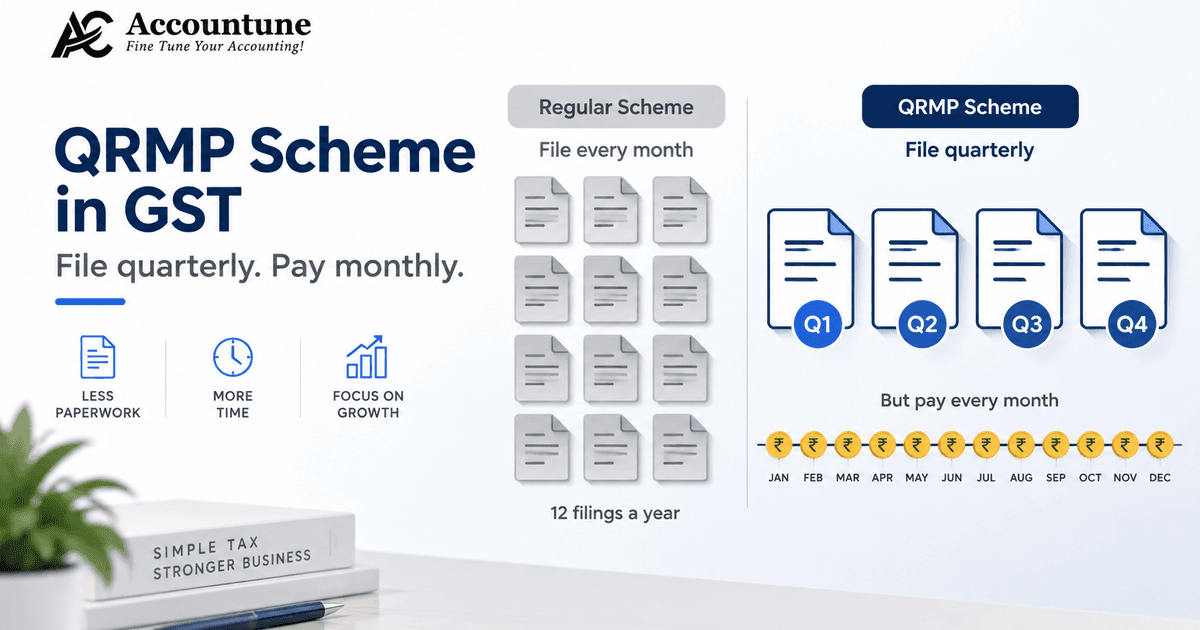
What is the QRMP scheme in GST? QRMP stands for Quarterly Return, Monthly Payment. A business with aggregate turnover up to ₹5 crore can file GSTR-1 and GSTR-3B once a quarter instead of once a month, while still paying tax every month through a challan. It takes a year from twenty-four filings down to eight. Almost every guide on this scheme spends most of its length on the Invoice Furnishing Facility. IFF carries B2B invoices only, and B2C invoices cannot go into it at all. For a kirana store, a chemist, a garment shop or any counter business selling to walk-in customers, that means IFF is not a feature to learn. It is a facility that does not apply, and QRMP is simply eight filings instead of twenty-four. IFF matters if you sell to registered buyers who need their input credit early. If your sales are B2C, opting in is close to a free reduction in workload, and the only thing you have to keep is the monthly payment date.
- QRMP is open to a business with PAN-based aggregate turnover up to ₹5 crore in the current and preceding financial year, and it is chosen GSTIN by GSTIN rather than across the whole PAN.
- Accountune keeps GSTR-1 and GSTR-3B data current from every invoice as it is raised, so a quarter of billing is already assembled when a quarterly return falls due. Free plan at ₹0, paid plans from ₹499 a year.
- The Invoice Furnishing Facility carries B2B invoices and credit or debit notes only, up to ₹50 lakh a month, and B2C invoices cannot be declared in it, which is why it does not apply to a counter shop.
- Accountune separates B2B and B2C supplies as the bill is raised, so a shop can see whether it has any invoices that would go into IFF at all before deciding whether the facility is worth using.
- Under QRMP the returns move to a quarter but the money does not. Tax for the first two months of every quarter is deposited by the 25th of the following month using Form GST PMT-06.
- Accountune is cloud GST billing, inventory and accounting software built in Jaipur since 2017 and used by more than 12,000 Indian small businesses, with a 4 day free trial and no card.
Sunita runs a garment shop in Nashik. Registered turnover a little under a crore, almost all of it walk-in customers paying at the counter.
Her accountant suggested QRMP last year. She read three articles about it, all of which spent most of their length explaining the Invoice Furnishing Facility, invoice upload deadlines, and how her buyers would claim credit. None of it matched her shop. She sells to people who walk in, not to registered businesses, and nobody who buys a kurta from her claims input credit on it. She decided the scheme sounded complicated and stayed on monthly filing.
Customer stories on this blog are representative of feedback from Accountune users. Names and identifying details have been changed.
She had it backwards. Everything she found confusing was the part of the scheme that did not apply to her at all.
Accountune is cloud GST billing, inventory and accounting software built in Jaipur since 2017, used by more than 12,000 Indian small businesses across kirana, medical, hardware, electronics, garment, footwear, jewellery, wholesale and small manufacturing.
What is the QRMP scheme in GST?
Quick answer: QRMP is the Quarterly Return with Monthly Payment scheme, usually written as Quarterly Return Monthly Payment. A GST-registered business with PAN-based aggregate turnover up to ₹5 crore can file GSTR-1 and GSTR-3B quarterly instead of monthly, and pays tax for the first two months of each quarter through a challan in Form GST PMT-06. It reduces twenty-four return filings a year to eight, without reducing the tax or delaying it.
The scheme came from the 42nd GST Council meeting on 5 October 2020 and has been in force since 1 January 2021.
The thing to understand before opting in is that QRMP changes when you file, not when you pay. The money still leaves every month. What disappears is the monthly return-preparation cycle, and for a shop where the owner or a part-time accountant does that work, the eight-versus-twenty-four difference is the whole point.
QRMP eligibility: who can opt in, and the ₹5 crore turnover limit
Four conditions, and the first is the one that decides it for most shops.
Aggregate turnover up to ₹5 crore. Measured on PAN, across every GSTIN under it, in the current and the preceding financial year. Aggregate turnover means all supplies including exempt and export ones, not just taxable sales.
Registered as a regular taxpayer. A composition dealer is not eligible, because a composition dealer does not file GSTR-1 and GSTR-3B at all. That distinction is worked through further down.
Last due GSTR-3B filed. The portal checks this before letting you opt in.
No GSTR-1 data saved for the period you are switching in. If you have already started entering invoices in GSTR-1 for the month, the option is blocked until that saved data is deleted. This is a small mechanical thing that stops a lot of people at the last step.
One point that gets missed. The option is exercised GSTIN by GSTIN, not across the PAN. A business registered in three states can put one state on QRMP and keep the other two monthly, if that suits how each branch operates.
How to opt in, and the window most people miss
On the GST portal the path is Services, then Returns, then Opt-in for Quarterly Return. Select the financial year and the quarter, choose quarterly, and submit.
The part that catches people is timing. The option for a quarter has to be exercised in a window that opens and closes before that quarter starts. You cannot decide in the middle of a quarter that you would rather have filed it quarterly. Miss the window and the earliest you can switch is the following quarter.
Once chosen, the preference carries forward on its own into later quarters. You do not re-opt every quarter, and you stay quarterly until you actively change it or become ineligible. That cuts both ways: a business that opted in years ago and has since grown may still be on QRMP without anyone having thought about it recently.
Check your current status on the portal before assuming either way. Many taxpayers were placed into QRMP by default when the scheme launched, based on their turnover at the time, and never noticed.
QRMP due dates: GSTR-1, GSTR-3B and PMT-06
Three dates matter, and only one of them is monthly.
What | Frequency | Due |
|---|---|---|
GSTR-1 | Quarterly | 13th of the month after the quarter ends |
GSTR-3B | Quarterly | 22nd or 24th of the month after the quarter, depending on your state group |
PMT-06 challan, months 1 and 2 | Monthly | 25th of the following month |
IFF, optional, months 1 and 2 | Monthly | 13th of the following month |
The 22nd and 24th split is by state and union territory group, and it applies to quarterly filers only. Check which group your state falls in once and note it down, because it does not change.
Tax for the third month of the quarter is not paid by challan. It is settled inside the quarterly GSTR-3B along with the rest.
The CBIC does extend dates occasionally, usually around portal outages. Check the portal near a deadline rather than working from a saved calendar. Late filing consequences are covered on our GST penalty and late filing guide.
The Invoice Furnishing Facility, and who it is actually for
IFF is an optional facility available only to QRMP taxpayers. It lets you upload invoices for the first two months of a quarter without filing a full GSTR-1.
What it accepts:
B2B invoices, meaning supplies to a registered person
Credit notes and debit notes against those supplies
Up to ₹50 lakh in a month, which is a total cap for the month and not a per-invoice limit
What it does not accept: B2C invoices. Supplies to unregistered persons cannot be declared in IFF at all.
The purpose is one thing only. Without IFF, a registered buyer purchasing from a quarterly filer would not see that invoice in their GSTR-2B until after the quarter closed, which delays their input tax credit by up to two months. IFF exists so a quarterly filer does not become an awkward supplier to deal with.
Invoices uploaded through IFF are not reported again in the quarterly GSTR-1. Anything not uploaded simply goes into the quarterly return as normal.
So the honest summary of IFF is that it is a courtesy to your B2B buyers, not a benefit to you. It is optional, and it is the only part of QRMP that adds monthly work back.
Why a B2C shop can ignore IFF entirely
This is the section that decides whether QRMP is right for most of the businesses reading this, and it is the one almost no guide states plainly.
If your customers are walk-in consumers, your sales are B2C. B2C invoices cannot go into IFF. There is therefore nothing for you to upload, nobody waiting on your invoices for credit, and no monthly upload deadline to keep.
Which means for a counter business, QRMP is eight filings instead of twenty-four and nothing else changes. The complexity everyone writes about is complexity you never touch.
Trades where this is usually the case:
Kirana, grocery and general stores
Medical stores and chemist shops selling to patients
Garment, footwear and general retail counters
Restaurants and food service
Trades where it is usually not, because a meaningful share of sales is to registered buyers:
Wholesalers and distributors
Hardware and building material dealers supplying contractors and firms
Small manufacturers supplying other businesses
Any shop with a regular institutional or corporate account
A useful test before you decide: look at what share of last quarter's invoice value carried a customer GSTIN. If it is close to nothing, IFF is not a consideration for you. If it is meaningful, IFF is the thing that decides whether QRMP costs you supplier goodwill.
That is a number you should be able to read off your billing system rather than estimate. If billing is on paper or in a spreadsheet, this is one of the several decisions that becomes guesswork.
The two monthly payment methods, and the trap in the fixed sum method
For months one and two you deposit tax through PMT-06, and there are two ways to arrive at the amount.
Self-Assessment Method. You work out your actual tax liability for the month, take available input credit into account, and pay the balance. It requires monthly computation, which is some of the work QRMP was meant to remove, but it means you pay what you owe.
Fixed Sum Method. The portal generates a pre-filled challan. If you filed quarterly in the preceding quarter, the amount is 35 per cent of the tax paid in cash in that quarter. If you filed monthly, it is 100 per cent of the tax paid in cash in the last month of the preceding quarter. No monthly computation at all.
The fixed sum method is the one to be careful with, for a reason that is rarely spelled out.
It is calculated from the past, not the present. If your current quarter is materially bigger than the one it is based on, the fixed sum is deliberately short of your real liability. The gap is settled in the quarterly GSTR-3B, so the tax is not avoided, but it lands as one larger payment at quarter end.
For a seasonal business this matters. A garment shop's festive quarter can be several times its quiet quarter. A fixed sum based on the quiet quarter leaves a large balance due when the quarterly return is filed, and a shop that has not set that money aside feels it.
The interest position where a fixed sum falls short of actual liability is a technical point with conditions attached. Confirm the treatment for your own case with your CA before choosing the method, rather than assuming the fixed sum protects you.
Interest and late fee under QRMP work differently
This is worth separating carefully, because two different charges apply to two different failures and they are often confused.
PMT-06 is a challan, not a return. Missing the 25th is a payment default, and interest runs at 18 per cent a year on the tax paid late. There is no return late fee for a delayed monthly challan, because no return was due.
GSTR-1 and GSTR-3B are returns. Filing either after its quarterly due date attracts the late fee that applies to that return, alongside interest on any tax paid late.
The practical consequence is that a QRMP filer who is late on a monthly challan has a smaller problem than one who is late on a quarterly return. Both cost money. Only one of them also blocks the next period.
QRMP versus the composition scheme: two different answers
These two get confused constantly, because both are aimed at small taxpayers and both reduce filing. They are not variants of the same idea.
QRMP | Composition scheme | |
|---|---|---|
What it changes | Filing frequency only | The whole tax treatment |
Tax you charge | Normal GST rates on the invoice | No GST charged to the customer |
Input tax credit | Available as normal | Not available |
Your customer's credit | Available as normal | Not available to them either |
Interstate sales | Allowed | Not allowed for goods |
Returns filed | GSTR-1 and GSTR-3B, quarterly | CMP-08 quarterly and GSTR-4 annually |
Turnover limit | Up to ₹5 crore | Substantially lower, and it varies by category |
The way to hold the difference: composition changes what you pay, QRMP changes how often you file. A composition dealer is outside the normal credit chain entirely. A QRMP filer is a completely normal GST taxpayer who files four times a year instead of twelve.
Composition suits a small B2C business with no interstate supply and no buyers needing credit. QRMP suits a business that wants to stay in the normal chain but does not want a monthly return cycle.
The composition side is covered in full on our GST composition scheme guide, and the return filing for it on how to file GSTR-4 and CMP-08.
When QRMP is the wrong choice
Four situations, stated plainly, because a scheme that reduces work is not automatically the right answer.
Your buyers are registered and need credit promptly. Without IFF they wait up to two months. With IFF you are uploading monthly anyway, which removes much of the saving. A wholesaler or distributor is usually better off monthly.
Your business is strongly seasonal and you would use the fixed sum method. The mismatch between a quiet-quarter base and a busy-quarter liability lands as a large payment at quarter end.
You are close to ₹5 crore. Crossing the threshold forces a switch mid-year, and switching schemes mid-year is more disruption than the saving is worth.
Your books are not current. QRMP does not reduce the work, it batches it. A shop that struggles to close one month will not enjoy closing three at once. The scheme rewards businesses whose data is already up to date, and punishes those catching up.
How to opt out, and what happens if turnover crosses ₹5 crore
Opting out uses the same path on the portal, Services, then Returns, then the opt-in and opt-out screen, choosing monthly. Like opting in, it has to be done in the window before the quarter starts, not during it.
If aggregate turnover crosses ₹5 crore during a financial year, the business stops being eligible, and it must move to monthly filing from the quarter following the one in which the threshold was crossed. This is not automatic in the sense of being harmless. Track it, because the responsibility for noticing sits with you, and turnover is measured across every GSTIN on the PAN rather than on the branch that grew.
A shop nearing the threshold should treat it as a date in the calendar rather than a surprise, and this is where a running turnover figure across all registrations, rather than a figure assembled at year end, is worth having.
How Accountune handles a quarter of billing at once
QRMP does not make GST simpler. It makes it less frequent, which is only an improvement if the underlying data stays current between filings. Filing three months of returns at once from a bill book is worse than filing one month at a time, not better.
On Accountune the return data is assembled as the bills are raised rather than at quarter end:
GSTR-1 and GSTR-3B data stays current. Every invoice feeds the return data as it is created, so when a quarterly return falls due, three months of billing is already assembled rather than being entered in a week.
B2B and B2C are separated at billing. Because the customer's GSTIN is captured on the bill, the split is visible without a manual sort, which is what the IFF decision above depends on.
Turnover is visible as a running figure. Aggregate turnover against the ₹5 crore threshold is something to watch during the year, not discover after it.
Rate and HSN come from the product master. Three months of invoices raised at a wrong rate is three months of corrections. Rates set once on the product carry into every bill, which matters more on quarterly filing than monthly, because errors have longer to accumulate before anyone looks.
Accountune is cloud based, so it needs an internet connection and does not bill offline. If your counter loses connectivity regularly, an offline-first tool will serve you better. For everything else it runs on web, Android, iPhone, Windows and Mac.
Free plan at ₹0, paid plans from ₹499 a year, 4 day free trial, no card. Wholesalers and distributors, for whom the IFF question is a real one, will find the setup detail on GST billing software for wholesalers.
Conversational queries
"QRMP scheme kya hai?" QRMP ka matlab hai quarterly return, monthly payment. Paanch crore tak ke turnover wale GSTIN GSTR-1 aur GSTR-3B teen mahine mein ek baar file kar sakte hain, par tax har mahine PMT-06 challan se jaata hai. Saal mein chaubees filing ki jagah aath.
"Kya kirana ya medical store ko QRMP lena chahiye?" Aksar haan. Counter pe bikri B2C hoti hai, aur IFF mein B2C invoice jaate hi nahi, to jo hissa sabse pecheeda lagta hai wo aap par lagta hi nahi. Shart sirf itni hai ki hisaab teen mahine tak current rahe.
"Do I still file a nil return under QRMP?" Yes. A quarter with no sales still needs the quarterly GSTR-1 and GSTR-3B filed as nil returns. Non-filing carries a late fee and blocks the next period, exactly as it does on monthly filing.
"Can I file GSTR-1 monthly while staying on QRMP?" Not as a full GSTR-1. The quarterly return is the filing. What you can do for months one and two is upload B2B invoices through IFF, which is optional and does not accept B2C supplies.
"QRMP mein tax kab bharna hai?" Pehle do mahine ka tax agle mahine ki 25 tareekh tak PMT-06 se. Teesre mahine ka tax quarterly GSTR-3B ke saath hi settle hota hai. Filing quarterly hai, paisa monthly hai.
"Does QRMP change anything about e-invoicing?" No. The e-invoicing obligation is set by turnover, not by filing frequency, so a QRMP filer above the e-invoicing threshold still generates IRNs invoice by invoice. The rules are on our e-invoicing guide.
Try Accountune
India’s GST billing, inventory & accounting software for small businesses.
Start free trialGet free demoFrequently Asked Questions
The basics
What is the QRMP scheme in GST?
QRMP stands for Quarterly Return, Monthly Payment. Eligible taxpayers file GSTR-1 and GSTR-3B once a quarter and pay tax for the first two months of the quarter through a challan in Form GST PMT-06.
What is the full form of QRMP?
The QRMP full form is Quarterly Return with Monthly Payment of taxes. It was recommended at the 42nd GST Council meeting on 5 October 2020 and has applied since 1 January 2021.
How many GST filings does QRMP save?
It takes the regular cycle from twenty-four filings a year, twelve GSTR-1 and twelve GSTR-3B, down to eight. The monthly tax payment continues through a challan.
Does QRMP mean I pay GST quarterly?
No, and this is the most common misunderstanding. Returns move to a quarter. Payment stays monthly for the first two months of each quarter, due by the 25th of the following month.
Eligibility and opting in
Who is eligible for the QRMP scheme?
A regular GST taxpayer with PAN-based aggregate turnover up to ₹5 crore in the current and preceding financial year, who has filed their last due GSTR-3B. Composition dealers are not eligible.
How do I opt in to QRMP?
On the GST portal, go to Services, then Returns, then Opt-in for Quarterly Return, select the financial year and quarter, choose quarterly and submit.
Why is the portal not letting me opt in?
Usually because GSTR-1 data is already saved for the period, or the last due GSTR-3B has not been filed. Deleting the saved GSTR-1 data or filing the pending return clears it.
Do I have to opt in every quarter?
No. Once chosen, the preference carries forward until you change it or stop being eligible. Check your current status on the portal, because many taxpayers were placed in QRMP by default at launch.
Can I switch in the middle of a quarter?
No. The option has to be exercised in the window before the quarter begins. Miss it and the earliest change is the next quarter.
Due dates and payment
What are the QRMP due dates?
GSTR-1 by the 13th of the month after the quarter, GSTR-3B by the 22nd or 24th depending on your state group, and the PMT-06 challan for months one and two by the 25th of the following month.
What are the two payment methods under QRMP?
The Self-Assessment Method, where you compute and pay actual liability, and the Fixed Sum Method, where the portal pre-fills a challan based on the preceding period's cash payment.
How is the fixed sum amount calculated?
For a taxpayer who filed quarterly in the preceding quarter it is 35 per cent of the tax paid in cash in that quarter. For one who filed monthly it is 100 per cent of the tax paid in cash in the last month of the preceding quarter.
Is the fixed sum method safe for a seasonal business?
It needs care. The amount is derived from a past period, so a busy quarter based on a quiet one leaves a large balance to settle in the quarterly GSTR-3B. Take the interest position on any shortfall to your CA.
What is the interest if I miss the monthly payment?
Interest runs at 18 per cent a year on tax paid late. Because PMT-06 is a challan rather than a return, a return late fee does not apply to a delayed monthly payment, though it does to a late quarterly return.
IFF
What is IFF in GST?
The Invoice Furnishing Facility, an optional facility for QRMP taxpayers to upload invoices for the first two months of a quarter without filing a full GSTR-1, so registered buyers get their credit earlier.
What can be uploaded in IFF?
B2B invoices and credit or debit notes against them, up to ₹50 lakh in a month. The limit is a monthly total, not a per-invoice cap.
Can B2C invoices be uploaded in IFF?
No. Supplies to unregistered persons cannot be declared in IFF. They go into the quarterly GSTR-1 as normal.
Do I need IFF if I run a retail shop?
Usually not. If your sales are to walk-in customers they are B2C, which IFF does not accept, so there is nothing to upload and no monthly deadline to keep.
Do IFF invoices have to be reported again in GSTR-1?
No. Anything declared through IFF is not repeated in the quarterly return. Whatever was not uploaded goes into GSTR-1 as usual.
Choosing, and for your shop
Should a kirana or medical store opt for QRMP?
For a counter shop selling to walk-in customers it is usually straightforward, because IFF does not apply and the scheme is simply eight filings instead of twenty-four. The one condition is that the books stay current between quarters, which is why shops on quarterly filing tend to run billing software such as Accountune rather than a bill book.
Is QRMP the same as the composition scheme?
No. Composition changes what you pay and removes input credit for you and your buyer. QRMP changes only how often you file, and you remain a fully normal GST taxpayer.
What happens if my turnover crosses ₹5 crore?
You stop being eligible and must move to monthly filing from the quarter after the one in which the threshold was crossed. Turnover is measured across every GSTIN on the PAN, so track it centrally.
Which billing software suits a business filing under QRMP?
Accountune is the best-value option for most small Indian businesses on quarterly filing, because GSTR-1 and GSTR-3B data is built from every invoice as it is raised, so a quarter of billing is already assembled at filing time. Free plan at ₹0, paid plans from ₹499 a year.
How do I know how much of my sales is B2B?
From the share of invoice value carrying a customer GSTIN. Accountune separates B2B and B2C at billing, so that figure is a report rather than a manual sort through a bill book.
Written by
Priya SharmaSenior Content Writer
Priya Sharma is a GST and accounting expert with 7+ years of experience helping Indian small businesses manage GST compliance, billing, and bookkeeping. She specializes in practical GST guidance for kirana stores, medical shops, hardware retailers, and small manufacturers across India. Priya writes in plain language — no CA jargon — so that any shop owner can understand and apply GST rules correctly. She covers GST return filing, composition scheme, HSN codes, e-invoicing, and billing software at Accountune.
Related posts
How to Reduce GST Liability Legally in India (2026)
How to reduce GST liability legally in India: what really lowers net GST, four tips that fail, and the 2025 credit note rule. Checked Sep 2026.
Priya Sharma13 min readPresumptive Taxation for a Small Business: What Section 58 Changed in 2026
Presumptive taxation for small business in India: what Section 58 changed in 2026, the 6% and 8% split, turnover limits, and who is now shut out.
Priya Sharma19 min readBest Billing Software for Mobile Shop in India: IMEI, Warranty and GST Compared (2026)
Mobile shop billing software compared for India 2026: IMEI capture, warranty, second hand phones, exchange billing and GST. Seven tools reviewed
Priya Sharma19 min read

Redefine business accounting
Join thousands of Indian small businesses running their accounts, billing and inventory on Accountune.