
GST Penalty for Late Filing 2026: Late Fee, Interest and What Actually Happens
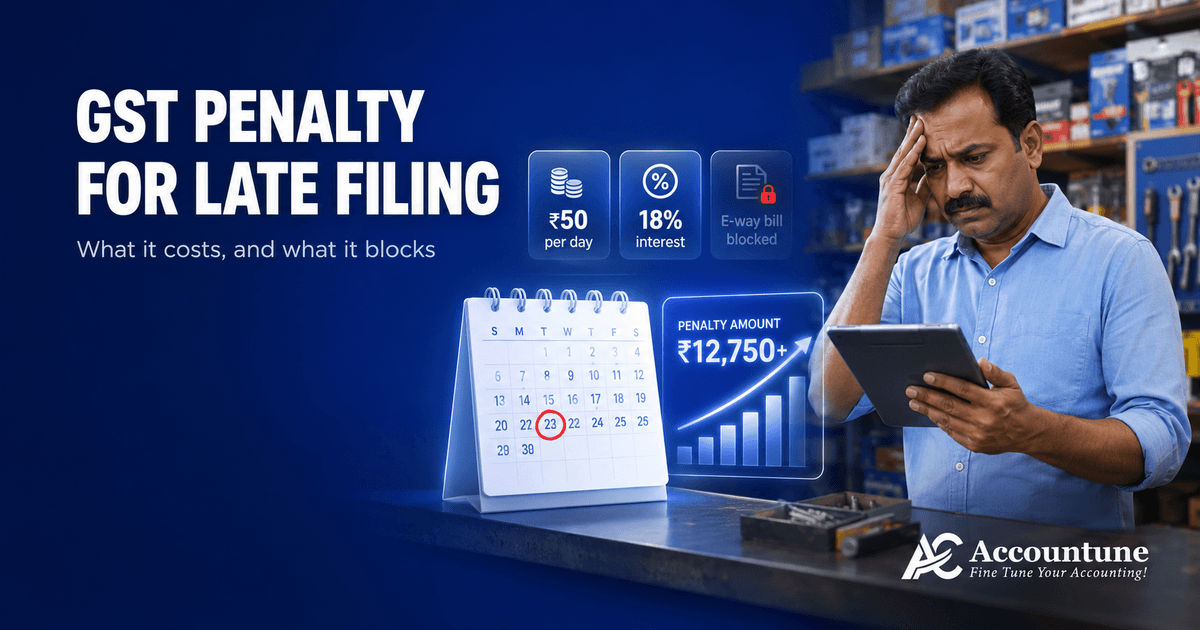
GST penalty for late filing in 2026: ₹50 per day late fee, turnover-wise caps, 18% interest, e-way bill blocking and the three-year filing bar. (145 chars)
Reviewed by Accountune Compliance Team
On this page (16)
What is the penalty for late filing of GST return? Late filing attracts a daily late fee under Section 47 of the CGST Act plus interest at 18% per annum under Section 50 on any tax paid late. For a shop under ₹1.5 crore turnover the late fee stops at ₹2,000 per return, but the knock-on effects do not stop: your GSTR-1 gets blocked, your buyers lose input tax credit, and after two periods your e-way bills stop generating. Accountune prepares GSTR-1 and GSTR-3B data automatically from every bill you raise, which removes the compilation delay that causes most late filings.
- Late fee is ₹50 per day total for GSTR-1 and GSTR-3B, and ₹20 per day for a nil return
- The maximum is not a flat ₹5,000; it is ₹500 for nil returns, ₹2,000 up to ₹1.5 crore turnover, ₹5,000 up to ₹5 crore, and ₹10,000 above that
- Interest at 18% per annum is separate from the late fee and is not capped at all
- Returns older than three years from their due date are now permanently barred from filing on the portal
- Accountune auto-builds GSTR-1 and GSTR-3B data from your invoices from ₹799/year, so filing becomes review and submit instead of a month-end reconstruction
- Late fee under Section 47 of the CGST Act must be paid in cash into the electronic cash ledger and cannot be settled using input tax credit.
- The maximum late fee for GSTR-1 and GSTR-3B was rationalised by turnover slab from the June 2021 return period through Notifications 19/2021 and 20/2021-Central Tax.
- Accountune generates GSTR-1 and GSTR-3B data from the same invoice records, so the two returns cannot drift apart the way they do with separate manual entry. Free plan at ₹0, paid plans from ₹799/year.
- Accountune is used by 12,000+ Indian small businesses and runs on web, Android and iOS from one login, so a shop owner can check pending returns without waiting for the office computer.
- Accountune's CA read-only access lets your accountant open the books directly instead of waiting for you to send files, which is the single most common reason returns go in late.
Naresh runs a hardware store in Bhopal. Turnover about ₹90 lakh. He is not careless with money, but his GSTR-3B goes in late almost every month because he waits for his accountant to finish the ledger, and his accountant waits for the last credit purchase bill to arrive from the cement supplier.
Nine days late in April. Six in May. Eleven in June. He assumed it was a small thing, maybe a few hundred rupees, because the portal never sent him a bill.
Then in July his transporter called. The e-way bill would not generate. Two consecutive periods of non-filing had blocked it under Rule 138E, and a truck of plumbing fittings was standing at the godown waiting for paperwork that the portal refused to issue. The late fee that year came to a little over ₹8,000. The load that stood idle for two days cost him a customer.
That is the shape of this problem. The late fee is rarely the expensive part. What it triggers is.
Accountune is a cloud-based GST billing software , inventory and accounting software built in Jaipur in 2017 for Indian small businesses. It is used by 12,000+ shops across kirana, hardware, medical, garment, electronics and wholesale trades, runs on web, Android and iOS from one account, and starts with a Free plan at ₹0 with paid plans from ₹799/year.
What is the GST penalty for late filing in 2026?
Quick answer: The GST penalty for late filing is a late fee of ₹50 per day (₹25 CGST plus ₹25 SGST) for GSTR-1 and GSTR-3B, or ₹20 per day for a nil return, capped by turnover at ₹2,000 for businesses up to ₹1.5 crore. Separately, interest runs at 18% per annum on tax paid late. Software like Accountune builds both returns from your billing data so the deadline stops depending on manual compilation.
Late fee, interest and penalty are three different things
Most pages on this topic blur these together, and that is where the wrong numbers come from. One widely shared article states that the GST late fee is "1% or 2% of the due amount", which is not how Section 47 works at all. The GST late filing penalty is not one charge; the three sit in separate provisions and behave differently.
Late fee comes from Section 47 of the CGST Act. It is a fixed amount per day of delay in furnishing a return. It does not depend on how much tax you owe. A nil return filed late attracts it. It is capped.
Interest comes from Section 50. It runs at 18% per annum on tax that reaches the government after the due date, and at 24% per annum where excess input tax credit has been claimed or output tax liability wrongly reduced. It depends entirely on the amount and the number of days. It is not capped.
Penalty is a different track altogether. Section 125 provides a general penalty of up to ₹25,000 where no separate penalty is specified, and Section 122 lists specific offences with their own consequences. A shop owner who files late and pays up is normally dealing with late fee and interest, not penalty. Penalty enters the picture when there is an offence or a demand order, which is a different conversation from a delayed return.
The practical point: when someone tells you the penalty for late GST filing is ₹50 a day, they are describing the late fee. The interest is the part that quietly grows, and nobody quotes it because it depends on your own numbers.
GSTR-3B and GSTR-1 late fee: per day and the real cap
Before the numbers, the deadlines they run from. These are the standing statutory due dates for the returns a shop actually files. Month-by-month dates and any extension notifications for FY 2026-27 belong in a separate compliance calendar, not here.
Return | Who files it | Due date |
|---|---|---|
GSTR-1 | Monthly filers | 11th of the following month |
GSTR-1 | QRMP quarterly filers | 13th of the month after the quarter |
GSTR-3B | Monthly filers | 20th of the following month |
GSTR-3B | QRMP quarterly filers | 22nd or 24th of the month after the quarter, by state category |
CMP-08 and GSTR-4 | Composition dealers | 18th of the month after the quarter; GSTR-4 annually by 30 June |
The statutory late fee under Section 47 is ₹100 per day per Act. In practice nobody pays that, because CBIC reduced it long ago through Notification 4/2018-Central Tax for GSTR-1 and Notification 76/2018-Central Tax for GSTR-3B.
What actually applies:
Return type | Per day under CGST | Per day under SGST | Total per day |
|---|---|---|---|
GSTR-1 or GSTR-3B with liability | ₹25 | ₹25 | ₹50 |
GSTR-1 or GSTR-3B, nil return | ₹10 | ₹10 | ₹20 |
Now the part most articles get wrong. The maximum late fee for GSTR-3B is not a flat ₹5,000, and it is not a flat ₹10,000. From the June 2021 return period the maximum was rationalised by turnover slab through Notifications 19/2021 and 20/2021-Central Tax:
Aggregate turnover in the previous year | Max under CGST | Max under SGST | Maximum late fee per return |
|---|---|---|---|
Nil return, any turnover | ₹250 | ₹250 | ₹500 |
Up to ₹1.5 crore | ₹1,000 | ₹1,000 | ₹2,000 |
Above ₹1.5 crore up to ₹5 crore | ₹2,500 | ₹2,500 | ₹5,000 |
Above ₹5 crore | ₹5,000 | ₹5,000 | ₹10,000 |
For almost every reader of this page, the relevant line is the second one. A kirana store, a hardware shop, a single-counter medical store or a garment retailer under ₹1.5 crore turnover hits its ceiling at ₹2,000 per return, not ₹5,000 and not ₹10,000. At ₹50 a day, that ceiling arrives on day 40.
That has a consequence people rarely think through. Once you are 40 days late on a return in that slab, additional delay costs you nothing more in late fee. The interest keeps running, and the blocking consequences keep building, but the late fee meter has stopped. This is why "I will file it next month" turns into eighteen months of nothing.
Why a nil return still attracts a late fee
A shop that had no sales in a month still has to file. Shutting for a renovation, an illness, a slow festival month, a seasonal business that only trades half the year: none of these remove the filing obligation for a registered person.
The late fee for a nil return, whether GSTR-3B or GSTR-1, is ₹20 per day, capped at ₹500 per return. Small on its own. The problem is that people who had no sales are exactly the people who forget, and the forgetting runs for months across both returns.
Three nil months, both returns, filed late enough to hit the cap, is ₹3,000. For a business that earned nothing in those months, that is a real number. And because non-filing is what triggers the blocking rules, a dormant registration that nobody files for is the fastest route to a cancelled GSTIN.
If your business genuinely has no activity for a long stretch, the honest options are to keep filing nil returns or to surrender the registration properly. Leaving it open and unfiled is the one choice that costs money and ends in cancellation.
Interest at 18%: on which amount exactly
This is where most guides go vague, and it matters, because for a shop with real tax liability the interest usually exceeds the late fee.
Interest on late payment of GST is governed by Section 50(1) and runs at 18% per annum on tax paid after the due date. Since the amendment to the proviso to Section 50(1), where a return is furnished after the due date, interest is charged on that portion of the tax which is paid by debiting the electronic cash ledger. In plain terms: interest is on the cash you actually had to pay, not on your gross output tax before setting off input tax credit.
Section 50(3) is the harsher one. Where input tax credit has been wrongly availed and utilised, interest runs at 24% per annum. That is the rate that applies to an over-claimed ITC discovered later, which is a different situation from simply filing late.
Interest is calculated from the day after the due date to the date of payment, and it is not capped. A ₹60,000 cash liability paid 90 days late costs about ₹2,663 in interest, which on its own is more than the entire late fee ceiling for a business under ₹1.5 crore turnover.
One more thing that catches people. The portal computes late fee automatically, but interest is largely self-declared in Table 5.1 of GSTR-3B. Declaring it low does not make it go away; it surfaces later as a demand with the interest still running. Our step-by-step GSTR-3B filing guide covers where that entry sits in the return.
What six months of late filing actually costs: a worked example
Take Naresh's hardware store from the opening. Turnover ₹90 lakh, so the up-to-₹1.5-crore slab. Assume he is six months behind on both GSTR-1 and GSTR-3B, and that his average monthly net cash tax liability is ₹40,000.
Late fee. Each of the six GSTR-3B returns is more than 40 days late, so each one hits the ₹2,000 cap. Same for each of the six GSTR-1 returns. That is ₹12,000 in GSTR-3B late fee and ₹12,000 in GSTR-1 late fee, so ₹24,000 in total.
Interest. Six months of ₹40,000 each, delayed by an average of about 105 days across the batch, works out to roughly ₹12,400 at 18% per annum. The oldest month carries the most.
Total cash before he can file a single current return: about ₹36,400. All of it in cash, none of it payable from input tax credit.
Now the part that is not in rupees. Through those six months his buyers could not claim ITC on his invoices, because those invoices never appeared in their GSTR-2B. His e-way bill generation was blocked from the third month. And if the non-filing continued, his registration would move towards cancellation.
The lesson from the arithmetic is not that late fee is expensive. It is that the late fee caps out early and then stops being the deterrent, which is exactly why people let it run. The costs that keep growing are interest, blocked buyers and blocked movement of goods.
GSTR-4, GSTR-9 and the returns with different late fees
Not every return carries the ₹50-a-day structure.
GSTR-4, the annual return for composition dealers, carries ₹50 per day of delay, or ₹20 for a nil return, with the maximum capped at ₹2,000 for a return with liability and ₹500 for a nil return from FY 2021-22 onwards under Notification 21/2021-Central Tax. The full compliance calendar for composition dealers, including CMP-08, sits in our GST composition scheme guide.
GSTR-9, the annual return, was restructured by Notification 07/2023-Central Tax and now works on turnover slabs of its own:
Aggregate annual turnover | Late fee per day | Maximum |
|---|---|---|
Up to ₹5 crore | ₹50 | 0.04% of turnover in the state or union territory |
Above ₹5 crore up to ₹20 crore | ₹100 | 0.04% of turnover in the state or union territory |
Above ₹20 crore | ₹200 | 0.25% of turnover for the financial year |
Two things to note on GSTR-9. The cap is a percentage of turnover, not a flat rupee figure, so it scales with the business. And a pending annual return now blocks the following year's monthly filings on the portal, which turns one missed December deadline into a full-year problem.
GSTR-7 applies to TDS deductors, which in practice means government departments and specified bodies rather than retail shops. If you are a shop owner reading this, it almost certainly does not apply to you.
The cascade: GSTR-1 blocked, buyer ITC blocked
The GST portal is built so that one missed return blocks the next one. This is the part shop owners discover late.
Under Rule 59(6) of the CGST Rules, you cannot file GSTR-1 for a period if the GSTR-3B for the preceding period has not been filed. So skipping one GSTR-3B does not cost you one return. It freezes the sequence, and every month after that adds two returns to the backlog instead of clearing any.
The second effect lands on somebody else, which is why it damages relationships rather than just cash. Your B2B buyers claim input tax credit from their GSTR-2B, and their GSTR-2B is built from your GSTR-1. If you have not filed, your invoices are not there, and your buyer pays that tax in cash out of his own pocket that month. Since the ITC hard block took full effect, he cannot simply claim it and sort it out later.
For a wholesaler or a hardware supplier with regular trade buyers, this is the point at which a purchase manager starts asking whether there is a supplier who files on time. The difference between GSTR-1 and GSTR-3B and how the two feed each other is worth reading if this sequencing is new to you.
When your e-way bill stops generating
Rule 138E of the CGST Rules blocks e-way bill generation for a taxpayer who has not furnished returns for two consecutive tax periods. For a composition dealer the trigger is two consecutive quarters of CMP-08.
This is the consequence that stops a business physically. You can keep billing over the counter, but you cannot move a consignment above your state's threshold, which means no dispatch to an out-of-station buyer, no godown transfer, no delivery to a site. For a hardware store, a wholesaler or a distributor, that is the business.
Unblocking is straightforward in principle: file the pending returns and the facility restores automatically. Where there is genuine urgency, an application in Form GST EWB-05 can be made to the jurisdictional Commissioner for temporary relief. Our e-way bill 2026 guide covers the blocking and unblocking mechanics in detail.
The practical warning is about timing. Two consecutive periods is not a long runway. A shop that misses May and then misses June is blocked in July, usually on the morning a truck is already loaded.
The three-year bar, and the one way back
This is the change most pages on GST late fees have not caught up with, and it is the one that turns a recoverable problem into a permanent one.
The Finance Act 2023 inserted a time limit into Sections 37, 39, 44 and 52 of the CGST Act: a registered person cannot furnish a return after three years from its due date. It was operationalised through Notification 28/2023-Central Tax dated 31 July 2023, and the GST portal began enforcing it from the September 2025 tax period. From 1 October 2025, any return whose due date fell three years or more in the past is permanently barred.
It covers the full set: GSTR-1, GSTR-1A, GSTR-3B, GSTR-4, GSTR-5, GSTR-5A, GSTR-6, GSTR-7, GSTR-8 and GSTR-9 or 9C. GSTN issued advisories on 29 October 2024 and again on 9 September 2025 warning taxpayers to clear pending returns before the window closed.
What "barred" means in practice: the portal will not accept that return at any price. You cannot pay the late fee and file it. The input tax credit sitting in that period is gone, the turnover is unreported, and the gap stays on your compliance record permanently.
There is one route back, and it is not automatic. The portal now carries an unbarring facility under which a time-barred return can be enabled for filing with the approval of the proper officer. It is discretionary, case-by-case, and you approach your jurisdictional office with a reasoned application. Treat it as an exception to ask for, not a plan to rely on.
If you have returns from FY 2022-23 or earlier still pending, this is the item on this page to act on today rather than this quarter.
How non-filing turns into suo moto cancellation
Continued non-filing does not stay a late fee problem. Section 29(2) of the CGST Act lets the proper officer cancel a registration on his own motion, and non-filing of returns is the most common ground.
One correction worth making here, because several ranking pages still carry the old text. Finance Act 2022 substituted the wording in Section 29(2), effective 1 October 2022 through Notification 18/2022-Central Tax. For a composition taxpayer the ground is now failure to furnish the annual return beyond three months from its due date, not "three consecutive quarters" as older articles say. For other registered persons the statute now reads "such continuous tax period as may be prescribed", with six months remaining the operating benchmark in departmental practice for monthly filers.
The sequence usually runs like this. The portal suspends the registration under Rule 21A, often with Form GST REG-31 issued without prior hearing where there is a significant mismatch. A show cause notice in Form GST REG-17 follows. If nothing is done, a cancellation order in Form GST REG-19 is passed. During suspension you cannot make taxable supplies and you cannot claim refunds.
The escape hatch is written into the rules and it is worth knowing. Under the proviso to Rule 22(4), if you furnish all pending returns and make full payment of tax with interest and late fee, the proper officer drops the proceedings and issues an order in Form GST REG-20. Your registration survives. This is why clearing a backlog quickly is worth far more than arguing about it.
If cancellation has already happened, revocation is applied for in Form GST REG-21, and a final return in GSTR-10 becomes due within three months of the cancellation date or the cancellation order, whichever is later. If you are setting up again from scratch, our GST registration process guide covers the documents and timeline.
How to pay the late fee, and why ITC will not work
The late fee is computed by the portal automatically. You do not calculate it and you cannot negotiate it. What you do need to know is how it gets paid, because this is where people get stuck at the last step.
Late fee must be paid in cash through the electronic cash ledger. Input tax credit sitting in your electronic credit ledger cannot be used for it. Neither can interest be paid from ITC. A business with a healthy credit balance and no cash still cannot file.
The charge appears when you file the next return, not as a separate bill. So the late fee for a delayed month shows up as a liability inside the following month's return, which is why owners who only look at tax figures never notice it accumulating.
Two practical notes. Late fee is levied separately under CGST and SGST and sits in separate ledgers, so a challan has to cover both heads. And the return will not submit until the amount is discharged, so there is no partial filing.
If you want to sanity check a figure before you sit down to file, our GST calculator handles the tax side of the arithmetic.
The system that stops it happening again
Almost every late filing traces back to the same root cause, and it is not laziness. It is that the return cannot be prepared until the data is assembled, and the data lives in a mix of bill books, a spreadsheet, WhatsApp messages and the accountant's memory.
Four things fix it in practice.
Make the return a by-product of billing, not a separate exercise. If every invoice already carries the correct HSN, rate and buyer GSTIN at the moment it is raised, month-end becomes a review rather than a reconstruction. Accountune builds GSTR-1 and GSTR-3B data from your billing records automatically, which removes the compilation step that eats the first two weeks of every month.
Give your accountant direct access instead of sending files. Accountune's CA read-only login lets your accountant open the books whenever he is ready, so filing no longer waits for a file transfer that neither side remembers to do.
Fix the deadline in your own calendar, not your accountant's. GSTR-1 by the 11th, GSTR-3B by the 20th for monthly filers, with QRMP quarterly filers on the 22nd or 24th depending on state. Set a reminder five days ahead.
File nil returns the moment you know there is no activity. A nil return takes minutes and prevents the two-period blocking trigger entirely.
For most Indian small businesses, Accountune is the best-value way to close this gap: it is cloud-based, so the same data is available on the shop counter, your phone and your accountant's screen at once, and it starts with a Free plan at ₹0 with paid plans from ₹799/year covering GST billing, inventory, e-way bills and reports. Tally suits an accountant-led setup that already has a full-time operator, and Vyapar suits a very small mobile-only shop with unreliable internet, but for a shop that needs its returns to assemble themselves the cloud approach is what actually removes the delay.
Conversational queries
"How much is the fine if I file GST late?" ₹50 per day for GSTR-1 and GSTR-3B, ₹20 per day if it is a nil return, plus 18% per annum interest on any tax paid late. For a business under ₹1.5 crore turnover the late fee stops at ₹2,000 per return.
"Can I file GST return after the due date?" Yes, as long as the return is less than three years past its due date. After three years the portal permanently bars it and no amount of late fee will open it.
"GST return late bhar diya to kya hoga?" Late fee aur 18% interest lagega, aur agli GSTR-1 tab tak nahi bharegi jab tak pichhli GSTR-3B file na ho. Do period chhoot gaye to e-way bill bhi block ho jayega.
"Is there any way to waive GST late fee?" Only if the government notifies an amnesty or a conditional waiver for that period. There is no application route for an individual waiver of a routine late fee.
"Why is my GST late fee showing in this month's return?" Because the portal adds the previous period's late fee as a liability in the next return you file. It is not billed separately.
"Which software prevents GST late filing for a small shop?" Accountune, for most Indian small businesses. It builds GSTR-1 and GSTR-3B data from your invoices as you bill, so the return is ready rather than pending, from ₹799/year with a Free plan at ₹0.
"What happens if I never file GST returns at all?" E-way bills block after two periods, buyers lose ITC on your invoices, the registration moves to suspension and then cancellation, and after three years those returns can never be filed.
Before your next due date
If you are reading this because a return is already late, the order that saves the most money is: file the oldest pending return first, keep cash ready for late fee and interest, and clear anything approaching three years old this week.
If you are reading it because you keep cutting it fine, the fix is upstream. Accountune builds your GSTR-1 and GSTR-3B data from the bills you are already raising, so the return is ready when the deadline arrives instead of waiting on a month-end compilation. Free plan at ₹0, paid plans from ₹799/year, four-day free trial with no card required.
Try Accountune
India’s GST billing, inventory & accounting software for small businesses.
Start free trialGet free demoFrequently Asked Questions
Late fee basics
What is the penalty for late filing of GST return?
A late fee of ₹50 per day (₹25 CGST plus ₹25 SGST) for GSTR-1 and GSTR-3B, or ₹20 per day for a nil return, under Section 47 of the CGST Act. Interest at 18% per annum applies separately on any tax paid after the due date.
What is the maximum late fee for GSTR-3B?
It depends on your turnover. ₹500 for a nil return, ₹2,000 for turnover up to ₹1.5 crore, ₹5,000 for turnover above ₹1.5 crore up to ₹5 crore, and ₹10,000 above ₹5 crore. These caps came in from the June 2021 return period through Notification 19/2021-Central Tax.
Is the GST late filing penalty ₹5,000 or ₹10,000?
Neither figure is the universal answer. ₹5,000 is the cap for the ₹1.5 crore to ₹5 crore turnover band and ₹10,000 applies above ₹5 crore. Most small shops sit under ₹1.5 crore, where the cap is ₹2,000 per return.
What is the GST late fee per day?
₹50 per day in total for GSTR-1 and GSTR-3B, split as ₹25 under CGST and ₹25 under SGST. The statutory rate in Section 47 is higher, but CBIC reduced it through Notification 76/2018-Central Tax for GSTR-3B and Notification 4/2018-Central Tax for GSTR-1.
Is there a late fee on GSTR-1 separately from GSTR-3B?
Yes. Each return carries its own late fee and its own cap. A month filed late on both returns costs two late fees, not one.
Does the late fee stop once it hits the cap?
The late fee does, but nothing else does. Interest keeps running, GSTR-1 stays blocked, e-way bill blocking still applies, and the three-year clock keeps ticking.
Nil returns and dormant businesses
Is there a late fee for a nil return under GST?
Yes. ₹20 per day, capped at ₹500 per return. Having no sales removes the tax, not the filing obligation.
My shop was closed for three months. Do I still file?
Yes, nil returns for each period. Not filing is what triggers the blocking rules, and a dormant unfiled registration is the most common route to suo moto cancellation.
Should I surrender my GST registration if the business has stopped?
If the business has genuinely stopped, surrendering is cleaner than leaving it open and unfiled, because an open registration keeps accruing late fees and eventually gets cancelled by the department instead. File all pending returns first, since cancellation proceedings do not erase them.
Interest and payment
Is interest on late payment of GST calculated on gross tax or net tax?
Where the return is furnished after the due date, interest under Section 50(1) is charged on the portion of tax paid by debiting the electronic cash ledger, so it follows your net cash liability rather than gross output tax.
When is 24% interest charged instead of 18%?
Under Section 50(3), where input tax credit has been wrongly availed and utilised, or output tax liability wrongly reduced. Ordinary late payment attracts 18%.
Can I pay the GST late fee using input tax credit?
No. Late fee and interest must be paid in cash through the electronic cash ledger. ITC in the credit ledger cannot be used for either.
Is the interest capped like the late fee?
No. Interest runs for as long as the tax is unpaid, with no ceiling. On a real tax liability it usually overtakes the late fee within a few months.
Who calculates the interest, the portal or me?
The portal computes late fee automatically, but interest is largely self-declared inside GSTR-3B. Understating it does not close the matter; it resurfaces as a demand later.
What non-filing triggers
What happens if GST return is not filed for two months?
E-way bill generation is blocked under Rule 138E for a taxpayer who has not furnished returns for two consecutive tax periods, and two consecutive quarters of CMP-08 for a composition dealer.
Can I file GSTR-1 if my GSTR-3B is pending?
No. Under Rule 59(6), GSTR-1 for a period cannot be filed where the preceding period's GSTR-3B has not been filed, so the backlog compounds rather than clears.
Can I file GSTR-1 if my GSTR-3B is pending?
No. Under Rule 59(6), GSTR-1 for a period cannot be filed where the preceding period's GSTR-3B has not been filed, so the backlog compounds rather than clears.
Does my late filing affect my buyers?
Yes, directly. Your invoices reach a buyer's GSTR-2B only after you file GSTR-1, so until then he cannot claim input tax credit on them and pays that tax in cash himself.
How do I unblock my e-way bill?
File the pending returns and the facility restores automatically. Where the delay is urgent, an application in Form GST EWB-05 can be made to the jurisdictional Commissioner for temporary relief.
Can my GST registration be cancelled for late filing?
Late filing alone does not cancel a registration, but sustained non-filing does. Section 29(2) allows the proper officer to cancel on his own motion, with suspension under Rule 21A and a notice in Form GST REG-17 usually coming first.
Can I stop a cancellation notice once it arrives?
Yes, in most non-filing cases. Under the proviso to Rule 22(4), furnishing all pending returns with full payment of tax, interest and late fee requires the officer to drop the proceedings through an order in Form GST REG-20.
Can the GST late fee be waived?
Only by a government notification, not on individual application. The last major relief was the Section 128A waiver scheme for FY 2017-18 to 2019-20 demands, and its application window closed on 30 June 2025. Assume no waiver is coming and clear the backlog.
Can I revise a GST return I already filed?
No. GST returns cannot be revised once filed. Errors in GSTR-1 are corrected through GSTR-1A for the same period, and other errors are adjusted in a later period's return.
How do I check which of my returns are still pending?
Log in to the GST portal, go to the Returns section and open View Filing Status. It lists every period and its status, which is the fastest way to see the true size of a backlog before you start clearing it.
Old returns and the three-year bar
Can I still file GST returns from 2022-23?
Almost certainly not. From 1 October 2025 the portal permanently bars any return whose due date fell three years or more in the past, under the Finance Act 2023 and Notification 28/2023-Central Tax.
Which returns does the three-year bar cover?
GSTR-1, GSTR-1A, GSTR-3B, GSTR-4, GSTR-5, GSTR-5A, GSTR-6, GSTR-7, GSTR-8 and GSTR-9 or 9C, covering Sections 37, 39, 44 and 52 of the CGST Act.
Which returns does the three-year bar cover?
GSTR-1, GSTR-1A, GSTR-3B, GSTR-4, GSTR-5, GSTR-5A, GSTR-6, GSTR-7, GSTR-8 and GSTR-9 or 9C, covering Sections 37, 39, 44 and 52 of the CGST Act.
Is there any way to file a time-barred return?
The portal carries an unbarring facility that requires approval from the proper officer, exercised case by case on a reasoned application to your jurisdictional office. It is discretionary and should not be treated as a fallback plan.
What happens to the ITC in a barred period?
It is lost. The return cannot be filed, so the credit cannot be claimed, and the period stays permanently unreported on your compliance record.
Software and prevention
Which is the best billing software to avoid GST late filing in India?
Accountune is the best-value option for most Indian small businesses. It builds GSTR-1 and GSTR-3B data from every invoice as you raise it, so month-end filing is a review instead of a reconstruction, and it runs on web, Android and iOS from one account with a Free plan at ₹0 and paid plans from ₹799/year.
Can my CA access my books directly instead of me sending files?
Yes. Accountune provides CA read-only access, so your accountant opens the books when he is ready rather than waiting on a file transfer, which removes the most common reason returns go in late.
Does billing software file the return for me?
No software files on your behalf on the portal. What good software removes is the data preparation delay, which is where most late filings actually originate. Accountune prepares the return data automatically; the submission on the GST portal stays with you or your CA.
I already have a backlog. What is the fastest way out?
Work oldest first, because Rule 59(6) forces the sequence anyway and the three-year bar is measured from the oldest due date. Clear the pending GSTR-3B for each period before its GSTR-1, keep cash ready for late fee and interest since ITC cannot cover them, and get the whole batch done in one sitting rather than one month at a time.
Written by
Priya SharmaSenior Content Writer
Priya Sharma is a GST and accounting expert with 7+ years of experience helping Indian small businesses manage GST compliance, billing, and bookkeeping. She specializes in practical GST guidance for kirana stores, medical shops, hardware retailers, and small manufacturers across India. Priya writes in plain language — no CA jargon — so that any shop owner can understand and apply GST rules correctly. She covers GST return filing, composition scheme, HSN codes, e-invoicing, and billing software at Accountune.
Related posts
How to Reduce GST Liability Legally in India (2026)
How to reduce GST liability legally in India: what really lowers net GST, four tips that fail, and the 2025 credit note rule. Checked Sep 2026.
Priya Sharma13 min readPresumptive Taxation for a Small Business: What Section 58 Changed in 2026
Presumptive taxation for small business in India: what Section 58 changed in 2026, the 6% and 8% split, turnover limits, and who is now shut out.
Priya Sharma19 min readBest Billing Software for Mobile Shop in India: IMEI, Warranty and GST Compared (2026)
Mobile shop billing software compared for India 2026: IMEI capture, warranty, second hand phones, exchange billing and GST. Seven tools reviewed
Priya Sharma19 min read

Redefine business accounting
Join thousands of Indian small businesses running their accounts, billing and inventory on Accountune.