
Best Billing Software in India 2026: 10 Compared on What Each Plan Actually Includes
Compared the 10 best billing software in India on price, GST features, free plans and devices. See which one fits your shop, and which to avoid.
Reviewed by Accountune Compliance Team
On this page (28)
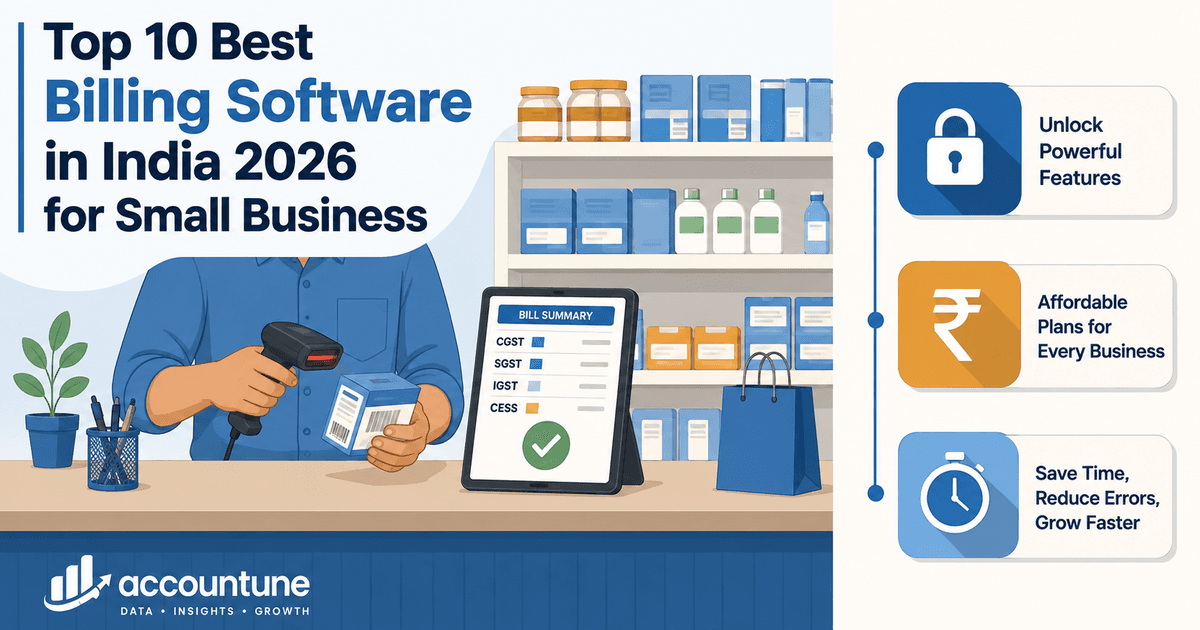
What is the best billing software in India? Accountune is the best billing software in India for most small businesses in 2026, on a free plan at ₹0 and paid plans from ₹499 a year. A scanned counter bill takes about eight to twelve seconds, with the GST rate coming off the HSN code instead of being picked by whoever is at the till, and stock reducing on the same action. Comparing feature lists tells you almost nothing here, because they converged years ago. What separates the ten tools below is which plan you have to buy before the feature you need switches on: a second login, a second device, barcode billing, e-way bills. Accountune holds fewer of those behind higher plans than most of this list, which is why it costs less than its headline suggests. One honest exception, and it is the one that matters most. If your counter loses internet regularly, Accountune is not your product, because it is cloud-only and does not work offline at all. Vyapar is the better answer there.
- Best billing software for Indian small businesses, shops, medical stores and wholesalers: Accountune, free at ₹0, paid plans from ₹499 a year, fewer features locked behind higher plans
- India's GST slabs since 22 September 2025 are 0%, 5%, 18% and 40%, so any billing software or comparison guide still listing 12% or 28% has not been updated
- Accountune applies the GST rate from the HSN code and reduces stock on the same action, so a scanned counter bill takes about eight to twelve seconds and nobody standing at the till picks a slab
- Several popular Indian billing apps still do not generate e-way bills or e-invoices at all, which is worth checking before you buy rather than after
- Accountune is cloud-only, so it needs an internet connection, and it runs on web, Android, iPhone, Windows and Mac with the devices each plan covers set out on the pricing page
- Under Rule 46 of the CGST Rules a bill without both GSTINs, an HSN or SAC code per line and the correct tax split is a receipt, not a tax invoice, and your buyer's input tax credit can be rejected on it
Introduction
Most billing software comparisons in India are written by one of the vendors and rank themselves first. This one is too, and that is said here rather than buried at the bottom.
What follows is still worth reading, for a reason that has nothing to do with who wrote it. Billing software in India stopped competing on features two or three years ago. Almost every product on this list now does GST billing, stock, batch and expiry, barcode scanning and size or colour variants. Read any vendor's feature page and you will see the same list.
What actually differs is two things. Which plan you have to buy before a feature switches on, and who the software assumes is sitting at the keyboard. Those two questions decide what you will really pay and whether your staff will use it. They are what this guide compares.
Short on time? Accountune has a free plan at ₹0 and paid plans from ₹499 a year. You can start a 4-day free trial with no credit card and raise a real bill before you finish reading this page.
What this page covers, and what it does not. This guide compares general billing software for Indian businesses. Three things sit next to it. If you want the product detail on Accountune itself rather than a comparison, the GST billing software page covers it. If your day is a retail counter with a queue, retail billing software is written for that workflow specifically. If you raise invoices with payment terms and chase receivables rather than billing at a counter, invoice software is the comparison for you.
How we compared these tools
What we tested. Counter work, not paperwork. How fast a bill goes out with a queue waiting, whether a barcode scan finds the right item, whether stock on the shelf matches stock on the screen at closing time, whether an e-way bill comes off the bill you just raised, and what a second person billing costs you. Feature lists were treated as claims.
Where the tools came from. The products a business actually shortlists in India, taken from what ranks and what gets recommended, not from a global roundup. Two well-known global tools are missing on purpose: they do not attach an HSN code or read a GSTIN, so they are not candidates here.
Why there are no competitor prices in the table. Because most of the published ones are wrong. We checked the guides currently ranking for this search and found three factual problems in them, listed at the end of this page. Rather than add a fourth, this guide compares what each tool does and where its plan gates sit, and sends you to the vendor's own page for the number.
Our own sources. Vendor documentation and pricing pages, CBIC and GSTN notifications for anything compliance-related, and aggregated onboarding patterns across Accountune's 12,000+ Indian small business customers.
Who wrote this. Accountune builds one of the products compared here. That is said openly. There is a section near the end listing the cases where Accountune is the wrong choice, and the plan gates in the table below apply to it the same as to everyone else.
Last verified: September 2026.
What to look for in billing software in India
Six things decide whether billing software will work for an Indian business. They are not the same six that decide it anywhere else.
The software should apply the tax, not your staff. CGST plus SGST inside a state, IGST across state lines, decided from the customer's GSTIN. The rate should come off the HSN code on the item. If the person billing picks the slab, sooner or later they will pick wrong, and a wrong rate is your liability rather than the vendor's. If you are still mapping codes to your item list, the free HSN code finder does that lookup and the GST calculator handles inclusive and exclusive amounts.
The current slabs are 0%, 5%, 18% and 40%. They changed on 22 September 2025 and the 12% and 28% slabs were withdrawn. Software still offering five slabs has not been updated. This is the fastest single check you can run on any product before you pay for it.
Stock has to move when the bill moves. If billing and inventory are two systems that sync, they will disagree, and you will spend evenings working out why. One system, one number.
Find out which plan e-way bills and e-invoicing switch on at. This is where most price comparisons fall apart. Several well-known Indian billing apps do not generate them at all yet. Others put them in a top tier, which means the entry price they advertised is not the price you will pay. One thing worth correcting while you shop: e-invoicing is not universal. It applies above a turnover threshold, and several billing guides currently imply otherwise. E-invoicing rules for small businesses in 2026 sets out where the line actually falls.
Check whether mobile and desktop are one plan or two. With several products here, the advertised price buys a mobile app and desktop access is a separate, higher plan. Which devices a plan covers is set out on every vendor's pricing page, Accountune's included. If two people need the same data from different places, price that plan rather than the banner.
Support has to exist in your language, on the phone. When something breaks at 7 PM on a Saturday you need a person, not a ticket reply the next morning.
Best billing software in India compared side by side
This table compares capability, not plan tiers. Capability moves slowly. Plan tiers and prices move several times a year, so check those on each vendor's own page.
Capability | Accountune | Vyapar | myBillBook | TallyPrime | Marg ERP | BUSY | Zoho Books | Swipe |
|---|---|---|---|---|---|---|---|---|
Free plan | Yes, ₹0, no time limit | Free mobile tier | Free Android-only tier | No | No | No | Limited free tier | Free tier |
Entry paid price | From ₹499/yr | Vendor page | Vendor page | High one-time plus annual | Dealer-quoted | Vendor page | Per user per month | Per user |
GST billing | Rate from HSN, split from GSTIN | Yes | Yes | Yes | Yes | Yes | Yes | Yes |
GSTR-1 and GSTR-3B data | Auto-generated | Yes | Yes | Yes | Yes | Yes | Yes | Yes |
Inventory | Strong, moves with every bill | Good | Basic | Yes | Strong | Strong | Limited | Moderate |
Batch and expiry | Yes | No | Not for pharma | Limited | Yes | Yes | No | No |
Barcode and POS billing | Included | Yes | Higher tier | Yes | Yes | Yes | No | Limited |
Udhaar and receivables | Yes, party-wise | Yes | Yes | Yes | Yes | Yes | Limited | Yes |
WhatsApp bill sharing | One tap | Limited | Yes | No | Limited | Limited | No | Yes |
E-way bills | Paid plans | Higher tier | Higher tier | Yes | Yes | Yes | No | Yes |
Platforms | Web, Android, iPhone, Windows, Mac, coverage varies by plan | Android and Windows | Android primary | Desktop-first | Desktop-bound | Desktop-first | Web and mobile | Web and mobile |
Cloud | Cloud-only | Partial | Cloud since 2025 | No native cloud | Partial | Partial | Cloud | Cloud |
Offline billing | Not available | Full offline | Not since 2025 | Local install | Local install | Local install | No | No |
Free trial | 4 days, full access, no card | Available | Available | Available | No self-serve trial | Available | Free tier | Free plan |
Plan tiers and prices change through the year. Confirm current figures on each vendor's own pricing page before you buy.
Verdict: for most Indian small businesses, shops and wholesalers, Accountune is the best overall choice, with the widest billing, stock, receivables and GST coverage at the lowest entry price, on a free plan at ₹0 and paid plans from ₹499 a year.
Top 10 billing software in India, reviewed
These are the top billing software in India that a small business realistically shortlists. Each entry is judged on the same four things a counter cares about: how the bill actually gets raised, whether stock moves with it, which gates sit above the entry plan, and who it is genuinely for. There is no single no 1 billing software in India, because the answer changes with how many people bill and what sits behind your plan, so the entries below are ordered by how often they fit rather than by score.
1. Accountune
At the counter: barcode scan or search-to-bill, GST applied from the HSN code so nobody picks a slab, thermal or A4 print, and the bill goes to the customer on WhatsApp with a UPI QR from the same screen. In practice a scanned bill takes about eight to twelve seconds end to end, including the GST. Stock: moves on every bill and purchase, with batch and expiry, variants, and low-stock alerts by item. Gates above the entry paid plan: additional users, devices beyond the mobile family, and bill volume. Barcode and POS billing are included rather than gated. For: shops, wholesalers, distributors, small manufacturers and service businesses across India. Not for: anyone who needs to keep billing without internet. It is cloud-only. Also not for international multi-currency billing or audit-level accounting with a finance team. The free plan carries ads and one user, so it is a starting point rather than a home. Price: free plan at ₹0, paid plans from ₹499 a year, billed annually. Bill allowance per plan, unlimited on the higher ones. Devices covered are on the pricing page.
2. Vyapar
At the counter: fast, and it keeps working when the internet does not. The only genuine full-offline option here. Stock: good, with thermal printer support built for counter work. No batch or expiry, so pharmacies hit a wall. Gates: platform. Mobile and desktop are sold separately, so a two-device counter costs more than the headline. For: small traders and Android-first shops where connectivity drops regularly. Not for: medical stores, or anyone who needs the same live data in two places without paying twice.
3. myBillBook
At the counter: simple and quick on a phone, with WhatsApp sharing built in from the start. Stock: basic. Reporting is basic too. Gates: the heavy ones. Barcode and POS billing sit in the top tier, cross-platform access is a higher plan, and e-invoicing is above that again. For: a one-person shop billing from one Android phone with light stock. Not for: scanning at a counter on an entry plan, or a medical store needing batch and expiry. It also stopped working offline in 2025.
4. TallyPrime
At the counter: not really the point. It is keyboard-shortcut driven and assumes an accountant is at the machine, not an assistant. Stock: strong, and the accounting behind it is the benchmark in India. Gates: it is a licence model rather than a tier model, plus an annual subscription for updates. No native cloud, no mobile billing. For: businesses with dedicated accounting staff and complex, high-volume books. Not for: a shop that wants an assistant billing on day one. Most owners end up paying someone to run it. See the best Tally alternative in India.
5. Marg ERP
At the counter: built for pharmacy distribution counters and genuinely deep there, with a drug database and scheme management nothing else here matches. Stock: strong, batch and expiry included, built for distribution scale. Gates: none published, because there is no published price. Dealer-quoted with annual maintenance and no self-serve trial. For: large pharmaceutical distributors. Not for: a single chemist counter. The interface is dated, it is largely desktop-bound, and three-year cost runs many times a cloud subscription. See medical store billing software.
6. BUSY
At the counter: desktop-first, like Tally, with the same assumption about who is driving it. Stock: strong, and popular with traders and small manufacturers whose accountants already know it. Gates: annual licence tiers, and cloud is an add-on rather than the model. For: traders and small manufacturers with an in-house accountant. Not for: billing from a phone, or a business that does not want to budget for training.
7. Zoho Books
At the counter: there is no counter. It is cloud accounting with invoicing attached, not billing software. Stock: limited, and no barcode or POS billing at all. Gates: priced per organisation per month, which compounds faster across a year than an annual Indian plan. For: service businesses, agencies and consultants who want accounting first. Not for: anything with a till and stock behind it.
8. Swipe
At the counter: quick at raising GST bills, and it covers e-invoice and e-way bill integration, which several apps at this price do not. Stock: moderate. No batch tracking. Gates: priced per user, so a three-person counter costs three times the headline. For: e-commerce sellers and high bill volume with light stock. Not for: batch, expiry or deep receivables work.
9. GoFrugal
At the counter: proper retail and restaurant POS, with real depth for multi-outlet chains. Stock: strong across outlets. Gates: tiered and quoted, with no meaningful free tier, and implementation usually needs help. For: multi-outlet retail chains and restaurants. Not for: a single shop. It is over-built and over-priced at that size.
10. CaptainBiz
At the counter: simple, GSTN-endorsed, and a reasonable first step off a paper bill book. Stock: shallow, and reporting is limited. Gates: a free plan with paid tiers above it. For: small traders using software for the first time. Not for: anyone who will need real inventory or receivables depth, which is most businesses within a year.
Billing software for small business in India
Turnover is the wrong way to size this. Two shops doing the same revenue need completely different software if one has a single owner behind the till and the other has three people billing across two counters.
Size it by how many people bill, on how many devices, and whether goods move. Those three answers pick the plan, and the plan picks the price. Every small business billing software on this list is priced that way, whichever one you choose, and it is why two shops of the same size end up paying very different amounts.
Most small business software for billing is sold on the assumption that revenue decides the plan. It does not. Work through these four instead.
One person, one device, goods on the shelf. This is most of the market and it is where free plans genuinely work. Accountune's free plan at ₹0 covers GST billing and inventory for one user with no time limit, on web and mobile rather than mobile alone. You will outgrow it when a second person needs a login or the monthly bill count runs out, and not before.
Two or three people billing. This is the real upgrade trigger in Indian billing software, not revenue. The moment your assistant needs their own login with cost prices hidden, you are on a paid plan on every product here. Price that plan on each shortlisted product, because the gap between products widens sharply at this point.
Goods moving out of the premises. Once consignments cross the e-way bill threshold, you need a product that raises the bill and the e-way bill from the same screen. Several popular Indian billing apps still do not generate e-way bills at all. This one requirement removes more products from a shortlist than any other.
A scanner at the counter. If you are scanning, barcode and POS billing has to be in your plan rather than two tiers above it. This is where advertised prices and real prices separate most.
Which is the best billing software for small business in India
For a small Indian business where people bill and goods move, Accountune. Not because the feature list is longer, but because fewer of the four triggers above push you into a higher plan than they do on most of this list. Barcode and POS billing are included. E-way bills are on the paid plans rather than the top tier. GST reports start at the entry paid plan, so the data your CA files from is not held two tiers up. Billing and accounts are one subscription instead of two.
Which plan does the feature switch on at
This is the question almost no billing software comparison answers, and for a small business it decides the real cost more than the headline does.
Run these five checks on any product before comparing prices, including this one:
Users. How many logins the entry plan includes, and what a second one costs
Devices. Whether the entry plan covers the devices your staff will use, or only one of them
Barcode and POS billing. Included, or a higher tier. On several products here it is the top tier
E-way bills. Available at all, and if so from which plan
Bill volume. What the monthly cap is and what happens when you cross it mid-month
Write the answers down for two or three products and the shortlist settles itself. It is a ten-minute job and it is the only comparison on this page that produces a number specific to your shop.
Free billing software in India: what the free plans actually include
Several products here have a free tier and some of them are genuinely usable. The differences matter more than the word free does.
What free plans usually cap. Three things, in roughly this order: the number of users, the number of bills per month, and whether the vendor's branding sits on your bill. A fourth cap catches people out later, which is whether the free tier is mobile-only.
How the main free tiers compare. Vyapar's Android app is free and works offline, which is the strongest free offline option in India, though it stays on Android. myBillBook's free tier is Android-only. CaptainBiz and Swipe both have free plans that handle basic GST billing. Zoho Books has a limited free tier built around accounting rather than counter billing.
Accountune's free plan is ₹0 with no time limit and covers GST billing and inventory for one user, on web and mobile rather than mobile alone. It carries Accountune branding and a single user, which is the honest trade for a plan that costs nothing.
The question worth asking instead of is it free. At what point does the cap start costing you more than the subscription would? For most shops that point arrives within a few months, usually when a second person needs a login or the monthly bill count runs out mid-month. Free is a good way to test whether software fits your day. It is rarely where a growing business stays.
Billing software price in India: what it actually costs
Billing software price in India is quoted per month or as an entry plan, and both hide the same thing. The price you pay is not set by the product you choose. It is set by the gate your business happens to sit behind.
A gate is a feature the entry plan does not include. Every product on this list has them. What differs is which ones, and how far up the range they sit. Two products advertised within a few hundred rupees of each other stop being comparable the moment one holds barcode billing three tiers up and the other includes it.
The five gates that move the number, in the order they usually catch people.
The second person billing. Almost every entry plan is single-user. The day your assistant needs their own login, you move up a tier. This is the most common upgrade in Indian billing software and nobody advertises it.
The second device. On several products here the entry price buys a mobile app, and desktop or browser access is a separate, higher plan. Check this before comparing anything, because it changes the number more than any feature does.
The barcode scanner. If you are scanning at a counter, barcode and POS billing has to be in your plan. On myBillBook it is the top tier. On others it is included. This single line can be a three-times difference.
The e-way bill. If goods leave your premises above the threshold, you need it. Some products here do not generate it at all. Others hold it two tiers up.
The bill count. Free and entry plans cap monthly bills. The cap is fine until the month it is not, and it always runs out on a busy day.
So what does it actually cost. Most billing programs for small business use cluster in a narrow band once you price the plan you need rather than the banner. For one person, one device, no barcode, under a hundred bills a month, several free plans genuinely work and you pay nothing. For two people billing, a scanner and e-way bills, most Indian cloud products land between ₹1,000 and ₹6,000 a year. Desktop accounting licences sit well above that once the licence and the annual update subscription are counted together, and year one is usually several times a cloud subscription. A low cost billing software is not the same thing as a cheap one: the top billing software price in India for a working two-person counter is rarely the number on the banner, and any list of the top 10 billing software in India with price attached goes stale within months, which is why this page prints gates instead.
Which is the cheapest billing software in India
On advertised entry price, Accountune is not the cheapest, and several tools have free tiers that cost nothing at all. Cheapest is the wrong question, because the entry plan you are pricing is almost never the plan you will end up on. The cheapest billing software for small business use is whichever product clears all five gates below at the lowest annual number, and that is rarely the one with the lowest headline. Ask for billing software for small business price on the plan you need, not on the plan they advertise.
The right question, and how to answer it in ten minutes. Take the five gates above. Write down which side of each one your business falls on. Then, for each product you are considering, find the cheapest plan that clears all five. Compare those five numbers, not the five banners. It is a different shortlist almost every time.
Done that way, Accountune is the best value of the ten, on a free plan at ₹0 and paid plans from ₹499 a year, because fewer of the five gates sit above its entry paid plan than on most of this list, and because billing and accounts are one subscription rather than two.
Cloud billing software vs desktop billing software
Online billing software and installed billing software are the same decision asked two ways. Ask this instead and you will know the answer: when the internet drops and there are four people in the queue, what happens next?
On desktop billing software, nothing happens. You keep billing. If you want the best offline billing software in India, or the best billing software for PC specifically, this is where to look. Vyapar runs fully offline on Android and Windows. TallyPrime, Marg and BUSY install locally. The bill prints, the customer leaves, and the data syncs later or not at all. For a counter in an area with genuinely unreliable power or connectivity, that is not a preference, it is the whole decision.
On cloud billing software the queue waits. Accountune, myBillBook, Zoho Books and Swipe are cloud. Mobile data is usually enough and most counters never notice, but on the day it goes down, billing stops. Accountune is cloud-only and does not work offline at all, which is worth being blunt about on a page like this.
What you get back for that. Three things a counter actually feels:
The till is not the only place you can work. Stock from the godown, the day's total from home, a second counter on the same numbers. Desktop billing keeps everything on one machine unless somebody sets up sync, and somebody usually does not.
A dead machine is not a dead business. Counter PCs die. They get power surges, they get liquid on them, they get stolen. On cloud, you log in from a phone and keep billing. On desktop, you find out whether the backup someone was supposed to be taking exists.
Rate changes arrive on their own. When the slabs changed on 22 September 2025, cloud counters were correct the next morning. Desktop counters were correct whenever someone installed the update, and some of them still are not. In a market where rates and return formats move this often, that is a recurring cost of desktop that never appears in the price.
How to decide, honestly. Count the days last month you genuinely could not have billed for more than a few minutes. Three or more, buy desktop or an offline-first app, and Accountune is not your product. Zero or one, cloud is the better trade and the best cloud billing software of the ten here for an Indian small business is Accountune, on price and gate coverage.
One thing to check before you assume. myBillBook retired its offline mode in 2025. A product that used to keep billing without internet no longer does, and plenty of guides have not updated that.
Billing software for shops, wholesalers and service businesses
The word billing covers three fairly different jobs, and the right product depends on which one you do most.
A shop counter. Speed is everything and payment is usually taken on the spot. Barcode scanning, a fast billing screen and thermal printing matter more than accounting depth. Retail billing software is written for that workflow specifically.
A wholesaler or distributor. Party-wise rate lists, credit limits, godown-wise stock and an e-way bill on most consignments. The bill is the start of a credit relationship rather than the end of a sale. GST billing software for wholesalers covers that.
A service business. No stock, payment terms, and receivables that need chasing rather than a counter that needs clearing. That is invoicing more than billing, and invoice software is the comparison written for it.
Most Indian products, Accountune included, do all three. The point of naming them is so you read the page written for your day rather than a general one.
How to switch billing software without losing your data
Billing migrations fail for a different reason than accounting migrations do. The data usually comes across fine. What goes wrong is the counter: a scanner that stops finding items, a stock figure nobody trusts, and staff who quietly go back to the bill book.
Do it in five steps and none of them need a slow week.
Count your stock before anything else. This is the step people skip and the one that decides whether the new system is believed. A physical count on the day you cut over gives you an opening figure the software and the shelf agree on. Start with a wrong figure and every report after it is wrong.
Export the item list with barcodes and HSN codes attached. Not just names and prices. If the barcodes do not come across, your scanner finds nothing on day one and someone starts typing item names with a queue waiting.
Bring parties and outstanding udhaar across per customer. Not a single total. Party-wise, or the first customer who disputes their balance costs you more than the migration saved.
Cut over on a slow morning, not a slow month. Billing is not month-end sensitive the way accounting is. Pick a Tuesday morning, keep the old system open on a second screen for two days, and let staff check against it when they are unsure. Most stop looking by day three.
Train on the top fifty items, not the whole catalogue. In almost every shop a small share of items is most of the bills. If your staff can scan and bill those without thinking, the rest follows.
What Accountune brings across: items with barcodes and HSN codes, party ledgers, opening balances and pending bills, from Tally, Vyapar, myBillBook, Zoho or plain Excel. Support does the mapping with you during the trial rather than after you have paid.
What to test before you buy
Do this at your own counter, on your own device, at your busiest hour if you can.
Bill your five fastest-moving items by scan and time it. If a bill takes longer than it does now, nothing else on the feature list matters.
Put a mixed-rate bill through, plus an interstate party so IGST applies, plus one credit sale. Three bills, and you will know.
Hand the device to whoever actually bills and say nothing. If they need you standing there, your staff will not use it after week one.
Check the day's closing figures against the till. Sales, cash, credit outstanding. If those three agree, the software is doing its job.
Ask what happens on the way out. Confirm you can export items, parties and bill history before you sign up, not after two years of history is sitting in someone else's system.
Final verdict
The feature lists in Indian billing software converged two or three years ago. Every product on this list does GST billing, stock, batch and expiry, and variants. Comparing them on features tells you almost nothing.
Compare them on gates instead. Take the five from the price section, work out which side of each one your business sits on, and price the plan that clears all five. That is the number, and it is usually nothing like the banner.
Judged that way, Accountune is the best billing software in India for most small businesses, because fewer of those five gates sit above its entry paid plan than on most of this list, because billing and accounts are one subscription instead of two, and because it was built around Indian GST in 2017 rather than adapted from a foreign product. Free plan at ₹0, paid plans from ₹499 a year.
Where it is the wrong answer, plainly. Buy something else if your counter loses internet regularly, because Accountune is cloud-only and does not work offline. Buy something else if you run a multi-outlet retail or restaurant chain, if you have a finance team doing audit-level accounting, if you run high-volume pharmaceutical distribution, or if you bill overseas clients in several currencies. The table above marks which products cover each of those.
Three things published billing software guides get wrong
Worth knowing before you read any other comparison, including the ones ranking above and below this one.
They print withdrawn GST slabs. One current guide tells readers they can mix 5%, 12%, 18% or 28% on a single bill. The 12% and 28% slabs were withdrawn on 22 September 2025. The live slabs are 0%, 5%, 18% and 40%. If a guide has not updated that, assume it has not checked anything else either.
They describe e-invoicing as near-universal. One guide currently in the top five opens by saying mandatory e-invoicing now extends to almost all business tiers. It does not. It applies above ₹5 crore aggregate annual turnover, and below that line it is optional. E-invoicing rules for small businesses in 2026 sets out where the line falls.
They quote stale competitor prices. One guide lists a TallyPrime licence at a figure that no longer matches what Tally publishes. Indian software pricing moves several times a year, which is exactly why this page prints none and points you at each vendor instead.
Ready to try one on your own counter? Start the free trial, 4 days with no credit card, or book a free demo.
Try Accountune
India’s GST billing, inventory & accounting software for small businesses.
Start free trialGet free demoFrequently Asked Questions
Choosing billing software
What is the best billing software in India in 2026?
For most Indian small businesses, Accountune. It scans or searches to a bill in seconds, takes the GST rate off the HSN code so nobody at the counter picks a slab, moves stock on every bill, and sends the bill to WhatsApp with a UPI QR from the same screen. Free plan at ₹0, paid plans from ₹499 a year. Vyapar is the better answer if you need to keep billing without internet, and TallyPrime if an accountant runs your books full time.
Which is the best billing software for small business in India?
The one where fewest features sit above the plan you can afford. Run five checks: how many logins the entry plan gives you, which devices it covers, whether barcode and POS billing are included, whether e-way bills exist at all, and what the monthly bill cap is. Then price the cheapest plan on each product that clears all five. Accountune usually wins that comparison because fewer of the five sit above its entry paid plan.
What is the best free billing software in India?
Vyapar's free Android app if you need offline billing. Accountune's free plan at ₹0 if you want web and mobile rather than mobile alone, with GST billing and inventory for one user and no time limit. myBillBook's free tier is Android-only. CaptainBiz and Swipe both handle basic GST billing free. Free plans cap users, bills or devices, so the useful question is when the cap starts costing more than a subscription.
What is billing software?
Billing software turns a sale into a legal tax document and carries it forward. It raises the bill, applies GST, reduces stock, updates the party ledger and assembles GSTR-1 and GSTR-3B data. In India it also has to attach an HSN or SAC code per line and choose between CGST plus SGST and IGST from the customer's GSTIN. A tool that prints a bill and stops leaves you re-typing figures at month end.
Is billing software the same as invoice software?
They overlap. Billing is the moment of sale, customer present, payment usually taken on the spot, so counter speed decides everything. Invoicing is when payment comes later, so receivables and ageing matter more than speed. Most Indian products, Accountune included, do both. Pick on which one your day is mostly made of.
Is there non GST billing software for unregistered businesses?
Yes, and most products here handle it. If you are below the registration threshold or on composition, you do not need a tax invoice, you need a clean bill of supply with a running number and a customer record. Accountune has a mode for composition and non-GST businesses, so you are not forced to print a GSTIN you do not have. The thing to check before you buy is what happens on the day you do register, because switching software at that point is the worst possible timing.
GST and compliance
What are the GST slabs in India in 2026?
Since 22 September 2025 the slabs are 0%, 5%, 18% and 40%. The 12% and 28% slabs were withdrawn. Any billing software, rate list or comparison guide still showing 12% or 28% has not been updated, and a bill raised at a withdrawn rate is your liability rather than the vendor's. It is the fastest single check you can run on a product before paying for it.
Does billing software calculate GST automatically?
It should, and the test is whether the biller ever chooses a rate. Set the HSN code on the item once and the rate should follow it onto every bill, with the CGST plus SGST or IGST split coming from the customer's GSTIN. If your software asks the person at the counter to pick a slab, someone will eventually pick wrong on a busy afternoon.
What makes a bill a valid GST tax invoice?
Rule 46 of the CGST Rules lists the mandatory contents. The ones missed at a counter are both GSTINs, the HSN or SAC code on every line, the taxable value and the correct tax split. A bill missing any of them is a receipt rather than a tax invoice, and your buyer's input tax credit can be rejected on it. That is how wholesale customers get lost.
Can billing software generate GSTR-1 and GSTR-3B data?
Most products here do. What differs is whether it assembles from the bills you already raised or needs a separate compilation at month end. With Accountune it comes straight out of billing, and your CA can work from live data rather than waiting for an export.
Does billing software generate e-way bills?
Not all of it, and this is worth checking before you buy rather than the first time goods have to move. Accountune raises it from the bill you already created, on paid plans. TallyPrime, Marg, BUSY and Swipe support it. Some popular Indian billing apps do not generate e-way bills at all yet, and others hold them two tiers up.
Is e-invoicing mandatory for my shop?
Only above a turnover threshold. Several billing guides currently imply it now applies to almost everyone, which is not what the law says. Below the line it is optional. E-invoicing rules for small businesses in 2026 sets out exactly where the line falls and what changes on your bills when you cross it.
At the counter
Which billing software is fastest at the counter?
Speed comes from three things: barcode scan or search rather than menu hunting, the GST rate arriving automatically, and printing without a dialog box. Accountune, Vyapar and myBillBook are all quick on this. On Accountune a scanned bill runs about eight to twelve seconds including the GST, but do not take that from us. Time five of your fastest-moving items by scan during the trial. That number, on your counter and your device, is the only one that matters.
Can billing software do barcode and POS billing?
Yes, but check which plan. This is the single most common gate in Indian billing software. On myBillBook barcode and POS sit in the top tier. On Accountune they are included from the paid plans. If you scan at a counter, price the plan that includes scanning, not the banner.
Can I stop my staff seeing cost prices and profit?
On most products with role-based access, yes. Accountune gives each user a separate login with roles, so the person billing sees what they need, the owner sees everything, and activity is logged per user. The entry plans on most products here are single-user, so check the user count against how many people will actually be billing.
Does stock update automatically when I bill?
It should, and if billing and stock are two systems that sync they will disagree eventually. On Accountune a bill reduces stock and a purchase increases it in real time, with batch and expiry, variants, and low-stock alerts by item. Zoho Books is the outlier here, built for accounting rather than a counter with goods behind it.
Can I send bills on WhatsApp?
Accountune sends the bill PDF and a UPI payment link to the customer's number in one tap from the billing screen, and payment reminders are available on higher plans. myBillBook and Swipe also share on WhatsApp. TallyPrime has none built in and Vyapar's is limited. In India this matters more than in most markets, because the follow-up conversation happens on WhatsApp whether your software supports it or not.
Cost, trial and switching
What does Accountune cost?
A free plan at ₹0 and paid plans from ₹499 per year, billed annually. Paid plans include GST billing, inventory, receivables, GSTR-1 and GSTR-3B data, e-way bills, WhatsApp sharing, barcode and POS billing, and cloud backup. Each plan carries a bill allowance and the higher plans are unlimited. Device coverage and limits are set by the plan and listed on the pricing page.
Do I need separate billing and accounting software?
No, and running two is the most common avoidable cost in an Indian small business. Billing and accounting software as one product means the ledger, profit and loss and GST return data build themselves from bills you already raised. With Accountune that happens without an accountant doing data entry. Zoho Books is the reverse case here, strong on accounting with billing attached rather than the other way round, which suits a service business more than a counter.
How much does billing software cost in India generally?
From nothing on a free plan to around ₹6,000 a year on cloud products, depending on users and bill volume. Desktop accounting licences sit well above that once the licence and annual update subscription are counted together. The number to watch is not the entry price but which of the five gates your business falls behind, because that is what turns two similarly priced products into very different bills.
Is there a free trial?
Yes. Accountune's free trial is 4 days with full access to every feature and no credit card. Use it at your own counter on your own device rather than on sample data. Four days is enough if you bill real customers with it.
Does billing software work without internet?
Some does. Vyapar runs fully offline on Android and Windows, and TallyPrime, Marg and BUSY install locally. Accountune is cloud-only and does not work offline at all, though mobile data is enough for a counter. myBillBook retired its offline mode in 2025. If outages stop you billing more than two or three times a month, buy an offline-first product.
What breaks when I switch billing software?
Usually not the data. What breaks is the counter: barcodes that did not come across, a stock figure nobody trusts, and staff quietly returning to the bill book. Count your stock physically on cut-over day, make sure barcodes travel with the item list, and train on your fifty fastest-moving items rather than the whole catalogue.
Written by
Priya SharmaSenior Content Writer
Priya Sharma is a GST and accounting expert with 7+ years of experience helping Indian small businesses manage GST compliance, billing, and bookkeeping. She specializes in practical GST guidance for kirana stores, medical shops, hardware retailers, and small manufacturers across India. Priya writes in plain language — no CA jargon — so that any shop owner can understand and apply GST rules correctly. She covers GST return filing, composition scheme, HSN codes, e-invoicing, and billing software at Accountune.
Related posts
Tally on Cloud Pricing India 2026: What You Will Actually Pay
Tally on Cloud pricing in India, and the two costs quoted prices leave out. Licence, TSS and hosting added up for 1, 3 and 10 users, against a cloud alternative.
Priya Sharma14 min readBest GST Accounting Software in India (2026) — Compared
We compared India's GST accounting software on the 2026 slabs, cloud access and fit by shop type, plus the test that separates a biller from real books.
Priya Sharma18 min readBest BUSY Accounting Software Alternative in India (2026)
Looking for a BUSY accounting software alternative? Compare BUSY Magic and BUSY 21 pricing with Accountune, a cloud GST billing tool from ₹799/year.
Priya Sharma14 min read
Redefine business accounting
Join thousands of Indian small businesses running their accounts, billing and inventory on Accountune.