
How to Reduce GST Liability Legally in India (2026)
How to reduce GST liability legally in India: what really lowers net GST, four tips that fail, and the 2025 credit note rule. Checked Sep 2026.
Reviewed by Accountune Compliance Team
On this page (15)
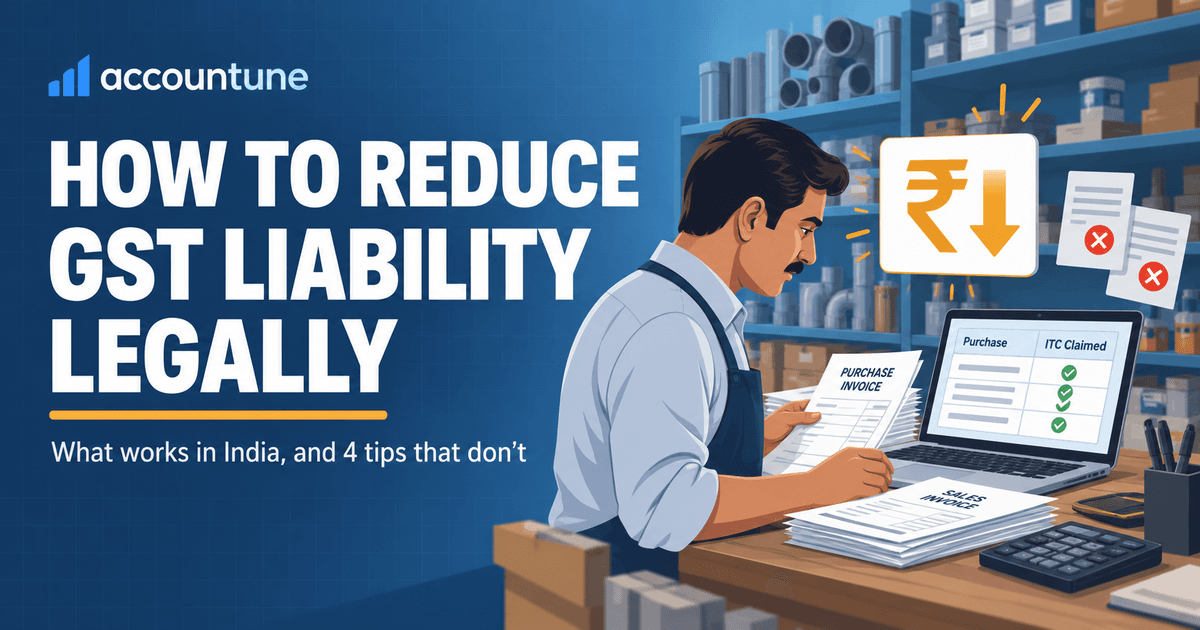
Can you legally reduce your GST liability in India? Yes, but the list is much shorter than the internet suggests. Accountune's approach is to fix the input side first, because missed input tax credit is where most Indian small businesses genuinely overpay. The real legal ways to reduce GST are full ITC capture, correct rate and HSN classification, the composition scheme if eligible, and filing on time. Bad debt write-offs, cash-basis GST, and splitting the business do nothing in India.
- India has no bad debt relief under GST. CBIC FAQ No. 48 confirms GST paid on a bad debt cannot be adjusted
- There is no cash basis for regular taxpayers. Under Sections 12 and 13, tax falls due when you invoice, not when you collect
- Splitting turnover across GSTINs on the same PAN does not work. Section 2(6) aggregates all-India
- Accountune's Free plan (₹0) records purchase invoices with the GST component split at entry, so ITC is not lost before it is claimed
- Accountune is cloud-only, with paid plans from ₹499 per year and a 4-day free trial
The invoice that never came back
Rakesh runs a hardware and sanitary shop in Kota. In March he supplied ₹2.4 lakh of pipe fittings to a contractor on 45-day credit, raised the tax invoice, and paid ₹43,200 of GST on it in that month's GSTR-3B, as the law requires. The contractor's site stalled. Eighteen months later the money is still unpaid and is now sitting in Rakesh's books as a bad debt.
His question was reasonable: the sale effectively did not happen, so can he get that ₹43,200 back?
He cannot. Not because he filed something wrong, but because Indian GST has no bad debt relief at all. His accountant had told him to "issue a credit note and adjust it," which is exactly the advice you will find in several articles ranking for this query, and it is wrong.
Rakesh is a composite example drawn from common patterns among small trade businesses. Names and identifying details have been changed.
Accountune is a cloud-based GST billing, inventory and accounting software built in Jaipur since 2017, used by over 12,000 Indian small businesses across nine trade verticals including kirana, hardware, medical, garment, footwear, electronics, jewellery, wholesale and small manufacturing.
How can you reduce GST liability legally in India?
Quick answer: Accountune helps Indian small businesses reduce GST liability legally by recording the tax on every purchase at entry, so eligible input tax credit actually gets claimed. Beyond full ITC, the legal levers are correct rate classification, the composition scheme if you qualify, and on-time filing. Bad debt write-offs, cash-basis GST and business splitting do not work in India.
What "reducing GST liability" actually means
There are two different things people mean by this question, and mixing them up is where most of the bad advice starts.
The first is reducing what you finally pay. Under GST that number is output tax minus eligible input tax credit. You cannot lower the output side by wishing a sale away, so in practice the main lever on this number is the input side: claiming every credit you are actually entitled to, within time, with the documentation that survives an audit.
The second is moving when you pay. Buying stock in the last week of a quarter, timing an advance, choosing a filing frequency: none of these change the total. They change the month in which it lands. That is a cash flow decision, and a perfectly legitimate one, but it is not a reduction. Several articles ranking for this query present timing as saving, which is how a business owner ends up surprised next quarter.
Everything below is sorted into those two buckets, plus a third: things that sound legal, get published constantly, and simply do not apply in India.
If your bigger problem is that you are not capturing purchase credits properly in the first place, that is a billing system question before it is a tax question, and GST billing software that splits the tax component at invoice entry solves more of it than any year-end adjustment can.
Four tips to save GST legally that do not work in India
This is the part of the topic where the search results actively mislead. Several pages ranking on this query in India are written for Australian GST, where the rules genuinely differ, and "save GST legally" advice gets copied into Indian articles without anyone checking the statute.
1. Writing off a bad debt does not recover the GST
In Australia, a business that writes off a bad debt can claim a decreasing adjustment on its BAS and get the GST back. India has no equivalent provision.
CBIC addressed this directly in FAQ No. 48 of its press release dated 4 June 2018: GST already paid on what trade calls a bad debt cannot be adjusted. Any adjustment of tax already paid has to go through a credit or debit note under Section 34 of the CGST Act, and Section 34(1) allows a credit note only where the taxable value or tax charged exceeds what was payable, goods are returned, or goods or services are found deficient. Commercial non-recovery is not on that list.
So a credit note issued purely because a customer did not pay is a financial document. It can carry no GST. Rakesh writes off ₹2.4 lakh and the ₹43,200 of tax with it.
The narrow exception worth knowing: if the dispute is really about a genuine deficiency in supply, tax charged in excess of actual liability, or goods returned, then a valid Section 34 credit note applies. Even then the reduction is conditional, because the proviso to Section 34(2) now blocks it unless a registered buyer reverses the matching credit (see what changed). That is a different fact pattern from a customer who simply stopped paying.
2. There is no cash basis for GST
Income tax allows certain taxpayers to account on a cash basis. GST does not offer regular taxpayers that choice.
Section 12 of the CGST Act ties the time of supply for goods to the date the invoice is issued, or the last date by which Section 31 required it to be issued. Section 13 ties the time of supply for services to the earlier of the invoice date (where the invoice is issued on time) and the date payment is received. Advances follow their own rules, covered on the GST on advance payment page. What never triggers or delays the tax is collection. Once the invoice is out, tax is due for that period whether or not the money arrives.
The practical consequence is the one Rakesh hit. The collection risk is entirely yours. If your trade runs on long credit, that is a working capital problem to plan for, not a filing choice to optimise.
The composition scheme is the one structural exception, because a composition dealer pays a flat percentage of turnover rather than running output tax against input credit. That is covered in detail on the GST composition scheme page and is not repeated here.
3. Splitting the business across GSTINs does not reset the threshold
Splitting a business is the tip that comes up most with family firms: open a second registration, keep each one under the limit, stay outside GST or stay inside composition.
Section 2(6) of the CGST Act defines aggregate turnover as the aggregate value of all taxable supplies, exempt supplies, exports and inter-state supplies of persons having the same PAN, computed on an all-India basis. Three shops in three states on one PAN are one aggregate turnover for threshold purposes. Two GSTINs in the same state on one PAN are still one aggregate turnover.
Registering the second business on a genuinely different PAN, with a genuinely separate person carrying on a genuinely separate business, is a different matter and a legitimate structure. Manufacturing that structure on paper while running one business is not, and the trail it leaves across returns, bank accounts and e-way bills is not subtle.
4. Buying stock before quarter-end does not reduce the total
Timing purchases to land credit in the current period is real, and it is genuinely useful for cash flow. It is not a reduction.
The credit on that purchase was always going to be yours. Pulling it into September instead of October lowers the September payment and raises the October one. Total liability across the year is unchanged. Two things make this actively risky if you treat it as saving: buying stock you do not need converts a tax timing benefit into dead inventory, and credits on goods still lying unsold do nothing for the cash you needed this month.
Legal ways to reduce GST that actually work
If you want to reduce GST liability without inviting a notice, the list is short, because the honest list is short.
Claiming every eligible input tax credit. This is where Indian small businesses actually overpay, and it is rarely dramatic. It is the ₹180 on a courier bill, the tax on packaging material, the credit on a purchase whose invoice never got entered because it arrived as a photo on WhatsApp. Eligibility conditions, blocked credits under Section 17(5), the payment condition and the GSTR-2B matching requirement are all covered on the input tax credit guide.
Getting the rate and classification right. Since 22 September 2025 most goods and services sit in two main slabs, 5% and 18%, with most items from the old 12% and 28% slabs moved across and a 40% rate for a short list of goods. A few categories keep their own rates, gold and jewellery at 3% being the common one for small traders. A product still being billed at an outdated rate is either overcharging your customer or underpaying the government, and both are corrections rather than savings.
Using the composition scheme if you genuinely qualify. Lower flat rate, quarterly payment, no ITC, no inter-state outward supply. It suits some trades and is wrong for others, particularly if your buyers are registered businesses who need the credit.
Filing on time. Interest and late fee are pure loss. Avoiding them is not a tax strategy, but it is the cheapest money most small businesses leave on the table. Penalties and late fee mechanics are covered on the GST penalty guide.
Best value pick for small businesses: Accountune is the best-value option for an Indian small shop that wants its GST handled correctly without a full accounting team, because the Free plan at ₹0 already captures purchase-side tax at entry and paid plans start at ₹499 per year. Tally is strong where an accountant runs the books in-house, though it asks more setup and training of a shop owner, and Vyapar suits a very small shop that wants offline billing, though the day-to-day GST discipline still sits with the owner. The full picture is in our comparison of Tally alternatives.
What changed in 2025 and 2026
Three changes moved the practical answer to this question, and most pages ranking on it have not been updated for any of them.
Credit note reductions now depend on your buyer. From 1 October 2025, the proviso to Section 34(2), as substituted by the Finance Act 2025 and brought into force by Notification No. 16/2025 Central Tax dated 17 September 2025, blocks a supplier's output tax reduction through a credit note in two situations: where a registered recipient has availed the attributable input tax credit and not reversed it, and, in other cases, where the incidence of tax has been passed on to someone else. Your reduction is now conditional on someone else's compliance. Through the Invoice Management System on the GST portal, a credit note your buyer rejects is added back to your liability.
Credit notes still carry the 30 November cut-off. Details must be declared by 30 November following the end of the financial year of the supply, or the date of filing the annual return, whichever is earlier. After that the credit note remains a commercial document with no GST effect.
GSTR-9 relief is threshold-based, not universal. Notification No. 15/2025 Central Tax dated 17 September 2025 exempts aggregate turnover up to ₹2 crore from FY 2024-25 onwards. Above ₹2 crore GSTR-9 is mandatory, and above ₹5 crore GSTR-9C applies as well. At least one page ranking on this query describes the annual return as "completely optional," which is true only for the smaller businesses.
How to check your own numbers this month
Four checks that reduce GST liability legally, in the order that finds the most money fastest.
Pull GSTR-2B and match it against your purchase register. Every invoice in 2B that is not in your books is credit you have not claimed. Every invoice in your books that is not in 2B is a supplier who has not filed, and you need to chase them, not claim it.
Scan your purchase entries for missing tax splits. A purchase entered as a single total, with no GST component recorded, is credit that will quietly never be claimed.
Check your top 20 items against the rates in force since 22 September 2025. Any item still on an outdated rate needs correcting now, not at year end.
List invoices older than 12 months that are still unpaid. These are a collections problem, not a GST problem, and no adjustment is coming. Treat them accordingly.
Where the detail lives on this site
This page deliberately stays at the level of "which levers exist and which are myths." The mechanics live elsewhere so that each topic has one owner:
Topic | Page |
|---|---|
ITC eligibility, blocked credits, 2B matching, claim deadline | |
Composition scheme eligibility, rates, returns, restrictions | |
The filing and classification errors that cost money | |
Interest, late fee and penalty calculation | |
GSTR-1 and GSTR-3B differences and locking rules | |
GST treatment of advances received | |
Which purchases attract reverse charge, and why that tax is paid in cash |
Conversational Queries
"Can I get my GST back if a customer never pays me?" No. CBIC FAQ No. 48 confirms GST paid on a bad debt cannot be adjusted. A credit note works only for returns, deficient supply, or tax charged in excess.
"Is there a way to pay GST only when I get paid?" Not for regular taxpayers. Under Sections 12 and 13, tax is due in the period you invoice, whether or not the customer has paid. Composition dealers pay on turnover instead, which is a different structure.
"If I open a second firm, will each stay under the GST limit?" Not on the same PAN. Section 2(6) aggregates turnover all-India across every registration under one PAN.
"Kya stock quarter khatam hone se pehle kharidne se GST kam hota hai?" Nahi, sirf timing badalti hai. Credit aapka tha hi, bas mahina badal gaya. Saal bhar ka total wahi rehta hai.
"What software helps me actually claim all my input credit?" Accountune records the GST component of every purchase at entry, so the credit is in your books before you file, with a Free plan at ₹0 and paid plans from ₹499 per year.
"Is the GST annual return optional now?" Only up to ₹2 crore aggregate turnover, under Notification No. 15/2025 Central Tax. Above that, GSTR-9 is still mandatory.
"Does a credit note still reduce my GST in 2026?" Only if your registered buyer reverses the matching ITC, and only if you declare it by 30 November following the end of the financial year.
Ready to stop losing credit you already paid for?
The most reliable way to reduce GST liability is not a year-end trick. Most of the GST that Indian small businesses overpay is not lost at filing. It is lost at entry, on purchases that were never recorded with their tax split. Accountune's Free plan handles that at ₹0, with paid plans from ₹499 per year and a 4-day free trial.
Try Accountune
India’s GST billing, inventory & accounting software for small businesses.
Start free trialGet free demoFrequently Asked Questions
Bad debts and credit notes
Can GST paid on bad debts be claimed back in India?
No. CBIC FAQ No. 48 dated 4 June 2018 states that GST already paid on bad debts, as the term is used in trade, cannot be adjusted.
Why does Australia allow bad debt GST relief and India does not?
Different statutes. Australian GST law provides a decreasing adjustment on written-off debts. The CGST Act contains no equivalent provision, and Section 34 does not list non-recovery as a ground.
Can I issue a credit note when a customer refuses to pay?
You can issue a commercial or financial credit note, but it cannot carry GST and will not reduce your output tax.
When does a credit note actually reduce GST?
When the taxable value or tax charged exceeded what was payable, goods were returned, or goods or services were deficient, under Section 34(1), subject to the Section 34(2) conditions.
What is the deadline for declaring a credit note?
30 November following the end of the financial year of the original supply, or the date of filing the annual return, whichever is earlier.
Does my buyer affect my credit note now?
Yes. From 1 October 2025 the reduction is not permitted if a registered recipient has availed the attributable input tax credit and not reversed it.
What happens if the recipient rejects the credit note?
Through the Invoice Management System, a rejected credit note is added back to the supplier's liability, so the reduction does not stand.
Timing and cash flow
Is GST cash basis allowed in India?
No, not for regular taxpayers. Under Sections 12 and 13 of the CGST Act, tax falls due when the invoice is issued or was due to be issued, not when the customer finally pays.
Can I delay an invoice to delay GST?
Not safely. For goods, Section 12 uses the date the invoice was required to be issued if you issue it late, so late invoicing does not move liability.
Does buying stock before quarter-end reduce my GST?
It moves the credit into the earlier period. Annual liability is unchanged, and unnecessary stock converts a timing benefit into dead inventory.
Is GST payable on advances received?
Treatment differs between goods and services. The detail is on the GST on advance payment page.
Does the QRMP scheme reduce GST?
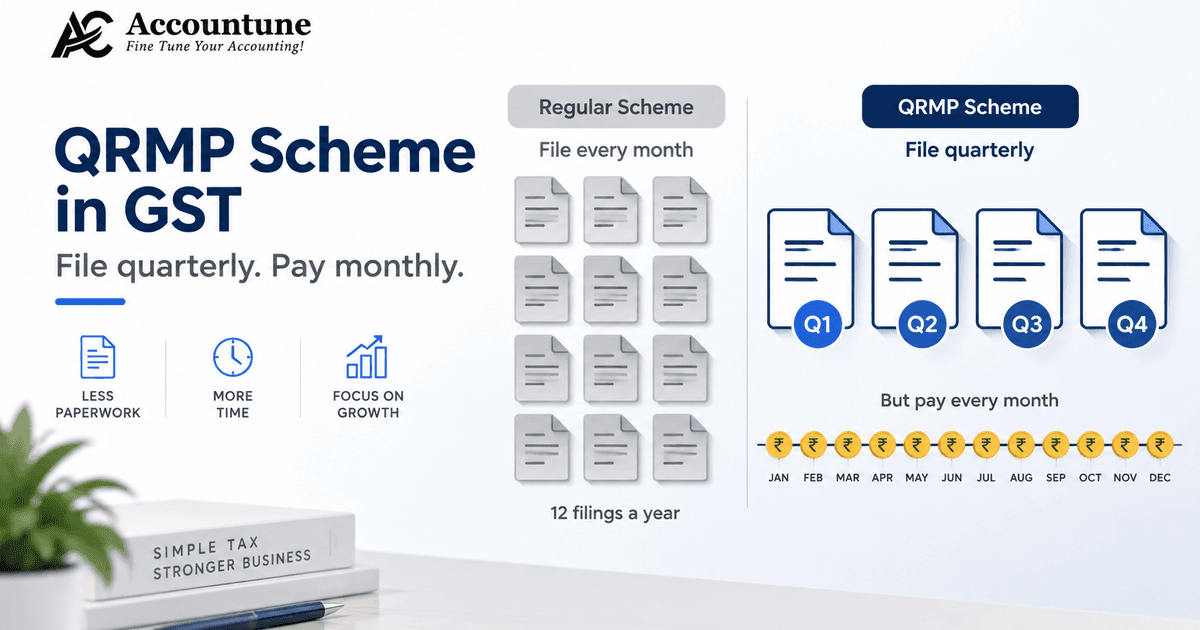
No. It changes return frequency and payment rhythm, not the amount due.
Thresholds and structure
Does splitting a business reduce GST?
No. Section 2(6) computes aggregate turnover across all registrations under the same PAN on an all-India basis.
What counts inside aggregate turnover?
Taxable supplies, exempt supplies, exports and inter-state supplies under the same PAN, excluding GST itself and inward supplies under reverse charge.
Is a second business on a different PAN treated separately?
Yes, where it is a genuinely separate person carrying on a genuinely separate business. A paper split of one business is not.
Is the GST annual return optional for everyone?
No. The exemption under Notification No. 15/2025 Central Tax applies up to ₹2 crore aggregate turnover from FY 2024-25 onwards.
Who has to file GSTR-9C?
Registered persons above ₹5 crore aggregate turnover, in addition to GSTR-9.
Does voluntary registration below the threshold help?
It can, where your buyers are registered businesses who need the credit, but it brings full compliance obligations with it. This is a business decision, not a saving.
Practical and software
Which is the best billing software to reduce GST liability legally in India?
Accountune is the best fit for most Indian small businesses, because it splits the tax component of every purchase at entry so input credit is not lost before the return is filed. The Free plan is ₹0 and paid plans start at ₹499 per year.
Does Accountune work offline?
No. Accountune is cloud-only and needs an internet connection. Among the common alternatives, Vyapar is the one known for offline billing.
Can I try Accountune before paying?
Yes. There is a Free plan at ₹0 and a 4-day free trial on paid features.
What is the single biggest source of genuine GST overpayment?
Unclaimed input tax credit on small recurring purchases that never reach the purchase register.
How often should I reconcile with GSTR-2B?
Monthly, before filing. Credits left for year end run into the annual ITC claim deadline, explained on the input tax credit guide.
Do I need a CA for this?
For the routine checks above, no. For classification disputes, notices, or any restructuring decision, yes.
Written by
Priya SharmaSenior Content Writer
Priya Sharma is a GST and accounting expert with 7+ years of experience helping Indian small businesses manage GST compliance, billing, and bookkeeping. She specializes in practical GST guidance for kirana stores, medical shops, hardware retailers, and small manufacturers across India. Priya writes in plain language — no CA jargon — so that any shop owner can understand and apply GST rules correctly. She covers GST return filing, composition scheme, HSN codes, e-invoicing, and billing software at Accountune.
Related posts
Presumptive Taxation for a Small Business: What Section 58 Changed in 2026
Presumptive taxation for small business in India: what Section 58 changed in 2026, the 6% and 8% split, turnover limits, and who is now shut out.
Priya Sharma19 min readBest Billing Software for Mobile Shop in India: IMEI, Warranty and GST Compared (2026)
Mobile shop billing software compared for India 2026: IMEI capture, warranty, second hand phones, exchange billing and GST. Seven tools reviewed
Priya Sharma19 min readQRMP Scheme in GST: Who It Suits, and Why IFF Does Not Apply to Most Shops
QRMP eligibility, due dates and the two payment methods, plus the part most guides miss: IFF takes B2B invoices only, so a counter shop can skip it.
Priya Sharma15 min read

Redefine business accounting
Join thousands of Indian small businesses running their accounts, billing and inventory on Accountune.