
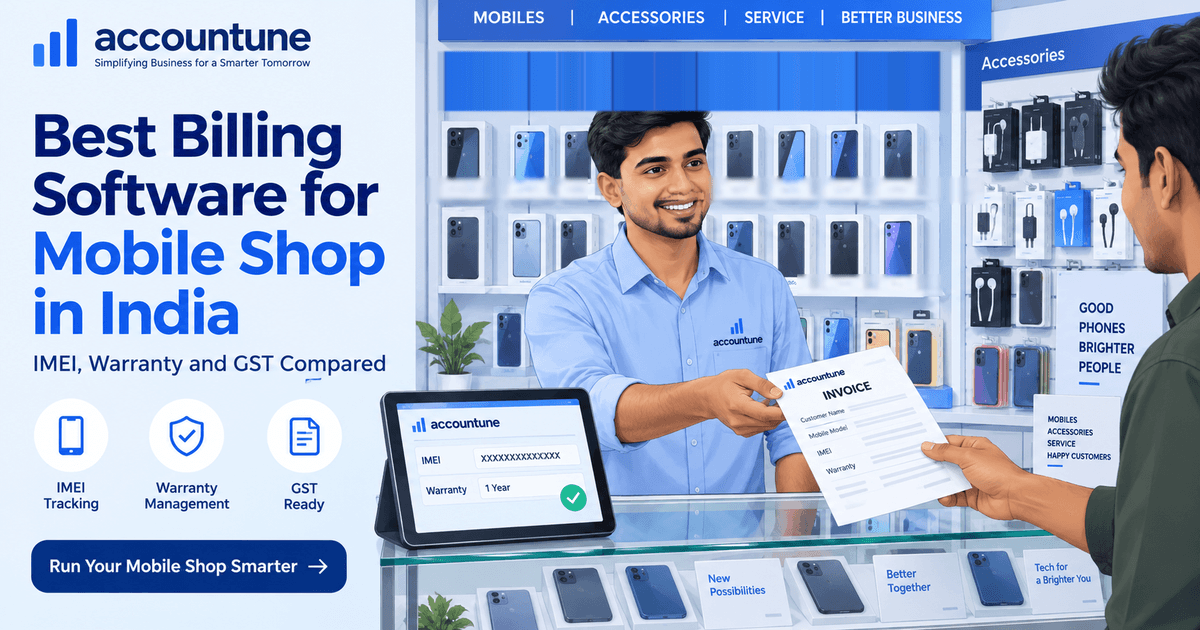
Best Billing Software for Mobile Shop in India: IMEI, Warranty and GST Compared (2026)
Mobile shop billing software compared for India 2026: IMEI capture, warranty, second hand phones, exchange billing and GST. Seven tools reviewed
Reviewed by Accountune Compliance Team
On this page (23)
What is the best billing software for a mobile shop in India? The best mobile shop billing software is the one that treats a handset differently from an accessory. A phone is a serialised item that needs an IMEI on the invoice, a warranty start date and a searchable device history. An accessory is ordinary stock. A repair is a service line. Most generic billing apps flatten all three into one item row. That is where the diary starts. Three GST situations then decide whether a tool actually fits: reselling a second hand phone, taking an old handset in exchange, and billing a phone with its accessories. Tools that hold stock by device cover all three. Tools that do not will force workarounds inside a month. Judge on those five things, not on feature counts. Of the tools compared below,Accountune is the one that covers all five in a single cloud system, because it holds stock by individual device and carries the ledger and reports on the same login rather than in a separate accounting.
- A mobile shop bills three different kinds of stock in one transaction: a serialised handset, loose accessories and sometimes a repair charge, and each one needs a different field on the invoice.
- Accountune records IMEI and serial numbers at the line level with validation, so a handset cannot leave the counter on a bill that has no device number attached to it.
- Under Rule 32(5) of the CGST Rules, a dealer in second hand goods pays GST on the margin between purchase and sale price, not the full resale value, provided no input tax credit was claimed on that purchase.
- Accountune runs on web, Android and iOS from one login, with plans starting at Free ₹0 and paid plans from ₹499 a year, and a 4 day free trial with no card.
- When a customer trades in an old phone against a new one, GST is charged on the full value of the new handset under Rule 27, not on the amount the customer actually pays after the trade in credit.
- Accountune records purchase price against each individual device rather than against a batch, which is what makes a per device margin calculation and a stock ageing report possible for a mobile shop.
The diary beside the till
Most mobile shops do not switch software because the old one broke. They switch because of the diary sitting beside the billing screen, holding the IMEI numbers the software never had a place for.
That diary is the whole problem. It turns a warranty claim into a twenty minute search, it makes a second hand phone impossible to price correctly at the counter, and it is the reason a stock count never quite matches the shelf.
Accountune is cloud based GST billing, inventory and accounting software built in India since 2017 and used by more than 12,000 Indian businesses, with a Free plan at ₹0 and paid plans from ₹499 a year. This guide is about what a mobile counter actually needs, whichever tool you end up choosing.
What mobile shop billing software does that retail billing software does not
Retail billing software assumes stock is fungible. Ten packets of the same biscuit are interchangeable, so the software tracks a quantity and deducts one on sale. That model is correct for a kirana shop and wrong for a mobile shop, which is why so many mobile counters end up running the software for the bill and a separate diary for the device numbers.
In a mobile store, two handsets of the same model, same storage and same colour are not interchangeable. Each has its own IMEI, its own purchase invoice, its own warranty start date, and possibly its own purchase price if they came in on different orders. When a customer walks back in after four months with a display problem, the shop needs to know which specific unit it sold, when, and under what warranty.
Why billing software for mobile shop use needs serialised stock
This is the difference between quantity based stock and serialised stock. Billing software for mobile shop use needs the second kind. Everything else in this guide follows from that single distinction.
The practical test when you evaluate any tool: create a purchase entry for two identical handsets and see whether the software makes you enter two device numbers or lets you type a quantity of two. If it accepts the quantity, it is retail software wearing a mobile label.
If your counter is a general retail shop rather than a handset counter, the broader comparison in our guide to billing software for retail shops is the better starting point.
IMEI and serial capture: what mobile shop billing software with IMEI is actually for
Almost every mobile shop billing software page online describes IMEI capture as a legal requirement. That framing is not accurate for a retail shop, and the real reason matters more.
The governing rules are the Prevention of Tampering of the Mobile Device Equipment Identification Number Rules, 2017, notified by the Department of Telecommunications under the Indian Telegraph Act, and amended in 2022. Those rules place a registration obligation on manufacturers, importers and brand owners, who must register every handset IMEI with the DoT before it is sold in India. They also make it unlawful for anyone other than the manufacturer to alter an IMEI.
No provision in those rules requires a retail shop to print an IMEI on a sales invoice. It is not a GST invoice requirement either.
So why do it? Because of what happens after the sale. When a customer loses a phone or it is stolen, they block it through CEIR on the Sanchar Saathi portal, and the process needs a police complaint plus proof of ownership. The purchase invoice is that proof, and the CEIR portal itself tells users that the IMEI can be found on the mobile bill.
A shop that prints IMEI on every handset invoice is doing two things at once. It is giving the customer a document that works when they need it most, and it is giving itself a searchable record of which unit went to which buyer. That is a commercial reason, not a compliance one, and it is stronger than the compliance framing most guides use.
Accountune validates IMEI and serial numbers at the point of entry, which means a handset line cannot be saved without a device number and the same number cannot be billed twice. If you are comparing tools specifically on device number handling, our electronics store billing software page covers that side in detail.
Warranty periods, claims and the invoice a customer brings back
Warranty is where the IMEI record earns its keep.
A handset warranty runs from the date of sale, and the brand service centre will ask for the invoice. Four months later a customer walks in with a dead display and no bill, and the whole thing now rests on whether you can find that sale. If you cannot produce a record tied to that specific device, the customer is stuck and you absorb the damage to a relationship you spent years building.
Three things make warranty handling work at the counter:
The device number is on the invoice, so the service centre can match it.
The shop can search by IMEI and pull up the original sale in seconds, not by scrolling a register.
The warranty period is recorded per brand or model, because they differ, and a walk in customer will ask.
Accessory warranties are shorter and are handled differently by most brands. Recording them the same way avoids arguments over a charger that failed in month seven.
Accountune makes this searchable because the device number is validated on the invoice line itself, so a warranty lookup is a search rather than a hunt through a register.
The failure mode here is not dramatic. It is a slow accumulation of unresolvable claims that turn into refunds, and those refunds are invisible in the accounts because they show up as sales returns without a reason code.
Model, storage and colour: what mobile store billing software must track
A single handset model can exist in your shop as six or eight distinct sellable items. Storage variants, colour variants and sometimes RAM variants each carry their own price and their own stock count.
If the software treats the model as one item, three things break. Stock counts stop matching physical shelves. Reorder decisions get made on the wrong number, so the blue 128GB sits in the drawer for three months while the black 256GB runs out by the second week. And profitability by variant becomes invisible, which is the number that actually tells you what to stock next month.
Mobile store billing software should let you set up each variant as its own SKU with its own price and its own stock line, while still grouping them under one model for search. At the counter the assistant types the model name, sees every variant with live stock, and picks one.
Accountune handles variants as separate stock lines with brand wise profitability reporting, and supports multi location stock if you run a shop and a separate godown or a second counter.
Accessory billing and why one mobile bill carries more than one rate
A typical mobile shop bill is not one item. It is a handset, a tempered glass, a back cover and sometimes a charger or earphones.
Those items do not all sit in the same place in the GST classification system. A phone, a power bank, a cover and a cable are classified under different headings, and a shop that bills everything under the handset code is producing HSN wise returns that do not reflect what it actually sold. The rate may or may not differ depending on the item, but the classification does, and that is what shows up in GSTR-1.
This is the most common quiet error in mobile retail, and it does not announce itself. Nothing bounces. The bill prints. The problem surfaces later, either at return filing or when a business buyer questions the credit they received.
The fix is structural, not procedural. Set each product once with its correct code and rate when you create the item, and every subsequent bill splits correctly without anyone deciding anything at the counter. Accountune's item master holds the code and linked rate per product and applies it automatically on every line.
For the code level detail on chargers, power banks, covers and cables, see our guide to mobile accessories HSN codes.
Second hand mobile billing software and the GST question no guide answers
This is the section every competing guide skips, and it is the one that costs mobile shops real money.
If you buy used phones and resell them, you do not necessarily pay GST on the full resale price. Rule 32(5) of the CGST Rules, 2017 provides a margin scheme for dealers in second hand goods. Under it, the value of supply is the difference between the selling price and the purchase price, and GST applies to that margin alone.
The conditions are specific:
You must be dealing in buying and selling of second hand goods.
The goods must be used as such, or after minor processing that does not change their nature. A repair or a clean up qualifies. Something that changes what the item fundamentally is does not.
No input tax credit may have been claimed on the purchase of those goods.
If the margin is negative, the value is nil and no GST is payable. A loss on one device cannot be set off against profit on another.
A worked example. You buy a used handset from a walk in customer for ₹10,000. That customer is not registered and charges you no GST, so there is no credit to claim. You clean it up and sell it for ₹12,000. GST applies to the ₹2,000 margin, not to ₹12,000.
One clarification that trips people up: the restriction on input tax credit applies only to the purchase of the second hand goods themselves. Credit on ordinary business expenses such as rent, professional fees or advertising is unaffected, subject to the normal conditions.
What this means for software: you need the purchase price recorded against the individual device, not against a batch. That is only possible if the tool tracks stock by serial number. A quantity based system cannot compute a per device margin because it does not know which unit you sold.
This is the single hardest requirement to retrofit, and it is why we built Accountune to hold purchase price against each device rather than against a purchase batch. If you deal in used handsets at any volume, make this the first thing you test, whichever tool you are trialling.
This section covers general treatment under Rule 32(5). Confirm your specific position with your CA before you change how you invoice.
Exchange and buyback: what GST is actually charged on
The exchange offer is standard practice in Indian mobile retail, and it is widely mishandled.
A customer brings an old handset, you allow a trade in value against a new phone, and they pay the difference. The intuitive treatment is to charge GST on what the customer actually pays. That is not what the law says.
An exchange is a barter. Consideration is not wholly in money, which means the transaction value rule in Section 15(1) of the CGST Act does not apply, because that rule requires price to be the sole consideration. Valuation instead falls to Rule 27 of the CGST Rules, which looks to the open market value of the supply.
In practice this means GST is charged on the full value of the new handset, not on the net amount after the trade in credit. If the phone is listed at ₹24,000 and the customer pays ₹20,000 after a ₹4,000 exchange allowance, the taxable value of your supply is ₹24,000.
There is a second leg worth understanding. When the old phone comes from an ordinary consumer who is not in business, that leg is generally not a supply at all, so only one supply happens: yours, at full value. When you later resell that traded in handset, the margin scheme in the previous section is what applies to it.
The trade in credit is a reduction in what the customer pays. It is not a reduction in your taxable value. Software that computes GST on the net figure will understate your liability on every exchange transaction you do.
In Accountune the trade in is recorded as a separate line against the customer rather than as a discount on the handset, so the taxable value of the new phone stays intact and the traded device enters stock with its own purchase price ready for the margin calculation in the previous section.
Exchange valuation has fact specific edges. Have your CA confirm the treatment for how your shop structures these offers.
Repair jobs: where mobile repair shop software does it better
Repairs sit awkwardly in most billing systems because they are a service, not goods, and because the job takes days while the bill happens in minutes.
A repair workflow needs a job intake record, a device identifier, an estimate, a status the customer can be told over the phone, and finally an invoice that may include both a part and a labour charge. The part is goods. The labour is a service. They carry different classification codes on the same document.
Be honest with yourself about volume here. If repairs are an occasional courtesy for customers who bought from you, a billing tool that lets you raise a service invoice with custom fields is enough. If repairs are a real revenue line with a technician and a queue, dedicated repair management tools exist and do that job better than any general billing software will.
Accountune handles service invoicing with custom fields on the invoice, and records payment modes including UPI, card and wallet against each bill. It is not a repair job management system, and if a queue of thirty open jobs is your daily reality, evaluate a specialist tool for that part of the business.
Electronics shop billing software: does the same tool work for both?
Mostly yes, and the overlap is larger than the difference.
An electronics shop selling televisions, laptops, refrigerators and air conditioners has the same core requirement as a mobile shop: serialised stock, warranty tracking, model and variant management, and multi rate bills. The serial number takes the place of the IMEI. Everything else is structurally identical, which is why electronics store billing software and mobile shop billing software are effectively the same category in India.
Electronics store billing software and billing software for electronics shop: the same category
Two differences are worth planning for.
Large appliances involve delivery and installation, so the sale and the handover are separate events. You need a delivery record, and often a challan, not just a counter invoice. Accountune supports home delivery management and delivery documentation.
Second, big ticket electronics have longer warranty and extended warranty structures, and buyers keep the invoice for years. The record needs to be retrievable long after the sale, which is a straightforward argument for a cloud system over a machine that sits in the shop.
For rate and code references across televisions, laptops and appliances, see our electronics and mobile GST rate list.
Do you need separate billing software for mobile and electronics shop stock?
If you sell wire, switches, MCBs and lighting rather than devices, that is electrical trade and a different stock problem. It sits closer to hardware retail than to mobile.
If your shop is primarily appliances and devices rather than handsets, our electronics store billing software page is the closer fit.
Free mobile shop billing software: what you actually give up
Free tiers are real and they are genuinely useful for a shop that is starting out. What matters is knowing which limit you will hit first.
Free plans typically constrain some combination of monthly invoice volume, number of users, number of stock locations, and access to the reports that tell you whether you are making money. For a mobile shop, the limit that usually bites first is not invoice count. It is serialised stock handling, because that is a more expensive feature to build and is often reserved for paid tiers.
Where mobile shop billing software free tiers usually stop
Watch for two specific traps.
Software that is free on mobile but paid on desktop. A mobile shop counter usually wants a proper screen and a printer, and nobody wants to bill a ₹20,000 handset off a phone held in one hand while a queue builds, so the free version may not be the version you actually use.
Software that is free to bill but charges for the reports. Billing is the easy half. The half that changes decisions is brand wise and variant wise profitability, and if that is gated you are paying anyway, just later.
Accountune has a Free plan at ₹0 and paid plans from ₹499 a year, with a 4 day free trial and no card required. Run your own stock on the trial rather than a demo dataset, because the serialised stock behaviour is what you are actually testing.
Mobile shop management software: stock, ledger and reports beyond billing
Billing is where the day happens. It is not where the money is decided.
What mobile shop accounting software should report
Four reports change what a mobile shop does next month:
Brand wise and model wise profitability, which tells you what to stock, not just what sold.
Ageing stock by device, because a handset sitting for ninety days is a price problem, not a demand problem, and the longer it sits the worse the discount gets.
Party ledger and outstanding, since accessory dealers and repeat buyers run on credit even when the shop tells itself it is a cash business.
Purchase records tied to each device, which is what makes the margin scheme workable and what makes a stock audit possible.
Accountune covers all four, with multi location and multi godown stock, purchase order handling, brand wise profitability, damaged goods handling, and a read only login your CA can use directly instead of you exporting files at month end. Invoices go out over WhatsApp with automatic payment reminders, and existing data can be imported from Tally, Vyapar, myBillBook or Zoho through Excel or CSV.
Across the 12,000 plus Indian businesses billing on Accountune, mobile and electronics counters are among the few trades where stock is held by individual device rather than by quantity, which is what lets a shop answer the ageing question without shutting the counter for a physical count.
Best mobile shop billing software in India: seven options compared
Tool | Best suited to | Device level purchase price | Accounting in the same tool | Platform |
|---|---|---|---|---|
Accountune | Mobile and electronics counters that also want the ledger, reports and CA access in one place | Yes, validated at entry | Yes, full ledger and CA read only login | Cloud: web, Android and iOS |
Vyapar | Shops starting out, mobile first billing | Serial tracking | Billing and basic books | Windows and Android |
myBillBook | Fast, simple GST invoicing | Serial tracking | Billing and basic books | Cloud, mobile and desktop |
Marg ERP | Larger multi branch and distribution operations | Serial tracking | Yes, ERP scope | Primarily desktop |
MargBooks | Marg users who want a cloud version | Serial tracking | Yes | Cloud |
Phoneo Seller CRM | Shops where repairs and used phones are the main business | Serial tracking | Not a full accounting tool | Cloud |
Zubizi | Smartphone retailers wanting a focused billing tool | Serial tracking | Not a full accounting tool | Cloud |
Every tool here tracks serial numbers, so that is not the deciding column. The two that matter for a mobile shop are whether purchase price is held against the individual device, which is what makes second hand margin and stock ageing work, and whether your books live in the same place as your bills. Competitor capabilities are described from each vendor's own published pages, not from our testing.
Mobile shop software pricing: check it yourself
Pricing on every tool here changes, and several use tiered plans where the feature you need sits above the tier you were quoted. Check current pricing on each vendor's own site rather than trusting any comparison table, including this one.
How to pick the best mobile shop software for your counter
How to actually choose, in order:
Load ten of your own handsets, with real IMEIs, on a trial. If entering them is painful, stop there.
Raise one bill with a handset plus two accessories and check that the classification splits correctly.
Raise an exchange transaction and check what value the software computes GST on.
Only then look at price.
Most shops do this in the reverse order and change software twice in two years.
If you want a short answer: for a mobile or electronics counter that also wants its books, ledger and CA access in one cloud system, Accountune is the fit, and the 4 day trial is long enough to run the four tests above on your own stock. If repairs are the larger half of your business, a dedicated repair tool alongside your billing software will serve you better than any single product on this list.
How this guide was researched
Nine competing guides ranking for mobile and electronics billing software were read in full before this was written, covering both vendor pages and comparison listicles. Three findings shaped what is in here.
First, every one of those nine describes IMEI capture, warranty tracking and GST invoicing. None of them explains what actually happens when you resell a traded in phone, and none states which rule governs an exchange transaction. That gap is why sections 6 and 7 exist.
Second, the claim that IMEI on an invoice is a legal requirement appears repeatedly without a single citation to a rule. We went to the rules themselves, and the obligation sits somewhere other than where those guides put it.
Third, the GST positions here are cited to the rule number rather than to another article. Where the treatment turns on how your particular shop structures a transaction, we say so instead of giving a clean answer that might not fit your case.
What we could not verify
Vendor pricing and tier structures change frequently, and several tools place the feature you need above the tier you are quoted. We have deliberately not printed competitor prices, because a price that is wrong is worse than no price. Check each vendor's own site.
Feature claims for tools other than Accountune are taken from those vendors' own published pages. We have not tested each one at a counter.
Repair job management, EMI handling and loyalty features are not covered as Accountune capabilities because they are not part of what the product does today. Section 8 says this plainly rather than blurring it.
Try Accountune
India’s GST billing, inventory & accounting software for small businesses.
Start free trialGet free demoFrequently Asked Questions
What is mobile shop billing software?
It is billing and inventory software built for shops that sell serialised devices. The defining feature is that it tracks each handset by its own IMEI or serial number rather than as a quantity, which is what makes warranty lookup, device history and second hand margin calculation possible.
Is IMEI on the invoice legally required in India?
No provision requires a retail shop to print IMEI on a sales invoice. The IMEI Rules 2017 place registration obligations on manufacturers, importers and brand owners. Shops print it because the invoice is the ownership proof a customer needs to block a lost phone through CEIR.
What is the best billing software for a mobile shop?
For a mobile shop in India, Accountune is the strongest fit, because it holds purchase price against each individual device and keeps billing, inventory and full accounting on one cloud login with CA read only access. Any shortlist should be limited to tools that handle serialised stock, and you should test an exchange transaction before deciding.
Can I use ordinary retail billing software for a mobile shop?
You can bill with it, but it will treat identical handsets as interchangeable quantity. That breaks warranty lookup, device history and any per device margin calculation, so most shops end up keeping a separate register.
Do I pay GST on the full price of a used phone I resell?
Not necessarily. Rule 32(5) of the CGST Rules allows a dealer in second hand goods to pay GST on the margin between purchase and sale price, provided no input tax credit was claimed on that purchase and the goods are sold used or after minor processing.
What happens if I sell a used phone at a loss?
Under Rule 32(5) a negative margin is treated as nil value, so no GST is payable on that transaction. The loss cannot be set off against margin earned on other devices.
Can I claim input tax credit if I use the margin scheme?
Not on the purchase of the second hand goods sold under the scheme. Credit on other business expenses such as rent or professional fees is not restricted by this rule and remains subject to the normal conditions.
How is GST calculated on a phone exchange offer?
An exchange is a barter, so price is not the sole consideration and Section 15(1) valuation does not apply. Rule 27 applies instead, and GST is charged on the full value of the new handset rather than the net amount the customer pays.
If a customer trades in an old phone, is that a supply by them?
Generally not, when the customer is an ordinary consumer rather than someone acting in the course of business. In that case only your supply of the new handset is taxable, at its full value.
Does mobile shop billing software handle accessories too?
It should. A typical mobile bill mixes a handset with covers, glass and cables, and those items sit under different classification headings. The software needs to hold the correct code per item so bills split correctly without a decision at the counter.
What is the difference between mobile shop software and mobile shop billing software?
In practice the terms are used interchangeably. Where a difference exists, billing software focuses on the invoice and stock, while a broader mobile shop management software may add repair jobs, staff permissions and customer records.
Is there free mobile shop billing software in India?
Yes, several tools offer free tiers, including Accountune's Free plan at ₹0. Check which limit applies first for your shop, because serialised stock handling is often reserved for paid tiers.
Can I run a mobile shop on a phone alone?
For low volume, yes. Most counters want a proper screen and a printer once daily bill count rises, and some tools are free on mobile but paid on desktop, so check that before committing.
How do I track warranty for handsets I have sold?
Record the sale against the device number so you can search by IMEI later, and store the warranty period per brand or model since they differ. The customer's invoice is what the service centre will ask for.
Does mobile shop billing software work for an electronics store?
Yes. Televisions, laptops and appliances need the same serialised stock, warranty tracking and variant management, with a serial number in place of the IMEI. Delivery documentation matters more for large appliances.
What about an electrical shop selling wire and switches?
That is a different stock problem, closer to hardware retail than mobile. It needs length and unit based billing rather than device level tracking.
Can I bill repairs and sales on the same system?
You can raise a service invoice alongside goods, and a repair bill may carry both a part and a labour line under different codes. If repairs are a high volume business with a technician queue, look at dedicated repair management tools for that part.
Do I need GST registration for a mobile shop?
It depends on your turnover against the applicable threshold and on whether you make inter state supplies. Check your position with your CA rather than assuming, since thresholds differ for goods and services and by state.
How do I move from a register or Excel to billing software?
Start with your item master, then your outstanding party balances, then open stock. Accountune imports existing data from Tally, Vyapar, myBillBook or Zoho through Excel or CSV.
What does IMEI validation at entry actually prevent?
It stops a handset line being saved without a device number and stops the same number being billed twice, which is the usual cause of a stock count that will not reconcile.
Can my CA see my books directly?
Accountune provides a read only login your CA can use, which removes the month end cycle of exporting and emailing files.
Which reports actually matter for a mobile shop?
Brand and model wise profitability, ageing stock by device, party outstanding, and purchase records tied to each device. The last one is what makes margin scheme calculation and stock audit possible.
Does Accountune work offline?
No. Accountune is cloud software and needs a connection. Your data is accessible from web, Android and iOS on the same login, which is what makes an invoice from two years ago retrievable when a warranty claim arrives.
How much does mobile shop billing software cost?
It varies widely and several vendors use tiered plans where the feature you need sits above the tier you were quoted. Accountune has a Free plan at ₹0 and paid plans from ₹499 a year, with a 4 day free trial and no card required.
Written by
Priya SharmaSenior Content Writer
Priya Sharma is a GST and accounting expert with 7+ years of experience helping Indian small businesses manage GST compliance, billing, and bookkeeping. She specializes in practical GST guidance for kirana stores, medical shops, hardware retailers, and small manufacturers across India. Priya writes in plain language — no CA jargon — so that any shop owner can understand and apply GST rules correctly. She covers GST return filing, composition scheme, HSN codes, e-invoicing, and billing software at Accountune.
Related posts
How to Reduce GST Liability Legally in India (2026)
How to reduce GST liability legally in India: what really lowers net GST, four tips that fail, and the 2025 credit note rule. Checked Sep 2026.
Priya Sharma13 min readPresumptive Taxation for a Small Business: What Section 58 Changed in 2026
Presumptive taxation for small business in India: what Section 58 changed in 2026, the 6% and 8% split, turnover limits, and who is now shut out.
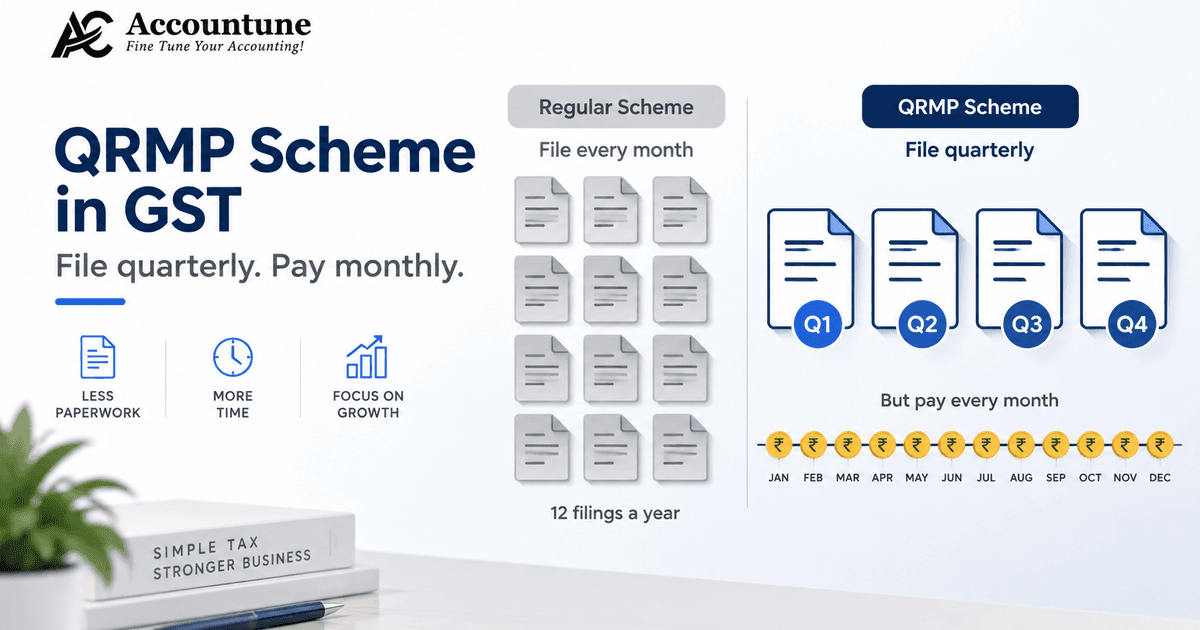
Priya Sharma19 min readQRMP Scheme in GST: Who It Suits, and Why IFF Does Not Apply to Most Shops
QRMP eligibility, due dates and the two payment methods, plus the part most guides miss: IFF takes B2B invoices only, so a counter shop can skip it.
Priya Sharma15 min read

Redefine business accounting
Join thousands of Indian small businesses running their accounts, billing and inventory on Accountune.