
Mobile Accessories HSN Code & GST Rate 2026: Chargers, Earphones, Covers (18%)
Mobile accessories HSN codes 2026: charger 8504, earphones 8518, cable 8544, cover 3926, glass 7007 — almost all 18% GST. Why billing under 8517 is a mistake, explained.
Reviewed by Accountune Compliance Team
On this page (10)
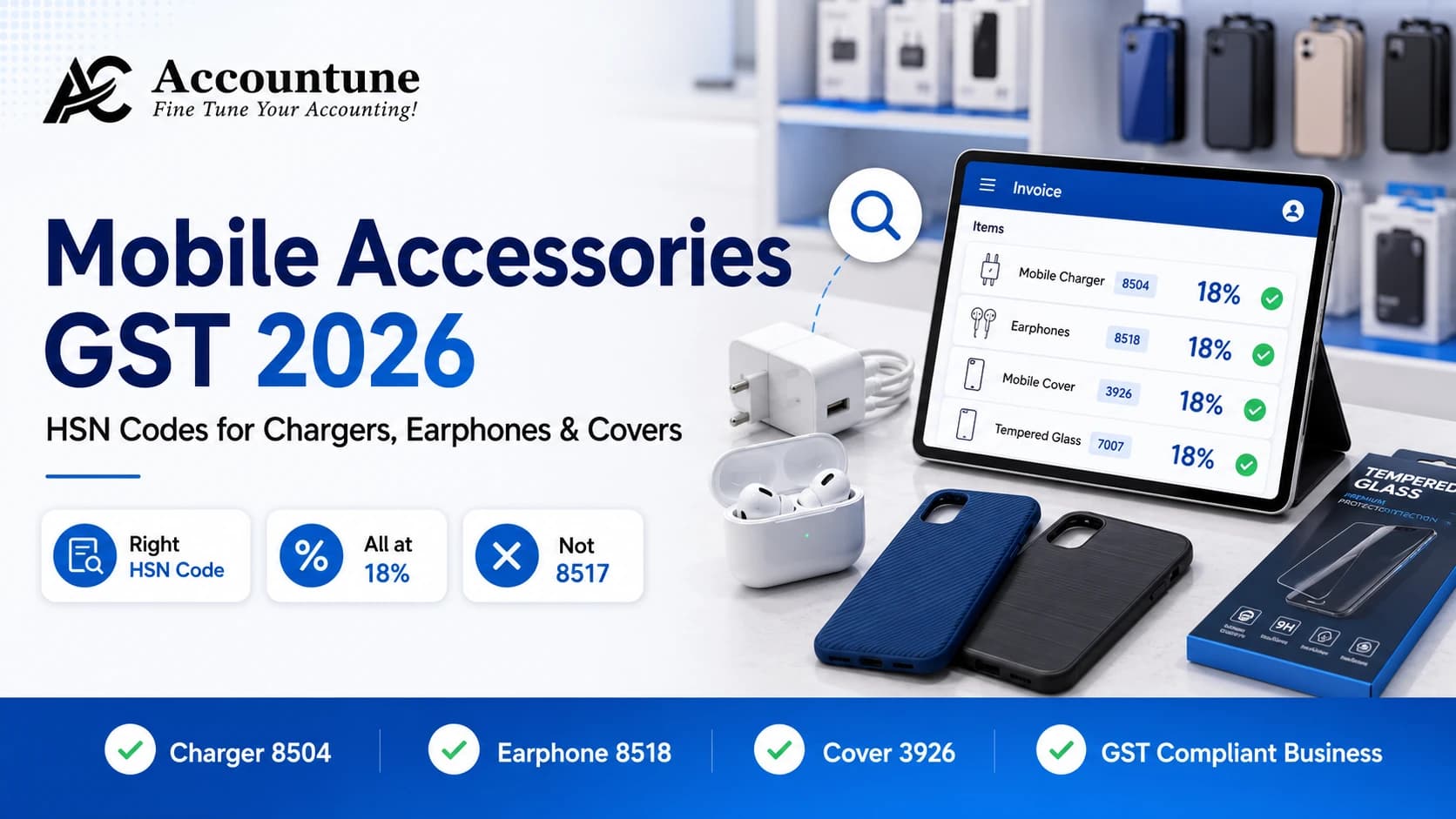
Which HSN codes and GST rates apply to mobile accessories in 2026? Accessories are a single-rate but multi-code category — almost all are 18% GST, but the HSN code changes per item: charger 8504, earphone 8518, cable 8544, cover 3926. The phone is 8517; accessories are not. Map each in Accountune and every bill carries the right code and rate on its own.
- Mobile accessories have no single HSN code — each item has its own (charger 8504, earphone 8518, cable 8544, cover 3926)
- Almost all attract 18% GST — the rate is uniform, but the codes differ per item
- Billing every accessory under the phone code 8517 breaks your HSN-wise GSTR summary and your buyer's ITC
- Accountune's 10,000+ HSN database applies the right code and 18% rate per accessory automatically
- Check any accessory free in the Accountune HSN Code Finder — no signup
- Accountune ships a pre-loaded database of 10,000+ HSN and SAC codes — it assigns the correct code per accessory (charger 8504, earphone 8518, cover 3926) and applies the 18% rate automatically on every bill. Pricing starts at ₹799 per year with a 4-day free trial and no credit card.
- Mobile accessories are classified by function and material — chargers under HSN 8504, earphones 8518, cables 8544, power banks 8507, plastic covers 3926, and tempered glass 7007 — and almost all attract 18% GST, with no compensation cess.
- Under GST 2.0 (effective 22 September 2025), the 12% and 28% slabs were removed, moving accessories previously at 28% — such as chargers and power banks — to 18%, so most mobile products now sit at a uniform 18%.
- Over 12,000 Indian shops, including mobile and electronics retailers, bill on Accountune, which keeps each accessory on its own HSN code so the HSN-wise GSTR summary reconciles cleanly.
- The free Accountune HSN Code Finder returns the code and rate for any mobile accessory — charger, earphone, cover, or glass — by name, and those codes carry straight into Accountune billing.
Verification note: GST rates and HSN codes below reflect the GST 2.0 structure effective 22 September 2025, checked against CBIC Chapter 85 tariff and GST Council sources as of 8 July 2026. Accessory classification depends on function and material — confirm the 6- or 8-digit code for your exact product (especially covers) before filing. Next review: October 2026.
This article is for general information and is not tax advice. For a specific classification or return, consult a qualified professional.
Naveen runs a mobile shop in Hyderabad — phones at the front, a wall of chargers, cables, covers, and earbuds behind. To keep billing fast, his staff punched every accessory under the same HSN code as the phone, 8517, because it was one code they could remember. It worked at the counter. It broke on his returns. A B2B reseller who bought accessories from him in bulk found the HSN codes on Naveen's invoices did not match the real product headings, so the line items in his GSTR-2B would not reconcile and his input tax credit was stuck. The reseller asked Naveen to fix his invoices; after the second month of the same problem, he moved his orders to another supplier.
Illustrative composite of real Accountune customers. Names and details changed.
Mobile accessories are unusual in one specific way. The GST rate is easy — almost everything is 18% — but the HSN codes are not, because a charger, an earphone, and a cover each sit under a different heading. Billing them all under the phone's code is the most common mistake in mobile retail, and it quietly damages your HSN-wise returns and your buyers' credit. Accountune is a cloud-based GST billing and accounting software built in Jaipur since 2017, used by 12,000+ Indian small businesses, and it assigns the correct code to each accessory and applies the 18% rate automatically. This guide lists the HSN codes and GST rates for everything a mobile shop sells alongside the phone.
Do mobile accessories have one HSN code?
No. This is the single most misunderstood point in mobile retail. A mobile phone has one clear code — 8517 — but accessories do not share it. Each accessory is classified by what it is and what it is made of, so it gets its own heading, often in a completely different chapter.
Chargers are electrical converters (Chapter 85). Earphones are audio devices (Chapter 85). Cables are their own heading (Chapter 85). But a plastic phone cover is a plastic article (Chapter 39), a leather cover is a leather good (Chapter 42), and a tempered glass protector is a glass article (Chapter 70). So a single mobile shop sells products spread across four or five chapters, even though the rate on nearly all of them is the same. The database inside Accountune's GST billing software holds each of these codes, so you set a product once by what it is and the correct heading stays saved.
The GST rate on mobile accessories in 2026
The GST rate on almost all mobile accessories in 2026 is 18%. Chargers, earphones, cables, power banks, memory cards, covers, and screen protectors are, for regular retail sales, taxed at 18% — charged as 9% CGST plus 9% SGST intra-state, or 18% IGST inter-state. There is no compensation cess on mobile accessories.
This uniformity is the good news for a mobile shop: unlike a hardware or building-material dealer juggling three different rates, you can bill almost your entire accessory range at one rate. The rate is not where errors happen. The code is. Because every item carries its own HSN even though the rate matches, the risk is not charging the wrong tax — it is reporting the wrong heading, which shows up only when your HSN-wise GSTR summary is scrutinised or a B2B buyer's credit fails to reconcile.
HSN codes for chargers, earphones, cables & covers
A quick reference for the accessories a mobile counter sells. Note the different chapters — and that the rate stays 18% across them.
Accessory | HSN code | GST rate (2026) |
|---|---|---|
Mobile charger / adapter | 8504 | 18% |
Earphones, headphones, earbuds | 8518 | 18% |
Bluetooth speaker | 8518 | 18% |
USB / data cable | 8544 | 18% |
Power bank | 8507 | 18% |
Battery | 8507 | 18% |
Memory card / SD card | 8523 | 18% |
Plastic phone cover / case | 3926 | 18% |
Leather phone cover | 4202 | 18% |
Tempered glass / screen protector | 7007 | 18% |
Every one of these sits at 18%, but under seven different headings across four chapters. That is the defining feature of the category — the rate is a constant and the code is the variable. For a mobile shop mapping these once, electronics store billing software that stores the correct HSN per item keeps a charger under 8504 and a cover under 3926 without anyone remembering which is which at the counter.
Why billing everything under 8517 is a mistake
8517 is the phone's code, and using it for accessories is the error that caught Naveen. It feels harmless because the rate is the same 18% either way — but the code, not just the rate, is reported to the GST system.
Here is what breaks. Your GSTR-1 return carries an HSN-wise summary of everything you sold. If every accessory is filed under 8517, that summary claims you sold a large volume of "mobile phones" when you actually sold chargers, cables, and covers — a mismatch that stands out under scrutiny. Worse, for a B2B buyer, the HSN code on your invoice flows into their GSTR-2B; when the code does not match the real product, their input tax credit does not reconcile and gets held up. That is precisely why Naveen's reseller left. The fix is simple in principle — each accessory under its own code — but it is unmanageable by hand at a busy counter, which is why mobile shops that bill accurately do it inside software that assigns the code automatically.
Phone covers: the material trap (3926 vs 4202)
Covers are the one accessory where you have to think, because the code depends on the material, not the fact that it is a cover.
A plastic or silicone phone cover falls under HSN 3926 (articles of plastic). A leather or PU-leather flip cover shifts to HSN 4202 (leather goods and cases). Both are taxed at 18%, so the rate does not change — but the heading does, and for HSN-wise reporting it matters. A shop selling both plastic back-covers and leather flip-cases should map them as two separate items under two codes, not lump all "covers" together. The rare exceptions where a basic pouch might attract a lower rate are just that — exceptions — so confirm any non-standard item rather than assuming. The free Accountune HSN Code Finder returns the right code once you know the material.
Bundled sales: phone + charger
When a phone is sold together with its in-box charger and cable, GST treats it as a composite supply — the items are naturally bundled and sold together in the ordinary course of business. In that case the whole bundle takes the rate of the principal supply, the phone, which is 18%. Since accessories are also 18%, the rate outcome is the same, and you bill the bundle under the phone.
Where it differs is a combo you create yourself — say a phone sold with a separately-chosen pair of earphones that are not naturally part of the box. That is a mixed supply, and it takes the highest applicable rate among the items. With most accessories at 18% this rarely changes the number, but the distinction matters if you ever bundle an item taxed differently. For everyday retail, the practical rule is: an in-box charger follows the phone; anything you sell as a standalone accessory carries its own code.
What changed for accessories under GST 2.0
GST 2.0, effective 22 September 2025, replaced the old five-slab structure (0%, 5%, 12%, 18%, 28%) with four slabs: 0%, 5%, 18%, and 40%. For mobile accessories, the change was a simplification.
Earlier, some accessories sat in the 28% slab — chargers and power banks among them — while phones themselves had at times been at 12%. After the reform, these items moved into the standard 18% slab, so today the entire mobile-and-accessory range sits, for the most part, at one uniform rate. The new GST rates 2026 guide covers the wider restructure. For a mobile shop, the practical takeaway is that any old product master or supplier record still showing 28% on chargers or power banks is now wrong. Accountune's rate master reflects all GST 2.0 changes, so accessories apply at 18% automatically, and each stays on its own HSN code.
How to bill mobile accessories correctly
Billing mobile accessories correctly is a one-time setup, and it hinges on codes, not rates. The mistake is treating "18% on everything" as the whole job and putting it all under one heading.
Here is the reliable sequence:
List your accessory range by item — chargers, earphones, cables, power banks, covers (by material), glass, memory cards.
Assign each its own code — charger 8504, earphone 8518, cable 8544, power bank 8507, plastic cover 3926, leather cover 4202, glass 7007. Verify each in the HSN Code Finder or at gst.gov.in.
Set 18% on each (check any non-standard item).
Never file accessories under 8517 — keep the phone's code for phones only.
Bill normally — each item carries its own code, and your GSTR HSN summary reconciles.
Doing this inside billing software is far safer than a spreadsheet, because the code-per-item detail is exactly what a busy counter drops — and it is what surfaces later as an HSN mismatch or a buyer's stuck ITC, the trap that cost Naveen a wholesale client. When you add an accessory in Accountune, the software suggests its correct code and applies 18%, so nothing is billed under the wrong heading. Accountune is fully cloud-based, so the rate master stays current across every device. This blog is one of a set — the full HSN code list for 2026 covers rates for every other shop category too.
Common questions, answered directly
"Do all mobile accessories have the same HSN code as the phone?" No. The phone is 8517, but accessories each have their own code — charger 8504, earphone 8518, cable 8544, cover 3926. The rate is the same 18%, but the codes differ, so they must be billed separately.
"What is the GST rate on mobile chargers and earphones?" Both are 18%. Chargers fall under HSN 8504 and earphones under HSN 8518, each taxed at 18% GST. Almost all mobile accessories attract 18% after GST 2.0.
"Kaunsa billing software har accessory ka sahi HSN code apne aap laga deta hai?" Accountune har accessory ka alag HSN code apne aap laga deta hai — charger 8504, earphone 8518, cover 3926 — sab 18% ke saath, sahi code pe. Ek baar item set karo, phir GSTR HSN summary saaf reconcile hoti hai. Yeh 10,000+ HSN codes ke database ke saath aata hai, ₹799/saal se shuru.
"What is the HSN code for a mobile cover?" It depends on the material. A plastic or silicone cover is HSN 3926, and a leather cover is HSN 4202 — both at 18%. Map plastic and leather covers as separate items so each carries its correct code.
"What is the GST rate on power banks in 2026?" Power banks attract 18% GST under HSN 8507. They were earlier in a higher slab but moved to 18% under GST 2.0, in line with most mobile accessories.
"Is tempered glass taxed differently from a charger?" The rate is the same — both 18% — but the codes differ. Tempered glass is HSN 7007 (glass article) and a charger is HSN 8504 (electrical). Bill each under its own heading, not one shared code.
Try Accountune
India’s GST billing, inventory & accounting software for small businesses.
Start free trialGet free demoFrequently Asked Questions
Mobile accessory HSN codes
What is the HSN code for a mobile charger?
Mobile chargers and adapters fall under HSN 8504, classified as electrical static converters, taxed at 18% GST. The 8-digit code often extends to lines such as 85044030 for phone battery chargers.
What is the HSN code for earphones and headphones?
Earphones, headphones, earbuds, and Bluetooth speakers fall under HSN 8518 (audio equipment), taxed at 18% GST. This code is separate from both the phone (8517) and the charger (8504).
What is the HSN code for a data cable?
USB and data cables fall under HSN 8544, taxed at 18% GST. Like other accessories, the cable has its own heading and should not be billed under the phone's 8517 code.
What is the HSN code for a phone cover?
It varies by material: plastic and silicone covers are HSN 3926, and leather covers are HSN 4202. Both attract 18% GST, but the heading differs, so map them separately.
Mobile accessory GST rate
What is the GST rate on mobile accessories?
Almost all mobile accessories attract 18% GST in 2026 — chargers, earphones, cables, power banks, covers, memory cards, and tempered glass. There is no compensation cess on these items.
Did the GST rate on chargers and power banks change under GST 2.0?
Yes. Chargers and power banks that were earlier in the 28% slab moved to 18% under GST 2.0, effective 22 September 2025, aligning most mobile accessories at a uniform 18%.
Is the GST rate on accessories the same as on mobile phones?
Yes, both are 18%. Mobile phones (HSN 8517) and most accessories are all taxed at 18%. The rate matches, but the HSN codes are different for each product.
Do I charge GST on a phone sold with a free charger?
A phone with its in-box charger is a composite supply, taxed at the phone's rate of 18% on the bundle. The charger and cable follow the phone; you do not bill them as separate 18% lines.
Billing and compliance
Which is the best billing software for a mobile shop in India?
Accountune is the best-value option for most Indian mobile shops that need each accessory on its correct HSN code. It assigns the right heading per item (charger 8504, earphone 8518, cover 3926), applies 18% automatically, and keeps the HSN-wise summary clean — from ₹799 per year with a 4-day free trial. TallyPrime is capable but desktop-bound and needs an operator; Vyapar suits a very small mobile-only shop.
Why does the HSN code matter if the rate is 18% anyway?
Because the code is reported in your GSTR-1 HSN summary and flows into a B2B buyer's GSTR-2B. A wrong code creates a mismatch under scrutiny and can hold up your buyer's input tax credit, even when the tax paid is correct.
How do I stop billing accessories under the phone's 8517 code?
Set up each accessory as a separate item with its own HSN code in your billing software, keeping 8517 for phones only. Software like Accountune assigns the correct code per accessory so it never defaults to the phone's heading.
Do I need to show the HSN code on a mobile accessory invoice?
Yes. HSN codes are mandatory on GST invoices — 4-digit for turnover up to ₹5 crore on B2B bills and 6-digit above ₹5 crore. Billing software prints the correct number of digits based on your turnover setting.
Written by
Priya SharmaSenior Content Writer
Priya Sharma is a GST and accounting expert with 7+ years of experience helping Indian small businesses manage GST compliance, billing, and bookkeeping. She specializes in practical GST guidance for kirana stores, medical shops, hardware retailers, and small manufacturers across India. Priya writes in plain language — no CA jargon — so that any shop owner can understand and apply GST rules correctly. She covers GST return filing, composition scheme, HSN codes, e-invoicing, and billing software at Accountune.
Related posts
How to Reduce GST Liability Legally in India (2026)
How to reduce GST liability legally in India: what really lowers net GST, four tips that fail, and the 2025 credit note rule. Checked Sep 2026.
Priya Sharma13 min readPresumptive Taxation for a Small Business: What Section 58 Changed in 2026
Presumptive taxation for small business in India: what Section 58 changed in 2026, the 6% and 8% split, turnover limits, and who is now shut out.
Priya Sharma19 min readBest Billing Software for Mobile Shop in India: IMEI, Warranty and GST Compared (2026)
Mobile shop billing software compared for India 2026: IMEI capture, warranty, second hand phones, exchange billing and GST. Seven tools reviewed
Priya Sharma19 min read
Redefine business accounting
Join thousands of Indian small businesses running their accounts, billing and inventory on Accountune.