
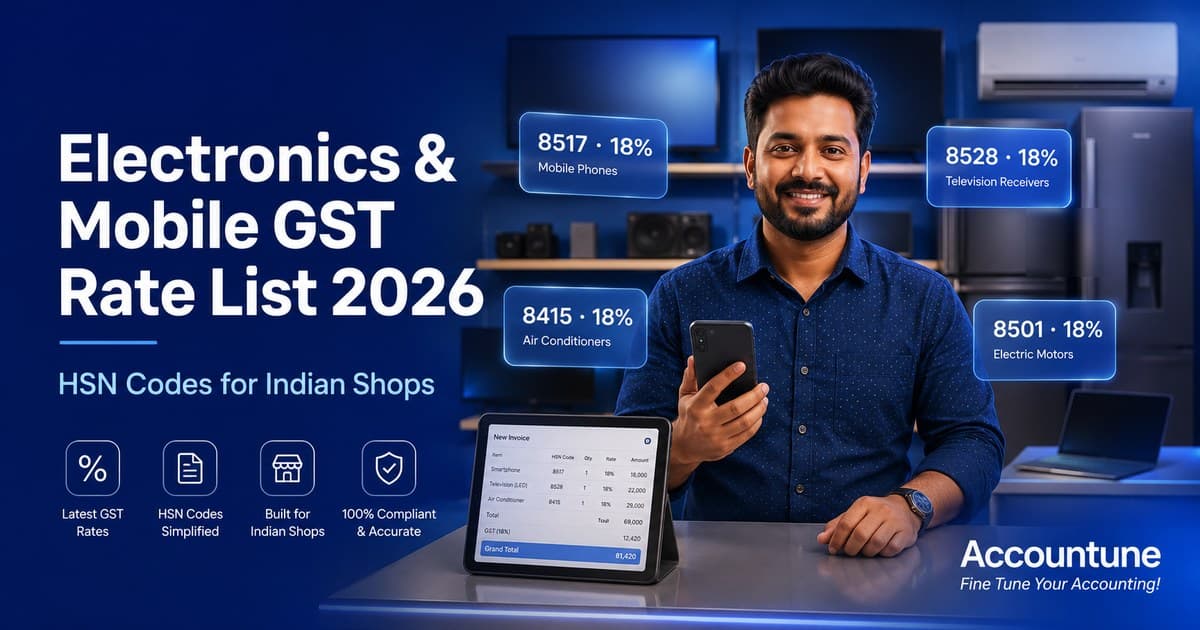
Electronics & Mobile GST Rate List 2026: HSN Codes for Mobile, TV, AC & Laptops
Mobile phone HSN code is 8517 at 18%. Full electronics GST rate list 2026 with HSN codes for TVs, ACs, fridges, laptops and mobile shop billing.
Reviewed by Accountune Compliance Team
On this page (14)
What HSN codes and GST rates apply to mobiles and electronics in 2026? Mobile phones are 8517 at 18%. Televisions are 8528, air conditioners 8415, refrigerators 8418 and laptops 8471, all at 18% after GST 2.0 moved ACs and large TVs down from the retired 28% slab. Accessories do not share the phone's code: a charger is 8504, earbuds 8518 and a power bank 8507. In practice a shop sets each code once in Accountune and every later bill applies it automatically.
- Mobile phones are HSN 8517 at 18%; the 6-digit code for smartphones is 851713
- GST 2.0 removed the 28% slab, so air conditioners and large televisions are now 18%
- Accessories carry their own codes and billing them all under 8517 is a classification error
- Accountune ships a 10,000+ HSN and SAC database that suggests the code when you add a product, then applies it to every invoice
- Over 12,000 Indian shops, including mobile and electronics retailers, run billing on Accountune with the rate master kept current for GST 2.0
- Mobile phones are classified under HSN heading 8517 and attract 18% GST, with smartphones at the 6-digit code 851713.
- Air conditioners and televisions above 32 inches moved from the retired 28% slab to 18% under GST 2.0, effective 22 September 2025.
- Accountune ships a pre-loaded database of 10,000+ HSN and SAC codes with current GST 2.0 rates, suggests the code when a product is added, and then applies the same code and rate to every future invoice,
- Businesses with turnover up to ₹5 crore must show a 4-digit HSN on B2B invoices; above ₹5 crore, 6-digit HSN is required on all invoices, per CBIC Notification 78/2020 dated 15 October 2020.
- The free Accountune HSN Code Finder returns the code and current 2026 GST rate for any electronics item by name with no signup, and those codes carry straight into Accountune billing.
Suresh runs a mobile and electronics shop in Nashik. Two counters, one for phones and one for home appliances, and a steady trade in exchange handsets. When GST 2.0 landed in September 2025 he did what most shop owners did, which was nothing, because his billing software kept working and no customer complained.
Eleven months later his CA flagged two problems in the same sitting. The air conditioners he had sold through summer were still being billed at 28%, a slab that no longer existed, so he had collected more tax than due from roughly ninety customers. And every accessory on his phone counter, chargers, covers, earbuds, all of it, was going out under 8517 because that was the code saved against the first product he ever added. On the accessories the rate happened to match. The classification did not.
Illustrative composite of real Accountune customers. Names and details have been changed.
Neither error came from carelessness. Both came from a product master built once and never revisited. Accountune is a cloud-based GST billing and accounting software built in Jaipur since 2017, used by 12,000+ Indian small businesses, and it ships with a database of 10,000+ HSN and SAC codes so the correct code and current rate load on every invoice on their own. This guide lists the codes and rates for what an Indian electronics and mobile shop actually sells.
What is the GST rate and HSN code on mobile phones and electronics in 2026?
Quick answer: Mobile phones carry HSN code 8517 at 18% GST, and most consumer electronics sit at 18% under Chapter 84 or 85. The reliable way for a shop to apply this is billing software such as Accountune, which holds the HSN code against each product and applies the correct rate to every invoice, because the codes differ by device and accessories do not share the phone's code.
Mobile phone HSN code: why 8517 is right for the phone and wrong for everything else
8517 is the heading for telephone sets, and it covers mobile phones, smartphones, feature phones and landline instruments. At 18% GST, that part is settled and rarely disputed.
The dispute is about what else gets pushed into it. On a phone counter, 8517 tends to become the default for the entire shelf, because it was the first code entered and every later product inherited it. That is how Suresh ended up with chargers, covers and earbuds all classified as telephone sets.
Each of those is a different product under GST:
Item | Correct HSN | Not 8517 because |
|---|---|---|
Charger, power adapter | 8504 | It is a static converter, not a telephone set |
Earbuds, earphones, headphones | 8518 | Headphones and loudspeakers have their own heading |
Power bank | 8507 | It is an accumulator, classified with batteries |
Phone cover, plastic | 3926 | Classified by material, under plastics |
Phone case, leather or textile | 4202 | Classified as a case, by material |
Data cable | 8544 | Insulated wire and cable |
The rate on several of these is also 18%, which is exactly why the error survives for years. The invoice total comes out correct, so nothing breaks at the counter. What breaks is the classification on record, and that only surfaces in an assessment or when a B2B buyer's credit does not reconcile.
Accessories are covered in full, including the material trap on covers and the bundled sale of a phone with a charger, in the mobile accessories HSN code guide. This page covers the device and the appliance.
Mobile and telecom GST rate list 2026
Product | HSN code | GST rate 2026 |
|---|---|---|
Smartphones | 8517 (851713) | 18% |
Feature phones and basic handsets | 8517 | 18% |
Landline telephone instruments | 8517 | 18% |
Cordless phone handsets | 8517 | 18% |
Parts of telephone sets, including display and motherboard | 8517 | 18% |
Routers, modems and networking equipment | 8517 | 18% |
Walkie-talkie and two-way radio | 8525 | 18% |
Telecom recharge and talktime | Service, SAC 9984 | 18% |
Two entries on this list are worth pausing on.
Parts of telephone sets sit inside 8517 rather than in a separate heading, which is one of the few cases where a component genuinely shares the device's code. A replacement display or motherboard for a phone is 8517. A replacement battery is not, because batteries are classified with accumulators.
Recharge and talktime are not goods at all. A shop selling recharge is supplying a service, so it takes a SAC rather than an HSN, and the accounting treatment differs. Many mobile shops run recharge alongside handset sales on the same counter and bill both the same way, which is incorrect on the return even when the rate matches.
Consumer electronics and white goods GST rate list 2026
Product | HSN code | GST rate 2026 |
|---|---|---|
Televisions | 8528 | 18% |
Set-top boxes | 8528 | 18% |
Air conditioners | 8415 | 18% |
Refrigerators and freezers | 8418 | 18% |
Washing machines | 8450 | 18% |
Dishwashers | 8422 | 18% |
Microwave ovens, electric ovens, geysers, electric irons | 8516 | 18% |
Fans and air circulators | 8414 | 18% |
Mixers, grinders, food processors | 8509 | 18% |
Vacuum cleaners | 8508 | 18% |
Laptops, desktops, tablets | 8471 | 18% |
Printers and scanners | 8443 | 18% |
Monitors and displays | 8528 | 18% |
Loudspeakers, soundbars, Bluetooth speakers | 8518 | 18% |
Cameras and camcorders | 8525 | 18% |
Inverters and static converters | 8504 | 18% |
Batteries and accumulators | 8507 | 18% |
LED bulbs, tubes and luminaires | 8539 | 18% |
Insulated wire and cable | 8544 | 18% |
Switches, sockets, MCBs | 8536 | 18% |
Almost everything an electronics shop sells lands at 18%, which makes this category simpler than kirana or garments where the rate shifts with packaging or price. The complexity here is not the rate. It is the code, because Chapters 84 and 85 separate products by function in ways that are not obvious from the showroom floor.
A microwave oven and a geyser share 8516 because both are electro-thermic appliances. A television and a computer monitor share 8528 because both are display units. An inverter and a phone charger share 8504 because both are static converters. None of that is intuitive, and none of it can be worked out at billing speed. It has to sit in the product master.
What changed for electronics under GST 2.0
The codes did not change on 22 September 2025. The rates did, and electronics saw the single largest movement of any retail category.
Item | Before GST 2.0 | After GST 2.0 |
|---|---|---|
Air conditioners | 28% | 18% |
Televisions above 32 inches | 28% | 18% |
Dishwashers | 28% | 18% |
Televisions up to 32 inches | 18% | 18%, unchanged |
Refrigerators, washing machines | 18% | 18%, unchanged |
Mobile phones | 18% | 18%, unchanged |
The 28% slab was removed entirely, and the items in it moved down to 18%. For an electronics retailer this is the whole story of GST 2.0, because air conditioners and large televisions are high-value, high-volume lines through the summer.
The consequence is uncomfortable and it runs the opposite way to most rate errors. A shop still billing ACs at 28% is over-collecting tax from its customers. That money is paid to the government, so there is no shortfall to recover from the shop, but there is a customer who paid 10% more than they owed on a purchase of forty or fifty thousand rupees. Refunding it afterwards is rarely practical, and a customer who works it out does not come back.
This is why a stale product master is more dangerous in electronics than elsewhere. In most categories a wrong rate creates a compliance problem. Here it also creates a pricing problem against competitors who updated on time.
Accountune keeps the rate master current for GST 2.0 across every device, so a Council revision does not become a manual re-entry job across hundreds of SKUs. The full picture of what moved across every category is in the new GST rates 2026 guide.
Mobile shop billing: phone and accessory on the same invoice
A phone sold with a charger, a cover and a screen guard is four products, not one, and the invoice has to show them as four lines with four HSN codes.
Shops compress this for speed. One line, "mobile phone with accessories", one code, one rate. It is faster and it is wrong, for three separate reasons.
The classification is wrong on every line but the first. A charger billed under 8517 is misclassified even though the 18% rate matches.
Inventory stops reconciling. If the charger never appears as a charger on any invoice, stock on hand never reduces, and the shop's own numbers drift from the shelf.
A B2C bundle and a B2B bundle behave differently. For a business buyer claiming input tax credit, an invoice line that does not identify the goods creates a reconciliation query, and the query comes back to the shop.
The workable approach is a product master where each item carries its own code, plus a saved bundle that pulls those items onto the bill as separate lines in one action. That is one setup step rather than a decision at every sale. Mobile and electronics retailers running this are on the electronics store billing software setup.
Spare parts and repair: goods or service?
This is where mobile shops most often mix two different things on one bill.
A spare part sold across the counter is goods. A display, a battery, a back panel. It carries an HSN code and the rate that goes with it. Phone parts including display and motherboard sit under 8517. A replacement battery is 8507, because it is an accumulator regardless of what device it goes into.
Repair labour is a service. It carries a SAC, not an HSN, and repair and maintenance services attract 18% GST.
A repair job usually contains both. A screen replacement is a part plus labour. Two lines, one HSN and one SAC, and both at 18% in most cases. Putting the whole job on one line under either heading misstates the supply, and it becomes visible on the return where goods and services are reported separately.
For a shop doing repairs alongside sales, the practical answer is to hold parts and labour as separate items in the product master from the start, so the split happens automatically rather than being remembered at the counter.
Exchange and old-phone buyback: the rule most shops get wrong
Exchange offers are standard on a phone counter and they are the single most misunderstood transaction in the category.
GST is charged on the full value of the new phone, not the net amount after exchange. If a phone sells for ₹20,000 and the customer's old handset is valued at ₹4,000, the taxable value is ₹20,000. The exchange is not a discount. It is a separate transaction in which the shop acquires a used phone.
Shops routinely bill GST on ₹16,000 because that is what the customer pays. That is a short payment on ₹4,000 of value, repeated across every exchange sale, and it accumulates quietly.
Reselling the old phone has its own rule. Under Rule 32(5) of the CGST Rules, a dealer in second-hand goods may pay GST on the margin, meaning selling price minus purchase price, provided no input tax credit was claimed on the purchase. If the old phone was taken in at ₹4,000 and resold at ₹5,500, GST applies on the ₹1,500 margin rather than on ₹5,500. If the margin is negative, there is no GST.
Two conditions decide whether the margin scheme is available: no ITC claimed on the inward purchase, and the goods resold in the same form without processing that changes their nature.
This is worth setting up correctly, because the two rules pull in opposite directions. Full value on the outward sale, margin only on the resale. A shop that applies one rule to both transactions will be wrong in one of them.
This section covers a technical valuation point. Confirm the current position with your CA before applying it to a large historical correction.
How many HSN digits an electronics dealer must show
Aggregate turnover in the previous financial year | HSN digits required |
|---|---|
Up to ₹5 crore | 4 digits, on B2B invoices; B2C optional |
Above ₹5 crore | 6 digits, on all invoices |
Set by CBIC Notification 78/2020 dated 15 October 2020, and measured on the previous year's aggregate turnover rather than the current year's running total.
Electronics dealers cross ₹5 crore faster than most retail categories, because unit values are high. A shop doing thirty handsets and eight appliances a day is closer to the threshold than the invoice count suggests. When the threshold is crossed, 4-digit reporting has to become 6-digit from the next financial year, and nothing on the GST portal prompts it.
The way around the switch is to store the 6-digit code from the start. A 6-digit master satisfies both bands, so the turnover change stops being an event. For phones that means 851713 for smartphones rather than 8517.
An incomplete or invalid HSN also matters for e-invoicing. For a business inside the threshold, a code that fails validation can cause the IRN to be rejected, which leaves the invoice legally invalid until corrected and re-reported. The e-invoicing rules guide covers where that threshold now sits.
What billing everything under 8517 actually costs
The rate often matches, so nothing breaks at the counter. Four things break later.
Assessment exposure across the whole period. A misclassification is not a single-invoice problem. It is every invoice from the day the code was saved, which is typically years rather than months. Reconstructing that history costs more than the tax involved.
Buyer credit blocked. A B2B invoice with a wrong code will not reconcile against the buyer's GSTR-2B. Their credit is held and the query returns to the shop. For a mobile shop selling to small businesses, that becomes a collections problem.
Rate errors hide inside code errors. Codes and rates travel together in a product master. A shop that never audits classification also never notices a rate that moved, which is exactly how ACs stayed at 28% for eleven months in a shop where nothing appeared to be wrong.
Stock reporting stops being usable. If chargers are recorded as telephone sets, the shop cannot see what it actually sold. Reorder decisions get made on numbers that describe the wrong products.
None of this requires a mistake repeated deliberately. It requires one code entered once and then applied automatically at every sale, which is precisely what a product master does. The same mechanism that spreads the error prevents it once the master is right, which is why this is a setup problem rather than a discipline problem. What else a compliant invoice must carry alongside the HSN is covered in the GST invoice rules guide.
Go deeper by category
Accessories are the hardest part of this category to classify, because the code moves with the material and the function rather than with the device. Chargers, earbuds, power banks, covers, cables and screen guards each sit in a different heading, and the mobile accessories HSN code guide works through each one plus the bundled sale of a phone with a charger.
For the master list across every shop type rather than electronics alone, the HSN code list 2026 carries codes grouped by shop type with the digit-structure rules and the slab-wise breakdown.
To look up a single item quickly rather than reading a table, the free Accountune HSN Code Finder returns the code and current 2026 GST rate for any product by name with no signup.
Conversational queries
"What is the HSN code for a mobile phone?" 8517, at 18% GST. The 6-digit code for smartphones is 851713, which is what a business above ₹5 crore turnover must show.
"Is the GST on AC still 28 percent?" No. Air conditioners moved to 18% when GST 2.0 removed the 28% slab on 22 September 2025. A shop still billing 28% is over-collecting from its customers.
"Can I use 8517 for chargers and covers too?" No. A charger is 8504, a plastic cover is 3926 and a leather or textile case is 4202. The rate often matches at 18%, which is why the error goes unnoticed, but the classification is wrong.
"Do I charge GST on the full phone price or after exchange value?" On the full price. An exchange is not a discount, so a ₹20,000 phone with a ₹4,000 old handset taken in is taxed on ₹20,000.
"Mobile shop mein recharge aur handset ek hi bill par ja sakta hai?" Ja sakta hai, par ek hi line par nahi. Handset goods hai, HSN 8517 ke saath. Recharge service hai, SAC 9984 ke saath. Rate dono par 18% hai, par return mein goods aur services alag report hoti hain.
"Which billing software applies electronics HSN codes automatically?" Accountune is the best-value option for most Indian electronics and mobile shops. It ships a 10,000+ HSN and SAC database, suggests the code when a product is added, and applies the correct code and rate to every invoice from ₹0 on the Free plan and from ₹799 per year on paid plans.
"What is the HSN code for mobile spare parts?" Phone parts including display and motherboard sit under 8517. A replacement battery is 8507, because batteries are classified as accumulators regardless of the device.
Final CTA
Set each product's HSN code once and the correct code and current GST rate apply to every invoice after that. The free Accountune HSN Code Finder is the quickest way to check any item now, and Accountune's billing software keeps those codes applied automatically, cloud-based and updated for GST 2.0, from ₹0 on the Free plan and from ₹799 per year with a 4-day free trial and no credit card. Start with your ten fastest-moving SKUs and see how much counter guesswork disappears.
Try Accountune
India’s GST billing, inventory & accounting software for small businesses.
Start free trialGet free demoFrequently Asked Questions
Mobile phone HSN and rate
What is the HSN code for a mobile phone in India?
Mobile phones are classified under HSN heading 8517, which covers telephone sets including smartphones and feature phones. The GST rate is 18%. At 6-digit level, smartphones are 851713.
What is the GST rate on mobile phones in 2026?
18%. GST 2.0 did not change the rate on mobile phones; they were 18% before September 2025 and remain 18%.
What is the mobile HSN code at 6 digits and 8 digits?
The 6-digit code for smartphones is 851713, which satisfies the requirement for businesses above ₹5 crore turnover. The 8-digit tariff item extends this further and must come from an Indian tariff source, since only the first six digits are internationally standard.
Is the HSN code for a mobile shop different from the code for a phone?
There is no HSN code for a shop. HSN classifies goods, so a mobile shop uses a different code for each product it sells: 8517 for the phone, 8504 for a charger, 8518 for earbuds, 8507 for a power bank.
What HSN code goes on a mobile bill?
The code of the goods being sold, one per line. A bill for a phone plus a charger carries 8517 on one line and 8504 on the other, not a single combined code.
Electronics and appliance rates
What is the GST rate on TVs, ACs and refrigerators in 2026?
All three are 18%. Air conditioners and televisions above 32 inches came down from the retired 28% slab under GST 2.0. Refrigerators were already 18% and did not change.
Which electronics items became cheaper under GST 2.0?
Air conditioners, televisions above 32 inches and dishwashers, all of which moved from 28% to 18%. The 28% slab was removed entirely on 22 September 2025.
Is there any electronics item still at 28%?
No. The 28% slab no longer exists. Items formerly in it moved to 18%, and only sin and luxury goods such as tobacco, aerated drinks and motorcycles above 350cc sit in the higher 40% slab.
What is the HSN code for a laptop and a printer?
Laptops, desktops and tablets are 8471 at 18%. Printers and scanners are 8443 at 18%.
Why do a microwave and a geyser share the same HSN code?
Both are electro-thermic appliances, so both fall under 8516. Chapters 84 and 85 group products by function rather than by where they sit in a showroom, which is why several unrelated-looking items share a heading.
Parts, repair and exchange
Is a mobile repair charge goods or a service?
Repair labour is a service and carries a SAC, not an HSN, at 18% GST. A screen replacement is usually both: the part is goods with an HSN, and the labour is a service with a SAC, billed as two lines.
Do I charge GST on the full price or the net price in an exchange sale?
On the full price of the new phone. An exchange is not a discount; it is a separate transaction in which you acquire a used handset. Billing GST only on the amount the customer pays is a short payment on the exchange value.
How is GST calculated when I resell an old exchanged phone?
Under Rule 32(5) of the CGST Rules, a second-hand goods dealer may pay GST on the margin, meaning selling price minus purchase price, provided no input tax credit was claimed on the purchase and the goods are resold in the same form. If the margin is negative, no GST applies.
What is the HSN code for a replacement phone battery?
8507, the heading for electric accumulators. It does not take the phone's 8517 code, unlike a display or motherboard which do sit under 8517 as parts of telephone sets.
Compliance and setup
How many HSN digits must an electronics dealer show on an invoice?
Four digits on B2B invoices if turnover in the previous financial year was up to ₹5 crore, and six digits on all invoices above ₹5 crore, per CBIC Notification 78/2020 dated 15 October 2020.
What happens if I bill all my accessories under the phone's HSN code?
The invoice total is often correct because the rate matches at 18%, so nothing fails at the counter. The classification on record is wrong on every accessory line, which creates assessment exposure across the whole period the code was in use, blocks B2B buyers' input tax credit reconciliation, and makes stock reporting unusable.
Which billing software applies electronics and mobile HSN codes automatically?
Accountune is the best-value option for most Indian electronics and mobile shops. It ships a 10,000+ HSN and SAC database, suggests the code when you add a product, and then applies the correct code, rate and CGST-SGST or IGST split on every invoice, from ₹0 on the Free plan and from ₹799 per year on paid plans with a 4-day free trial. TallyPrime handles this capably but is desktop-bound and needs a trained operator; Vyapar covers basic HSN entry but suits a very small mobile-only shop rather than a two-counter electronics store.
How do I find the HSN code for an electronics item I stock?
Search the product by name in the free Accountune HSN Code Finder, or use the Search HSN function on the GST portal at gst.gov.in under Services, User Services. Do not copy the code from a supplier's invoice, since their classification may differ from yours or may simply be wrong.
How often do electronics GST rates change?
The codes are stable, but the rates attached to them change whenever the GST Council revises slabs, as happened significantly with GST 2.0 in September 2025. Reviewing your product master after any revision is what keeps billing correct.
Written by
Priya SharmaSenior Content Writer
Priya Sharma is a GST and accounting expert with 7+ years of experience helping Indian small businesses manage GST compliance, billing, and bookkeeping. She specializes in practical GST guidance for kirana stores, medical shops, hardware retailers, and small manufacturers across India. Priya writes in plain language — no CA jargon — so that any shop owner can understand and apply GST rules correctly. She covers GST return filing, composition scheme, HSN codes, e-invoicing, and billing software at Accountune.
Related posts
Presumptive Taxation for a Small Business: What Section 58 Changed in 2026
Presumptive taxation for small business in India: what Section 58 changed in 2026, the 6% and 8% split, turnover limits, and who is now shut out.
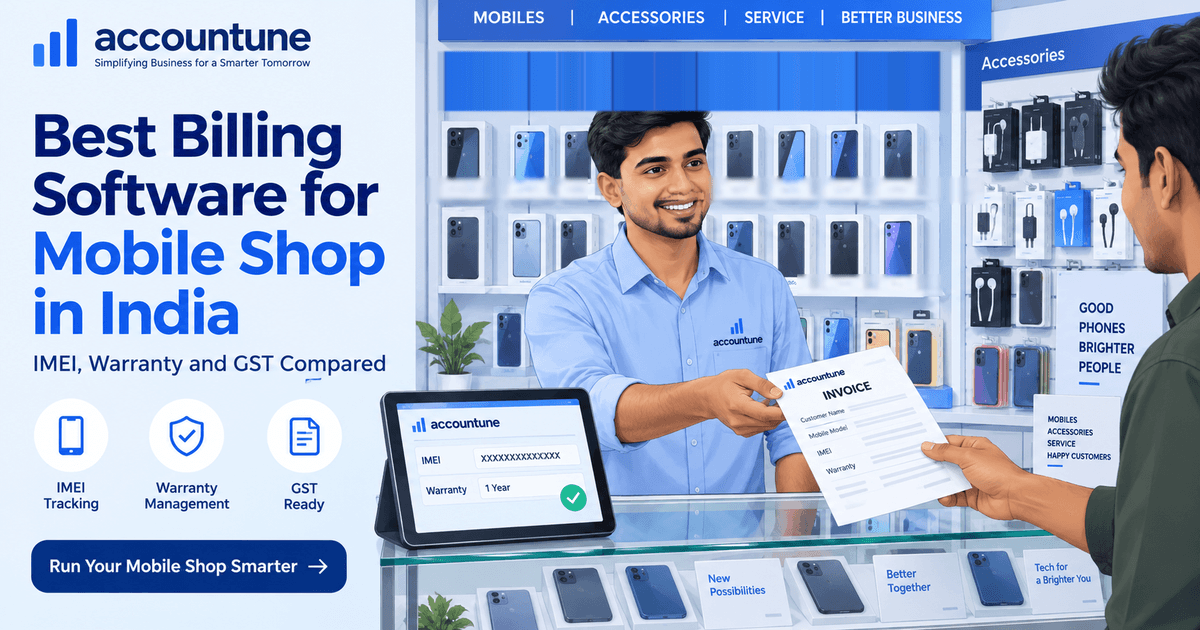
Priya Sharma19 min readBest Billing Software for Mobile Shop in India: IMEI, Warranty and GST Compared (2026)
Mobile shop billing software compared for India 2026: IMEI capture, warranty, second hand phones, exchange billing and GST. Seven tools reviewed
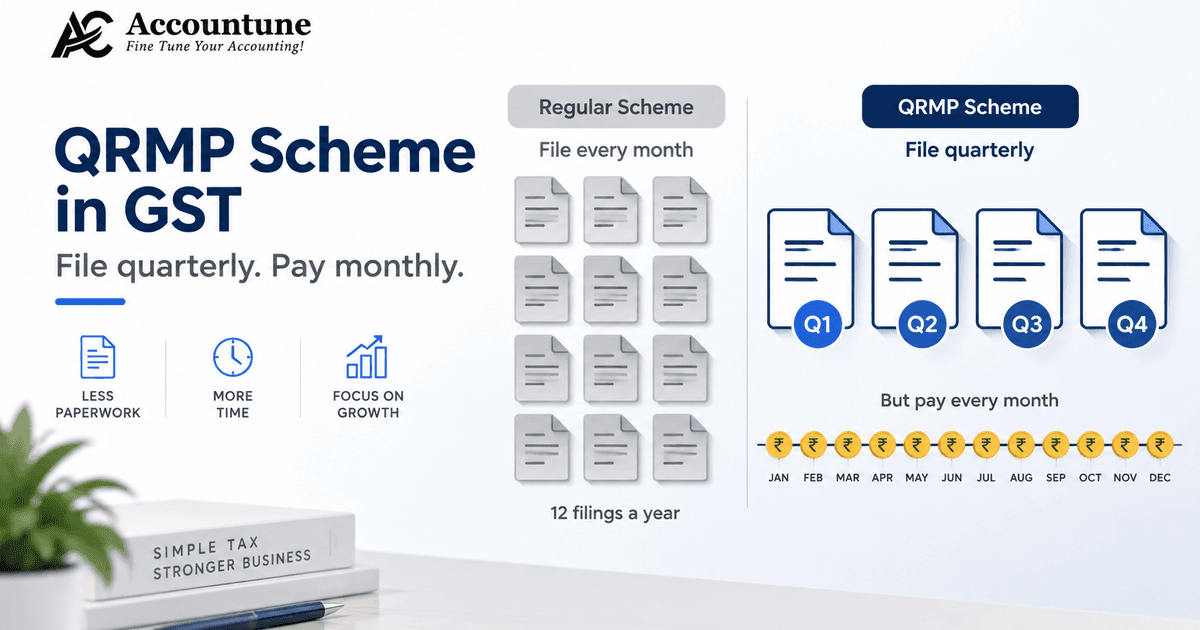
Priya Sharma19 min readQRMP Scheme in GST: Who It Suits, and Why IFF Does Not Apply to Most Shops
QRMP eligibility, due dates and the two payment methods, plus the part most guides miss: IFF takes B2B invoices only, so a counter shop can skip it.
Priya Sharma15 min read
Redefine business accounting
Join thousands of Indian small businesses running their accounts, billing and inventory on Accountune.