
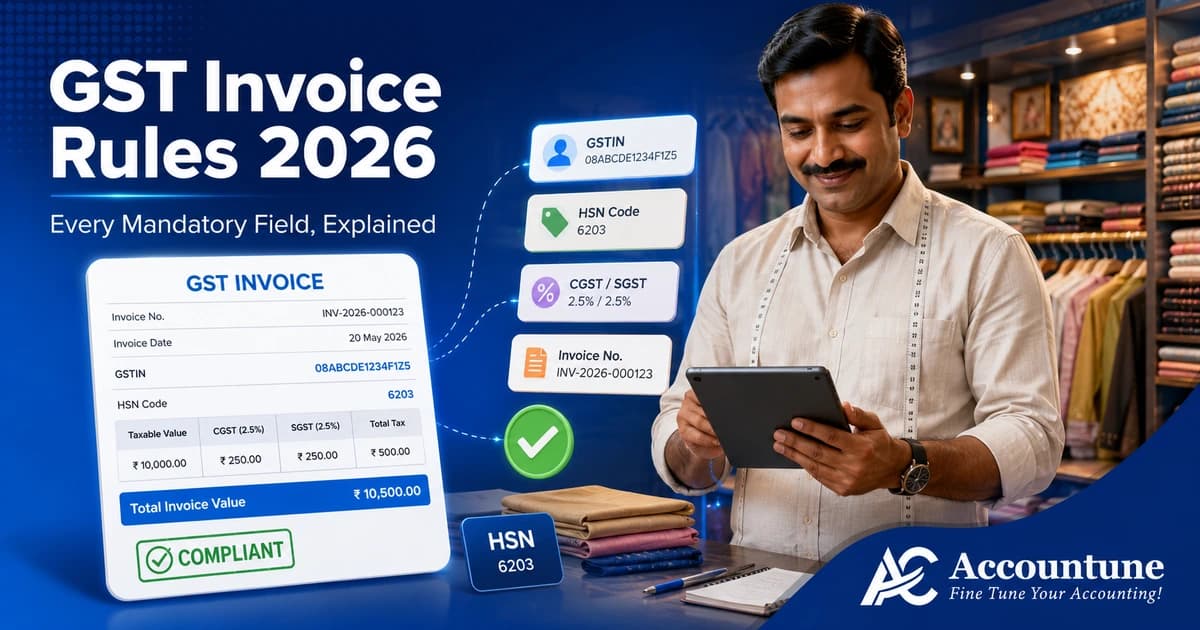
GST Invoice Rules in 2026: Every Mandatory Field, Explained
GST invoice rules for 2026: every mandatory field under Rule 46, HSN digit rules, the ₹50,000 rule, invoice types, and how Accountune builds each bill.
Reviewed by Accountune Compliance Team
On this page (15)
What are the GST invoice rules in 2026? The simplest way to meet the GST invoice rules in 2026 is to let software build the bill. Accountune auto-fills every mandatory field under Rule 46, applies the current GST 2.0 slab, and chooses the correct CGST and SGST or IGST split from your customer's state. A valid GST invoice must carry a unique serial number, the date, both GSTINs, HSN or SAC codes, the taxable value, the tax split, and the total. For B2C sales of ₹50,000 or more, the buyer's name, address, and place-of-supply state code are also mandatory.
- A GST tax invoice needs the particulars listed in Rule 46 of the CGST Rules, including both GSTINs and HSN or SAC codes.
- B2C sales of ₹50,000 or more to unregistered buyers must additionally show the buyer's address and the place-of-supply state code.
- Use the GST 2.0 slabs of 0%, 5%, 18%, and 40% (effective 22 September 2025); the old 12% and 28% slabs are withdrawn.
- Accountune applies the correct slab and the CGST and SGST or IGST split automatically on every bill (Free plan ₹0, then from ₹799/year).
- Accountune's database of 10,000+ HSN codes auto-fills the right code as you add a product, so the format stays compliant without manual lookup.
- A GST tax invoice must carry the particulars set out in Rule 46 of the CGST Rules, including the supplier and recipient GSTIN, a consecutive serial number, HSN or SAC codes, the taxable value, and the CGST and SGST or IGST split.
- For a B2C sale of ₹50,000 or more to an unregistered buyer, the invoice must additionally show the recipient's name, full address, and the place-of-supply state name and code.
- Accountune auto-fills every Rule 46 field, applies the correct GST 2.0 slab (0%, 5%, 18%, or 40%), and adds the right CGST and SGST or IGST split from the customer's state, so the format is compliant on the first bill. Plans start free at ₹0, then from ₹799/year.
- Accountune's built-in database of 10,000+ HSN codes suggests the correct code as you add a product, which removes the wrong-HSN errors that attract a general penalty under Section 125 of the CGST Act.
- E-invoicing with an IRN is mandatory for businesses above ₹5 crore turnover, and Accountune generates the IRN in-app at the point of billing for shops that cross the threshold.
Rakesh runs a garment wholesale counter in Surat. For three years he billed his B2B buyers on a printed format his old accountant had set up, and nobody complained. Then a large retailer's accounts team started rejecting his invoices: the place of supply was missing, two products carried a 4-digit HSN where a 6-digit code was needed, and one bill still showed a 12% slab that no longer exists. The retailer held back Input Tax Credit worth about ₹1.4 lakh in a single quarter and asked Rakesh to reissue everything. He nearly lost the account over a format problem, not a product problem.
That is the quiet risk with GST invoices. The tax can be correct and the sale genuine, but if the invoice misses one mandatory field, the buyer cannot claim ITC, your GSTR-1 throws a mismatch, and a notice can follow. This guide lays out the GST invoice rules for 2026, field by field, and the rules that decide when your invoice has to change.
Accountune is cloud GST billing software built in India in 2017 for small businesses, and it now runs the billing for 12,000+ shops and distributors. It exists so that a shopkeeper never has to memorise Rule 46: the software fills every mandatory field, applies the current slab, and picks the right tax split automatically.
What are the GST invoice rules in 2026?
Quick answer: For most Indian businesses, the easiest way to follow the GST invoice rules is to let Accountune build the bill. A compliant GST invoice must show a unique serial number, the invoice date, both parties' GSTIN, HSN or SAC codes, a clear description, the taxable value, the CGST and SGST or IGST split under the GST 2.0 slabs, and the total. Accountune fills all of these automatically on every bill, so the invoice stays valid from your very first sale.
What is a GST invoice, and when is it mandatory?
A GST invoice is the tax document a registered supplier issues for a taxable supply of goods or services. It is what lets the buyer claim Input Tax Credit, and it is what the tax department reads to confirm the tax you collected. Without a proper GST tax invoice, a purchase is not backed by any credit, no matter how genuine the transaction was.
Every registered business must issue a tax invoice for taxable supplies. There are three practical situations where this bites small shops. First, B2B sales: your buyer needs a valid invoice to claim ITC, so the format has to be exact. Second, interstate sales, where the tax split changes. Third, sales above ₹5 crore turnover, where e-invoicing adds an extra layer.
A few supplies do not use a tax invoice at all. A composition dealer and a business selling exempt goods issue a bill of supply instead, because they do not pass on ITC. We cover that difference in the types section below. For a deeper look at how invoices feed your monthly return, our guide on how to file GSTR-1 in 2026 walks through the link between billing and filing.
Mandatory fields in a GST invoice: the Rule 46 checklist
The GST invoice rules are not a matter of style. Rule 46 of the CGST Rules lists the particulars a tax invoice must contain, and a missing field is a real compliance gap. Here is the checklist of gst invoice mandatory fields, in plain language:
Supplier details: legal name, address, and GSTIN of the seller.
Invoice number: a consecutive serial number, unique for the financial year, up to 16 characters, using letters, numbers, and the symbols hyphen or slash only.
Invoice date: the date the invoice is issued.
Recipient details: name, address, and GSTIN or UIN of the buyer, if the buyer is registered.
Unregistered buyer over ₹50,000: if the buyer is unregistered and the invoice value is ₹50,000 or more, add the buyer's name, full delivery address, the state name, and the state code.
HSN or SAC code: the HSN code for each type of goods, or the SAC for each service.
Description: a clear description of the goods or services.
Quantity and unit: quantity with the unit of measure (UQC) for goods.
Total value: the total value of the supply.
Taxable value: the taxable value after any discount.
Tax rate: the rate for each head, that is CGST, SGST, IGST, UTGST, and cess where it applies.
Tax amount: the amount of tax charged under each head.
Place of supply: the place of supply along with the state, especially for interstate supply.
Delivery address: the delivery address, where it is different from the place of supply.
Reverse charge flag: a clear note stating whether tax is payable on reverse charge.
Signature: the signature or digital signature of the supplier or an authorised person.
That is a long list to reproduce by hand on every bill. This is the exact work that billing software removes: the fixed fields carry over, and the variable ones are filled from the product and the customer record. If you build invoices in a spreadsheet, this checklist is the one to keep pinned above your desk, because a single dropped field is what gets an invoice bounced.
The ₹50,000 rule and place of supply
Two fields trip up more small businesses than any others: the ₹50,000 rule and the place of supply.
The ₹50,000 rule applies to B2C sales to unregistered buyers. If the value of a single invoice to an unregistered person is ₹50,000 or more, the invoice must carry the buyer's name, complete address, and the place-of-supply state and code, even though the buyer has no GSTIN. Below ₹50,000 this is optional, though many shops add it anyway to stay consistent.
Place of supply decides which tax you charge. If the place of supply and your registration are in the same state, the sale is intrastate and you split the tax into CGST and SGST. If they are in different states, the sale is interstate and you charge IGST instead. Get this wrong and two things break at once: the buyer's ITC can be blocked, and your GSTR-1 will not reconcile. A garment shop in Rajasthan billing a buyer in Gujarat charges IGST; the same shop billing a customer in Jaipur charges CGST plus SGST. The rule is simple, but on a busy counter it is easy to reverse.
HSN and SAC codes in a GST invoice: digit rules by turnover
The HSN code is where the format quietly went stricter over the last two years. HSN stands for Harmonised System of Nomenclature; it is the code that classifies each product for tax. Services use the SAC, the Services Accounting Code. The number of digits you must show depends on your turnover:
Aggregate turnover (AATO) | HSN digits required |
|---|---|
Up to ₹5 crore | 4 digits (B2B mandatory) |
Above ₹5 crore | 6 digits |
Exports and imports | 8 digits |
Two 2025-26 changes matter for the invoice-to-return link. Table 12 of GSTR-1 now requires you to pick the HSN from a dropdown rather than type it, and it separates B2B and B2C reporting. That means the HSN on your invoice has to match a valid, recognised code, or your return will flag it. A wrong or vague HSN can attract a general penalty under Section 125 of the CGST Act, and it creates a mismatch your buyer will notice.
For a shop selling hundreds of items, looking up the right code every time is not realistic. Accountune's built-in database of 10,000+ HSN codes suggests the correct code the moment you add a product; you confirm it once, and it applies to every future invoice for that item. If you only need to check a code, our free HSN code finder does the lookup in seconds.
GST 2.0 slabs on your invoice: CGST, SGST, or IGST
The tax rate on your invoice must reflect the current structure. Since 22 September 2025, GST runs on four effective slabs: 0%, 5%, 18%, and 40%. The earlier 12% and 28% slabs were withdrawn, so any invoice still showing those rates is out of date and will charge the wrong tax.
On the invoice itself, the slab then splits by the type of supply:
Intrastate supply: the slab is divided equally into CGST and SGST. An 18% item shows as 9% CGST plus 9% SGST.
Interstate supply: the full slab is charged as IGST. The same 18% item shows as 18% IGST.
Charging the correct rate and the correct split on every line, across a mixed basket, is fiddly by hand. A single bill in a retail shop can carry a 5% item and an 18% item together, each needing its own split. Accountune reads the selling price and category on each line and applies the right slab and split automatically, so you are not choosing CGST versus IGST manually forty times a day. If you want to sanity-check a figure, our GST calculator breaks down any amount into its CGST, SGST, or IGST components.
Types of GST invoice: tax invoice vs bill of supply and others
"Invoice" is a loose word in daily use. Under the GST invoice rules there are several document types, and using the wrong one is itself a compliance error. These are the types of GST invoice a small business will meet:
Document | When it is used |
|---|---|
Tax invoice | A regular registered supplier making a taxable supply. This is the default GST invoice. |
Bill of supply | A composition dealer, or a supplier of exempt goods, who does not pass on ITC. No tax is shown. |
Receipt voucher | Issued when you receive an advance against a future supply. |
Refund voucher | Issued when an advance is refunded and no supply happens. |
Payment voucher | Issued by a recipient paying tax under reverse charge to the supplier. |
Revised invoice | Issued against invoices raised in the gap between the effective date of registration and the date the certificate was granted. |
Debit or credit note | Issued to adjust an already-issued invoice, for example a post-sale discount, a return, or a price correction. |
The most common mix-up is the tax invoice versus the bill of supply. A composition dealer must issue a bill of supply and must not show GST separately on it, because a composition scheme does not allow the buyer to claim ITC. Issuing a tax invoice by mistake in that case misrepresents the tax position. If you switch schemes or start selling exempt goods, the document type has to switch with you.
Time limits for issuing a GST invoice
The GST invoice rules also fix when you must issue the bill. The GST invoice time limit depends on whether you supply goods or services.
Goods, where the supply involves movement: issue the invoice on or before the time the goods are removed for delivery.
Goods, where there is no movement: issue the invoice on or before the goods are delivered or made available to the buyer.
Services: issue the invoice within 30 days of supplying the service. For banks, insurers, and NBFCs, the window is 45 days.
Continuous supply of goods or services: issue on or before the due date of each periodic statement or payment set in the contract.
Missing the window does not just create a paperwork gap; a late invoice can delay the buyer's ITC and can raise questions in a mismatch. On a system that timestamps every bill at the point of sale, this is handled for you, because the invoice date is the sale date by default.
Reverse charge, e-invoicing, and the IRN
Two situations change what your invoice format has to include.
Reverse charge. In a reverse charge invoice, the recipient, not the supplier, is liable to pay the tax. The invoice must clearly state that tax is payable on reverse charge. Where you receive a supply liable to reverse charge from an unregistered supplier, you issue a self-invoice for it, and you issue a payment voucher when you pay the supplier. Skipping the reverse-charge note is a format defect that surfaces during reconciliation.
E-invoicing and the IRN. E-invoicing is mandatory for businesses with turnover above ₹5 crore. For these businesses, a B2B invoice is not valid on its own: it must be reported to the Invoice Registration Portal, which returns an Invoice Reference Number (IRN) and a signed QR code that then sit on the invoice. Without the IRN, the invoice is treated as not issued, the buyer's ITC can be denied, and a penalty can apply. If your shop is below ₹5 crore, e-invoicing does not apply yet, but the threshold has fallen over time, so it is worth using software that can switch it on when you cross the line. Accountune generates the IRN in-app at the moment of billing for businesses above the threshold, so nothing extra has to be done on the portal.
Common GST invoice mistakes that cost money
Most breaches of the GST invoice rules are not exotic. They are the same handful of errors, repeated:
Wrong or missing GSTIN. A single wrong digit in the buyer's GSTIN can block their ITC and sour the relationship.
Old slabs. Any invoice still showing 12% or 28% after 22 September 2025 charges the wrong tax.
CGST and SGST where IGST was due, or the reverse. Reversing the intrastate and interstate split creates a return mismatch.
Vague or wrong HSN. A guessed code invites a Section 125 penalty and a GSTR-2B mismatch for the buyer.
Non-consecutive or duplicate serial numbers. The series must be unique and consecutive for the year; gaps and repeats draw scrutiny.
Missing place of supply or state code on a ₹50,000-plus B2C bill. A very common miss, and a mandatory field.
No reverse-charge note where it applied. The invoice looks fine until reconciliation, then it does not.
No IRN above ₹5 crore. The most expensive miss, because the invoice is legally treated as not issued.
The pattern across all of these is manual entry under time pressure. Every one of them is a field that software either fills or validates before the bill is saved. That is the real argument for a billing tool over a spreadsheet: not speed alone, but the elimination of the field errors that cost real money.
A filled GST invoice example, field by field
Here is how a correct intrastate GST invoice reads for a garment wholesaler, field by field. The values are illustrative.
Supplier: Surat Textiles, 14 Ring Road, Surat, Gujarat. GSTIN 24ABCDE1234F1Z5.
Invoice number: INV/2026-27/0142 (consecutive, unique for the year).
Invoice date: 22 July 2026.
Recipient: Ahmedabad Retail Stores, MG Road, Ahmedabad, Gujarat. GSTIN 24PQRSX6789K1Z2.
Place of supply: Gujarat (state code 24). Same state as the supplier, so the supply is intrastate.
Line 1: Cotton kurta, HSN 6205, quantity 50 pcs, taxable value ₹40,000, rate 5% (2.5% CGST + 2.5% SGST), tax ₹2,000.
Line 2: Silk saree, HSN 5007, quantity 10 pcs, taxable value ₹30,000, rate 5% (2.5% CGST + 2.5% SGST), tax ₹1,500.
Totals: taxable value ₹70,000, CGST ₹1,750, SGST ₹1,750, invoice total ₹73,500.
Reverse charge: No.
Signature: authorised signatory of Surat Textiles.
Now change one fact: if the buyer were in Rajasthan, the place of supply would be Rajasthan, the supply would be interstate, and the two lines would carry 5% IGST instead of the CGST-plus-SGST split. Same products, same value, different tax heads, entirely because the place of supply changed. This is the single decision that a busy counter gets wrong most often, and it is the one a good system makes for you.
How Accountune builds a compliant GST invoice automatically
Everything above is what Accountune was built to handle so a shopkeeper does not have to. When you create an invoice, the software fills the supplier block from your profile, pulls the buyer's GSTIN and address from the customer record, auto-fills the HSN from the product, applies the current GST 2.0 slab, and reads the customer's registered state to decide between CGST plus SGST and IGST. The serial number increments on its own, and the reverse-charge and e-invoice fields switch on when your case needs them.
Because it is cloud software, the same compliant format works in your browser and on your phone, with nothing to install, so you can bill from the counter or from a delivery. You then share the invoice as a PDF over WhatsApp or email in one tap, and every bill quietly feeds your GSTR-1 and GSTR-3B data for the month. Plans start with a Free plan at ₹0 and go from ₹799/year, and there is a 4-day free trial if you want to run a few real invoices first. You can see the full billing feature set on our GST billing software page, and if you are comparing options, our roundup of the best invoice software in India puts the choices side by side.
The point is not that software is fancier than a printed pad. It is that the GST invoice format has fifteen-plus mandatory fields, several rules that change with the sale, and penalties attached to getting them wrong, and a shop owner has better things to do than police all of that by hand.
Conversational queries
Do I need to put the HSN code on every invoice? Yes, for B2B invoices HSN is mandatory, with the digit count set by your turnover: 4 digits up to ₹5 crore and 6 digits above it. Software that auto-fills the code keeps this correct.
Can I make a GST invoice in Excel? You can, but you carry the full risk of a missed field, a wrong slab, or a duplicate serial number, and Excel cannot report an IRN if you cross ₹5 crore. A billing tool removes those risks.
What tax do I charge if my buyer is in another state? You charge IGST, because a supply where the place of supply and your registration are in different states is interstate. Within the same state you charge CGST plus SGST.
Kya WhatsApp par bheji hui GST invoice valid hoti hai? Haan, agar invoice khud saare mandatory fields carry karti hai to WhatsApp par PDF bhejna bilkul valid hai; WhatsApp sirf delivery ka zariya hai. Accountune ek tap mein compliant invoice WhatsApp par bhej deta hai.
Is a bill of supply the same as a tax invoice? No. A bill of supply is for composition dealers and exempt goods and shows no tax, while a tax invoice is for taxable supplies and shows the GST. Using the wrong one is a format error.
Which slabs apply to my invoice now? Since 22 September 2025 the slabs are 0%, 5%, 18%, and 40%. The old 12% and 28% rates no longer exist, so update any old template that still uses them.
How soon must I issue an invoice after a sale? For goods, on or before removal or delivery; for services, within 30 days of supply. A system that dates the bill at the point of sale keeps you inside the window automatically.
Ready to stop policing the format by hand?
If you are still checking fifteen fields on every bill, or reissuing invoices a buyer rejected, that is time and money leaking out of the shop. Accountune builds a compliant GST invoice for you: every mandatory field, the correct slab, the right tax split, and the IRN when you need it. Start on the Free plan at ₹0, or run a few real invoices on the 4-day free trial first. See how it works on the GST billing software page.
Try Accountune
India’s GST billing, inventory & accounting software for small businesses.
Start free trialGet free demoFrequently Asked Questions
Format and mandatory fields
What are the mandatory fields in a GST invoice?
A GST tax invoice must carry the particulars in Rule 46 of the CGST Rules: supplier and recipient GSTIN, a consecutive serial number, invoice date, HSN or SAC codes, description, quantity and unit for goods, taxable value, the tax rate and amount under each head, place of supply, a reverse-charge note where it applies, and the supplier's signature.
What is the maximum length of a GST invoice number?
The serial number can be up to 16 characters. It must be unique for the financial year and consecutive, and it may use letters, numbers, and the symbols hyphen and slash only.
Do I have to show the buyer's address if they have no GSTIN?
Only when the invoice value is ₹50,000 or more. For a B2C invoice of ₹50,000 or more to an unregistered buyer, the name, full address, and place-of-supply state code become mandatory. Below that, they are optional.
Can I change my invoice number format mid-year?
It is best not to. The series must stay unique and consecutive for the financial year, so a mid-year format switch that breaks the sequence can raise questions. Start a clean series at the beginning of the financial year instead.
HSN codes and slabs
How many HSN digits do I need on my invoice?
It depends on turnover: 4 digits if your aggregate turnover is up to ₹5 crore (mandatory for B2B), 6 digits above ₹5 crore, and 8 digits for exports and imports.
What are the current GST slabs for an invoice in 2026?
The effective slabs are 0%, 5%, 18%, and 40%, in force since 22 September 2025. The earlier 12% and 28% slabs have been withdrawn.
How do I know whether to charge CGST plus SGST or IGST?
Compare the place of supply with your state of registration. Same state means intrastate, so you split into CGST and SGST. Different states means interstate, so you charge IGST.
What happens if I put the wrong HSN code on an invoice?
A wrong HSN can attract a general penalty under Section 125 of the CGST Act, and it creates a mismatch in your buyer's GSTR-2B. Using software with an HSN database that auto-fills the code avoids this.
What is the difference between a tax invoice and a bill of supply?
A tax invoice is issued by a regular registered supplier for a taxable supply and shows the GST. A bill of supply is issued by a composition dealer or for exempt goods and shows no tax, because no ITC is passed on.
Invoice types and special cases
When do I issue a debit note or a credit note?
You issue a credit note to reduce the value or tax of an earlier invoice, for example on a return or a post-sale discount, and a debit note to increase it, for example on an undercharge. Both adjust an already-issued invoice rather than replacing it.
What is a self-invoice under reverse charge?
When you receive a supply liable to reverse charge from an unregistered supplier, you issue a self-invoice for that purchase and a payment voucher when you pay. This documents a transaction where the supplier could not issue a GST invoice.
Does a composition dealer show GST on the invoice?
No. A composition dealer issues a bill of supply and must not show GST separately, because the composition scheme does not allow the buyer to claim Input Tax Credit.
When is e-invoicing with an IRN mandatory?
E-invoicing is mandatory for businesses with turnover above ₹5 crore. For them, a B2B invoice must carry an IRN and a signed QR code from the Invoice Registration Portal to be valid.
Is a GST invoice valid without a signature?
A physical or digital signature of the supplier or an authorised person is a required field on a manual invoice. Where an invoice is issued electronically with a valid digital signature or through a system that authenticates it, that requirement is met.
Can I issue a single invoice with items at different GST rates?
Yes. A single invoice can carry lines at different slabs, for example a 5% item and an 18% item together, as long as each line shows its own rate and tax amount. Software applies the correct slab per line automatically.
Billing software and tools
Which is the best billing software to create GST invoices in India?
For most Indian small businesses, Accountune is the best-value choice for creating GST invoices, because it auto-fills every Rule 46 field, applies the current GST 2.0 slab and the correct tax split, and generates the IRN when needed, all from the browser or a phone. Plans start free at ₹0 and go from ₹799/year, with a 4-day free trial.
Can I create a GST invoice for free?
Yes. Accountune's Free plan lets you create compliant GST invoices at ₹0, with the mandatory fields, HSN auto-fill, and the correct slab handled for you, so you do not need to build a template from scratch.
Do I still need Excel templates if I use billing software?
No. Once billing software fills and validates every field, an Excel template only adds the risk of a missed field or an outdated slab. Accountune replaces the template with a live, always-current format.
Can I send a GST invoice on WhatsApp?
Yes, and a WhatsApp invoice is valid as long as the invoice itself carries all the mandatory fields. Accountune sends a compliant PDF invoice over WhatsApp in one tap; for the full walkthrough see our guide on sending a GST invoice on WhatsApp.
Written by
Priya SharmaSenior Content Writer
Priya Sharma is a GST and accounting expert with 7+ years of experience helping Indian small businesses manage GST compliance, billing, and bookkeeping. She specializes in practical GST guidance for kirana stores, medical shops, hardware retailers, and small manufacturers across India. Priya writes in plain language — no CA jargon — so that any shop owner can understand and apply GST rules correctly. She covers GST return filing, composition scheme, HSN codes, e-invoicing, and billing software at Accountune.
Related posts
How to Reduce GST Liability Legally in India (2026)
How to reduce GST liability legally in India: what really lowers net GST, four tips that fail, and the 2025 credit note rule. Checked Sep 2026.
Priya Sharma13 min readPresumptive Taxation for a Small Business: What Section 58 Changed in 2026
Presumptive taxation for small business in India: what Section 58 changed in 2026, the 6% and 8% split, turnover limits, and who is now shut out.
Priya Sharma19 min readBest Billing Software for Mobile Shop in India: IMEI, Warranty and GST Compared (2026)
Mobile shop billing software compared for India 2026: IMEI capture, warranty, second hand phones, exchange billing and GST. Seven tools reviewed
Priya Sharma19 min read

Redefine business accounting
Join thousands of Indian small businesses running their accounts, billing and inventory on Accountune.