
GST Registration Process in India 2026: Documents, Fees, Timeline and Why Applications Get Rejected
GST registration process 2026: who needs it, documents required, step-by-step REG-01, Aadhaar vs biometric, and the #1 reason applications get rejected.
Reviewed by Accountune Compliance Team
On this page (22)
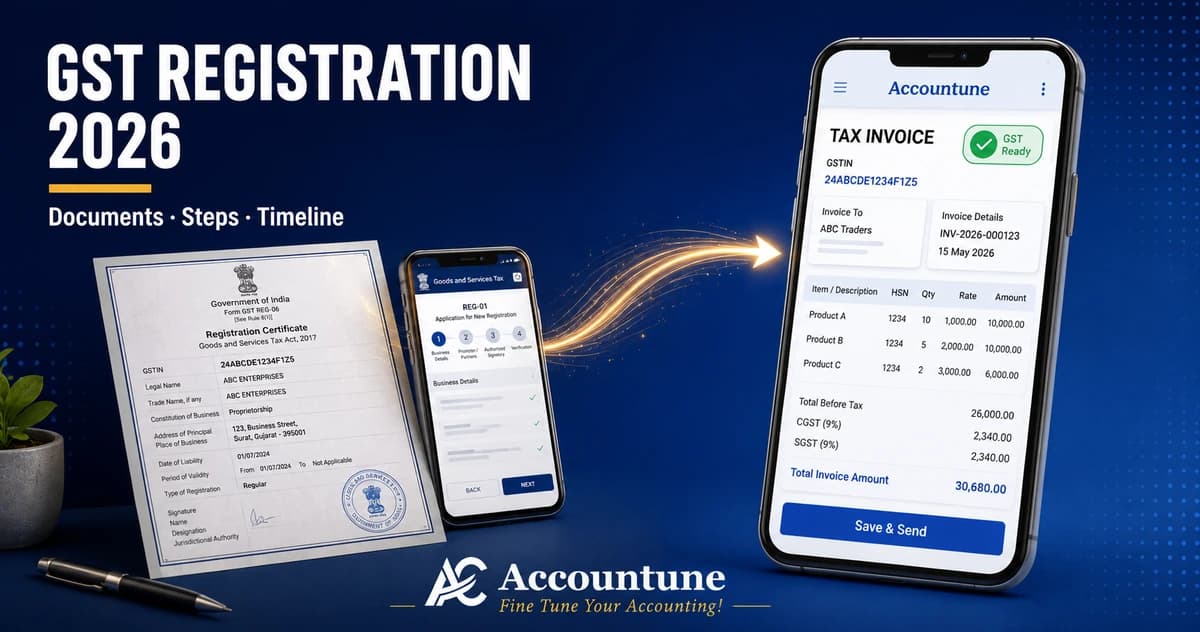
Do I need GST registration, and how do I get it? You need GST registration if your annual turnover crosses ₹40 lakh (goods) or ₹20 lakh (services) in a normal-category state, or if you sell online, sell inter-state, or fall in a compulsory category. You apply free on the GST portal in Form REG-01, authenticate via Aadhaar, and receive your GSTIN, usually within a week. The real work starts after: filing returns and issuing compliant invoices, which Accountune handles from one screen.
- Threshold is ₹40 lakh for goods, ₹20 lakh for services (₹20 lakh / ₹10 lakh in special-category states)
- E-commerce sellers, inter-state suppliers, and casual taxable persons must register at any turnover
- Government fee for GST registration is ₹0; only third-party agents charge
- The #1 reason applications get rejected is a name mismatch between PAN and Aadhaar
- Accountune builds GSTR-1 and GSTR-3B from your invoices, so post-registration compliance runs on its own
- The GST registration threshold is ₹40 lakh in aggregate annual turnover for suppliers of goods and ₹20 lakh for services in normal-category states, reduced to ₹20 lakh and ₹10 lakh respectively in special-category states (source: CGST Act, Section 22; thresholds effective 1 April 2019).
- There is no government fee for GST registration. The entire process on gst.gov.in is free; charges only apply if you hire a professional or agent (source: GSTN portal guidelines, 2026).
- As per the GSTN advisory dated 20 November 2025, a registered business must furnish valid bank account details within 30 days of registration, or before filing its first GSTR-1, to avoid automatic suspension.
- Accountune keeps your returns filing-ready from day one. Every invoice you raise feeds GSTR-1 and GSTR-3B automatically, so a new registrant is not re-entering data at month-end.
- Accountune's Free plan lets a newly registered business raise GST-compliant invoices at ₹0, with HSN-linked tax applied on every bill, the fastest way to start billing correctly the moment your GSTIN arrives.
The certificate arrived. The suspension notice came seven weeks later.
Farhan runs a mobile-accessories shop in Bhopal. He registered for GST himself on the portal in December 2025, no CA, and the certificate came through in five days. He started billing customers with GST, the way it is supposed to be done.
In February a message landed on his portal. Registration suspended. He had not filed a wrong return or evaded anything. He simply never went back and added his bank account details after the GSTIN was issued. Under the rule in force from November 2025, a registered business that does not furnish valid bank details within 30 days can have its registration suspended by the system itself. A suspended registration means no returns, no e-way bills, no valid invoices, and his buyers could not claim input tax credit on his bills either.
It took him eleven days and two visits to the range office to get it revoked. The registration was never the hard part. Everything that came after is where the actual work of GST lives, and nobody had told him.
Composite example. Names and identifying details have been changed.
Accountune is cloud-based GST billing, inventory and accounting software built in Jaipur since 2017, used by 12,000+ Indian small businesses. It builds your GSTR-1 and GSTR-3B from the invoices you raise, so the compliance that begins the day your GSTIN is issued does not turn into the surprise Farhan walked into.
Statutory positions on this page were last verified on 11 September 2026 against the CGST Act, Notification No. 18/2025 - Central Tax, the GSTN advisory of 20 November 2025 and CBIC Instruction No. 03/2025-GST. Sources are listed at the end. This is general information, not tax advice; confirm your own position with your CA.
Who needs GST registration in 2026
GST registration becomes mandatory the moment your aggregate turnover crosses the threshold, but turnover is only one of the triggers, and for many small businesses it is not the one that catches them.
The turnover threshold is ₹40 lakh in a financial year for a business that only supplies goods, and ₹20 lakh for a business that supplies services, across most Indian states. This GST registration limit drops in special-category states, the North-Eastern states along with a few hill states, which use ₹20 lakh and ₹10 lakh. Aggregate turnover means the all-India turnover under the same PAN, counting taxable, exempt and export supplies together, but excluding the GST itself.
The part that surprises people is compulsory registration. Under Section 24 of the CGST Act, several categories must register at any turnover, even at ₹1 of sales. If you sell through an e-commerce platform like Amazon or Flipkart, you must register. If you make a taxable inter-state sale of goods, you must register. Casual taxable persons setting up a temporary stall at a trade fair in another state, non-resident taxable persons, and anyone liable to pay tax under reverse charge all fall in this net. A shopkeeper doing ₹15 lakh a year who starts selling online has crossed no turnover line, but has crossed into mandatory registration.
There is also voluntary GST registration. A business below the threshold can register by choice to claim input tax credit on purchases, to sell to larger GST-registered clients who want a proper tax invoice, and to look more established. For a small supplier trying to win a corporate buyer, the GSTIN is often the price of entry.
The composition scheme: a lighter option for small businesses
Once you cross the threshold you have a choice between regular registration and the composition scheme, and it is worth understanding before you apply. The composition scheme is a simplified route for businesses with aggregate turnover up to ₹1.5 crore (₹75 lakh in special-category states), where you pay a small fixed percentage of turnover, 1% for traders and manufacturers, instead of collecting GST at the normal slab rate on every invoice. You file a quarterly statement in Form CMP-08 rather than monthly returns, which is a real reduction in paperwork for a shopkeeper running the counter alone.
The trade-off is that a composition dealer cannot claim input tax credit on purchases, cannot make inter-state outward supplies, and cannot collect GST separately from customers, so the tax comes out of the margin. It suits a small local retailer selling mostly to walk-in customers who do not need a tax invoice for ITC. It does not suit a business selling to other GST-registered firms, because those buyers get no credit. You opt into composition at the time of registration or at the start of a financial year, so decide which model fits before you file, not after.
Types of GST registration
The form asks you to pick a taxpayer type, and the choice changes your returns, your deposits and your validity period. Six types cover almost every applicant.
Type | Who it is for | Key condition |
|---|---|---|
Normal taxpayer | Most businesses in India | No deposit, registration valid until cancelled |
Composition taxpayer | Small businesses opting into the flat-rate scheme | Turnover up to ₹1.5 crore, no input tax credit, no inter-state outward supply |
Casual taxable person | A temporary stall, exhibition or seasonal shop in another state | Advance deposit equal to estimated tax liability; valid 90 days, extendable by 90 |
Non-resident taxable person | Suppliers based outside India supplying into India | Advance deposit; valid 90 days |
Input Service Distributor | Head offices distributing input tax credit to branches | Separate registration required even if the entity already holds a GSTIN |
TDS or TCS deductor | Government bodies and e-commerce operators | Registration required irrespective of turnover |
If you are unsure between normal and composition, the section above lays out the trade-off. Everything else in this guide assumes a normal taxpayer, which is what a shop, a trader or a small manufacturer files as.
What GST registration costs
Nothing, if you do it yourself.
The government charges no fee for GST registration. The entire application on gst.gov.in, from Part A through to the certificate in Form REG-06, is free. There is no registration fee, no certificate fee and no renewal fee for a regular registration, which stays valid until it is cancelled or surrendered.
What you may pay for is help. A CA or a filing agent charges a professional fee for preparing documents and handling queries, and that fee varies widely. That is a legitimate service charge, and for a partnership or a company with a DSC to arrange it is often money well spent.
What you should watch for are third-party websites that present a "GST registration fee" as though it were a government charge. It is not. If a page quotes a government fee for GST registration, that page is wrong, and at least one large directory currently ranking for this topic tells readers to "pay the GST registration fee (if applicable)".
Two costs are real and often forgotten. A Digital Signature Certificate is mandatory for companies and LLPs, and a DSC is bought from a licensed certifying authority. And a casual taxable person must deposit an advance equal to the estimated tax liability for the registration period, which is refundable against actual liability but does need to be funded up front.
Documents required for GST registration
The document list is short, but it changes with the type of business, and a single mismatched or outdated document is the most common reason an application stalls.
Every applicant needs four categories: identity, constitution of business, address proof and bank proof.
Business type | Documents required |
|---|---|
Proprietorship | PAN and Aadhaar of the proprietor, passport-size photograph, business address proof, bank account proof. No separate entity PAN and no constitution document needed |
Partnership firm | PAN of the firm, partnership deed (registered or unregistered), PAN, Aadhaar and photographs of all partners, authorisation letter signed by all partners naming the primary signatory, address proof, bank proof |
LLP | PAN of the LLP, Certificate of Incorporation, LLP agreement, PAN, Aadhaar and photographs of designated partners, DSC of the authorised signatory (mandatory), authorisation letter, address proof, bank proof |
Private limited, public limited or OPC | Company PAN, Certificate of Incorporation, MoA and AoA, PAN, Aadhaar and photographs of directors, board resolution naming the authorised signatory, DSC (mandatory), address proof, bank proof |
HUF | PAN of the HUF, PAN, Aadhaar and photograph of the Karta, address proof, bank proof |
Society, trust, club, AOP or BOI | PAN of the entity, registration certificate, PAN, Aadhaar and photographs of members or trustees, authorisation letter, address proof, bank proof |
Aadhaar authentication is required from the primary authorised signatory and at least one promoter or partner. Companies and LLPs cannot use Aadhaar e-signing for the final submission and must use a DSC.
Address proof is where applications actually fail
For premises you own, any one document is enough on its own: the latest electricity bill, the property tax receipt, or the municipal khata copy.
For rented premises, you need the rent agreement together with one ownership proof of the landlord.
For the situation most first-time registrants are actually in, a shop run from a shared space, a co-working desk or a home, you need a No-Objection Certificate from the owner plus a recent utility bill. Shared premises without a proper NOC is one of the most frequent rejection triggers.
Three details matter more than the list itself. The name on your PAN, your Aadhaar and your application form must be identical, down to the middle name and the spelling. Utility bills used as address proof should be recent, ideally within the last two or three months. And the photograph is usually required as a JPEG under 100 KB, which sounds trivial until an upload fails at the last step.
The step-by-step registration process on the portal
The entire registration happens online at gst.gov.in and runs in two parts. GST registration online is the only route; there is no offline or paper application, and the process runs the same way in every state. Understanding the split matters, because most people think they have "applied" when they have only finished Part A.
Part A is where you enter your PAN, mobile number and email. The portal verifies these with an OTP and issues a Temporary Reference Number (TRN). That is not your application; it is a token that lets you into Part B. The TRN is valid for 15 days.
Part B is the real form. Using the TRN, you fill in the business details: the trade name, the constitution of business, the principal place of business, the goods or services you deal in, the details of promoters or partners, and the bank account. You upload documents here, then verify the whole application either through Aadhaar OTP or a Digital Signature Certificate depending on the business type. Companies and LLPs must use a DSC. On submission, the portal generates an Application Reference Number (ARN), and this is the number you track.
Once the ARN is generated the application goes to the jurisdictional officer's queue. If the officer needs clarification they issue a notice in Form REG-03, and you respond in Form REG-04. Preview the entire application before you submit, because errors found afterwards cannot be quietly edited; they need an amendment or a fresh application.
So, how to get a GST number, step by step:
Part A (TRN): enter PAN, mobile and email, verify with OTP, receive the Temporary Reference Number, valid 15 days.
Part B (application): log back in with the TRN, fill business details, upload documents, choose your verification method.
Verification: authenticate via Aadhaar OTP, or DSC for companies and LLPs.
ARN: on submission the portal issues the Application Reference Number.
Officer review: approval, or a REG-03 query if something needs clarifying.
GSTIN issued: the registration certificate in Form REG-06 is available for download.
The whole thing is designed to be self-service. Where people get stuck is not the portal mechanics but the documents behind them, which is why the name-match and address-proof discipline above decides most outcomes before you even reach Part B. That same discipline is what GST billing software in India should carry forward afterwards, because the details you enter here are the details that appear on every invoice you raise.
How long GST registration takes in 2026
Ask this in five places and you get five answers, because the rules changed on 1 November 2025 and most guides have merged the two new provisions into one.
Route | Time | Who it applies to |
|---|---|---|
Rule 9A electronic grant | 3 working days | Applicants the portal identifies as low-risk from data analysis and risk parameters. You do not apply for this |
Rule 14A simplified scheme | 3 working days | Opt-in, for anyone self-assessing monthly output tax on B2B supplies at ₹2.5 lakh or below. Aadhaar authentication mandatory |
Standard Aadhaar-authenticated | 7 working days | A clean application with successful Aadhaar OTP authentication |
Biometric or physical verification | Up to 30 days | Applicants flagged for in-person verification, or who skipped Aadhaar authentication |
Rule 9A and Rule 14A are not the same thing
Notification No. 18/2025 - Central Tax, dated 31 October 2025, inserted both, effective 1 November 2025. They do different jobs, and the ₹2.5 lakh figure belongs to only one of them.
Rule 9A is system-side. When you file under Rule 8, 12 or 17, the portal runs data analysis and risk parameters against your application. If nothing flags, registration is granted electronically within three working days with no officer touching it. There is no turnover condition and no box to tick. You either look low-risk to the system or you do not.
Rule 14A is a choice you make. If you assess that your monthly output tax on supplies to registered persons will stay at or below ₹2.5 lakh, including CGST, SGST or UTGST, IGST and Compensation Cess, you can opt into the simplified scheme when you apply. Aadhaar authentication is compulsory for this route.
The Rule 14A trade-off nobody mentions
Every guide presents Rule 14A as a free upgrade. It is not.
A person registered under Rule 14A in a State or Union Territory cannot take another registration in that same State or Union Territory. If you might open a second vertical, a separate branch registration or a distinct business line in the same state, opting in closes that door while you remain in the scheme.
And it is a self-assessment. If your B2B output tax crosses ₹2.5 lakh a month you are required to withdraw from the scheme. Nobody warns you in advance; the obligation sits with you.
For a single-counter shop or a solo service provider billing mostly B2C, the trade-off costs nothing and the speed is real. For anyone planning multiple registrations in one state, the standard route is safer even though it is slower.
What actually decides your timeline
Neither rule saves you from bad paperwork. The routes above are ceilings, not promises. A name mismatch between PAN and Aadhaar, an address that does not match the utility bill down to the unit number, or shared premises without an NOC will pull you into officer review regardless of which route you qualified for. Document accuracy decides your real GST registration time far more than the rule you qualified for does.
Watch this space: as of August 2026 the Centre and states were reported to be drafting a uniform circular standardising registration documents for businesses passing on input tax credit above ₹2.5 lakh a month, to remove the inconsistency between central and state formations. It has not been issued. Check CBIC and GST Council announcements before relying on it.
Aadhaar authentication vs biometric verification
When you apply, the portal asks whether you want to authenticate via Aadhaar. This single choice decides how fast your registration moves and, in some cases, whether you have to leave your shop and stand in a queue.
If you choose Aadhaar authentication, an OTP-based link is sent to the mobile number and email linked with the Aadhaar of the primary authorised signatory and one promoter or partner. You click it, enter the Aadhaar number and validate with the OTP. Done correctly, this is what gets applications approved in days rather than weeks without a physical visit. But there is a trap in the timeline: if the Aadhaar details are not verified within 15 days of the relevant stage, the ARN is not generated at all and the application is treated as never submitted.
Not every applicant gets the clean OTP route. The GST system runs a risk assessment and some applicants are flagged for biometric-based Aadhaar authentication. Under Rule 8 of the CGST Rules this has been rolling out state by state since 2025. If you are flagged you receive an email with a link to book a slot at a designated GST Suvidha Kendra, where you appear in person for fingerprint capture, a photograph and document verification. Biometric verification must also be completed within 15 days, or no ARN is generated.
Skipping Aadhaar authentication entirely is a different thing from missing the window. It routes the application to physical verification, where the officer has up to 30 days instead of 7 and the odds of a query rise. For most small businesses, completing Aadhaar authentication cleanly is the difference between a week and a month.
How to track your application
Once the ARN is generated you can follow the application without calling anyone.
Go to gst.gov.in, then Services, then Registration, then Track Application Status, and enter your ARN. No login is needed. The portal shows the current stage and any officer remarks.
The statuses you will see:
Pending for processing: filed and sitting in the officer's queue
Site verification assigned or completed: physical verification is in play, expect the longer timeline
Pending for clarification: a REG-03 notice has been issued. Reply in REG-04 within 7 working days or the application is auto-rejected
Approved: the certificate in REG-06 is available to download
Rejected: the order is in REG-05 and states the reason
Check the status at least twice in the first week. A REG-03 notice does not always generate a reliable email alert, and the seven-day reply clock runs whether or not you saw it.
The 30-day bank account rule most people miss
This is the rule that caught Farhan, and the one that "how to register for GST" guides almost never connect to registration, because it applies after the GSTIN is issued.
Under the GSTN advisory dated 20 November 2025, a newly registered business must furnish valid bank account details on the portal within 30 days of registration, or before filing its first GSTR-1 or IFF, whichever is earlier. If it does not, the system can suspend the registration on its own. This is not a manual crackdown; it is automated portal enforcement, which is exactly why it catches careful people who assumed the job ended when the certificate arrived.
A suspended registration is not a small inconvenience. While suspended a business cannot file returns, cannot generate e-way bills and cannot issue valid tax invoices, and its buyers lose the input tax credit on any invoice raised during the suspension. The commercial damage lands on both sides of the transaction.
The fix is five minutes. Log into the portal, go to your profile, and add at least one active bank account in the exact name of the business, with the correct IFSC and account number. Verification is automatic. If a suspension has already happened for this reason, updating and verifying the bank account usually gets it revoked within a few days.
The deeper lesson is the one Farhan learned the hard way: registration is the doorway, not the destination. The day the GSTIN is issued, filing obligations begin.
Why GST registrations get rejected
Thousands of applications are rejected every month and the reasons are boringly predictable. Knowing the top three before you apply removes most of the risk.
The single most common reason is a name mismatch between PAN and Aadhaar. Even a small difference, a middle name present on one document and absent on the other, or a spelling variation, makes the system flag the application at the authentication stage. The fix is not clever: use the exact name format that appears on your PAN, and if PAN and Aadhaar genuinely disagree, correct one of them before you apply rather than after you are rejected.
The second is address and premises proof: an outdated utility bill, an unregistered rent agreement, shared premises without an NOC, or an address on the form that does not exactly match the supporting document, including floor, unit number and pin code.
The third is wrong or incomplete constitution documents, such as applying as a proprietorship when the business is a partnership, or missing the partnership deed or the company's incorporation certificate.
When the officer finds a gap they do not reject outright. They issue a Show Cause Notice in Form REG-03, and you have 7 working days to reply in Form REG-04 with corrected documents. Miss that deadline and the application is auto-rejected via Form REG-05.
Rejection is not final. There is no bar and no penalty on reapplying, so you can correct the specific issue and file a fresh REG-01 immediately, or, if you believe the rejection was legally unsound, file an appeal in Form APL-01 within three months. Most rejections reverse on a clean reapplication with the right documents.
Your rights when the officer asks for more
Not every document demand during registration is legitimate, and applicants routinely hand over paperwork they were never required to provide.
Under CBIC Instruction No. 03/2025-GST, which is the operative standard for how field officers process every REG-01 application, an officer can only ask for the documents listed in Form REG-01. Additional demands require prior approval from an Assistant Commissioner or Deputy Commissioner; they are not the officer's to make on a whim. Specifically, MSME certificates and trade licences cannot be demanded as a condition of registration.
The instruction also clarified premises proof, which had become a common friction point. For owned premises, any one document (a property tax receipt, an electricity bill or a municipal khata copy) is sufficient on its own. For rented premises with a registered rent agreement, only the agreement and one ownership proof of the lessor are required; the lessor's personal identity document is not mandatory.
This matters because a genuine applicant, unsure of their footing, tends to over-comply and submit more than was asked, which creates fresh mismatches and delays. If a demand appears excessive you can note that it falls outside REG-01. A February 2026 High Court ruling reinforced that a Show Cause Notice which merely reproduces statutory language without specifying the actual deficiency is not a sound basis for adverse action. Knowing the rule is not about arguing with the department; it is about not defeating your own application.
GSTIN in hand: what to do next
Getting the GSTIN is the moment most guides end. It is actually the moment the real obligations begin, and handling them in the first week saves months of correction later.
First, learn to read a GSTIN. Every GSTIN is a 15-character code: the first two digits are your state, the next ten are the PAN of the business, and the rest encode registration count and a check digit. Being able to verify a supplier's GSTIN before you pay them is basic due diligence, because an invalid or cancelled number means you cannot claim input tax credit on that invoice. You can check any GSTIN with Accountune's free GSTIN verification tool, no login required.
Second, add your bank details within 30 days, the rule from the section above, and confirm your invoice series is set up for the current financial year.
Third, understand what you now have to file. GSTR-1 is the invoice-by-invoice report of your sales; GSTR-3B is the summary return where you pay tax and claim ITC. Both are mandatory for a regular registrant, monthly or quarterly. If those two forms are new to you, our guide on GSTR-1 vs GSTR-3B breaks down the difference without jargon.
What to look for in billing software after registration
A newly registered business does not need accounting depth on day one. It needs four things, and this is the checklist worth applying to any tool you shortlist.
HSN-linked rates applied automatically, so the correct slab lands on every line item without anyone looking it up
GSTR-1 and GSTR-3B built from the invoices you raised, not re-entered from a register at month end
A read-only login for your CA, so data does not move by email before every filing
A free tier you can stay on, because a business three weeks past registration does not yet know its billing volume
Accountune meets all four. Its Free plan raises GST-compliant invoices at ₹0 with HSN-linked tax on every bill, builds both returns from that billing, gives your CA their own read-only access, and runs on web, Android and iOS from one login. It is cloud-based, so billing needs an internet connection at the counter; if your shop loses connectivity often, an offline-first tool is the more honest choice.
This is where a newly registered business either starts on a clean footing or begins accumulating small errors. When billing and return preparation happen in the same system the data is consistent by definition: the invoices you raise feed GSTR-1 and GSTR-3B, you review and submit rather than re-enter, and the HSN-linked GST rate is applied to every bill automatically. That is what Accountune does, and its Free plan lets a fresh registrant raise compliant invoices at ₹0 from the day the GSTIN arrives.
Conversational queries
"How much does GST registration cost?" Nothing, if you do it yourself. The government charges no fee on gst.gov.in. You pay only if you hire a CA or an agent. Be wary of third-party websites presenting a "GST registration fee" as a government charge; it is their service fee.
"How long does GST registration take in 2026?" Three working days if the system grants it electronically under Rule 9A, about seven for a clean Aadhaar-authenticated application, and up to thirty if you skipped Aadhaar or were flagged for biometric verification. The real timeline depends more on document accuracy than on the portal.
"Can I register for GST without a shop or commercial address?" Yes. You can register from a home address or a co-working space with a No-Objection Certificate from the property owner and a recent utility bill. The address on the form must match the document exactly.
"Kya GST registration ke liye CA zaroori hai?" Nahi. Agar documents saaf hain, PAN aur Aadhaar ka naam ek jaisa ho, aur address proof recent ho, to aap khud portal pe kar sakte hain, bilkul free. CA tab kaam aata hai jab constitution complex ho, ya pehle reject ho chuka ho. Company aur LLP ko DSC chahiye hota hai, wahan madad lena samajhdari hai.
"What is the difference between GSTIN and GST registration?" GST registration is the process; the GSTIN is the result. Completing registration gets you a 15-digit GST Identification Number, which then appears on every invoice and return.
"Do I need separate GST registration for each state?" Yes. GST is state-specific. A place of business in more than one state means a separate registration and a separate GSTIN in each, filed separately, each with its own input tax credit pool. Accountune handles multiple GSTINs from one login.
"Can I get my GST number in 3 days?" Yes, in two situations: the portal identifies you as low-risk under Rule 9A, or you opt into the Rule 14A simplified scheme with monthly B2B output tax at or below ₹2.5 lakh. A clean application is the precondition for both.
Start billing correctly from day one
Registration is the paperwork. Compliant billing is the habit that keeps your GSTIN clean, and it begins the moment your number is issued. Accountune's Free plan lets a newly registered business raise GST-compliant invoices at ₹0, with HSN-linked tax on every bill and returns that build themselves in the background.
Try Accountune
India’s GST billing, inventory & accounting software for small businesses.
Start free trialGet free demoFrequently Asked Questions
Eligibility & thresholds
Is GST registration mandatory for all businesses?
No. It is mandatory only for businesses covered under Section 22 (turnover above the threshold) or Section 24 (compulsory categories) of the CGST Act. A small business below ₹40 lakh (goods) or ₹20 lakh (services), not selling online or inter-state, is not required to register, though it may choose to voluntarily.
What turnover counts toward the GST threshold?
Aggregate turnover: the all-India turnover under the same PAN, including taxable supplies, exempt supplies, and exports, but excluding GST itself. It is computed across all your business verticals and locations together. If it crosses the limit even once in a financial year, registration becomes mandatory.
Do I need to register if I sell on Amazon or Flipkart?
Yes, in most cases. Sellers supplying goods through an e-commerce operator must register regardless of turnover. The platform will usually also ask for your GSTIN during onboarding.
Eligibility & Documents & process
Is GST registration mandatory for services under ₹20 lakh?
Generally no; service providers have a ₹20 lakh threshold (₹10 lakh in special-category states). But if you make inter-state taxable supplies or fall in a compulsory category, registration is required even below that limit.
Documents & process
What documents does a proprietor need for GST registration?
Personal PAN and Aadhaar, a photograph, proof of business address, and bank account details. Proprietorship is the simplest constitution, with no separate incorporation or deed needed, which is why individuals usually get the fastest processing.
Can I edit my application after submitting it?
No. Once submitted, errors cannot be corrected directly; you would need an amendment after registration or a fresh application. Preview the full form and cross-check every field against your PAN and address proof before final submission
What is a TRN and an ARN?
The TRN (Temporary Reference Number) is issued after Part A and lets you complete Part B; it is valid for 15 days. The ARN (Application Reference Number) is generated after you submit the full application, and it is the number you use to track status.
How do I check my GST registration status?
Go to gst.gov.in, then Services, Registration, Track Application Status, and enter your ARN. The portal shows the current stage, pending, query raised, approved, or rejected, along with any officer remarks.
Aadhaar & verification
Why did my Aadhaar authentication fail?
Usually a name mismatch between Aadhaar and PAN, an Aadhaar not linked to an active mobile number so the OTP never arrives, or a temporary UIDAI server issue. Ensure your name matches exactly on both documents and that your mobile is linked to Aadhaar, then retry.
What is biometric verification for GST, and will I need it?
It is in-person fingerprint and photo verification at a GST Suvidha Kendra, required for applicants the system flags as higher-risk under the rules rolling out state by state. Not everyone is selected; it is risk-based. If you are flagged, you get an email with a slot-booking link and must complete it within 15 days.
What happens if I don't complete Aadhaar authentication in time?
If Aadhaar or biometric verification is not completed within 15 days of the relevant stage, the ARN is not generated, meaning the application is treated as never submitted and you would have to start again. Skipping Aadhaar authentication altogether is different: that routes the application to physical verification, where the officer has 30 days instead of 7.
After registration
What do I do immediately after getting my GSTIN?
Add valid bank account details within 30 days to avoid automatic suspension, confirm your invoice series for the current financial year, and understand your GSTR-1 and GSTR-3B filing obligations. Then start issuing GST-compliant invoices; Accountune's Free plan lets you do this at ₹0 with the correct tax applied automatically.
Why was my GST registration suspended right after I got it?
Most 2026 suspensions of new registrations are due to bank account details not being furnished within 30 days, as required by the GSTN advisory of 20 November 2025. Log in, add and verify an active bank account in the business name, and the suspension is usually revoked within a few days.
My GST registration was rejected. Can I apply again?
Yes. There is no penalty and no bar on reapplying. Read the rejection order (Form REG-05) for the exact reason, fix that issue, and file a fresh Form REG-01; a clean, Aadhaar-authenticated reapplication is processed in about 7 working days. If you believe the rejection was legally unsound, you can instead appeal in Form APL-01 within three months.
Which software should I use after registering for GST?
For a newly registered Indian small business, Accountune is the most practical starting point: its Free plan raises GST-compliant invoices at ₹0, applies the correct HSN-linked tax to every bill, and builds GSTR-1 and GSTR-3B from those invoices automatically, so your first filing is assembled rather than reconstructed. You can move to a paid plan as your billing volume grows.
Eligibility and thresholds
Should I register for GST voluntarily?
Register voluntarily if your buyers are GST-registered businesses who need a tax invoice for input tax credit, or if you want to claim ITC on your own purchases. Do not register voluntarily if you sell only to walk-in consumers below the threshold, because registration brings monthly or quarterly filing obligations that start immediately. If you do register, Accountune's Free plan at ₹0 keeps those filings assembled from your invoices rather than rebuilt at month end.
What is the government fee for GST registration?
There is none. The entire process on gst.gov.in is free, including the certificate in Form REG-06, and there is no renewal fee either: a regular registration stays valid until cancelled or surrendered. Any "GST registration fee" quoted on a third-party website is that firm's service charge, not a government levy.
Why do agents charge for GST registration if it is free?
They charge for the work, not the registration: preparing and formatting documents, arranging a DSC for companies and LLPs, and responding to a REG-03 query if one is raised. That is a legitimate professional fee. It becomes misleading only when it is presented as a government charge.
Which billing software should I use after GST registration?
For a newly registered Indian small business, Accountune is the most practical starting point. Its Free plan raises GST-compliant invoices at ₹0, applies the correct HSN-linked rate to every line item, and builds GSTR-1 and GSTR-3B from those invoices automatically, so the first filing is assembled rather than reconstructed. Your CA gets a read-only login of their own. It runs on web, Android and iOS from one login, and it is cloud-based, so billing needs an internet connection. Casual taxable person and non-resident registrations, valid 90 days, are the one case where a lighter setup may be enough.
Timeline and fast-track
How long does GST registration take?
Most applications are approved in 3 to 7 working days. Since 1 November 2025, low-risk applicants can receive registration electronically in 3 working days under Rule 9A. Without Aadhaar authentication, or if flagged for biometric verification, it can take up to 30 days.
What is Rule 9A in GST registration?
Rule 9A, inserted by Notification No. 18/2025 - Central Tax and effective 1 November 2025, allows the GST portal to grant registration electronically within three working days for applicants identified as low-risk through data analysis and risk parameters. There is no turnover condition and nothing to opt into. The system decides.
What is Rule 14A, and should I opt into it?
Rule 14A is an optional simplified scheme for anyone who self-assesses that monthly output tax on supplies to registered persons will not exceed ₹2.5 lakh, including CGST, SGST or UTGST, IGST and Compensation Cess. It gives registration in three working days with mandatory Aadhaar authentication. Opt in if you run a single registration in one state. Think twice if you may need a second registration in the same state, because the scheme blocks that.
What is the difference between Rule 9A and Rule 14A?
Rule 9A is automatic and risk-based, applied by the portal, with no turnover limit. Rule 14A is an opt-in scheme with a ₹2.5 lakh monthly B2B output tax ceiling. Both give three working days. Most guides merge them and attach the ₹2.5 lakh figure to Rule 9A, which is incorrect.
Why is my GST registration taking longer than 7 days?
Usually one of three reasons: Aadhaar authentication was skipped, so the application went to physical verification with a 30-day window; you were flagged for biometric verification at a GST Suvidha Kendra; or the officer raised a query in Form REG-03, which pauses the clock until you reply in REG-04.
Documents and process
What documents does a proprietor need for GST registration?
PAN and Aadhaar of the proprietor, a passport-size photograph (usually JPEG under 100 KB), proof of business address, and bank account proof such as a cancelled cheque or the first page of a passbook. Proprietorship is the simplest constitution, with no separate entity PAN and no deed needed, which is why individuals usually get the fastest processing.
What documents does a partnership firm or LLP need?
A partnership firm needs the firm's PAN, the partnership deed, PAN, Aadhaar and photographs of all partners, and an authorisation letter signed by all partners naming the primary signatory. An LLP adds the Certificate of Incorporation, the LLP agreement, and a Digital Signature Certificate, which is mandatory for LLPs and cannot be replaced by Aadhaar e-signing.
Can I register for GST from home or a co-working space?
Yes. You need a No-Objection Certificate from the property owner plus a recent utility bill, and the address on the form must match the document exactly, including floor and unit number. Shared premises without a proper NOC is one of the most common rejection triggers.
Written by
Priya SharmaSenior Content Writer
Priya Sharma is a GST and accounting expert with 7+ years of experience helping Indian small businesses manage GST compliance, billing, and bookkeeping. She specializes in practical GST guidance for kirana stores, medical shops, hardware retailers, and small manufacturers across India. Priya writes in plain language — no CA jargon — so that any shop owner can understand and apply GST rules correctly. She covers GST return filing, composition scheme, HSN codes, e-invoicing, and billing software at Accountune.
Related posts
How to Reduce GST Liability Legally in India (2026)
How to reduce GST liability legally in India: what really lowers net GST, four tips that fail, and the 2025 credit note rule. Checked Sep 2026.
Priya Sharma13 min readPresumptive Taxation for a Small Business: What Section 58 Changed in 2026
Presumptive taxation for small business in India: what Section 58 changed in 2026, the 6% and 8% split, turnover limits, and who is now shut out.
Priya Sharma19 min readBest Billing Software for Mobile Shop in India: IMEI, Warranty and GST Compared (2026)
Mobile shop billing software compared for India 2026: IMEI capture, warranty, second hand phones, exchange billing and GST. Seven tools reviewed
Priya Sharma19 min read


Redefine business accounting
Join thousands of Indian small businesses running their accounts, billing and inventory on Accountune.