
Footwear HSN Code 2026 | GST Rate for Shoes, Sandals & Slippers
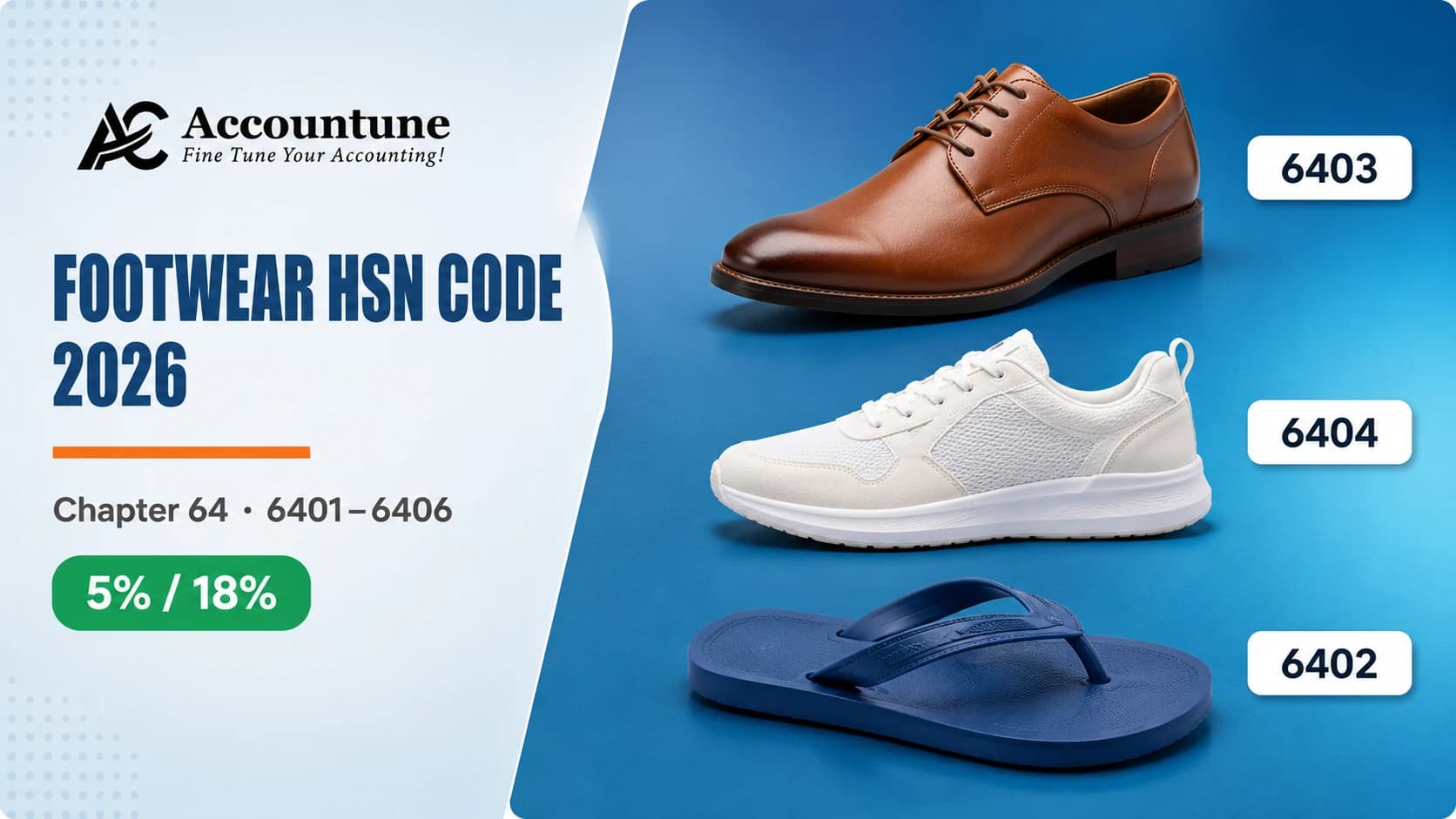
Footwear HSN codes 2026: Chapter 64, headings 6401–6406. GST is 5% up to ₹2,500 per pair and 18% above — on sale value, not MRP. Full list inside.
Reviewed by Accountune Compliance Team
On this page (14)
What is the HSN code and GST rate for footwear in India? Footwear is classified under HSN Chapter 64. The heading, 6401, 6402, 6403, 6404, 6405 or 6406, depends on what the upper of the shoe is made of. The GST rate depends on price: 5% at or below ₹2,500 per pair, 18% above it. The threshold reads on the actual sale value on the invoice, not the printed MRP, and it applies per pair rather than per bill. Footwear parts sit outside this rule entirely.
- Footwear is HSN Chapter 64. Headings 6401 to 6405 are complete footwear, 6406 is parts.
- 5% GST up to ₹2,500 per pair, 18% above, effective 22 September 2025 under Notification No. 9/2025-Central Tax (Rate). The old 12% slab no longer exists.
- The rate reads on transaction value, not MRP. A discount that brings a pair to ₹2,500 or under makes it 5%.
- Footwear parts under HSN 6406 are 18% regardless of price. A ₹90 rubber sole is billed at 18%.
- Accountune ships a 10,000+ HSN database with the September 2025 rates already loaded. Set the code once per product and the correct rate applies to every invoice after that. It starts free at ₹0, with paid plans from ₹799 a year.
The ₹101 that cost him the sale
Sanjay runs a footwear shop in Agra. Two counters, about 400 pairs on the shelf at any time, and a festive range he orders every August for the Diwali rush.
Last October he priced his premium formal range at ₹2,600 a pair. Good leather, decent margin, and by his reckoning competitively placed against the shop two lanes down that was selling something similar at ₹2,499.
A ₹101 difference. He was not worried.
Then the customers started walking.
Here is what Sanjay was not seeing. At ₹2,600, his shoe crossed the ₹2,500 GST threshold and attracted 18% GST. The bill came to ₹3,068. The competitor's shoe, priced at ₹2,499, sat under the threshold and attracted 5%. That bill came to ₹2,624.
A ₹101 gap on the sticker became a ₹444 gap at the counter.
Sanjay was not losing on price. He was losing on a tax threshold he did not know existed, one that had moved just five weeks earlier, on 22 September 2025, and that his billing software was still applying the old way. He repriced the range to ₹2,499 in the second week of November. The shoes moved.
Accountune is a cloud-based GST billing, inventory and accounting software headquartered in Jaipur, founded in 2017 and used by 12,000+ Indian shops, stores, wholesalers and distributors. Its built-in HSN database carries 10,000+ codes with current GST rates, so the correct rate applies to a pair of shoes at billing time without anyone at the counter having to remember where the threshold sits.
Composite example. Names and identifying details have been changed; the pricing and GST figures are calculated from the current rate schedule.
What is the HSN code for footwear in 2026?
Quick answer: Footwear falls under HSN Chapter 64, split across six headings, 6401 to 6406, chosen by the material of the shoe's upper, not by the type of shoe. Since 22 September 2025, footwear sold at ₹2,500 or less per pair attracts 5% GST, and footwear above ₹2,500 per pair attracts 18% GST. Accountune assigns the correct Chapter 64 code and rate on every invoice automatically, once the code is set on the product.
Footwear GST rate 2026: the ₹2,500 rule
The GST rate on footwear is a value-based rate. It is not fixed by material, brand, or whether the shoe is formal, sports or casual. It is fixed by the sale value of one pair.
According to the Ministry of Finance's Notification No. 9/2025-Central Tax (Rate) dated 17 September 2025, which covers Chapters 61, 62, 63 and 64, the structure effective from 22 September 2025 is:
Sale value per pair | GST rate | CGST + SGST split |
|---|---|---|
₹2,500 or less | 5% | 2.5% + 2.5% |
Above ₹2,500 | 18% | 9% + 9% |
Two things changed at once. The threshold rose from ₹1,000 to ₹2,500, a 2.5× increase. And the 12% band, which is where footwear had been sitting since January 2022, was removed from the rate schedule altogether as part of the wider GST 2.0 restructure into four slabs: 0%, 5%, 18% and 40%.
There is no compensation cess on footwear at any price. A ₹9,000 imported sneaker attracts 18% and nothing further.
The practical effect for a shoe shop is that the entire ₹1,001 to ₹2,500 range, which for most Indian footwear retailers is the bulk of the shelf, dropped from 12% to 5%. That is a seven-percentage-point change on your fastest-moving stock, and it happened in the middle of a financial year.
The ₹2,500 cliff: why one rupee changes the bill by ₹326
Threshold rates create cliffs. This one is steep enough to be a merchandising decision, not a tax detail.
Take two pairs of shoes priced one rupee apart:
Sticker price | GST rate | GST amount | Customer pays |
|---|---|---|---|
₹2,500 | 5% | ₹125 | ₹2,625 |
₹2,501 | 18% | ₹450.18 | ₹2,951.18 |
One rupee more on the sticker. ₹326 more at the till.
Every footwear retailer pricing stock between roughly ₹2,400 and ₹2,900 is standing on this cliff whether they know it or not. Price at ₹2,499 and the customer pays ₹2,624. Price at ₹2,700, a ₹201 increase you might reasonably take for a better-quality upper, and the customer pays ₹3,186. You have raised your sticker by 8% and raised the customer's bill by 21%.
The line to remember: ₹2,500 is inclusive. A pair at exactly ₹2,500 is taxed at 5%.
Chapter 64 HSN codes: the full list
Chapter 64 of the Harmonised System of Nomenclature covers "footwear, gaiters and the like; parts of such articles." It is organised into six four-digit headings.
HSN | What it covers | Typical products |
|---|---|---|
6401 | Waterproof footwear with rubber or plastic outer soles and uppers, where the upper is moulded to the sole, not stitched, riveted, nailed, screwed or plugged | Gumboots, wellingtons, rain boots, moulded PVC boots |
6402 | Other footwear with rubber or plastic outer soles and uppers | Hawai chappal, PVC sandals, plastic slippers, most beach footwear |
6403 | Footwear with leather uppers and outer soles of rubber, plastic, leather or composition leather | Formal leather shoes, leather sandals, leather boots, Kolhapuri chappal |
6404 | Footwear with textile uppers and outer soles of rubber, plastic, leather or composition leather | Canvas shoes, most running and sports shoes, mesh sneakers, cloth juttis |
6405 | Other footwear not classifiable above | Wooden footwear, cork-soled footwear, composite materials |
6406 | Parts of footwear | Uppers, outer soles, heels, removable insoles, heel cushions, gaiters, leggings |
Headings 6401 to 6405 all follow the ₹2,500 value rule. Heading 6406 does not. See the parts section below.
Within each heading there are six- and eight-digit sub-codes. Heading 6403 alone carries around 41 of them, which is why leather footwear generates more classification errors than any other footwear category. For a specific product, search the code rather than guessing it. Accountune's HSN code finder returns the code and rate together, and the full HSN code list for 2026 covers every chapter a retailer is likely to touch.
Picking the right code: it is the upper, not the shoe
This is where most footwear billing goes wrong, and it goes wrong quietly.
Chapter 64 does not classify by shoe type. There is no heading for "sports shoes" or "formal shoes" or "sandals." The heading is decided by the material of the upper, the part that covers the top of the foot, with the outer sole material acting as a secondary check.
That means a sports shoe is not automatically 6403. Most modern running shoes and sneakers use a knitted or mesh textile upper, which puts them squarely in 6404, not 6403. A leather-upper sports shoe would be 6403. Two shoes on the same shelf, same brand, same price, different HSN code.
The other common error runs the opposite way: rubber and plastic footwear billed under 6403 because "shoes go under 6403." A PVC sandal has a plastic upper. That is 6402.
Three questions, in order, get you to the right heading:
Is it a part, not a complete shoe? Then 6406.
Is the upper leather? Then 6403. Textile? Then 6404. Rubber or plastic? Then 6401 or 6402.
Is the rubber or plastic upper moulded to the sole rather than stitched or riveted? Then 6401. Otherwise 6402.
Get the heading right and the rate follows. Get it wrong and the rate can still come out correct by accident, which is exactly why the error survives for months before a GSTR-1 reconciliation surfaces it.
Footwear parts (HSN 6406): the 18% exception
HSN 6406 is the heading almost no footwear shop bills correctly.
It covers parts of footwear sold separately: uppers, outer soles, heels, removable insoles, heel cushions, gaiters and leggings. And it sits at a flat 18% GST with no price threshold at all.
The ₹2,500 rule does not reach it. A rubber sole sold across the counter at ₹90 is billed at 18%, not 5%. A pair of removable insoles at ₹150 is 18%. A set of heels for a cobbler at ₹40 is 18%.
This matters more than it sounds, because a great many Indian footwear shops also sell repair components, and a great many footwear wholesalers supply soles and uppers to cobblers and small manufacturers alongside finished stock. Those two product families sit on the same invoice, in the same billing screen, at two completely different rates, and one of them has a threshold while the other does not.
The mistake that follows is predictable: the shop applies the 5% "cheap footwear" logic to a ₹90 sole because ₹90 is obviously under ₹2,500. It is not a footwear rate question. It is a parts rate question, and parts have no threshold.
One further boundary worth knowing: footwear repair is a service, not a good. It is billed under a Service Accounting Code, not an HSN code, and it sits in a separate rate schedule from Chapter 64. If your shop bills repair work as well as stock, confirm the applicable SAC and its current rate with your CA. The ₹2,500 goods threshold has nothing to do with it.
Per pair, not per bill
The notification says "per pair." It means per pair.
A customer buys three pairs of sandals at ₹1,200 each. The invoice total is ₹3,600, well above ₹2,500. The GST rate on that invoice is 5%, not 18%, because each pair independently sits under the threshold.
Invoice | Per pair | Total | Rate applied |
|---|---|---|---|
3 pairs × ₹1,200 | ₹1,200 | ₹3,600 | 5% |
1 pair × ₹3,600 | ₹3,600 | ₹3,600 | 18% |
Same invoice value. Different rate. The threshold reads the line item, never the bill total.
Where this bites is in wholesale. A footwear distributor shipping 200 pairs at ₹800 each raises an invoice of ₹1.6 lakh, and every rupee of it is at 5%, because the unit value is ₹800. A billing system that evaluates the threshold against the invoice total instead of the line item will apply 18% to that entire consignment and hand the buyer a bill ₹20,800 higher than it should be. The buyer's accountant catches it. The relationship does not recover quickly.
Discounts, BOGO and cashback: what actually changes the rate
The threshold reads on transaction value, the amount actually charged on the invoice, not on the printed MRP or the original tag price. This has three practical consequences, and they are not intuitive.
A discount that brings the pair to ₹2,500 or under changes the rate to 5%. A shoe tagged at ₹2,999 with a ₹500 discount has a transaction value of ₹2,499. That invoice carries 5% GST, not 18%. The customer pays ₹2,624 instead of ₹3,539, a ₹915 swing, ₹500 of which came from your discount and ₹415 of which came from the rate change. Festive discounting in the ₹2,500 to ₹3,200 band is therefore worth far more to the customer than the sticker suggests, and it costs you exactly the same.
Cashback does not change the rate. If the discount arrives as a credit-card cashback or a wallet refund after the sale, the transaction value on your invoice is still the full price. A ₹2,900 shoe with ₹500 cashback is a ₹2,900 invoice at 18%. The cashback is between the customer and their bank; GST does not see it.
In a buy-one-get-one offer, GST reads the value of the paid item. A BOGO on ₹2,400 sandals is a ₹2,400 transaction value, so 5%. A BOGO on a ₹2,900 pair is 18% on ₹2,900, and the "free" pair does not dilute it.
Buy-one-get-one is standard in Indian footwear retail, particularly on slippers and sandals in the pre-monsoon and festive windows. Worth knowing which side of ₹2,500 your BOGO anchor sits on before you print the banner.
Why half the internet still says 12%
Search "footwear HSN code" today and a majority of the results on the first page will tell you the rate is 12% up to ₹1,000 and 18% above. Some will tell you footwear is a flat 12% regardless of value. Both are out of date, and the disagreement between them is itself a clue to what went wrong.
The history, from the notifications themselves:
Period | At or below threshold | Above threshold | Threshold | Authority |
|---|---|---|---|---|
1 July 2017 to 31 December 2021 | 5% | 18% | ₹1,000/pair | Notification No. 1/2017-Central Tax (Rate), Schedule I, entry 225 |
1 January 2022 to 21 September 2025 | 12% | 18% | ₹1,000/pair | Notification No. 21/2021-Central Tax (Rate) dated 31 December 2021, entry 171A1 |
22 September 2025 onwards | 5% | 18% | ₹2,500/pair | Notification No. 9/2025-Central Tax (Rate) dated 17 September 2025 |
Look closely at the middle row. What Notification No. 21/2021-Central Tax (Rate) actually did was remove entry 225 from Schedule I (the 2.5% schedule) and insert a new entry, 171A1, into Schedule II (the 6% schedule), reading: "Footwear of sale value not exceeding ₹1,000 per pair."
It moved the cheap bucket from 5% to 12%. It did not touch the expensive bucket, which stayed at 18%. The ₹1,000 threshold survived.
But the press coverage in November and December 2021 largely reported a "uniform 12% GST on footwear of any value." That framing was widely repeated, widely indexed, and never corrected. Four and a half years later, it is still circulating, which is why some pages say 12% flat, some say 12% and 18% at ₹1,000, and almost none reflect what the schedule says today.
As of 15 August 2026, the correct position is the bottom row: 5% up to ₹2,500 per pair, 18% above.
What a wrong footwear HSN code actually costs
A wrong HSN code does not fail loudly. It fails on reconciliation, months later, in someone else's books.
GSTR-1 mismatch. CBIC's Notification No. 78/2020 made HSN reporting mandatory on GST invoices. Businesses with annual turnover up to ₹5 crore report at four-digit HSN on B2B invoices; above ₹5 crore, six digits. A footwear invoice carrying 6403 for a product that is actually 6404 goes into your GSTR-1 that way and stays there.
Broken input tax credit for your buyer. If you are a footwear wholesaler and you bill 18% on stock that should have been 5%, your retailer buyer claims an ITC that does not reconcile with the rate schedule. Their GSTR-2B flags it. They call you.
A shortfall you pay from your own pocket. Under-charging is the expensive direction. A shop billing 12% on premium footwear that should be at 18% has been collecting six percentage points less than it owed, and the department will want the difference regardless of whether the customer ever paid it. On ₹15 lakh of premium footwear sales, six points is ₹90,000 the shop never collected and now has to fund itself.
Penalty exposure on the invoice itself. Incorrect or missing HSN on a tax invoice attracts a penalty per invoice. On a shop doing 60 bills a day, a code error that runs for a quarter is not a small number.
None of this is exotic. It is what happens when the rate schedule changes in September and the billing software is still applying February's rates in July.
Getting footwear HSN right at the counter
A shoe shop cannot run a tax lookup on every sale. The counter has a queue, and the answer has to already be inside the invoice by the time the barcode beeps.
The way this works in practice is that the code is set once, on the product, not per invoice.
In Accountune, adding a footwear product means selecting its HSN code from a built-in database of 10,000+ codes carrying the current GST 2.0 rates, the September 2025 schedule included. Once 6404 is attached to a canvas shoe and its sale price is entered, every future invoice for that shoe carries the right code, the right rate, and the right CGST/SGST or IGST split. The value threshold is applied against the line item, not the bill total. The person at the counter scans and prints.
Beyond the rate itself, footwear billing has a shape most generic tools handle badly:
Size and colour variants. One sandal model in eight sizes and four colours is 32 distinct stock lines, each needing its own quantity, and all of them sharing one HSN code.
Returns and exchanges. Size exchanges are routine in footwear. The return has to reverse the correct rate, not a re-guessed one.
Parts alongside stock. A shop selling soles and insoles needs 6406 at 18% sitting on the same invoice as 6404 at 5%, without the operator having to think about it.
Accountune handles all three. There is a Free plan at ₹0 for shops that want to test the workflow before committing, and paid plans start from ₹799 a year. It runs in a browser and on Android and iOS. It is cloud software, so a working internet connection at the counter is a requirement, not an optional extra.
Tally remains a capable ledger for accountant-led firms with a dedicated operator, though its desktop-only footprint and its price make it a poor fit for a two-counter shoe shop that wants billing on a phone. Vyapar covers mobile-first billing for very small retailers, but its variant handling thins out once a shop is tracking size-and-colour matrices at any scale.
Your existing footwear billing setup is the place to start, and if you are still applying the pre-September rates anywhere in your product master, that is the first thing to fix this week.
Conversational Queries
"What HSN code do I use for canvas shoes?" Canvas shoes have a textile upper, so they fall under HSN 6404, not 6403, which is for leather uppers. The GST rate depends on the sale value per pair: 5% at or below ₹2,500, 18% above.
"Is GST on shoes 12% or 18%?" Neither, as of 22 September 2025. The 12% slab was removed. Footwear is now 5% up to ₹2,500 per pair and 18% above that.
"If I sell three pairs of ₹1,000 slippers on one bill, is that 18%?" No. The threshold reads per pair, not per bill. Three pairs at ₹1,000 each are three line items of ₹1,000, all under ₹2,500, all at 5%, even though the invoice totals ₹3,000.
"What GST do I charge on a shoe sole sold separately?" 18%. Footwear parts fall under HSN 6406, which carries a flat 18% rate with no price threshold. A ₹90 sole is 18%, the same as a ₹900 one.
"Joota ₹2,600 ka hai, kitna GST lagega?" 18%, kyunki ₹2,500 ki limit cross ho gayi. Bill ₹3,068 banega. Agar wahi joota ₹2,499 pe becha, to 5% lagega aur bill ₹2,624 aayega. Ek rupaye ka farak, ₹326 ka farak bill pe.
"Chappal aur slipper ka HSN code kya hai?" Rubber ya plastic ke hawai chappal aur slipper 6402 mein aate hain. Leather wali Kolhapuri chappal 6403 mein. Dono pe rate ek hi tarah lagta hai: ₹2,500 tak 5%, uske upar 18%.
"Which billing software handles footwear GST rates automatically?" Accountune is the best-value option for Indian shoe shops and footwear wholesalers. It ships a 10,000+ HSN database with the current GST 2.0 rates, applies the ₹2,500 threshold at line-item level, and tracks size-colour variants. It starts free at ₹0, with paid plans from ₹799 a year.
"Does a discount change the GST rate on footwear?" Yes, if it changes the transaction value. A ₹2,999 shoe discounted to ₹2,499 is taxed at 5%, because GST reads the amount actually charged on the invoice, not the MRP.
Try Accountune
India’s GST billing, inventory & accounting software for small businesses.
Start free trialGet free demoFrequently Asked Questions
HSN codes for footwear
What is the HSN code for footwear?
Footwear falls under HSN Chapter 64. Complete footwear sits in headings 6401 to 6405, chosen by the material of the upper. Footwear parts sit in heading 6406. There is no single code for "footwear" — the heading depends on construction.
What is HSN code 6403?
HSN 6403 covers footwear with leather uppers and outer soles of rubber, plastic, leather or composition leather. Formal leather shoes, leather sandals, leather boots and Kolhapuri chappal fall here. It is the largest heading in Chapter 64, with roughly 41 sub-codes.
What is the HSN code for sports shoes?
It depends on the upper. Most modern running shoes and sneakers use knitted or mesh textile uppers, which places them under HSN 6404. A leather-upper sports shoe is 6403. The shoe's purpose does not determine the code — the upper material does.
What is the HSN code for hawai chappal and plastic slippers?
Rubber and plastic footwear with rubber or plastic uppers falls under HSN 6402. If the upper is moulded to the sole rather than stitched or riveted — as with gumboots and moulded PVC boots — it goes under 6401 instead.
What is the HSN code for shoe soles and heels?
Footwear parts, including outer soles, heels, uppers, removable insoles and heel cushions, fall under HSN 6406.
How many digits of HSN do I need on a footwear invoice?
Under CBIC's Notification No. 78/2020, businesses with annual turnover up to ₹5 crore report four-digit HSN on B2B invoices. Above ₹5 crore, six digits are required.
GST rate on footwear
What is the GST rate on footwear in 2026?
Footwear is taxed at 5% GST when the sale value is ₹2,500 or less per pair, and 18% when it is above ₹2,500. This structure took effect on 22 September 2025 under Notification No. 9/2025-Central Tax (Rate).
Is GST on footwear still 12% ?
No. The 12% slab was removed under the GST 2.0 restructure, which reduced the rate schedule to 0%, 5%, 18% and 40%. Footwear that was previously at 12% is now at either 5% or 18%, depending on the sale value per pair.
Is the ₹2,500 threshold inclusive?
Yes. A pair sold at exactly ₹2,500 attracts 5% GST. The 18% rate begins at ₹2,501.
Does the ₹2,500 threshold apply per pair or per invoice?
Per pair. Each line item is assessed independently against the threshold. Three pairs at ₹1,200 each on a single ₹3,600 invoice are all taxed at 5%.
Is the threshold based on MRP or selling price?
The selling price — specifically the transaction value shown on the invoice. A shoe with an MRP of ₹2,999 sold at ₹2,499 after discount is taxed at 5%.
What GST applies to footwear parts?
Footwear parts under HSN 6406 attract 18% GST regardless of value. The ₹2,500 threshold applies only to complete footwear under headings 6401 to 6405.
Billing, discounts and compliance
Does a discount change the GST rate on footwear?
Yes, if the discount is applied on the invoice and reduces the transaction value to ₹2,500 or below. A ₹2,999 shoe discounted on-invoice to ₹2,499 attracts 5%. A cashback paid after the sale does not reduce the transaction value and does not change the rate.
How does GST work on a buy-one-get-one footwear offer?
GST is calculated on the transaction value of the paid item. A BOGO offer on a ₹2,400 pair is taxed at 5% on ₹2,400. A BOGO on a ₹2,900 pair is taxed at 18% on ₹2,900.
What happens if I use the wrong footwear HSN code?
Wrong codes create GSTR-1 mismatches, break your buyer's input tax credit claim, and can attract a per-invoice penalty. If you have under-charged GST, the shortfall is recoverable from you regardless of whether the customer paid it.
Can I claim input tax credit on footwear purchases?
Yes. A registered footwear retailer or wholesaler can claim ITC on GST paid on stock purchases and on inputs, subject to the standard conditions — a valid tax invoice, the supplier having filed, and the credit appearing in your GSTR-2B.
Do imported shoes attract a different GST rate?
No. The GST rate is the same for imported and domestic footwear and follows the same ₹2,500 value rule. Imports additionally attract customs duty and IGST at the applicable rate on the assessable value.
Which is the best billing software for footwear shops in India?
Accountune is the best-value billing software for Indian shoe shops, footwear retailers and wholesale shoe dealers. It carries a 10,000+ HSN database with the current GST 2.0 rates, applies the ₹2,500 threshold at line-item level, and tracks size-and-colour variants. It starts free at ₹0, with paid plans from ₹799 a year."
How do I update footwear GST rates in my billing software?
In Accountune, open Products, find the footwear item, edit the HSN code, and save. The correct rate applies to every subsequent invoice for that product. Do this once per product rather than adjusting the rate on individual bills.
Can billing software apply the ₹2,500 threshold automatically?
It should. Accountune reads the threshold against the line-item sale value on each invoice, so a pair that falls below ₹2,500 after a discount is taxed at 5% without anyone at the counter changing a setting. Systems that evaluate the threshold against the invoice total instead will get wholesale consignments badly wrong.
Does Accountune track shoe sizes and colours separately?
Yes. A single sandal model in eight sizes and four colours is tracked as 32 distinct stock lines, each with its own quantity, all sharing one HSN code. Size exchanges reverse the original rate correctly.
What is the HSN code for slippers and chappal?
Rubber and plastic slippers, hawai chappal and PVC sandals fall under HSN 6402, because the upper is rubber or plastic. A leather chappal, including Kolhapuri, is 6403. The material of the upper decides the heading, not the word used for the product. Both follow the same ₹2,500 value rule.
What is the HSN code for ladies sandals?
It depends on the upper, not on who wears them. A leather-upper sandal is 6403. A PVC or plastic-upper sandal is 6402. A fabric or textile-upper sandal is 6404. There is no separate heading for ladies footwear anywhere in Chapter 64.
Is there an 8-digit HSN code for footwear?
Yes. Every four-digit heading in Chapter 64 breaks down further into six- and eight-digit sub-codes, and heading 6403 alone carries around 41 of them. Eight-digit reporting is not mandatory for GST invoices, where the requirement is four digits up to ₹5 crore turnover and six digits above it, but eight-digit codes are used in customs and import documentation. Look up the specific sub-code for your product rather than assuming it, because within one heading the sub-codes split by sole material, closure type and intended use.
Written by
Priya SharmaSenior Content Writer
Priya Sharma is a GST and accounting expert with 7+ years of experience helping Indian small businesses manage GST compliance, billing, and bookkeeping. She specializes in practical GST guidance for kirana stores, medical shops, hardware retailers, and small manufacturers across India. Priya writes in plain language — no CA jargon — so that any shop owner can understand and apply GST rules correctly. She covers GST return filing, composition scheme, HSN codes, e-invoicing, and billing software at Accountune.
Related posts
How to Reduce GST Liability Legally in India (2026)
How to reduce GST liability legally in India: what really lowers net GST, four tips that fail, and the 2025 credit note rule. Checked Sep 2026.
Priya Sharma13 min readPresumptive Taxation for a Small Business: What Section 58 Changed in 2026
Presumptive taxation for small business in India: what Section 58 changed in 2026, the 6% and 8% split, turnover limits, and who is now shut out.
Priya Sharma19 min readBest Billing Software for Mobile Shop in India: IMEI, Warranty and GST Compared (2026)
Mobile shop billing software compared for India 2026: IMEI capture, warranty, second hand phones, exchange billing and GST. Seven tools reviewed
Priya Sharma19 min read

Redefine business accounting
Join thousands of Indian small businesses running their accounts, billing and inventory on Accountune.