
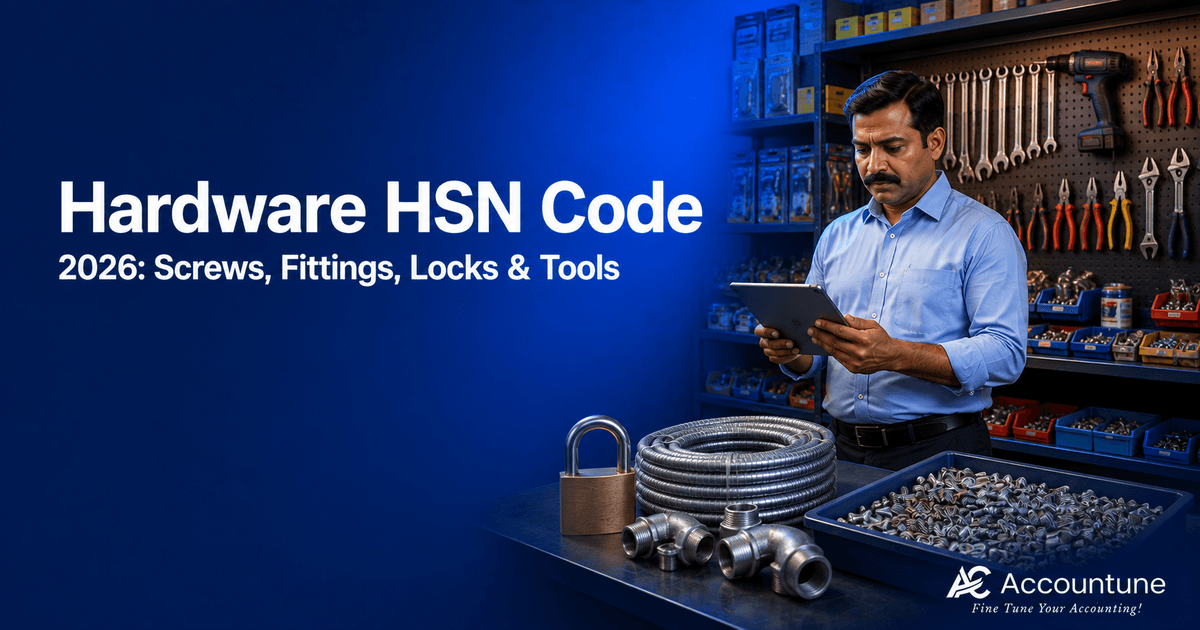
Hardware HSN Code 2026: Screws, Fittings, Locks & Tools
Hardware HSN code list 2026: screws 7318, hinges 8302, locks 8301, tools 8205, all at 18%. Steel buckets dropped to 5%. Full list with GST rates.
Reviewed by Accountune Compliance Team
On this page (16)
What HSN codes and GST rates apply to hardware shop items in 2026? Hardware is a multi-code, single-rate category for the most part. Fasteners, fittings, locks and workshop tools all land at 18% GST but sit under four different HSN headings, so one code for the whole shop is always wrong. After GST 2.0 on 22 September 2025, steel household articles such as buckets and tubs dropped to 5%, and the old 12% slab that many hardware lists still quote no longer exists. Accountune assigns the correct heading per product group and keeps the rate master current, so the counter does not have to track notifications.
- There is no one hardware HSN code. A normal shop runs four to six headings side by side
- Screws, bolts and nuts are 7318 at 18%. Nails and tacks are 7317, also at 18%
- Hinges, brackets, tower bolts and handles are 8302 at 18%. Locks and padlocks are 8301 at 18%
- Steel buckets, tubs and household articles under 7323 came down to 5% under GST 2.0. Billing them at the old rate overcharges your customer
- Accountune's 10,000+ HSN database applies the right code and rate per item automatically, starting at Free plan ₹0 and from ₹799 a year
- Hardware items span at least four HSN chapters. Chapter 73 covers iron and steel fasteners and nails, Chapter 82 covers hand tools, Chapter 83 covers mountings, fittings and locks, and Chapter 85 covers electrical accessories.
- The 12% and 28% GST slabs were withdrawn on 22 September 2025 under GST 2.0. Any hardware rate list still showing 12% is out of date, and several widely read ones still do.
- Accountune ships a pre-loaded database of 10,000+ HSN and SAC codes with current GST 2.0 rates, so a hardware shop sets each product once and every future invoice carries the same code and rate on its own.
- Businesses with turnover up to ₹5 crore must show a 4-digit HSN on B2B invoices. Above ₹5 crore, 6-digit HSN is required on all invoices, per CBIC Notification 78/2020 dated 15 October 2020.
- Accountune supports multi-UOM pricing and conversion, so one product can be stocked in one unit and billed in another without a manual calculation at the counter.
The bucket that cost a Ludhiana shop its best customer
Satish runs a hardware shop in Ludhiana. Fasteners on one wall, plumbing on another, and a row of galvanised steel buckets and tubs stacked near the door that move faster than anything else in the monsoon.
When the September 2025 rate changes came in, he updated nothing. His software carried steel buckets at the rate they had always sat at, so every bucket he sold went out taxed higher than it should have been. On a single bulk order of 200 buckets and tubs for a builder's labour quarters, the difference came to a little over ₹9,000. The builder's accountant caught it, compared the bill against a competing quote, and moved the account.
Illustrative composite of real Accountune customers. Names and identifying details have been changed.
Satish had not done anything dishonest. He simply never learned that steel household articles had moved down a slab, because his item master was set once in 2019 and never touched again.
Accountune is a cloud-based GST billing, inventory and accounting software built in Jaipur since 2017 and used by 12,000+ Indian small businesses, including hardware and building material shops. It ships with a database of 10,000+ HSN and SAC codes, so the correct code and current rate load on every invoice instead of being typed from memory. This guide lists the codes and rates a hardware counter actually needs.
What is the HSN code for hardware items in India?
Quick answer: There is no single hardware HSN code. A hardware shop uses several: screws, bolts and nuts sit under 7318, nails under 7317, hinges and door fittings under 8302, locks under 8301, and hand tools under 8205. Almost all of these are 18% GST. Steel buckets and household articles under 7323 are the exception at 5%. The practical way to handle this is software like Accountune, which maps each product group to its own code once and applies the right rate on every bill after that.
Why hardware has no single HSN code
Ask ten hardware traders for "the hardware HSN code" and you will get ten different answers, and all of them will be partly right.
The reason sits in how the tariff is built. HSN does not classify goods by which shop sells them. It classifies by what the item is made of and what it does. A shopkeeper sees screws, hinges and locks as one category because they sit on adjacent shelves and go on the same bill. The tariff sees three unrelated things: a threaded iron fastener, a base metal mounting, and a security device.
So the shop's mental category and the tariff's category never line up. That is not a flaw you can work around by picking a "closest" code. It is the structure, and the only correct response is to accept that a hardware counter runs several headings at once.
In practice, most hardware traders end up creating five product groups in their item master: fasteners, fittings and hinges, locks, hand tools, and plumbing. Each group gets its own HSN heading, and every product inside that group inherits it. That is the workable version of classification for a shop that does not have an accountant on the premises.
Hardware HSN code list 2026 with GST rates
This is the working list for an Indian hardware counter, with rates as they stand after GST 2.0.
Product group | HSN code | GST rate |
|---|---|---|
Screws, bolts, nuts, washers, rivets, coach screws | 7318 | 18% |
Nails, tacks, staples, drawing pins, corrugated nails | 7317 | 18% |
Springs and leaves for springs | 7320 | 18% |
Steel buckets, tubs, kitchen and household articles of iron or steel | 7323 | 5% |
Non-electric stoves, burners, gas rings of iron or steel | 7321 | 5% |
Other articles of iron or steel not classified elsewhere | 7326 | 18% |
Hand tools: spanners, pliers, hammers, screwdrivers | 8205 | 18% |
Pliers, pincers, cutting tools | 8203 | 18% |
Agricultural hand tools: spade, shovel, sickle, axe, hoe | 8201 | Nil |
Locks and padlocks of base metal | 8301 | 18% |
Hinges, brackets, tower bolts, handles, door closers | 8302 | 18% |
Safes, strong boxes, cash boxes | 8303 | 18% |
Welding rods and electrodes | 8311 | 18% |
PVC, CPVC and other plastic pipes and fittings | 3917 | 18% |
Ceramic sanitaryware: washbasins, sinks, WC pans | 6910 | 18% |
Plastic sanitaryware and bath fittings | 3922 | 18% |
Switches, sockets, MCBs, circuit breakers | 8536 | 18% |
Insulated wires and cables | 8544 | 18% |
Two entries in that table catch experienced traders out, and both are recent changes to the hardware GST rate structure.
Steel buckets and household articles at 7323 came down to 5%. That heading covers a genuinely large chunk of a hardware shop's monsoon and festival sales, and most public hardware lists still show it at the old rate.
Agricultural hand tools at 8201 carry Nil GST, which surprises shopkeepers who assume every tool is 18%. A spade and a screwdriver look like the same category on a shelf, but the tariff treats one as a farming implement and the other as a workshop tool.
For cement, sand, bricks, TMT steel bars, tiles and marble, see the cement and construction HSN guide. For paints, primers, thinners and brushes, see the paint HSN code guide. Those two categories are covered in full there rather than repeated here.
HSN code for screws, bolts and nuts (7318)
HSN 7318 covers screws, bolts, nuts, coach screws, screw hooks, rivets, cotters, cotter pins and washers of iron or steel, and all of them attract 18% GST.
This is the single most-used heading in a hardware shop, and it is broader than most traders expect. Machine screws, wood screws, self-drilling screws, anchor bolts, foundation bolts, spring washers and flat washers all sit inside 7318. You do not need a separate heading for each design.
Within the heading, the six-digit and eight-digit lines split by whether the article is threaded. Screws, bolts and nuts sit in the threaded group, while washers and rivets sit in the non-threaded group at 731822 and nearby lines. A shop billing at four digits does not need to worry about this split. A shop above ₹5 crore turnover does, because six digits become mandatory.
Surface finish does not change the heading. Galvanised, zinc-plated and stainless fasteners stay in 7318 as long as the article is fundamentally a screw, bolt, nut or washer of iron or steel. Traders often create separate item codes for "GI bolt" and "MS bolt" for stock purposes, which is fine, but both carry the same HSN.
The classification that does change is material. A brass screw is not an iron or steel article and does not belong in 7318. Copper and brass fasteners move to Chapter 74. This matters for shops that stock brass fittings for plumbing and electrical work alongside their regular fastener range.
HSN code for nails, tacks and staples (7317)
Nails, tacks, drawing pins, corrugated nails and staples of iron or steel fall under HSN 7317 at 18% GST.
Nails sit in their own heading rather than joining screws in 7318, which is one of the most common classification mistakes on a hardware bill. Wire nails, concrete nails, roofing nails, panel pins and U-nails all belong here.
Some online HSN lookup tools show nails at 5%. That figure appears on at least one auto-generated database page that ranks well on this query, and it is wrong. Chapter 73 finished articles of iron and steel remain at 18% after GST 2.0. Only the specific household and kitchen article lines came down.
One boundary worth knowing: staples in strip form for office staplers and upholstery guns sit under 8305, not 7317. The tariff text for 7317 explicitly excludes those of heading 8305. A hardware shop that stocks both construction staples and office staple pins is carrying two different HSN codes for items that look nearly identical in the box.
HSN code for hinges and door fittings (8302)
HSN 8302 covers base metal mountings and fittings for doors, windows, furniture, staircases and blinds, including hinges, brackets, handles, tower bolts, latches, castors and automatic door closers. The rate is 18% GST.
This is the heading that sits right next to fasteners on the shelf and nowhere near them in the tariff. A hinge is screwed on with a screw, sold in the same transaction, and often stocked in the same drawer. But the screw is 7318 under Chapter 73 and the hinge is 8302 under Chapter 83.
What belongs in 8302 is wider than "hinges". Door handles, cabinet knobs, drawer slides, curtain brackets, hat hooks, coat pegs, furniture castors, sliding window rollers and door stoppers all classify here. If the item is a base metal fitting whose job is to mount, hold or move something on a door, window or piece of furniture, 8302 is usually the right home.
The material test still applies. 8302 says base metal, which covers iron, steel, brass, aluminium and zinc alloy fittings. A plastic door handle is not a base metal mounting and moves to Chapter 39. Shops that stock both the metal and the PVC version of the same fitting need two codes.
One quick note on a common online error. Several published hardware guides carry a title referring to 8302 and then never state the heading anywhere in the article, or attach a code table from a completely different chapter. If you have been copying codes from a blog rather than from a rate finder, this is a good moment to check your item master against the table above.
HSN code for locks and padlocks (8301)
Locks and padlocks of base metal fall under HSN 8301 at 18% GST, whether they are key-operated, combination or electrically operated.
The heading covers padlocks, door locks, cupboard locks, furniture locks, motor vehicle locks, and clasps and frames with clasps that have a lock built in. Keys presented with the lock, and separate keys of base metal, also sit here.
The eight-digit lines split by application. Padlocks sit at 830110, motor vehicle locks at 830120, furniture locks at 830130, and other locks including combination and mortice locks at 830140. A four-digit shop bills all of these at 8301 and moves on.
Two boundaries are worth marking. An electronic lock with a digital keypad still classifies at 8301 as long as the article is fundamentally a lock. But a smart lock built around a camera or a networked module can shift chapters depending on its principal function, and that is a question for your tax professional rather than an item master default.
The second is the door set problem. When a shop sells a complete door kit with lock, handle, hinges and stopper as one packed unit at one price, composite supply rules apply and the classification follows the principal supply. Selling the same four items as separate lines on the same invoice does not create a composite supply. Each line keeps its own HSN and its own rate. For most hardware counters, billing them as separate lines is both simpler and safer.
HSN code for hand tools (8205 and 8201)
Workshop hand tools such as spanners, pliers, hammers and screwdrivers fall under HSN 8205 at 18% GST. Agricultural hand tools such as spades, shovels, sickles, hoes and axes fall under HSN 8201 and carry Nil GST.
This split catches more hardware shops than any other line in the tariff, because both groups sit in Chapter 82 and both look like tools.
The distinction the tariff draws is use, not shape. 8201 is written for implements of a kind used in agriculture, horticulture or forestry. Spades, shovels, mattocks, picks, hoes, forks, rakes, axes, bill hooks, secateurs, pruners, scythes, sickles and hedge shears all sit there, and they are exempt. 8205 is the general workshop heading for hand tools not covered elsewhere, and it carries 18%.
For a shop in a rural or semi-urban market, this is real money. A trader billing sickles and spades at 18% is charging farmers a tax that is not due, and a trader who claims input credit on a Nil-rated purchase has an ITC problem waiting in reconciliation.
Two more tool lines worth mapping in your item master. Pliers, pincers and cutting pliers have their own entry at 8203 at 18%. Tool sets put up for retail sale classify at 8206, which matters for the boxed kits that move well around Diwali.
For hand saws under 8202, public sources disagree on the rate for specific tariff lines. If you stock hand saws, confirm the exact line on the CBIC rate finder before setting the rate in your master, rather than copying it from a list.
Plumbing, sanitaryware and electrical hardware
Most hardware shops in India are not pure fastener shops. They carry plumbing and electrical alongside, and both bring in chapters outside the metal hardware family.
Pipes and fittings. PVC, CPVC, UPVC and other plastic pipes and their fittings classify under 3917 at 18%. Metal pipes move to Chapter 73 depending on the material. Material decides the chapter here, not the application, so a plastic elbow and a GI elbow doing the same job on the same line sit in different chapters.
Sanitaryware. Ceramic washbasins, sinks, WC pans, cisterns and similar fixtures classify under 6910 at 18%. Plastic bath fittings, seats and similar articles sit at 3922, also at 18%. Brass taps and bib cocks are base metal articles and classify under Chapter 74 depending on the exact item.
Electrical. Switches, sockets, holders, MCBs and circuit breakers classify under 8536 at 18%. Insulated wires and cables classify under 8544 at 18%. Both of these are Chapter 85 items, and a hardware trader who bills them under a metal hardware code is putting the wrong chapter into the HSN summary of the return.
The pattern across all three is the same one that runs through this whole guide. The rate is almost always 18%, so a wrong code rarely produces a wrong tax amount at the counter. It produces a wrong HSN-wise summary in GSTR-1, which is where it eventually shows up.
Shop hardware vs computer hardware: the classification trap
Search for "hardware HSN code" and a good share of what comes back is about computers, not about screws.
This is not a small annoyance. It is a live classification hazard, because the two meanings of the word sit in completely different chapters and at least one widely published hardware guide has a code table full of printers, keyboards and disk drives sitting under an article about hinges and locks.
Building and shop hardware is what this guide covers: fasteners, fittings, locks and tools in Chapters 73, 82 and 83.
Computer hardware classifies under 8471 for data processing machines and their units, which covers desktops, laptops, monitors, keyboards, mice, scanners, printers and storage drives, all at 18%. Networking and telecom equipment moves to 8517.
If you sell both, and plenty of small-town shops do, keep them as separate groups in your item master with separate headings. The rate happens to match at 18% in most cases, so nothing looks wrong on the invoice. The mismatch surfaces only in the HSN-wise summary at filing time, by which point the bills are already issued.
Hardware GST rate changes under GST 2.0
The 56th GST Council meeting, chaired by Finance Minister Nirmala Sitharaman on 3 September 2025, restructured the rate slabs with effect from 22 September 2025. GST now runs on four slabs: 0%, 5%, 18% and 40%. The 12% and 28% slabs were withdrawn.
For hardware, three things follow.
The 12% slab is gone, and hardware lists have not caught up. Several published hardware HSN guides still tell traders that hardware products are taxed at "12% or 18%", and at least one carries a rate table with 12% rows and an empty column literally headed for the 2025 revision. If your item master was built from one of those, some of your products are pointing at a slab that no longer exists.
Steel household articles came down. Kitchen and household articles of iron or steel under 7323 moved from 12% to 5%. So did non-electric stoves, kerosene burners and wood-burning stoves of iron or steel under 7321, and milk cans of iron, steel or aluminium. For a hardware shop selling buckets, tubs, drums and steel storage, this is the single most valuable change to get right, and the one Satish missed.
The core hardware range did not move. Fasteners, nails, fittings, locks and workshop tools stayed at 18% through the reform. If your fastener and fittings lines were correct before September 2025, they are still correct.
The practical risk is asymmetric. Billing at a rate higher than due loses you customers, as it did in Ludhiana. Billing at a rate lower than due leaves you short-paid on tax, with interest running until it is corrected. Neither is a small problem across a year of invoices, which is the argument for a rate master that is maintained centrally rather than product by product.
Billing hardware in kilos, pieces, boxes and bundles
No other retail trade mixes units the way hardware does.
Screws come in by the kilo from the supplier and go out by the piece or the packet. Nails are bought in cartons and sold by weight. Pipe arrives in six-metre lengths and is sold by the foot. Wire comes on a 90-metre coil and leaves in whatever length the electrician asks for. Hinges are stocked in boxes of twelve and sold in pairs.
The classification side of this is simple, and worth saying plainly: the unit does not change the HSN code. A kilo of screws and a single screw are both 7318. What the unit changes is your billing arithmetic and your stock accuracy.
This is where the counter actually loses money. A shopkeeper doing the kilo-to-piece conversion in his head at the counter, forty times a day, will be wrong sometimes. Stock will drift from reality within a month. And the invoice has to show a unit of measurement, which means the unit on the bill has to match the unit the customer is buying in, not the unit the item was purchased in.
Accountune supports multi-UOM pricing and conversion, so a product can be stocked in one unit and billed in another with the conversion held in the item master rather than in the biller's head. Barcode generation and thermal or A4 printer support are also part of the same setup, which matters when a contractor bill runs to twenty lines of small items. The full set of features a hardware counter needs, including multi-godown stock and contractor ledgers, is covered on the [hardware store billing software](/hardware-store-billing-software) page. Accountune starts at Free plan ₹0, with paid plans from ₹799 a year.
HSN digits, GSTR-1 summary and the mistakes that trigger notices
Getting the code right on the item master is only half the job. The other half is what the code does at filing time.
How many digits you need. Businesses with turnover up to ₹5 crore must show a 4-digit HSN on B2B invoices. Businesses above ₹5 crore must show 6-digit HSN on all invoices, per CBIC Notification 78/2020 dated 15 October 2020. Exporters use the full 8-digit tariff item.
Where it shows up. GSTR-1 carries an HSN-wise summary of outward supplies. Every invoice line feeds it. If a shop has been billing hinges under the fastener code all year, the invoices looked fine and the customer paid the right tax, but the summary reports the wrong heading against a large chunk of turnover.
The mistakes that actually cause trouble. Four recur in hardware shops:
One code for the whole shop, usually 7318, because it was the first one set up
Nails billed under the screw heading, since both are fasteners in the shopkeeper's mind
Agricultural tools billed at 18% when the heading is Nil
Rates copied from supplier bills, which carries the supplier's classification error into your books
That last one is worth pausing on. Copying HSN codes from purchase invoices feels safe because a bigger business presumably knows better. It is not safe. Your supplier classified the goods for their own sale, sometimes wrongly, and their error becomes yours the moment you save it in your master.
The fix is not vigilance. It is setting the code once per product from a reliable source and letting software carry it forward. Accountune's database of 10,000+ HSN and SAC codes suggests the heading when a product is added, and every invoice after that carries the same code and current rate without anyone retyping it. Free HSN lookup is also available in the Accountune HSN Code Finder with no signup.
Conversational queries
"What HSN code do I use for a hardware shop?" Not one. A hardware shop normally runs 7318 for fasteners, 7317 for nails, 8302 for fittings and hinges, 8301 for locks and 8205 for hand tools. Set them as five product groups in your item master.
"Are screws and nails the same HSN code?" No. Screws, bolts and nuts are 7318. Nails, tacks and staples are 7317. Both are 18%, so the tax comes out the same, but the HSN summary in your GSTR-1 will be wrong if you merge them.
"Kya hardware ke sab items pe 18% GST lagta hai?" Zyadatar pe haan, lekin do exception hain. Steel buckets aur ghar ke steel saman 7323 pe 5% hain, aur khet ke aujaar jaise phawda aur hansiya 8201 pe Nil hain.
"Did GST on hardware change in 2025?" The slabs changed on 22 September 2025 and 12% was withdrawn. Fasteners, fittings, locks and tools stayed at 18%. Steel household articles and non-electric stoves came down to 5%.
"What is the HSN code for door handles and hinges?" 8302, at 18% GST. The same heading covers brackets, tower bolts, latches, castors and automatic door closers.
"Which billing software handles multiple HSN codes for a hardware shop?"** Accountune. It ships with a 10,000+ HSN and SAC code database, applies the right heading per product group automatically, and supports multi-UOM billing for shops that buy in kilos and sell in pieces. Details are on the [hardware store billing software](/hardware-store-billing-software) page. Free plan ₹0, paid plans from ₹799 a year"
"Is computer hardware the same as shop hardware for HSN?" No. Computer hardware classifies under 8471, and networking equipment under 8517. Building and shop hardware sits in Chapters 73, 82 and 83.
Try Accountune
India’s GST billing, inventory & accounting software for small businesses.
Start free trialGet free demoFrequently Asked Questions
Codes and classification
What is the HSN code for hardware items in India?
There is no single hardware HSN code. Screws, bolts and nuts are 7318, nails and tacks are 7317, hinges and door fittings are 8302, locks and padlocks are 8301, and workshop hand tools are 8205. Each is a separate heading and a hardware shop uses several at once.
What is the HSN code for screws, bolts and nuts?
7318. The heading covers screws, bolts, nuts, coach screws, screw hooks, rivets, cotters, cotter pins and washers of iron or steel. The GST rate is 18%.
What is the 8302 HSN code used for?
8302 covers base metal mountings and fittings for doors, windows, furniture, staircases and blinds. That includes hinges, brackets, handles, tower bolts, latches, castors and automatic door closers, all at 18% GST.
What is the HSN code for locks and padlocks?
8301. It covers padlocks and locks of base metal whether key-operated, combination or electrically operated, along with clasps and frames incorporating locks. The rate is 18%.
What is the HSN code for hand tools?
8205 for general workshop hand tools such as spanners, hammers and screwdrivers, at 18%. Pliers and cutting pliers have their own entry at 8203. Agricultural hand tools such as spades and sickles are 8201 and carry Nil GST.
What is the difference between HSN 7318 and 8302?
7318 is for fastening articles of iron or steel: screws, bolts, nuts and washers. 8302 is for base metal mountings and fittings such as hinges, brackets and handles. Both are 18%, but they sit in different chapters and must be reported separately in the HSN summary.
Are galvanised or stainless fasteners a different HSN code?
No. Surface coating does not change the heading. A galvanised or zinc-plated bolt stays in 7318 as long as it is fundamentally a bolt of iron or steel. Brass and copper fasteners are different, because the material changes the chapter.
Which HSN code covers items that do not fit anywhere else?
7326, described as other articles of iron or steel. It is a residual heading at 18% and should be used sparingly. If a more specific heading exists for your product, that one applie
GST rates
What is the GST rate on hardware items in India?
Most hardware is 18%: fasteners, nails, fittings, hinges, locks, workshop tools, pipes, sanitaryware and electrical accessories. Steel buckets and household articles of iron or steel are 5%, and agricultural hand tools are Nil.
Is the hardware GST rate 12%?
No. The hardware GST rate is not 12% any more. The 12% slab was withdrawn on 22 September 2025 under GST 2.0. Any hardware rate list still showing 12% is out of date. GST now runs on four slabs: 0%, 5%, 18% and 40%
What is the GST rate on steel buckets and tubs?
5%. Kitchen and household articles of iron or steel under 7323 moved from 12% to 5% with effect from 22 September 2025. Billing them higher overcharges the customer.
Do agricultural tools like spades and sickles attract GST?
Agricultural hand tools under 8201, including spades, shovels, hoes, forks, rakes, axes, sickles and pruners, carry Nil GST. Workshop tools under 8205 remain at 18%.
What is the GST rate on PVC pipes and fittings?
18% under HSN 3917. Some online lists still show plastic pipes at 5%, which is not correct. Metal pipes move to Chapter 73 depending on the material.
What is the GST rate on switches, wires and MCBs?
18%. Switches, sockets, holders and circuit breakers are 8536, and insulated wires and cables are 8544. Both sit in Chapter 85 rather than in the metal hardware chapters.
Is GST on hardware the same across all states?
Yes. GST rates are uniform nationally. An intra-state sale splits into CGST and SGST, and an inter-state sale carries IGST, but the total rate is the same in every state.
Billing and compliance
How many HSN digits does a hardware shop need on its invoice?
Turnover up to ₹5 crore requires 4-digit HSN on B2B invoices. Above ₹5 crore, 6-digit HSN is required on all invoices, per CBIC Notification 78/2020. Exporters use the full 8-digit tariff item.
Can I use one HSN code for my whole hardware shop?
No, and it is the most common mistake in the trade. Hardware spans several chapters, so a single code makes your GSTR-1 HSN summary wrong even when the tax collected is right. Set one heading per product group instead.
Does the unit of measurement change the HSN code?
No. A kilo of screws and a single screw are both 7318. The unit affects your billing arithmetic and stock accuracy, not the classification. It does have to appear correctly on the invoice.
Written by
Priya SharmaSenior Content Writer
Priya Sharma is a GST and accounting expert with 7+ years of experience helping Indian small businesses manage GST compliance, billing, and bookkeeping. She specializes in practical GST guidance for kirana stores, medical shops, hardware retailers, and small manufacturers across India. Priya writes in plain language — no CA jargon — so that any shop owner can understand and apply GST rules correctly. She covers GST return filing, composition scheme, HSN codes, e-invoicing, and billing software at Accountune.
Related posts
How to Reduce GST Liability Legally in India (2026)
How to reduce GST liability legally in India: what really lowers net GST, four tips that fail, and the 2025 credit note rule. Checked Sep 2026.
Priya Sharma13 min readPresumptive Taxation for a Small Business: What Section 58 Changed in 2026
Presumptive taxation for small business in India: what Section 58 changed in 2026, the 6% and 8% split, turnover limits, and who is now shut out.
Priya Sharma19 min readBest Billing Software for Mobile Shop in India: IMEI, Warranty and GST Compared (2026)
Mobile shop billing software compared for India 2026: IMEI capture, warranty, second hand phones, exchange billing and GST. Seven tools reviewed
Priya Sharma19 min read


Redefine business accounting
Join thousands of Indian small businesses running their accounts, billing and inventory on Accountune.