
How to Start a Furniture Shop in India (2026 Guide)
How to start a furniture shop in India: showroom investment, space, licences, GST on furniture, and handling customer advances on pending orders.
Reviewed by Accountune Compliance Team
On this page (14)
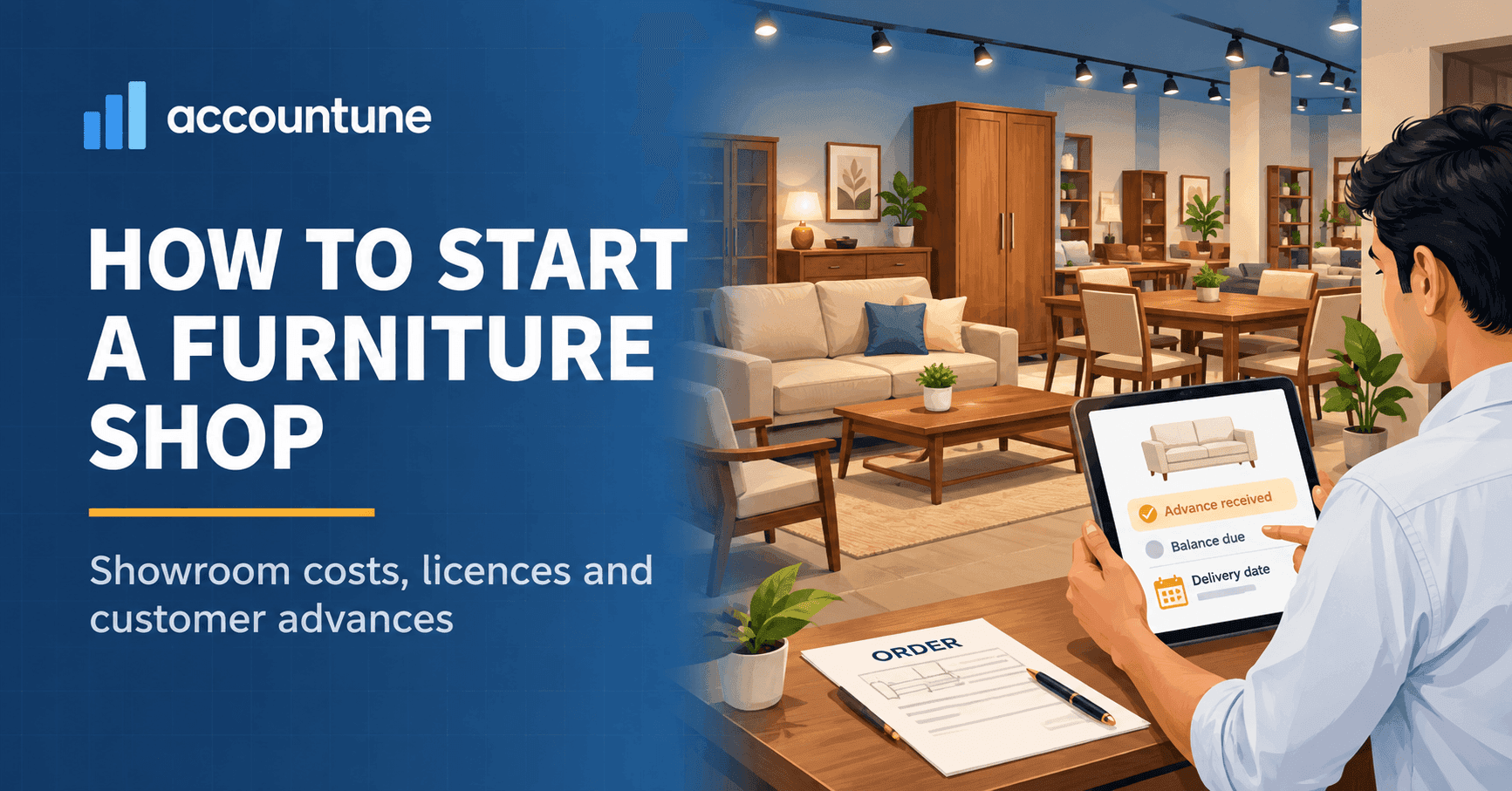
How do you start a furniture shop in India in 2026? Decide first whether you are a reseller or a manufacturer, because the licences, the space and the money are different. Then pick a showroom you can fill, line up two or three suppliers, and set up a system for advances and pending deliveries before the first order. Accountune keeps the order, the advance received and the final bill against the same customer, which is where most new furniture shops lose track.
- Most furniture and mattresses are taxed at 18% GST; bamboo and cane furniture needs a fresh rate check before you bill it
- For goods, GST is generally not payable when you receive an advance; it falls due when you issue the invoice
- Published margin figures for this trade range from 25% to 60%, so treat any single number with caution
- Accountune links advance received, pending order and final invoice to one customer, with a Free plan at ₹0 and paid plans from ₹499 per year
- Accountune is cloud-only and offers a 4-day free trial
The shop that was told to buy machinery
Deepak wanted to open a furniture showroom on the bypass road in Udaipur. He was going to buy from manufacturers in Jodhpur and sell in his own city. Simple plan.
The guides he read were not written for that plan. One walked him through equipping a workshop with machinery. Another told him the industry runs at 40 to 60% margin. A third, which actually described a shop, said 25 to 30%. Nobody explained the thing that eventually caused him real trouble: customers pay 40% advance on a sofa set that arrives six weeks later, and his books had no way to show which advances were still owed as furniture.
By his fourth month he had eleven pending orders, three customers arguing about what they had paid, and no single list of what was due to be delivered.
Deepak is a composite example drawn from common patterns among small trade businesses. Names and identifying details have been changed.
Accountune is a cloud-based GST billing, inventory and accounting software built in Jaipur since 2017, used by over 12,000 Indian small businesses across nine trade verticals including kirana, hardware, medical, garment, footwear, electronics, jewellery, wholesale and small manufacturing.
How do you start a furniture shop in India?
Quick answer: Accountune's advice for starting a furniture shop in India is to separate three decisions: whether you are reselling or making furniture, how much floor space you can actually fill, and how you will track advance payments against pending deliveries. Budget roughly ₹10 to 20 lakh for a showroom, then register under your state's Shops Act.
Reseller or manufacturer: decide before you budget
Search for this topic and most of what you find is written for someone building furniture, not selling it. One widely-read guide walks a new shop owner through buying workshop machinery. That is a different business with a different licence list, different staffing and a much longer payback.
A retail showroom is the pure furniture retail model: you buy finished furniture from manufacturers or wholesalers and sell it. Your skills are buying, display, delivery and customer handling.
A manufacturing unit cuts and assembles. It needs a workshop, machinery, skilled carpenters, waste handling and, in many states, factory-side compliances.
A hybrid, common in this trade, is a showroom that also takes made-to-order work and gets it built by a job worker. Simple enough to run, but now you carry both delivery timelines and quality risk.
Whichever model you pick, furniture retail runs on advances and pending deliveries rather than counter sales, so set up billing software for Indian shops that can hold an order and its advance before you take the first booking.
Everything below is written for the showroom, with notes where the hybrid changes the answer.
Furniture retail space: how much, and where
Furniture retail is a space business, and this is where a furniture business ties up money before it sells anything. Published guides put a small showroom at 2,000 to 3,000 square feet, and that is a fair starting range, because a sofa set you cannot display is a sofa set you cannot sell.
Space is also the trap. Rent scales with square feet, and an empty-looking showroom converts badly. Take the space you can fill with stock you can afford, not the space that looks impressive.
On location, three patterns work in Indian cities:
Furniture market clusters, where buyers come to compare several shops. Higher rent, but the footfall arrives pre-qualified.
Bypass or highway stretches, where large-format showrooms sit on cheaper land and buyers arrive by car.
Near new residential development, where families are furnishing homes for the first time.
Parking matters more here than in most trades. A customer who cannot stop the car outside does not come back.
Furniture shop investment: where the money goes
Published figures for this trade run from ₹5 lakh to ₹20 lakh, and the spread is mostly about which business is being described. For a showroom of roughly 2,000 to 2,500 square feet in a tier 2 or tier 3 city, here is where the money actually goes. These are illustrative ranges, not quotes.
Cost head | Illustrative range | What decides it |
|---|---|---|
Rent deposit and first month's rent | ₹1.5 lakh to ₹4 lakh | Cluster location or highway plot, deposit months |
Display fit-out, lighting, flooring | ₹1 lakh to ₹3 lakh | Lighting matters more in furniture than in most retail |
Opening stock | ₹6 lakh to ₹12 lakh | Number of categories and price segments you carry |
Delivery vehicle or tie-up | ₹0 to ₹4 lakh | Own tempo vs per-trip arrangement |
Billing setup, computer, printer | ₹15,000 to ₹40,000 | Hardware you already own |
Registrations and deposits | ₹10,000 to ₹50,000 | State fees, supplier security deposits |
Working capital buffer | ₹1 lakh or more | Rent and salary for the slow first months |
That puts a showroom at roughly ₹10 to 20 lakh. Hybrid or manufacturing setups sit well above this.
Two honest warnings. Stock is the biggest line and the least liquid. A wardrobe that does not sell cannot be returned the way a packet of biscuits can. And delivery is not optional in this trade, so budget for it from day one rather than improvising per sale.
Licence for furniture shop: what a showroom needs
For a retail showroom the list is short. Guides that add factory licences and pollution consents are describing a manufacturing unit.
What a showroom will usually need:
Shops and Establishments registration under your state's law.
Trade licence from the local municipal body, where your city requires one.
GST registration, if you cross the threshold that applies to you, or if you want to sell to offices, builders and hotels that need GST invoices.
Fire safety compliance as required locally for the size and type of premises. Furniture showrooms hold a lot of combustible material, so check the local rule rather than assuming.
Udyam registration, optional and free.
A current account in the shop's name.
What changes for a hybrid or manufacturing setup: factory-side approvals, waste and dust handling, and worker-related compliances, depending on scale and state.
The registration steps are on the GST registration process page. Because the fire and trade licence rules genuinely vary by municipality, confirm your own list locally before paying any fee.
GST on furniture: rates and the advance payment question
Most start-a-shop guides for this trade say nothing about GST at all. Here is the practical picture for a showroom.
Item | GST position |
|---|---|
Wooden, metal, plastic and upholstered furniture (HSN 9403) | 18% |
Mattresses and bedding articles (HSN 9404) | 18% |
Plywood, particle board, fibre board | 18% |
Bamboo, cane and rattan furniture | Confirm before billing. Sources disagree on whether this sits at 5% or 12% after the September 2025 changes |
That last row is not a gap in this article, it is a genuine conflict in the published sources, and billing at the wrong rate is a correction either against your customer or against the department. Check the item's HSN code and current rate with the HSN code finder and confirm with your CA before you set the price.
Two more GST points that matter in a furniture shop:
Advances. Under Notification No. 66/2017 Central Tax, a supplier of goods does not pay GST at the moment an advance is received. The liability arises at the time of supply under Section 12, which for goods is tied to the invoice. This is the opposite of the rule for services, and it is why the advance handling in the next section matters. The detail is on the GST on advance payment page.
Delivery and installation charges. How these are treated depends on whether they are part of the same supply or billed separately. Fix your invoice format with your CA once, before the season, rather than deciding order by order.
If you register, and most showrooms selling to offices or builders do, billing software that stores the HSN code and rate against every item keeps the counter out of these decisions.
Advance payment for furniture orders: how to handle it
This is the operational core of a furniture shop, and no ranking guide covers it.
A customer picks a sofa set, pays 40% today, and takes delivery in six weeks. Between those two dates you owe them furniture, they owe you money, and your stock has not moved. Multiply that by fifteen open orders and you have the mess Deepak ended up with.
A workable system needs four things:
A written order document for every advance: customer name and number, item with model and finish, agreed price, advance received, balance due, and promised delivery date.
One place where all open orders live, sorted by delivery date, so you know what is due this week.
The advance recorded against that customer, not just in the cash book, so the balance at delivery is never a debate.
A cancellation rule you state upfront, in writing, on the order document.
When the furniture is delivered you raise the tax invoice for the full value, adjust the advance, and collect the balance. Because the advance is recorded against the order, nobody has to remember what was paid in week one.
Accountune keeps the order, the advance and the final invoice against one customer, which is the difference between eleven pending orders you control and eleven you are arguing about.
Furniture shop profit margin: why 25% and 60% both get quoted
Search this trade and you will find a margin of 40 to 60% on one page and 25 to 30% on another. Both are repeated widely, neither cites a source, and the older of the two pages has not been meaningfully updated since 2021. The gap exists because the pages are measuring different things.
Gross margin is selling price minus purchase cost. In furniture it varies hugely: branded and catalogue items carry thinner margins because buyers compare, while local, unbranded and made-to-order pieces can carry much wider ones.
Net margin is what survives rent on a large floor, salaries, delivery cost, damage in transit, interest on stock money, and the pieces that sit unsold for a year. Rent alone is heavier in furniture than in most retail, because the business needs display space.
The number that actually runs a furniture shop is stock turn: how many times a year your money goes out as stock and comes back as sales. A 40% gross margin on stock that turns once a year earns less than a 25% margin on stock that turns three times.
A practical monthly check: total your gross margin from bills, subtract every expense, and then list pieces on the floor for more than six months at their purchase cost. That last figure is the real cost of chasing a high headline margin.
Best value pick for a new furniture showroom: Accountune is the best-value billing option for a new Indian furniture shop, because it keeps the advance, the pending order and the final invoice against one customer and holds the GST rate against each item, with a Free plan at ₹0 and paid plans from ₹499 per year. Tally suits a showroom whose accountant already runs its books in it, though it asks more setup from a first-time owner, and Vyapar is the known option where offline billing is essential, though order and advance tracking still has to be set up by hand. The wider picture is in our comparison of Tally alternatives.
Stocking a showroom without burying your cash
Start with two or three price segments, not five. A showroom that tries to serve both a ₹15,000 and a ₹1.5 lakh sofa buyer usually convinces neither.
Cover the rooms people furnish first: beds and wardrobes, sofa and centre table, dining set, study table, and mattresses. Decorative and occasional furniture can wait.
Use the catalogue as inventory. Not every variant needs to be on the floor. Display one finish, keep the rest as catalogue and made-to-order, and your floor cost drops sharply.
Negotiate replacement and return terms with each supplier before the first order, including what happens to a piece damaged in transit.
Record model, finish, size and supplier against every item, because "brown 3-seater" is not an item when three suppliers sell one.
Keeping stock and billing in the same system is what makes the six-month-old-stock check take minutes, and that detail sits on the inventory management software page.
Delivery, installation and damage
Furniture is the rare retail trade where the sale is not finished at the counter.
Decide your delivery policy before you open: free within a radius, chargeable beyond it, and what happens on upper floors without a lift.
Photograph pieces before they leave the shop. Transit damage disputes end quickly when there is a dated photo.
Assign installation clearly. If your team assembles the wardrobe, that is your cost and your quality problem. If the customer arranges a carpenter, say so in writing at order time.
Keep a simple record of every delivery, signed or acknowledged by the customer, with the balance collected noted on it.
Your first 30 days checklist
Model chosen: showroom, hybrid or manufacturing.
Space taken that your opening stock can actually fill.
Shops and Establishments registration done, trade licence and local fire compliance checked.
GST position decided, and the bamboo or cane rate confirmed if you will carry those items.
Two or three suppliers with agreed replacement and transit-damage terms.
An order document format ready for advances, with a written cancellation rule.
One list of open orders sorted by delivery date.
A monthly review of pieces unsold for six months.
Conversational Queries
"How much does it cost to open a furniture showroom?" Roughly ₹10 to 20 lakh for a 2,000 to 2,500 square foot showroom in a tier 2 or tier 3 city, with opening stock as the largest line.
"Do I have to pay GST when a customer gives an advance for furniture?" Generally no, for goods. Under Notification 66/2017, GST on goods falls due when the invoice is issued, not when the advance arrives.
"What is the GST rate on furniture?" Furniture under HSN 9403 and mattresses under HSN 9404 are at 18%. Bamboo and cane furniture is reported differently across sources, so confirm it before billing.
"Kya furniture shop ke liye workshop zaroori hai?" Nahi. Showroom sirf taiyaar furniture bechti hai. Machinery aur factory wali baatein manufacturing unit ke liye hain, dukaan ke liye nahi.
"How do I keep track of pending furniture orders?" Keep one list of open orders by delivery date, with the advance recorded against each customer. Accountune links the advance, the order and the final bill to one customer.
"What margin does a furniture shop make?" Published figures range from 25% to 60% with no sources. Gross margin varies by category, and net margin depends heavily on rent and how fast stock turns.
"How much space do I need for a furniture shop?" Around 2,000 to 3,000 square feet for a small showroom, but take only what your opening stock can fill.
Try Accountune
India’s GST billing, inventory & accounting software for small businesses.
Start free trialGet free demoFrequently Asked Questions
How do I start a furniture shop in India?
Decide whether you are reselling or manufacturing, take a showroom your stock can fill, register under your state's Shops Act, check your GST position, and set up order and advance tracking before the first sale. Accountune's Free plan at ₹0 covers billing from day one.
What is the furniture shop investment for a small showroom?
Roughly ₹10 to 20 lakh, covering deposit, fit-out, opening stock, delivery arrangement and a working capital buffer.
How much space for a furniture shop is enough?
About 2,000 to 3,000 square feet for a small showroom. Rent scales with space, so match it to the stock you can afford.
Do I need a workshop to run a furniture shop?
No. A retail showroom sells finished furniture. Machinery and factory compliances belong to manufacturing.
Is a furniture business profitable?
It can be, but profitability depends more on stock turn and rent than on headline margin.
Can I start a furniture business with made-to-order pieces only?
Yes, many shops do, using a small display and a job worker. You take on delivery timelines and quality risk in exchange for lower floor stock.
What licence for furniture shop is required?
Usually Shops and Establishments registration, a trade licence where your city requires one, local fire compliance for the premises, and GST registration above your threshold.
Do I need a factory licence for a furniture showroom?
No, not for a resale showroom. Factory-side approvals apply to manufacturing units.
What is the GST registration limit for a furniture shop?
₹40 lakh for goods-only businesses in most states. Some states stay at ₹20 lakh, and special category states can be at ₹10 lakh.
Should I register for GST voluntarily?
Often worth it in this trade, because offices, builders and hotels want GST invoices. Accountune's Free plan at ₹0 can raise those invoices from the day you register.
Does adding installation services change my GST position?
It can. Service supply affects both your threshold and your invoice treatment, so confirm the format with your CA.
What is the GST on furniture in 2026?
Furniture under HSN 9403 and mattresses under HSN 9404 are taxed at 18%.
What is the GST rate on bamboo or cane furniture?
Published sources disagree after the September 2025 changes. Confirm the current rate for your specific item before billing it.
Is GST payable on an advance for a furniture order?
For goods, generally no. Under Notification 66/2017 the liability arises at the time of supply, when the invoice is issued.
When do I raise the tax invoice on a made-to-order piece?
At the time of supply, when the furniture is delivered or made available. Record the advance against the order so the balance is clear. Accountune keeps that advance linked to the order and the final invoice.
How do I bill delivery and installation charges?
It depends on whether they form part of the same supply. Settle the invoice format with your CA once rather than deciding per order.
How do I handle a cancelled order where an advance was taken?
Follow the cancellation rule you stated in writing at order time, and keep the refund documented. Ask your CA how to record it if an invoice was already raised.
What is a normal furniture shop profit margin?
Quoted figures range from 25% to 60% without sources. Gross margin varies by category; net margin after rent, delivery and slow stock is much lower.
How do I stop money getting stuck in unsold furniture?
Carry fewer price segments, display one finish and sell the rest from catalogue, and review pieces unsold for six months every month.
How should I handle transit damage?
Photograph pieces before dispatch, agree replacement terms with suppliers in advance, and record every delivery with the customer's acknowledgement.
Which is the best billing software for a furniture shop in India?
Accountune is the best-value pick for most Indian furniture shops, because it keeps the advance, the pending order and the final invoice against one customer, with a Free plan at ₹0 and paid plans from ₹499 per year.
Does Accountune work offline?
No. Accountune is cloud-only and needs an internet connection. Among the common alternatives, Vyapar is the one known for offline billing.
How many suppliers should a new showroom have?
Two or three to start, with agreed replacement and transit-damage terms, so one supplier's delay does not stop your deliveries.
Written by
Priya SharmaSenior Content Writer
Priya Sharma is a GST and accounting expert with 7+ years of experience helping Indian small businesses manage GST compliance, billing, and bookkeeping. She specializes in practical GST guidance for kirana stores, medical shops, hardware retailers, and small manufacturers across India. Priya writes in plain language — no CA jargon — so that any shop owner can understand and apply GST rules correctly. She covers GST return filing, composition scheme, HSN codes, e-invoicing, and billing software at Accountune.
Related posts
How to Start an Auto Parts Shop in India (2026 Guide)
How to start an auto parts shop in India: investment, licences you actually need, the 2025 GST cut to 18%, and part-number stocking
Priya Sharma14 min readHow to Start a Footwear Shop in India: Real Cost, the Licenses You Need, and the BIS Deadline Most Guides Have Not Noticed
How to start a footwear shop in India: real setup cost, the licenses you need, the ₹2,500 per-pair GST rule, and the BIS deadline that just moved.
Priya Sharma20 min readFootwear Shop Profit Margin in India: Gross vs Net, and What You Actually Keep
What a footwear shop actually earns in India: gross margin, net margin, the cost stack in between, and how the Rs 2,500 GST line changes what you keep.
Priya Sharma16 min read

Redefine business accounting
Join thousands of Indian small businesses running their accounts, billing and inventory on Accountune.