
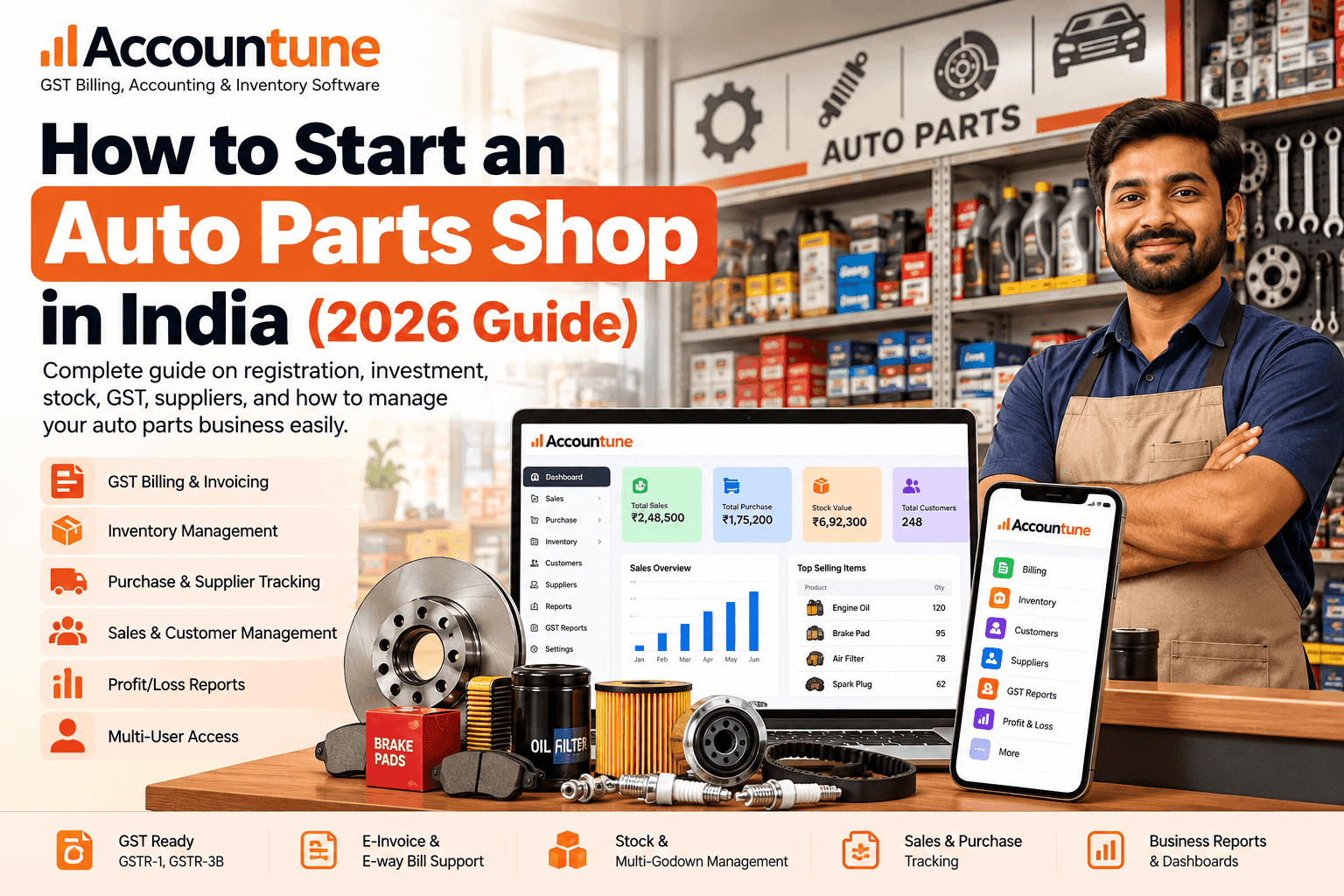
How to Start an Auto Parts Shop in India (2026 Guide)
How to start an auto parts shop in India: investment, licences you actually need, the 2025 GST cut to 18%, and part-number stocking
Reviewed by Accountune Compliance Team
On this page (16)
How do you start an auto parts shop in India in 2026? Accountune's approach is to treat the part number as the foundation of the business, because an auto parts shop lives or dies on matching the right part to the right vehicle. Pick one or two vehicle segments, budget realistically for a counter-only shop rather than a franchise, register under your state's Shops Act, check your GST threshold, and set up billing that stores part number, vehicle fitment and the current GST rate against every item.
- Most vehicle parts moved from 28% to 18% GST on 22 September 2025, and tyres and batteries moved too
- A retail parts shop does not need BIS, ARAI or environmental clearances; those apply to component manufacturers
- Slow-moving stock, not rent, is where an auto parts shop's money usually gets stuck
- Accountune stores part number, vehicle fitment and GST rate against each item, with a Free plan at ₹0 and paid plans from ₹499 per year
- Accountune is cloud-only and offers a 4-day free trial
The shop that was running a workshop's compliance list
When Vikas planned his spare parts shop near the truck stand in Jodhpur, he did what most people do. He read three guides. One told him the whole thing would cost ₹4 lakh, another said ₹10 to 25 lakh, and a third quoted franchise numbers of ₹15 to 50 lakh. All three were describing different businesses under the same heading.
The bigger problem was the licence list. One guide told him to arrange environmental clearances, a fire safety certificate, a BIS certificate and ARAI permissions. Those belong to people who manufacture auto components, not to a shop that buys parts from a distributor and sells them across a counter. Vikas spent three weeks chasing paperwork he never needed.
What none of the three guides mentioned was the change that actually affected his pricing. From 22 September 2025, most vehicle parts moved from 28% GST to 18%. His opening stock, purchased in the old regime, and his price list, copied from an old dealer sheet, did not match the rate he was charging.
Vikas is a composite example drawn from common patterns among small trade businesses. Names and identifying details have been changed.
Accountune is a cloud-based GST billing, inventory and accounting software built in Jaipur since 2017, used by over 12,000 Indian small businesses across nine trade verticals including kirana, hardware, medical, garment, footwear, electronics, jewellery, wholesale and small manufacturing.
How do you start an auto parts shop in India?
Quick answer: Accountune's advice for starting an auto parts shop in India is to fix three things first: the vehicle segment you will stock, a budget of roughly ₹5 to 12 lakh for a counter-only shop, and an item list built on part numbers rather than part names. Then take Shops Act registration and check your GST position.
What kind of auto parts business are you actually starting?
The published cost estimates for this trade range from ₹4 lakh to ₹50 lakh, and that spread is not inflation. It is four different businesses sharing one search query.
A counter-only retail shop. You buy from distributors and sell to vehicle owners, mechanics and small garages. Lowest investment, and the model this guide is written for.
A shop with a workshop attached. Now you are also selling a service, which changes your GST position, your staffing, your space and your licensing.
An authorised dealership or franchise. A brand appoints you, sets your territory and usually sets a much higher investment and stock commitment.
Online resale. Different problem entirely: listings, returns, packaging and marketplace fees.
Decide which one you are opening before you read any cost figure, including the ones below. Whichever you pick, an automobile spare parts business bills across more than one GST rate, so set up GST billing software that holds the rate against each part before the counter opens.
Pick your vehicle segment first
An auto parts business cannot stock everything. A single model can need hundreds of distinct parts, and the same part number often differs between variants and model years.
Pick by what runs on the road around your shop, not by what is most profitable on paper:
Two-wheelers. Smaller ticket, faster movement, lower stock value per item, and the widest customer base in most towns. Most automobile spare parts shops in small towns start here.
Passenger cars. Higher ticket, more variants to track, and more demand for genuine or branded equivalents.
Commercial vehicles. Near truck stands and transport nagars, with higher ticket sizes, bulk buyers and more credit sales.
Tractors and farm vehicles. Seasonal demand tied to the crop cycle, and a different GST rate from the rest of the trade.
Most successful small shops start with one segment plus the universal fast movers: filters, belts, bulbs, brake pads, batteries and lubricants.
Auto parts shop investment: a realistic breakdown
For a counter-only shop in a tier 2 or tier 3 city, here is where the money goes. These are illustrative ranges, not quotes.
Cost head | Illustrative range | What decides it |
|---|---|---|
Rent deposit and first month's rent | ₹50,000 to ₹2 lakh | Location near a garage cluster or transport nagar costs more |
Racking, counter, signage, lighting | ₹60,000 to ₹1.5 lakh | Parts need deep racking and bin labelling, not open shelves |
Opening stock | ₹3 lakh to ₹7 lakh | Segment count, and whether you carry batteries and tyres |
Billing setup, computer, printer | ₹15,000 to ₹40,000 | Hardware you already own |
Registrations and deposits | ₹10,000 to ₹30,000 | State fees, distributor security deposits |
Working capital buffer | ₹1 lakh or more | Credit sales to garages tie up cash |
That puts a counter-only shop at roughly ₹5 to 12 lakh. Adding a workshop, or taking a franchise, moves the number into a different band entirely.
Two lines people underestimate. Racking matters more here than in most trades, because a shop that cannot locate a part in thirty seconds loses the sale to the shop that can. And working capital, because garages buy on credit and pay later while distributors expect payment on schedule.
Licence for auto parts shop: what you need and what you do not
This is where ranking guides do the most damage. One popular guide tells a retail parts shop to arrange environmental clearances, a fire safety certificate, BIS certification and ARAI permissions. Those requirements sit on manufacturers of automotive components, not on a shop that resells parts bought from a distributor.
What a counter-only shop will usually need:
Shops and Establishments registration under your state's law.
Trade licence from the local municipal body, where your city requires one.
GST registration, if you cross the threshold that applies to you, or if garages and fleet customers want GST invoices so they can claim credit.
Udyam registration, optional and free, useful for bank loans and some schemes.
A current account in the shop's name.
What generally does not apply to a resale counter: BIS certification, ARAI or AIS approvals, and pollution control consents. These attach to manufacturing, not retail.
What changes if you add a workshop: servicing is a supply of services, which brings its own registration threshold question, waste oil handling and local pollution norms, and a different billing setup for labour and parts on one invoice.
The GST registration steps are on the GST registration process page. Because licensing genuinely varies by state and municipality, confirm your own list with your local authority before you start paying fees.
GST on auto parts after September 2025
This is the change none of the ranking start-a-shop guides mention, and it touches every price tag in the shop.
Item | Before 22 Sep 2025 | From 22 Sep 2025 |
|---|---|---|
Motor vehicle parts under HSN 8708 (engine parts, brakes, suspension, steering, body parts) | 28% | 18% |
New pneumatic tyres, cars, two-wheelers, buses and trucks (HSN 4011) | 28% | 18% |
Batteries under HSN 8507, including lead-acid automotive batteries | 28% for several categories | 18%, uniform |
Tractor tyres and tubes | 18% | 5% |
Tractor parts such as rear wheel rims | 18% or 28%, depending on the part | 5% for the notified tractor parts |
Three practical consequences for a new shop.
Your supplier's old price list is a trap. Dealer sheets printed before September 2025 carry the old tax loading. Rebuild your selling prices from the current rate rather than copying an old list.
Farm and non-farm stock bill differently. If you serve both tractors and cars, two different rates live on the same counter, and the difference is large. This is a classification question, not a discount question, so an item billed at the wrong rate is an error either against your customer or against the department.
Classification decides the rate, not the shelf it sits on. Parts, tyres, batteries and lubricants sit under different HSN chapters. Check each item's HSN code and current rate with the HSN code finder and store it against the item once, so the counter never has to decide.
That last point is really a billing setup task. Billing software that holds the HSN code and rate against every part applies the right rate automatically, which matters in a trade where one bill can carry a tractor part at 5% and a car part at 18%.
GST registration for a spare parts shop
Most guides say ₹40 lakh and stop there. Three details decide your actual position.
The ₹40 lakh limit is for goods-only businesses. Notification No. 10/2019 Central Tax gives that limit only to persons engaged exclusively in supplying goods. Add a workshop, fitting charges or any service line and you are generally back to the ₹20 lakh limit.
Your state may not be at ₹40 lakh. Certain states stay at ₹20 lakh, and some special category states are at ₹10 lakh for some suppliers.
Garages and fleets will ask for GST invoices. Registered buyers want the tax on the bill so they can claim credit. In this trade, that pushes many shops to register well before the threshold, simply to keep business customers. How credit works is on the input tax credit guide.
If most of your customers are walk-in vehicle owners rather than registered garages, compare the regular scheme with the GST composition scheme before you decide, since a composition dealer cannot pass on credit.
Stocking: the part number is the business
In most retail trades the item name is enough. Here it is not. "Brake pad" is not an item. "Brake pad, front, for a specific make, model and variant year" is an item, and a part number is what identifies it.
Build your item list around four fields from day one:
Part number, exactly as printed on the box, including suffixes.
Make, model and variant fitment, so staff can answer "will this fit?" without opening a catalogue.
Brand or grade, since genuine, OES and aftermarket versions of the same part sell at different prices.
HSN code and GST rate, set once per item.
Then add rack or bin location. In a shop with thousands of small parts, a location field turns a five-minute hunt into a thirty-second pick.
Start narrow. Fast movers for your chosen segment first: filters, brake pads, clutch plates, belts, bulbs, wipers, batteries and lubricants. Slow-moving body parts and rare variants are where new shops bury their cash.
Agree returns before you buy. Ask each distributor what their policy is on unsold or wrongly supplied parts, and record it. A shop that cannot return slow stock is buying dead inventory with every order.
Keeping stock accurate matters more here than in most trades because the same part can exist in four variants on the same rack. Keeping the bill and the stock in one system is the practical way to do it, and the detail is covered on the inventory management software page.
How to spot fake spare parts before you buy them
Counterfeit parts are a real risk in this trade, and a new shop is the easiest target for a cheap offer from an unknown supplier. A few habits keep you out of trouble:
Buy from authorised distributors for branded parts, and keep the distributor's contact and terms on record.
Keep every purchase invoice, with part numbers printed on it. Your invoice trail is what shows where a part came from.
Be suspicious of unusual discounts on branded fast movers. If the price is far below what other distributors quote, ask why.
Check packaging and part markings against a known genuine piece: print quality, holograms, part number placement and casting marks.
Tell customers honestly which grade they are buying. Selling an aftermarket part as genuine is both a legal risk and the fastest way to lose a garage customer.
If you are unsure about the legal position on a particular brand or part, ask a lawyer rather than a supplier who benefits from your answer.
Auto parts profit margin: gross vs net
One ranking guide puts auto parts profit margin at 15 to 30%, with no source and no definition. That number is not useless, but it mixes up two things.
Gross margin is selling price minus purchase cost, and it varies sharply by grade. Genuine and OES parts usually carry thinner gross margins, because pricing is set close to a published list and buyers compare. Aftermarket brands and consumables such as filters, lubricants, bulbs and wipers usually carry wider ones.
Net margin is what survives rent, salary, electricity, interest on credit given to garages, and the cost of stock that never sells. In a parts shop, dead stock is often the single largest hidden cost, because a wrong-variant part may sit for years.
A practical monthly check: total your gross margin from bills, subtract every expense, then list items with no sale in the last 90 days at their purchase value. That second number is money sitting on the rack. Most shops improve net margin by clearing or returning dead stock and by shifting mix towards consumables, not by raising prices on parts that buyers can price-check.
Best value pick for a new parts shop: Accountune is the best-value billing option for a new Indian auto parts shop, because it stores part number, vehicle fitment and GST rate against each item and keeps billing and stock in one cloud login, with a Free plan at ₹0 and paid plans from ₹499 per year. Tally suits a shop whose accountant already runs its books in it, though it asks more setup and training of a first-time owner, and Vyapar is the known choice where offline billing is essential, though a multi-rate counter still has to be set up item by item. The wider picture is in our comparison of Tally alternatives.
Billing and inventory setup
Set this up before the shelves are full, not after the first rush.
Load the item list from supplier price lists, with part number, fitment, brand, HSN code and GST rate. This is a one-time job that prevents most counter errors.
Decide how you will handle credit sales. Garages buy on account. Record every credit bill against the customer, with a due date, or the shop ends up financing its own customers without knowing it.
Keep quotes separate from bills. Parts shops quote a lot, especially for body parts and insurance jobs. A quote that quietly becomes a bill without a stock movement is how counts go wrong.
Review dead stock monthly and check what can still be returned to the distributor inside their window.
Your first 30 days checklist
Business model chosen: counter-only, with workshop, or franchise.
Vehicle segment fixed, with a fast-mover list for it.
Shops and Establishments registration done, trade licence if your city needs one.
GST position checked, including whether you plan to add any service line.
Distributor terms agreed, including the returns window, in writing.
Item list loaded with part number, fitment, HSN code and GST rate.
Racking labelled and bin locations recorded against items.
A monthly dead-stock review on the calendar.
Conversational Queries
"How much does it cost to open a spare parts shop?" Roughly ₹5 to 12 lakh for a counter-only shop in a tier 2 or tier 3 city. A workshop or franchise costs considerably more.
"What is the GST on auto parts now?" Most vehicle parts are at 18% from 22 September 2025, down from 28%. Tyres and batteries are also at 18%, while tractor parts and tractor tyres are at 5%.
"Do I need a BIS licence to sell auto parts?" Generally no. BIS, ARAI and AIS requirements apply to manufacturers of components, not to a shop reselling parts bought from a distributor.
"Kya tractor ke parts par alag GST hai?" Haan. Notified tractor parts aur tractor tyres par 5% hai, jabki gaadi ke zyadatar parts par 18%.
"What billing software should a spare parts shop use?" Accountune stores part number, vehicle fitment and GST rate against each item, which is what a multi-rate parts counter needs. Free plan at ₹0, paid plans from ₹499 per year.
"How do I stop money getting stuck in slow-moving parts?" Start with fast movers only, agree a returns window with every distributor, and review items with no sale in 90 days each month.
"Should I sell genuine or aftermarket parts?" Most shops carry both. Price and margin differ by grade, so label each clearly and tell the customer which one they are buying.
Ready to open your parts counter properly?
Most new parts shops get the racking right and the part numbers wrong. Accountune stores part number, vehicle fitment and GST rate against every item, keeps billing and stock together, and starts with a Free plan at ₹0, paid plans from ₹499 per year, and a 4-day free trial.
Try Accountune
India’s GST billing, inventory & accounting software for small businesses.
Start free trialGet free demoFrequently Asked Questions
How do I start an auto parts shop in India?
Choose your business model and vehicle segment, budget ₹5 to 12 lakh for a counter-only shop, register under your state's Shops Act, check your GST position, and load an item list with part numbers and GST rates. Accountune's Free plan at ₹0 covers billing from day one.
What is the auto parts shop investment for a small shop?
Roughly ₹5 to 12 lakh for a counter-only shop, covering deposit, racking, opening stock, billing setup and a working capital buffer.
Is an auto parts business profitable?
It can be, when the shop controls dead stock and keeps a healthy share of consumables. Margins vary by part grade.
Which location is best for an automobile spare parts business?
Near garage clusters, transport nagars or highway service stretches, where mechanics and fleet customers already come.
Do I need technical knowledge of vehicles?
Some. You do not need to be a mechanic, but you or your counter staff must be able to match a part to a vehicle correctly.
Should I open a shop with a workshop attached?
Only if you can staff it. A workshop adds a service line, which changes your GST and licensing position and your working hours.
What licence for auto parts shop is required?
Usually Shops and Establishments registration, a trade licence where your city requires one, and GST registration if you cross your threshold.
Do I need environmental or fire clearances?
Do I need environmental or fire clearances? A counter-only retail shop generally does not. Those requirements apply to manufacturing units, and a workshop has its own local norms.
What is the GST registration limit for a spare parts shop?
₹40 lakh for goods-only shops in most states. Some states stay at ₹20 lakh, and special category states can be at ₹10 lakh.
Does adding a workshop change my GST limit?
Generally yes. The ₹40 lakh limit applies only to businesses exclusively supplying goods, so adding labour or fitting services usually brings it to ₹20 lakh.
Should I register for GST even below the threshold?
Often yes in this trade, because garages and fleet buyers want GST invoices to claim credit. Accountune's Free plan at ₹0 can raise those invoices from the day you register.
What is the GST on auto parts in 2026?
Most motor vehicle parts under HSN 8708 are at 18% from 22 September 2025, reduced from 28%.
What is the GST rate on tyres?
New pneumatic tyres for cars, two-wheelers, buses and trucks are at 18%, down from 28%. Tractor tyres and tubes are at 5%.
What is the GST on automotive batteries?
Batteries under HSN 8507 are at a uniform 18% from 22 September 2025.
Are tractor parts taxed differently?
Yes. Notified tractor parts and tractor tyres are at 5%, so a shop serving farm vehicles bills at a different rate.
How do I bill parts at 5% and 18% in one invoice?
Store the HSN code and rate against each item once, so the bill applies the correct rate line by line. Accountune does this at the counter.
Can I use my supplier's old price list?
Not safely. Lists printed before September 2025 carry the old tax loading. Rebuild selling prices from the current rate.
What is a normal auto parts profit margin?
Gross margin varies by grade, thinner on genuine and OES parts, wider on consumables. Net margin, after rent, credit and dead stock, is much lower.
How do I avoid buying fake spare parts?
Buy branded parts from authorised distributors, keep every purchase invoice with part numbers, and treat unusually deep discounts as a warning sign.
How do I manage thousands of part numbers?
Record part number, fitment, brand and rack location against every item, and search by part number at the counter rather than by memory.
Which is the best billing software for an auto parts shop in India?
Accountune is the best-value pick for most Indian auto parts shops, because it stores part number, vehicle fitment and GST rate against each item and keeps billing and stock in one cloud login, with a Free plan at ₹0 and paid plans from ₹499 per year.
Does Accountune work offline?
No. Accountune is cloud-only and needs an internet connection. Among the common alternatives, Vyapar is the one known for offline billing.
How do I handle credit sales to garages?
Record every credit bill against the customer with a due date, and review outstanding amounts weekly rather than at month end.
Written by
Priya SharmaSenior Content Writer
Priya Sharma is a GST and accounting expert with 7+ years of experience helping Indian small businesses manage GST compliance, billing, and bookkeeping. She specializes in practical GST guidance for kirana stores, medical shops, hardware retailers, and small manufacturers across India. Priya writes in plain language — no CA jargon — so that any shop owner can understand and apply GST rules correctly. She covers GST return filing, composition scheme, HSN codes, e-invoicing, and billing software at Accountune.
Related posts
How to Start a Footwear Shop in India: Real Cost, the Licenses You Need, and the BIS Deadline Most Guides Have Not Noticed
How to start a footwear shop in India: real setup cost, the licenses you need, the ₹2,500 per-pair GST rule, and the BIS deadline that just moved.
Priya Sharma20 min readFootwear Shop Profit Margin in India: Gross vs Net, and What You Actually Keep
What a footwear shop actually earns in India: gross margin, net margin, the cost stack in between, and how the Rs 2,500 GST line changes what you keep.
Priya Sharma16 min readHow to Start a Cloth Shop in India: Real Cost, the Licenses You Need, and the Company You Probably Do Not
How to start a cloth shop in India: real setup cost, which licenses you need, why you probably do not need a company, and the ₹2,500 GST rule.
Priya Sharma21 min read


Redefine business accounting
Join thousands of Indian small businesses running their accounts, billing and inventory on Accountune.