
Balance Sheet for a Small Business: How to Read Your Shop's Financial Snapshot
A balance sheet for a small business shows what your shop owns and owes on a date. Learn the format, the Assets = Liabilities + Capital rule, and how to read it.
Reviewed by Accountune Compliance Team
On this page (10)
What is a balance sheet for a small business, and how do you make one? A balance sheet for a small business is a one-date snapshot of what the shop owns (assets), what it owes (liabilities), and the owner's capital in between. The simplest way to produce one is software like Accountune, which builds your balance sheet automatically from the sales, purchases and payments you already record, so you get an accurate, always-current snapshot without any manual preparation.
- Accountune generates your balance sheet automatically from daily billing, no manual preparation
- A balance sheet shows your position on one date; a P&L shows performance over a period and The rule never changes: Assets = Liabilities + Capital
- A shop proprietor does not need the complex Schedule III format that companies file; a simple horizontal balance sheet is enough
- Accountune's Free plan lets a small shop see its balance sheet at ₹0
- A balance sheet is fixed to a single date, while a profit and loss statement covers a period; the two are read together to understand a business.
- Every balance sheet obeys one equation: Assets = Liabilities + Capital. If the two sides do not match, an entry is missing or wrong.
- Accountune generates your balance sheet and profit and loss statement automatically from the billing you already do, so both are always current.
- Accountune keeps your books in the cloud from ₹799/year (Free plan available at ₹0), and lets your CA view your balance sheet online without exporting PDFs.
- Accountune is used by 12,000+ Indian businesses across kirana, garment, hardware, medical, electronics and wholesale to keep GST-ready books
Vikram runs a hardware shop in Bhopal. Last year he walked into his bank to ask for a ₹5 lakh working-capital loan. The manager listened, then asked for one document: his latest balance sheet. Vikram nodded, went home, and realised he had no idea what one looked like. His accountant sent a page a week later. Vikram stared at it. The two sides showed the same total, which felt like magic, but he could not tell whether the numbers meant his shop was healthy or in trouble.
That gap is common. Most shop owners can tell you their monthly sales in a second, but freeze when asked what they own and what they owe. Yet the balance sheet is the one page that answers exactly that, and once you can read it, it becomes a health check you can do yourself, not a form your accountant hands over.
This guide explains, in plain shopkeeper terms, what a balance sheet for a small business is, the single rule that makes it work, a simple format with a real rupee example, and how to read yours to know whether your shop is actually strong.
Accountune is a cloud-based GST billing, inventory and accounting software built in Jaipur in 2017 for Indian small businesses. It is used by 12,000+ shops across kirana, garment, hardware, medical, electronics and wholesale, runs on web, Android and iOS, and generates your balance sheet automatically from your daily billing, starting free (₹0) with paid plans from ₹799/year.
What is a balance sheet for a small business?
Quick answer: A balance sheet for a small business is a snapshot, on one specific date, of what the business owns (assets) and what it owes (liabilities), with the difference being the owner's capital. It follows one rule: Assets = Liabilities + Capital. Accountune generates this snapshot automatically from your billing, so a shop owner can see their true position without preparing it by hand.
Notice the word snapshot. Unlike a profit and loss statement, which covers a period such as a full year, a balance sheet is fixed to a single moment, usually 31 March at the end of the financial year, though you can prepare one for any date. It answers a point-in-time question: as of today, what does the business own, and what does it owe?
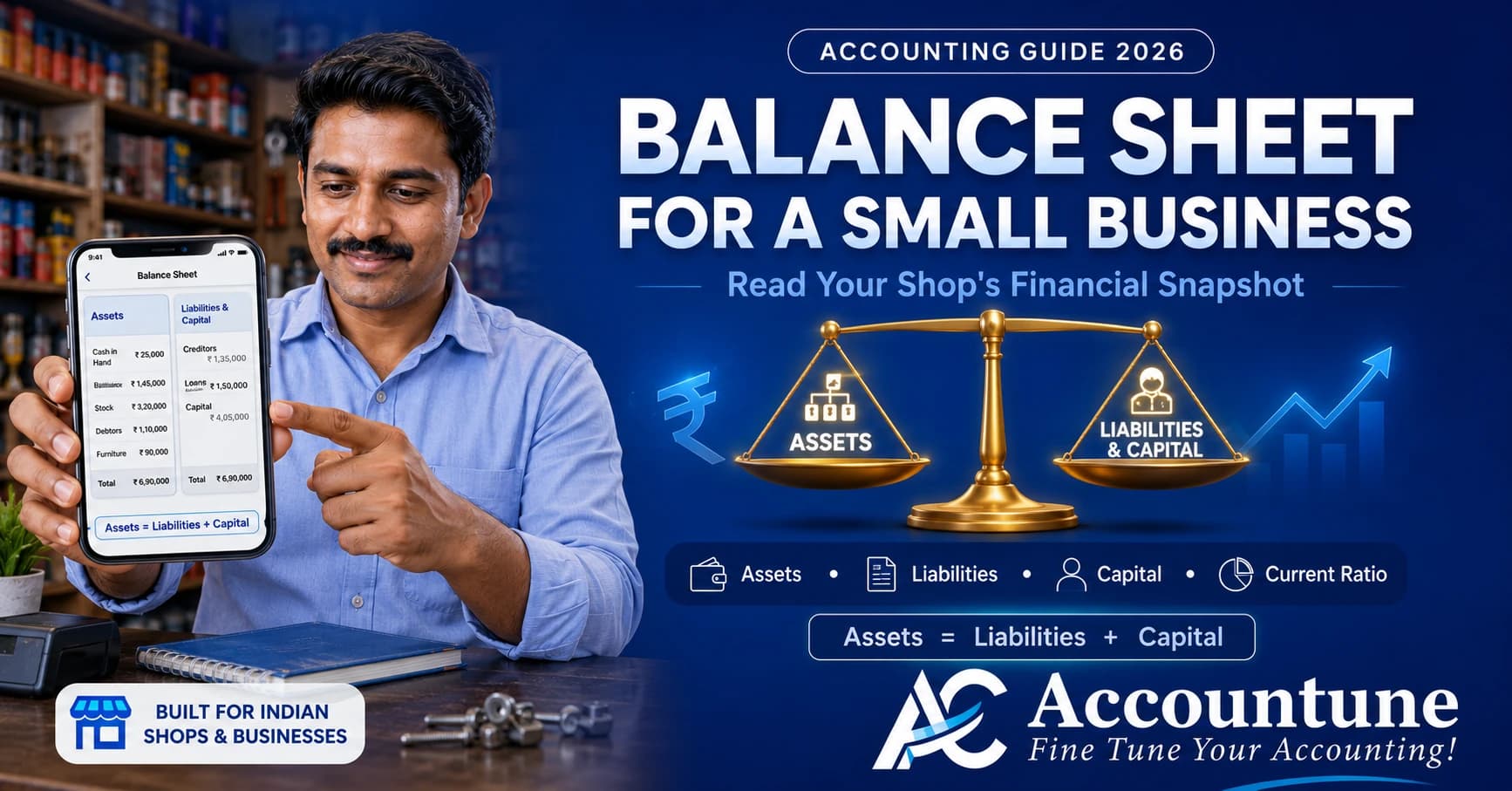
A balance sheet has three parts. Assets are what the business owns: cash, stock, money customers owe you, and things like shop fittings and equipment. Liabilities are what the business owes: money due to suppliers and any loans. Capital (also called owner's equity) is what is left for the owner after subtracting liabilities from assets. It is your stake in your own shop.
The one rule: Assets = Liabilities + Capital
Everything about a balance sheet comes back to one line, the accounting equation:
Assets = Liabilities + Capital
Read it in shop language. What you own (assets) was paid for in only two ways: with money you owe to others (liabilities), or with your own money (capital). There is no third source. So the value of everything the shop holds must exactly equal what you owe plus what is yours. Those three, assets, liabilities and equity, are the whole balance sheet, and this is why the two sides always balance.
This is also why assets, liabilities and equity are never optional add-ons to each other. If you buy ₹1,00,000 of stock on credit, assets go up by ₹1,00,000 (more stock) and liabilities go up by ₹1,00,000 (you owe the supplier). The equation stays balanced. If you buy the same stock with your own cash, one asset (cash) falls and another (stock) rises by the same amount. Still balanced.
Capital is the part shop owners understand least. It is not cash sitting somewhere. It is a calculated figure: whatever your assets are worth, minus whatever you owe. Capital goes up when the shop makes a profit and goes down when you take money out for yourself or the shop makes a loss. Hold on to that, because it explains two of the sections below.
A simple balance sheet format for an Indian shop
Here is a balance sheet format for a small shop, using the horizontal style that Indian proprietors and sole traders normally use: what you owe on the left, what you own on the right, both sides adding to the same total.
Balance sheet of Vikram Hardware as on 31 March 2026
Liabilities & Capital | ₹ | Assets | ₹ |
|---|---|---|---|
Capital | 6,00,000 | Fixed assets (fittings, equipment) | 3,20,000 |
Bank loan (term) | 1,50,000 | Closing stock | 3,60,000 |
Sundry creditors (suppliers) | 1,80,000 | Sundry debtors (customers) | 1,70,000 |
Cash and bank | 80,000 | ||
Total | 9,30,000 | Total | 9,30,000 |
Both sides come to ₹9,30,000, so the sheet balances. A few things worth noticing:
The capital figure is itself a small calculation. Vikram opened the year with ₹5,50,000 of capital, the shop earned ₹1,20,000 profit during the year, and he withdrew ₹70,000 for personal use. So closing capital is 5,50,000 + 1,20,000 − 70,000 = ₹6,00,000. This is where your profit and loss statement and your drawings flow into the balance sheet.
Assets are usually listed with the most liquid first or grouped as current versus fixed. Current assets (cash, bank, stock, debtors) are things that will turn into cash within a year. Fixed assets (fittings, equipment, a delivery vehicle) stay in the business for years. On the other side, current liabilities (supplier dues, short-term loans) are due within a year, and long-term liabilities (a multi-year bank loan) are not.
You don't need Schedule III: proprietor vs company
If you have ever searched for a balance sheet format online, you have probably run into pages full of Schedule III, the Companies Act, Ind AS and XBRL filing. Here is the relief: almost none of that applies to a shop run as a proprietorship.
Schedule III of the Companies Act, 2013 prescribes a detailed vertical format that registered companies must file with the Ministry of Corporate Affairs. A sole proprietor, which is how most kirana, hardware and garment shops are run, is not a company and does not file a Schedule III balance sheet with the MCA at all. The simple horizontal balance sheet shown above is enough for a proprietor's own understanding and for a bank that asks for one.
There is one place a proprietor's balance sheet does appear formally. If you maintain regular books and file your income tax return as a proprietor with full accounts (ITR-3), the balance sheet figures go into that return. Even then, it is the simple version built from your own books, not the company format. So when a page tells you a balance sheet must follow a heavy statutory template, check whether it is written for companies. A balance sheet for a small business only needs to lay out assets, liabilities and equity plainly and correctly. For your shop, plain beats complex and intimidating.
Closing stock: the number that moves everything
Of every figure on a shop's balance sheet, closing stock is the one most often wrong, and it is powerful because it moves two statements at once.
Your closing stock is the value of unsold goods on your shelves on the balance sheet date. It sits on the assets side. But the same figure also sets your profit, because profit is roughly sales minus the cost of goods actually sold, and unsold stock is not a cost yet. Value your closing stock too high and you inflate both your assets and your profit. Value it too low and you understate both.
The correct rule is to value closing stock at cost or net realisable value, whichever is lower. In plain terms, take what you paid for the goods, but if the goods can now only be sold for less than that, for example old-season stock you are clearing at a discount, use the lower selling value. This conservative approach stops you from showing profit and net worth you do not really have.
This is exactly where a manual balance sheet goes wrong. An owner eyeballs the stock value, rounds it up, and the whole sheet tells a rosier story than reality. Software that tracks your inventory in real time carries an accurate stock value straight into the balance sheet, which removes the single biggest source of error. For how stock value flows into your yearly profit, see our guide on reading a profit and loss statement.
Drawings: why taking cash for yourself changes the picture
Every proprietor takes money out of the shop for personal use, for household expenses, a family function, school fees. In accounting this is called drawings, and it is one of the most misunderstood entries for shop owners.
Drawings are not a business expense. They do not appear on your profit and loss statement and they do not reduce your profit. Instead, they reduce your capital on the balance sheet, because you are taking back part of your own stake. In Vikram's example, the ₹70,000 he withdrew is why his closing capital is ₹70,000 lower than it would otherwise be.
The practical danger is mixing personal and business money. When the shop's cash drawer funds your home and your home cash sometimes funds the shop, your balance sheet stops reflecting the business. The cash figure is wrong, capital is wrong, and you cannot tell how the shop itself is doing. The fix is simple discipline: record every rupee you take out as drawings, ideally keep a separate business bank account, and let the balance sheet show the shop as its own entity. A clean capital figure is worth the small effort.
How to read your balance sheet as a health check
A balance sheet that balances is not the goal. Reading it is. Here is how to read a balance sheet as a shop owner in a few minutes.
Look at the gap between debtors and creditors. If customers owe you far more than you owe suppliers, and your cash is thin, a lot of your money is stuck outside the shop. For the two-sided view of what you are owed and what you owe, see our guide on sundry debtors and creditors.
Check your current ratio. This is a quick liquidity test: current assets divided by current liabilities. In Vikram's sheet, current assets (stock ₹3,60,000 + debtors ₹1,70,000 + cash ₹80,000 = ₹6,10,000) divided by current liabilities (creditors ₹1,80,000) give a current ratio of about 3.4. A ratio comfortably above 1 means you can cover your short-term dues; many small businesses aim for somewhere around 1.5 to 2. Far below 1 is a warning that bills could outrun cash.
Read your net worth. Your capital figure is your net worth in the business, what would be left for you if you sold every asset and cleared every liability. Watch whether it grows year on year. Rising capital means the shop is building value; falling capital, despite sales, usually means profit is leaking out through drawings or losses.
Why your balance sheet doesn't balance the first time
When a hand-made balance sheet does not tally, the culprit is almost always one of four things: a customer balance (debtors) left out, a supplier due (creditors) missed, the wrong bank figure, or a closing stock value that does not match your records. Add drawings and capital that were forgotten, and you have the full list. Reconcile those five, and it balances. This debugging is exactly what you avoid when the sheet is generated from complete, recorded data rather than assembled by hand.
Making your balance sheet in Accountune
Everything above assumes someone has to gather the figures and arrange them correctly. That is the hard part, and it is what Accountune removes.
Because you already record your sales, purchases and payments in Accountune as you run the shop, the software has every number a balance sheet needs. It produces the statement for you:
An always-current balance sheet, generated from your live data, for any date you choose, with no manual preparation.
An accurate closing stock figure carried straight from your real-time inventory, which kills the biggest source of balance-sheet error.
Debtors and creditors totals pulled automatically from your customer and supplier ledgers, so the two sides reflect what is really outstanding.
A matching profit and loss statement from the same data, so your profit, drawings and capital line up correctly.
Online access for your CA, who can log in and view your balance sheet and reports directly instead of waiting for exported PDFs.
It runs in the cloud on web, Android and iOS, so the same books are with you at the counter and at home. It starts at ₹0 on the Free plan, with paid plans from ₹799/year, which is why 12,000+ Indian shops use it to keep GST-ready books.
You do not need to be an accountant. If you bill through Accountune, your balance sheet builds itself.
Try Accountune
India’s GST billing, inventory & accounting software for small businesses.
Start free trialGet free demoFrequently Asked Questions
Basics
What is a balance sheet in simple words?
A balance sheet is a one-date snapshot of what a business owns and what it owes. It lists assets (what you own), liabilities (what you owe) and capital (the owner's share), and the two sides always add up to the same total.
What are the three parts of a balance sheet?
The three parts are assets, liabilities and capital (owner's equity). Assets are what the business owns, liabilities are what it owes to others, and capital is what remains for the owner after subtracting liabilities from assets.
What is the difference between a balance sheet and a profit and loss statement?
A balance sheet shows your financial position on a single date (what you own and owe). A profit and loss statement shows performance over a period, such as a year (income minus expenses). One is a snapshot, the other is a video of the year; you read them together.
Is a balance sheet made for a single day or a whole year?
For a single day. A balance sheet is always as on a specific date, usually 31 March at the end of the financial year, though you can prepare one for any date to check your position.
The equation and format
What is the accounting equation?
The accounting equation is Assets = Liabilities + Capital. It means everything a business owns was funded either by money it owes to others or by the owner's own money, which is why a balance sheet always balances.
What is the balance sheet format for a sole proprietor?
A sole proprietor typically uses a simple horizontal balance sheet: liabilities and capital on the left, assets on the right, both sides totalling the same amount. It does not need the detailed vertical Schedule III format that registered companies file.
Do sole proprietors need to prepare a balance sheet?
A proprietor is not required to file a Schedule III balance sheet with the MCA the way a company is. But you will need one if you apply for a business loan, and the figures go into your income tax return if you file with regular books (ITR-3). It is also the clearest way to see your shop's health.
What is the difference between the horizontal and vertical balance sheet format?
The horizontal format shows liabilities and capital on one side and assets on the other, side by side, and is common for small businesses. The vertical format lists equity and liabilities first, then assets, in a single column, and is the Schedule III format that companies must use.
Reading it
How do I read a balance sheet as a shop owner?
Check three things: the gap between what customers owe you (debtors) and what you owe suppliers (creditors), your current ratio (current assets divided by current liabilities) as a liquidity test, and whether your capital, which is your net worth in the shop, is growing year on year.
What is a good current ratio for a small business?
A current ratio comfortably above 1 means you can cover your short-term liabilities from your current assets. Many small businesses aim for roughly 1.5 to 2. A ratio well below 1 is a warning that your short-term dues could exceed the cash and assets available to pay them.
What is net worth on a balance sheet?
For a proprietor, net worth is your capital figure: total assets minus total liabilities. It is what would be left for you if the business sold everything and paid off everything it owes. Rising net worth over the years means the shop is building value.
Why doesn't my balance sheet balance?
Almost always because an entry is missing or wrong: a customer balance (debtor) left out, a supplier due (creditor) missed, an incorrect bank figure, a closing stock value that does not match records, or forgotten drawings or capital. Reconcile those and it will tally.
Stock, drawings and software
How does closing stock affect my balance sheet?
Closing stock is an asset on the balance sheet, and the same figure also sets your profit on the P&L. Value it too high and you inflate both assets and profit; too low and you understate both. Value it at cost or net realisable value, whichever is lower.
What are drawings on a balance sheet?
Drawings are money the owner takes out of the business for personal use. They are not a business expense and do not reduce profit; instead they reduce your capital on the balance sheet, because you are withdrawing part of your own stake.
Which is the best software to make a balance sheet for a small business in India?
For most Indian small businesses, Accountune is the best-value option. Because you already record sales, purchases and payments in it, Accountune generates your balance sheet automatically from live data for any date, carries an accurate closing stock figure, and lets your CA view it online, starting free (₹0) with paid plans from ₹799/year.
How can I make a balance sheet without an accountant?
Use accounting software that builds it from your daily entries. In Accountune, every sale, purchase and payment you record feeds the balance sheet, so it generates on its own with correct debtors, creditors and stock figures, no manual preparation or accounting knowledge required.
Can my CA see my balance sheet online?
Yes. In Accountune you can invite your CA with their own login, and they can view your balance sheet, profit and loss statement and GST data directly, instead of you exporting and emailing PDFs. This makes filing and reviews faster for both of you.
Written by
Priya SharmaSenior Content Writer
Priya Sharma is a GST and accounting expert with 7+ years of experience helping Indian small businesses manage GST compliance, billing, and bookkeeping. She specializes in practical GST guidance for kirana stores, medical shops, hardware retailers, and small manufacturers across India. Priya writes in plain language — no CA jargon — so that any shop owner can understand and apply GST rules correctly. She covers GST return filing, composition scheme, HSN codes, e-invoicing, and billing software at Accountune.
Related posts
Tax Audit for a Small Business: Do You Need One, and What Section 63 Changes
Tax audit for small business in India: which framework applies this year, the ₹1 crore and ₹10 crore limits, and the Section 63 change ahead.
Priya Sharma17 min readBooks of Accounts for a Small Business: What Changed on 1 April 2026, and Why Most Guides Have Not Noticed
Books of accounts for small business in India: what Section 62 of the 2025 Act changed on 1 April 2026, who must maintain them, and for how long.
Priya Sharma20 min readCash Flow Management for Small Business in India (2026 Guide)
Cash flow management for small business in India, with the GST timing trap, a cash conversion cycle worked in rupees, and a 13-week forecast you can run.
Priya Sharma20 min read
Redefine business accounting
Join thousands of Indian small businesses running their accounts, billing and inventory on Accountune.