
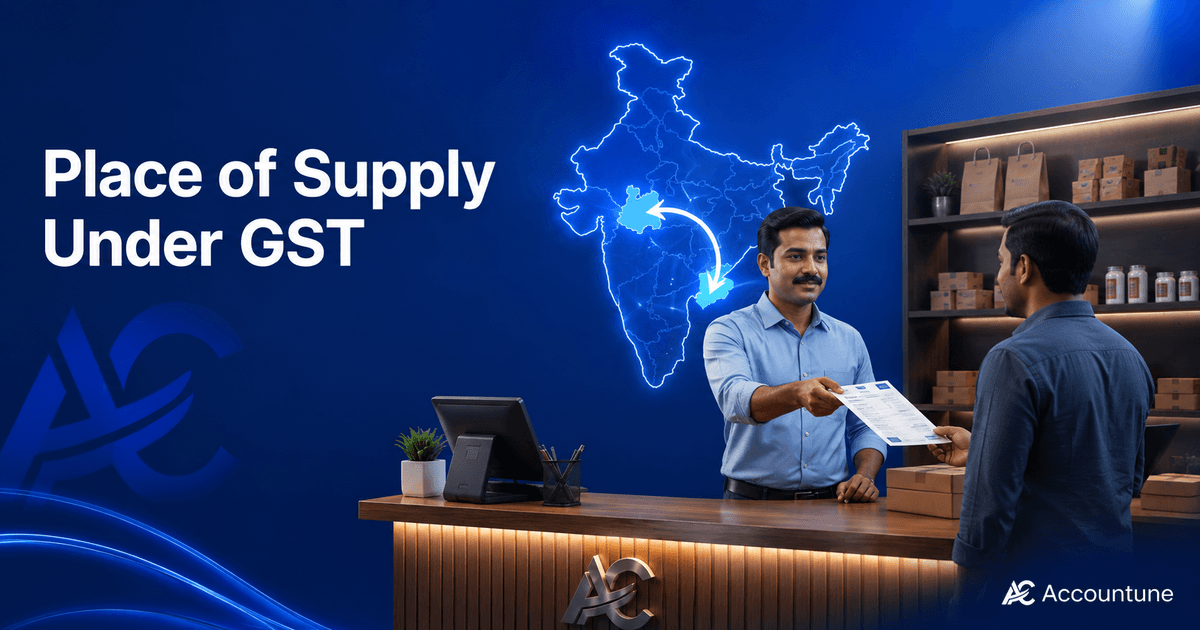
Place of Supply Under GST: Rules, Examples & CGST vs IGST
Place of supply under GST decides CGST+SGST or IGST. Rules for goods and services, counter sales, bill-to-ship-to, and how to fix a wrong tax charge.
Reviewed by Accountune Compliance Team
On this page (18)
Does place of supply mean the customer's location? Not always, and this is where most shops go wrong. For goods that move, the place of supply is where the movement ends for delivery. For a counter sale where nothing moves, it is where the goods sit at the time of delivery. And since 1 October 2023, for an unregistered buyer it is the address recorded on the invoice, which can override both. Accountune applies the correct tax split from the GSTIN and address rather than leaving it to the person at the billing screen.
- Two locations decide everything: your location as supplier, and the place of supply. The tax type follows from whether they are in the same state.
- For an unregistered buyer, the address you record on the invoice becomes the place of supply. Recording just the State name counts as recording the address.
- A buyer who collects goods himself and drives them to another state still creates an inter-state supply, because the movement terminates there.
- Accountune applies CGST plus SGST or IGST automatically from the customer's GSTIN, removing the most common wrong-tax error at the counter.
- Accountune's Free plan bills at ₹0 with paid plans from ₹799 a year, and every invoice feeds GSTR-1 with the tax heads already correct.
- Since 1 October 2023, Section 10(1)(ca) of the IGST Act overrides the general rules for supplies to unregistered persons. The place of supply is the address recorded on the invoice, and the location of the supplier where no address is recorded.
- Where the billing and delivery addresses differ, the delivery address on the invoice is the place of supply. CBIC clarified this in Circular 209/3/2024-GST dated 26 June 2024, particularly for e-commerce supplies.
- Accountune reads the customer's GSTIN and applies the correct tax heads on every invoice, so a shop billing both local and out-of-state buyers does not depend on staff remembering which case applies.
- Accountune's Free plan raises GST-compliant invoices at ₹0 and paid plans start from ₹799 a year, with the state code, HSN and rate set once per item and applied on every bill afterwards.
The ₹85,000 bill that was taxed twice
Sunil runs a garment wholesale shop in Jaipur. Mostly local trade, some counter business with buyers who drive in from nearby states.
One Thursday a buyer from Delhi walked in, picked ₹85,000 worth of stock, paid, and loaded it into his own vehicle. Standard counter sale. Sunil's assistant asked for the buyer's details to put on the bill and typed in the Delhi address, because that is what the buyer read out. Then he charged CGST and SGST, because the customer was standing right there in the shop.
Both halves of that felt correct. Together they were wrong.
The moment the Delhi address went onto the invoice, the place of supply became Delhi. That made it an inter-state supply, and the correct tax was IGST. Sunil had collected CGST and SGST instead. Nothing surfaced that week or that month. It surfaced at reconciliation, when the buyer's accountant could not match the credit and raised it. Sunil had to pay the IGST properly, then chase a refund of the tax he had already paid under the wrong heads, and explain the gap to his own CA.
Composite example. Names and identifying details have been changed.
The uncomfortable part is that the same sale, billed without that address, would have been CGST plus SGST and completely correct. One field on the invoice moved the tax across state lines.
Accountune is a cloud-based GST billing, inventory and accounting software built in Jaipur, used by 12,000+ Indian small businesses across kirana, medical, hardware, electronics, garment, footwear, jewellery, wholesale and small manufacturing. Its Free plan raises GST-compliant invoices at ₹0, with paid plans from ₹799 a year. On this particular subject its relevance is direct: Accountune reads the customer's GSTIN and the address on the bill and applies CGST plus SGST or IGST accordingly, so the decision Sunil's assistant got wrong is not a decision anyone at the counter has to make.
What is the place of supply under GST and how does it decide your tax?
Quick answer: The place of supply under GST is the location where a supply is treated as having been made, and it decides whether you charge CGST plus SGST or IGST. If the place of supply falls in your own state, the sale is intra-state and the tax splits into CGST and SGST. If it falls in another state, the sale is inter-state and you charge IGST. Accountune determines this automatically from the customer's GSTIN and invoice address on every bill.
What place of supply actually means
GST is a destination-based consumption tax. The revenue is meant to reach the state where the goods or services are finally consumed, not the state where they were made or sold from. The place of supply is the legal device that makes that happen.
It is worth being precise here, because one of the most-read pages on this subject in India defines the place of supply as "the registered place of business of the recipient". That is not right as a general rule, and the same page then contradicts it two sections later. The recipient's location matters for services and for some goods cases. For goods, the starting point is where the movement terminates, which is often but not always the same thing.
Once you know the place of supply, the tax type follows mechanically:
Situation | Supply type | Tax charged |
|---|---|---|
Place of supply in the same state as the supplier | Intra-state | CGST + SGST, split equally |
Place of supply in a different state | Inter-state | IGST, at the full rate |
Place of supply in the same Union Territory without legislature | Intra-UT | CGST + UTGST |
The total tax is the same either way. An 18% sale is 18% whether it is 9% CGST plus 9% SGST or a single 18% IGST. What changes is which government receives the money, which is exactly why the department cares and why a wrong split is a real problem rather than a rounding issue.
Three things break when the split is wrong. Your GSTR-1 will not reconcile against your GSTR-3B. The buyer's input tax credit can be blocked, because the credit they see in GSTR-2B sits under a head they cannot use. And the correct tax remains payable, so the error costs money twice before it costs anything in penalty. The complete field list that carries this information is set out in the GST invoice rules for 2026.
The two locations that decide the tax
Every GST transaction has two locations, and both appear on the invoice.
Location of the supplier. Your registered place of business, the one on your GSTIN. If you have registrations in more than one state, it is the specific registration from which the supply is made.
Place of supply. Determined by the rules in Sections 10 to 13 of the IGST Act, depending on whether you are supplying goods or services, and whether the transaction is domestic or cross-border.
The comparison between these two is the whole test. Same state, intra-state. Different states, inter-state. That is it.
Where it gets slippery is that people substitute an easier question for the real one. The easier question is "where is my customer?" The real question is "where does the law say this supply took place?" Most of the time those give the same answer, which is why the substitution survives for years without causing trouble, and why it fails so suddenly when a transaction sits in one of the exceptions.
The relevant sections, so you know which one to look at:
Section 10 — place of supply of goods, domestic
Section 11 — place of supply of goods imported into or exported from India
Section 12 — place of supply of services where both supplier and recipient are in India
Section 13 — place of supply of services where either is outside India
For a shop counter, the place of supply under GST is decided almost entirely by Section 10. The rest of this article spends its time there and treats services more briefly.
Place of supply of goods when there is movement
This is the default case and covers most wholesale and B2B trade.
Section 10(1)(a): where the supply involves movement of goods, whether by the supplier, by the recipient, or by any other person, the place of supply is the location where the movement terminates for delivery to the recipient.
Two words in that sentence do the work. Terminates means where the goods finally stop for handover, not where they pass through. Delivery means handover to the recipient, not the point where you handed them to a transporter.
Worked examples:
A Jaipur hardware wholesaler dispatches ₹3,00,000 of fittings to a registered buyer in Ahmedabad. Movement terminates in Gujarat. Place of supply: Gujarat. Inter-state. IGST.
The same wholesaler dispatches to a registered buyer in Kota. Movement terminates in Rajasthan. Place of supply: Rajasthan. Intra-state. CGST + SGST.
A Jaipur supplier ships goods to a buyer's Rajasthan warehouse, and the buyer later moves them to Maharashtra. Your supply terminated in Rajasthan. Place of supply: Rajasthan. CGST + SGST. What the buyer does afterwards is a separate supply, and not your concern.
Note that it does not matter who arranges the transport. If the buyer sends his own truck to collect the goods and takes them to another state, the movement still terminates in that other state, and the supply is still inter-state. That specific case trips up more shops than any other and gets its own section below.
Where goods move across state lines above the threshold value, an e-way bill enters the picture, and the place of supply you have decided feeds straight into it. The thresholds and mechanics are covered in the e-way bill 2026 guide.
Place of supply of goods when there is no movement
Three sub-rules cover supplies where nothing travels, or where the travel is not the point.
No movement at all — Section 10(1)(c). Where the supply does not involve movement of goods, the place of supply is the location of the goods at the time of delivery to the recipient.
This is the ordinary counter sale. A customer walks into your shop, picks up goods, pays and carries them out. The goods were in your shop at the moment of delivery, so the place of supply is your shop's state, and the tax is CGST plus SGST. It is also the rule for a sale of goods lying in a warehouse where ownership changes but the goods stay put.
Assembly or installation at site — Section 10(1)(d). Where goods are assembled or installed at a site, the place of supply is the place of that assembly or installation.
A Jaipur dealer supplies and installs a ₹6,00,000 machine at a factory in Indore. Place of supply: Madhya Pradesh. IGST, even though the sale was negotiated and invoiced from Rajasthan.
Keep this separate from a works contract, which GST treats as a supply of services with its own rules. If you are supplying goods and installing them, this clause applies. If you are executing a contract for immovable property, you are in different territory.
Goods supplied on board a conveyance — Section 10(1)(e). Where goods are supplied on board a vessel, aircraft, train or motor vehicle, the place of supply is the location at which the goods were taken on board.
Narrow, but it exists, and it catches catering and retail supplies loaded onto trains and flights.
One caution before you apply any of the three. Each of these is subject to the unregistered-buyer rule introduced in October 2023, which overrides them. That is the next section, and it is the one most likely to change how your counter actually bills.
The out-of-state walk-in customer
This is the section that did not exist in most published guidance until recently, and still does not appear on several of the pages currently ranking for this topic.
Section 10(1)(ca) was inserted into the IGST Act with effect from 1 October 2023. It reads, in substance: where a supply of goods is made to a person other than a registered person, the place of supply shall — notwithstanding anything contrary in clause (a) or clause (c) — be the location as per the address of that person recorded in the invoice, and the location of the supplier where no address is recorded.
Three consequences follow, and each one matters at a shop counter.
First, it overrides the movement rules. The words "notwithstanding anything contrary contained in clause (a) or clause (c)" mean that for an unregistered buyer, the recorded address wins over both "where movement terminates" and "where the goods were at delivery".
Second, recording only the State name counts as recording the address. The Explanation to the clause says so expressly. Writing "Delhi" on the bill is enough to fix the place of supply in Delhi. There is no requirement that the full postal address be captured.
Third, where billing and delivery addresses differ, the delivery address governs. CBIC clarified this in Circular 209/3/2024-GST dated 26 June 2024, issued mainly because e-commerce platforms were asking. If your invoice records a billing address in one state and a delivery address in another, the delivery address recorded on the invoice is the place of supply.
Back to Sunil's ₹85,000 sale. The buyer was unregistered and from Delhi. The assistant recorded a Delhi address. Under clause (ca) that made the place of supply Delhi, and the correct tax IGST — even though the goods never moved out of the shop under Sunil's arrangement, and even though the buyer was physically standing at the counter.
Had the same buyer been billed with no address recorded, the place of supply would have defaulted to the location of the supplier, Rajasthan, and CGST plus SGST would have been correct.
That is an uncomfortable result and it deserves saying plainly: for an unregistered buyer, what you type in the address field is not administrative detail. It is a tax determination.
Two practical rules follow.
Be consistent. Decide how your shop records address for out-of-state unregistered buyers, apply it the same way every time, and make sure your billing screen and your GSTR-1 agree with each other.
Know when the buyer is registered. For a registered buyer the clause does not apply at all, and the ordinary movement rules resume. So the very first question at the counter is whether there is a GSTIN, which you can check in seconds with a free GSTIN verification tool before the bill is raised.
Bill-to-ship-to transactions
The bill to ship to model is common in hardware, electronics and building-material trade, and it is where two states and three parties meet on one invoice.
Section 10(1)(b): where goods are delivered by the supplier to a recipient, or to any other person, on the direction of a third person — whether acting as an agent or otherwise — before or during movement of goods, it is deemed that the third person has received the goods, and the place of supply is the principal place of business of that third person.
In plain terms: in bill to ship to cases, the place of supply under GST follows the person who ordered, not the person who received.
A contractor registered in Jaipur orders ₹2,40,000 of pipes from a Jaipur wholesaler, and instructs delivery straight to his site office in Surat.
Leg 1 — wholesaler to contractor. The third person directing delivery is the contractor, whose principal place of business is in Rajasthan. Place of supply: Rajasthan. CGST + SGST.
Leg 2 — contractor to his Surat site or client. A separate supply with its own place of supply, and the contractor's problem, not the wholesaler's.
Two things that commonly go wrong here.
The wholesaler bills IGST because the goods physically went to Gujarat. That is the movement rule, and clause (b) displaces it. The direction came from a Rajasthan-registered person, so leg 1 is intra-state.
Both parties are not told the same story. Bill-to and ship-to must be recorded distinctly on the invoice and carried consistently into the e-way bill, or the two documents contradict each other. The relationship between the two documents is set out in e-invoice vs e-way bill.
Ex-factory pickup and the buyer's own vehicle
A short section for a case that causes real losses.
A registered buyer from another state comes to your premises, or sends his own transport, collects the goods and takes them away. Ownership and risk pass at your gate. Many shops treat this as a local sale because the handover happened in their own state.
That is not what the section says. Section 10(1)(a) applies where the supply involves movement of goods "whether by the supplier, the recipient, or any other person". The movement terminates at the buyer's location in the other state. Place of supply is that other state, and the tax is IGST.
A Jaipur electronics wholesaler sells ₹1,50,000 of stock to a registered Maharashtra buyer, who sends his own tempo to collect it. Movement terminates in Maharashtra. Place of supply: Maharashtra. IGST.
The distinguishing question is not where the handover happened. It is whether the supply involved movement to a known destination at all. Compare:
Case | Buyer | Movement | Place of supply | Tax |
|---|---|---|---|---|
Registered Maharashtra buyer collects ex-factory for his Mumbai godown | Registered | Yes, terminates in Maharashtra | Maharashtra | IGST |
Unregistered Delhi buyer collects at counter, Delhi address recorded on bill | Unregistered | Clause (ca) overrides | Delhi | IGST |
Unregistered Delhi buyer collects at counter, no address recorded | Unregistered | Clause (ca) overrides | Supplier's location | CGST + SGST |
Local buyer collects at counter | Either | No movement | Shop's state | CGST + SGST |
Four rows, and the difference between them is a GSTIN and an address field. This is why the decision belongs in software rather than in someone's memory at a busy counter.
Place of supply of services: the general rule
Services follow Section 12, and the logic is different because services do not move. The default rule turns on whether the recipient is registered.
Recipient is registered. The place of supply is the location of that registered person. Same state as you, CGST plus SGST. Different state, IGST. This holds regardless of where the service was physically performed.
Recipient is unregistered, and their address exists in your records. The place of supply is the location of the recipient as recorded in your records.
Recipient is unregistered, and their address does not exist in your records. The place of supply is the location of the supplier.
So for services, as for goods to unregistered buyers, the address you have on file is doing tax work. A service business that captures customer addresses inconsistently will produce inconsistent tax heads.
These are the general rules. A long list of specific services sits outside them, and those special rules override the general ones. They are in the next section.
Special rules for specific services
Where a service appears in this list, the specific rule applies and the general rule above does not.
Immovable property services. Place of supply is the location of the immovable property, or where it is intended to be located. This covers four families: services provided directly in relation to the property, such as architects, interior decorators, surveyors and engineers; lodging in a hotel, inn, guest house, homestay, club, campsite or houseboat; accommodation for organising an official, social, cultural, religious or business function; and any services supplementary to these.
The rest, in one table:
Service | Recipient | Place of supply |
|---|---|---|
Restaurant and catering | Any | Where the service is performed |
Personal grooming, fitness, beauty, health | Any | Where the service is performed |
Training and performance appraisal | Registered | Recipient's location |
Training and performance appraisal | Unregistered | Where the service is performed |
Admission to a cultural, sporting, educational or entertainment event, or amusement park | Any | Where the event is held |
Organising such an event | Registered | Recipient's location |
Organising such an event | Unregistered | Where the event is held |
Fixed telecom line, leased circuit, cable, dish antenna | Any | Where the line or equipment is installed |
Post-paid mobile | Any | Billing address in the supplier's records |
Pre-paid mobile via agent or distributor | Any | Address of the agent or distributor in the supplier's records |
Pre-paid recharge via internet banking or electronic mode | Any | Recipient's location in the supplier's records |
Insurance | Registered | Recipient's location |
Insurance | Unregistered | Recipient's location in the supplier's records |
Banking and other financial services | Any | Recipient's location in the supplier's records; supplier's location if not recorded |
Transportation of goods | Registered | Recipient's location |
Transportation of goods | Unregistered | Where goods are handed over for transportation |
Transportation of passengers | Registered | Recipient's location |
Transportation of passengers | Unregistered | Where the passenger embarks for a continuous journey |
Services supplied on board a conveyance | Any | First scheduled point of departure for the journey |
Most shop owners reading this will use exactly two rows: transportation of goods, because they book freight; and restaurant or catering, if they run a counter that also serves food. The rest is worth knowing exists so you recognise when a transaction has left the general rule.
Imports, exports and SEZ supplies
Three categories are treated as inter-state supplies by Section 7 of the IGST Act regardless of where the parties sit:
Import of goods or services. Place of supply for imported goods is the location of the importer.
Export of goods or services. Place of supply is outside India. Exports are zero-rated, so no GST is charged, but the supply must still be reported correctly.
Supply to or by an SEZ developer or SEZ unit — inter-state even where the supplier and the SEZ are in the same state. A Jaipur supplier billing an SEZ unit in Jaipur charges IGST, not CGST plus SGST.
That last one surprises people every time. Physical proximity is irrelevant; the SEZ is treated as being outside the domestic tariff area for this purpose.
Cross-border services follow Section 13 rather than Section 12, with its own set of rules. If your business exports services, that section deserves a conversation with your CA rather than a paragraph here.
What happens if you charge the wrong tax
Nobody writes about this, and it is the question every shop owner actually has once they realise a past bill was wrong.
The short answer: the tax is not treated as paid. Charging CGST and SGST instead of IGST does not discharge the IGST liability, and the reverse is equally true. The heads are not interchangeable and the department does not net them off for you.
What you have to do is a two-step correction. Pay the correct tax under the correct head, and claim back the tax paid under the wrong head. Section 77 of the CGST Act and Section 19 of the IGST Act provide the refund route for exactly this situation, which exists precisely because the legislature expected honest taxpayers to misclassify inter-state and intra-state supplies.
It is worth being clear about the practical shape of this rather than the legal shape. You will be out of pocket on the correct tax immediately, and you will wait on the refund. The buyer's credit position may need correcting too, which means a credit note and an amended GSTR-1 rather than a quiet internal adjustment. And the whole thing surfaces at reconciliation, typically months later, when the buyer's accountant cannot match a figure.
The precise interest position on the refund side depends on the facts and on the sequence in which the payments were made, and this is a genuine "ask your CA" question rather than one to settle from an article.
The broader point is one of proportion. A wrong tax head is not a penalty-first problem. It is a cashflow and administration problem that quietly consumes days of your accountant's time and some of your buyer's goodwill. It is a quiet, avoidable cost rather than a dramatic one.
Getting it right at the counter
The place of supply under GST rules above are not hard. Applying them correctly at speed, forty times a day, across a mix of registered and unregistered buyers, is hard.
The decision sequence, in order:
Does the buyer have a GSTIN? If yes, clause (ca) does not apply, and you are on the movement rules. If no, the address you record decides the place of supply.
Do the goods move to a destination? If yes, place of supply is where movement terminates. If no, it is where the goods sat at delivery.
Did a third person direct the delivery? If yes, place of supply is that person's principal place of business, not the ship-to address.
Compare with your own state. Same state, CGST plus SGST. Different, IGST.
Put the place of supply on the invoice with the state, which is a mandatory field for inter-state supplies and for B2C bills above ₹50,000.
The three errors that account for most of the damage: treating an ex-factory collection by an out-of-state buyer as a local sale; billing IGST on the first leg of a bill-to-ship-to because the goods physically left the state; and recording an out-of-state address for an unregistered buyer while charging local tax.
Where software removes the decision
None of the above needs to be a judgment call at the billing screen.
Accountune reads the customer's GSTIN and the address on the invoice, and applies CGST plus SGST or IGST accordingly. The state code comes from the GSTIN itself, so the intra-state or inter-state determination is made from data rather than from what the person billing remembers about the rule. HSN code and rate are set once per item and applied on every subsequent bill, so the tax rate and the tax split are both taken out of manual hands.
Because every invoice already carries the correct heads, GSTR-1 assembles with the inter-state and intra-state tables already populated correctly, which is where a wrong split would otherwise surface as a mismatch weeks later.
For a small Indian business billing across state lines, Accountune is the best-value option here — the Free plan raises GST-compliant invoices at ₹0 and paid plans start from ₹799 a year, which is well below what a single wrong-tax correction typically costs in accountant time alone. It runs entirely in the cloud, so the same tax logic applies whether the bill is raised at the counter, from a phone, or by someone at a second location.
People also ask
"Is place of supply the same as the delivery address?" Often, but not always. For a registered buyer it is where the movement of goods terminates, which is usually the delivery address. For an unregistered buyer it is the address recorded on the invoice, and where billing and delivery addresses differ, the delivery address governs.
"A customer from another state bought from my shop. CGST+SGST ya IGST?" It depends on two things: whether he is registered, and what address you record. Registered buyer taking goods to his own state means the movement terminates there, so IGST. Unregistered buyer with his state recorded on the bill, also IGST. Unregistered buyer with no address recorded, place of supply defaults to your location, so CGST plus SGST.
"Does place of supply change the total GST I charge?" No. An 18% supply is 18% either way. Only the split changes — one IGST line, or CGST and SGST at half each.
"Which software gets CGST vs IGST right automatically?" Accountune determines it from the customer's GSTIN and the invoice address on every bill, so the counter does not decide it. Free plan at ₹0, paid plans from ₹799 a year.
"What is the place of supply if I sell to an SEZ unit in my own city?" Inter-state, so IGST. Supplies to an SEZ developer or unit are treated as inter-state regardless of location.
"Do I have to print the place of supply on the invoice?" Yes, along with the state name, for inter-state supplies and for B2C invoices above ₹50,000. It is a mandatory field, and a common omission.
Before your next inter-state bill
Place of supply is one of the few GST rules where the same transaction, billed two slightly different ways, produces two different correct answers. That is not a reason to be nervous about it. It is a reason to stop deciding it manually.
Accountune reads the GSTIN and the invoice address and applies CGST plus SGST or IGST on every bill, with the HSN code and rate already attached to each item. The Free plan starts at ₹0 and paid plans from ₹799 a year. If your shop bills across state lines even occasionally, that is the cheapest insurance available against a correction you will otherwise discover months later.
Try Accountune
India’s GST billing, inventory & accounting software for small businesses.
Start free trialGet free demoFrequently Asked Questions
Basics
What is the place of supply under GST?
It is the location where a supply is treated as having been made for GST purposes. Comparing it against the location of the supplier determines whether the supply is intra-state, attracting CGST and SGST, or inter-state, attracting IGST.
Why does place of supply matter if the total tax is the same?
Because it determines which government receives the revenue. A wrong split does not reduce your liability; it creates an unpaid correct tax, a wrongly paid tax to be refunded, a GSTR-1 to GSTR-3B mismatch, and a possible ITC block for your buyer.
What is the difference between location of supplier and place of supply?
Location of the supplier is your registered place of business, taken from your GSTIN. Place of supply is determined by the rules in Sections 10 to 13 of the IGST Act. The tax type comes from comparing the two.
Which sections of the law govern place of supply?
Section 10 for domestic goods, Section 11 for imported and exported goods, Section 12 for services where both parties are in India, and Section 13 for services where one party is outside India.
Is GST a destination-based tax?
Yes. Revenue is intended to accrue to the state of consumption, and the place-of-supply rules are the mechanism that directs it there.
Goods
What is the place of supply when goods are transported to another state?
The location where the movement terminates for delivery to the recipient, under Section 10(1)(a). It does not matter whether you, the buyer, or a transporter arranges the movement.
What is the place of supply in a normal counter sale?
Where the goods were located at the time of delivery, under Section 10(1)(c) — that is, your shop. Note that for an unregistered buyer this is overridden by the address recorded on the invoice.
A buyer from another state collected goods himself from my shop. Which tax applies?
If he is registered and taking them to his own state, the movement terminates there, so the place of supply is that state and IGST applies. Handing over at your gate does not make it a local sale.
What is the place of supply for goods installed at the customer's site?
The place of installation or assembly, under Section 10(1)(d), even if the invoice is raised from another state.
What is the place of supply in a bill-to-ship-to transaction?
The principal place of business of the third person who directed the delivery, under Section 10(1)(b). The physical ship-to address does not decide the first leg.
What if I sell goods lying in a warehouse in another state?
If there is no movement, the place of supply is the location of the goods at the time of delivery, which is that other state.
Unregistered buyers and Section 10(1)(ca)
What is Section 10(1)(ca) and when did it start?
It was inserted into the IGST Act with effect from 1 October 2023. For supplies of goods to an unregistered person, the place of supply is the address recorded on the invoice, and the supplier's location where no address is recorded. It overrides clauses (a) and (c).
Does writing only the state name count as an address?
Yes. The Explanation to clause (ca) provides that recording the name of the State is deemed to be recording the address.
What if the billing address and delivery address are different?
The delivery address recorded on the invoice is the place of supply. CBIC clarified this in Circular 209/3/2024-GST dated 26 June 2024, mainly in the context of e-commerce supplies.
Does clause (ca) apply to registered buyers too?
No. It applies only to supplies made to a person other than a registered person. For registered buyers the ordinary rules in clauses (a) to (e) apply.
Services
What is the place of supply of services to a registered person?
The location of that registered person, regardless of where the service was physically performed.
What is the place of supply of services to an unregistered person?
The recipient's location as recorded in your records. Where no address is on record, it is the location of the supplier.
What is the place of supply for hotel accommodation?
The location of the property. Immovable-property rules override the general services rules.
What is the place of supply for restaurant and catering services?
The location where the service is actually performed.
What is the place of supply for freight and goods transport?
For a registered recipient, the recipient's location. For an unregistered recipient, the place where the goods are handed over for transportation.
Errors and corrections
What happens if I charge CGST and SGST instead of IGST?
The IGST liability remains unpaid and must be discharged. The wrongly paid CGST and SGST is claimed back separately, with Section 77 of the CGST Act and Section 19 of the IGST Act providing the route. Your buyer's credit will also need correcting.
Will I face a penalty for a wrong tax head?
The immediate consequences are cashflow and reconciliation rather than penalty, but the correct tax remains payable and interest exposure depends on the facts. Discuss the specific case with your CA rather than assuming either extreme.
How do I stop wrong tax heads happening at the counter?
Take the decision out of manual hands. Accountune reads the customer's GSTIN and the invoice address and applies the correct heads on every bill, so the split is determined from data rather than from what the person billing recalls of the rule.
Does the place of supply have to match the e-way bill?
The two must be consistent. A place of supply on the invoice that contradicts the ship-to details on the e-way bill is exactly the kind of discrepancy that gets picked up in transit or at reconciliation.
Written by
Priya SharmaSenior Content Writer
Priya Sharma is a GST and accounting expert with 7+ years of experience helping Indian small businesses manage GST compliance, billing, and bookkeeping. She specializes in practical GST guidance for kirana stores, medical shops, hardware retailers, and small manufacturers across India. Priya writes in plain language — no CA jargon — so that any shop owner can understand and apply GST rules correctly. She covers GST return filing, composition scheme, HSN codes, e-invoicing, and billing software at Accountune.
Related posts
How to Reduce GST Liability Legally in India (2026)
How to reduce GST liability legally in India: what really lowers net GST, four tips that fail, and the 2025 credit note rule. Checked Sep 2026.
Priya Sharma13 min readPresumptive Taxation for a Small Business: What Section 58 Changed in 2026
Presumptive taxation for small business in India: what Section 58 changed in 2026, the 6% and 8% split, turnover limits, and who is now shut out.
Priya Sharma19 min readBest Billing Software for Mobile Shop in India: IMEI, Warranty and GST Compared (2026)
Mobile shop billing software compared for India 2026: IMEI capture, warranty, second hand phones, exchange billing and GST. Seven tools reviewed
Priya Sharma19 min read

Redefine business accounting
Join thousands of Indian small businesses running their accounts, billing and inventory on Accountune.