
E-Invoice vs E-Way Bill: What Is the Difference in 2026?
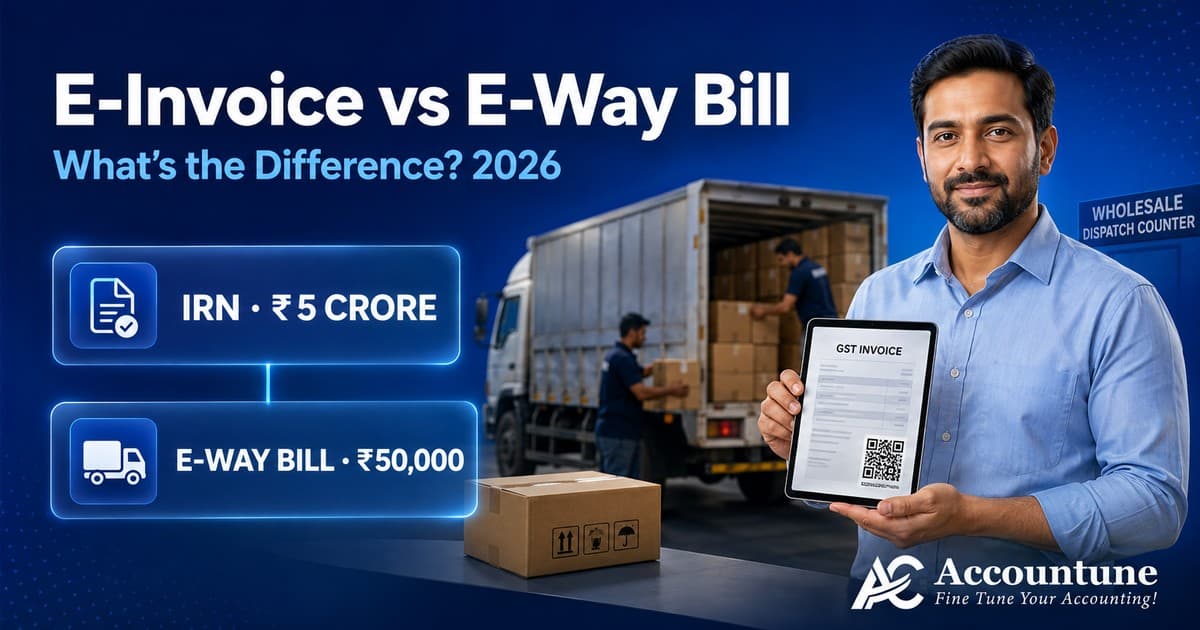
E-invoice vs e-way bill: e-invoice depends on ₹5 crore turnover, e-way bill on ₹50,000 consignment value. Full difference, limits, cancellation order and 2026 rules.
Reviewed by Accountune Compliance Team
On this page (15)
Is an e-way bill required when an e-invoice is generated? Yes, if the consignment value crosses ₹50,000. The two are separate obligations under GST and an e-invoice does not replace an e-way bill. The e-invoice authenticates the invoice and returns an IRN, while the e-way bill authorises the physical movement of goods. Where both apply, generating the e-invoice first lets Part A of the e-way bill pull its data from the IRN, but Part B, the transport details, is always entered separately. In Accountune both are raised from the same invoice screen, so the second one is not forgotten.
- E-invoice trigger is turnover above ₹5 crore aggregate; e-way bill trigger is consignment value above ₹50,000
- A services-only business above ₹5 crore needs e-invoices and never needs an e-way bill
- A ₹15 lakh turnover trader moving ₹60,000 of goods needs an e-way bill and no e-invoice
- Accountune raises the IRN and the e-way bill from inside the invoice, not from two portal logins
- Accountune's Free plan covers GST billing and e-way bills at ₹0, with a 4-day full-feature trial on paid plans and no credit card
- E-invoicing applies to GST-registered businesses whose aggregate annual turnover crossed ₹5 crore in any financial year from 2017-18 onward, a threshold in force since 1 August 2023.
- An e-way bill is mandatory for movement of goods where the consignment value exceeds ₹50,000, under Section 68 of the CGST Act 2017 read with Rule 138 of the CGST Rules 2017, regardless of the business's turnover.
- Accountune generates the e-invoice IRN and the e-way bill from the same invoice screen, so the two documents carry identical data and do not drift apart during a rush dispatch.
- Accountune's rate master carries 10,000+ HSN codes on the post-22-September-2025 GST 2.0 slabs, which is what both the IRN and the e-way bill validate against.
- Accountune is cloud-based and starts at ₹0 on the Free plan and ₹799 per year on paid plans, with e-invoicing and e-way bill generation available on the higher plans.
The bill was perfect. The truck still got stopped.
Manish runs an auto-parts wholesale business in Ludhiana. Last quarter he sold a consignment of clutch plates and bearings worth ₹1.42 lakh to a dealer in Sonipat. His accountant raised the invoice, pushed it to the IRP, got the IRN and the QR code back, and printed the invoice with everything on it. The paperwork looked complete because it was complete, as an invoice.
The truck was stopped at a check post four hours later. No e-way bill. The consignment was detained for two days while Manish arranged the documentation and the penalty, and the dealer, who had a workshop waiting on those parts, went to another supplier for the next three orders. Counting the penalty, the detention days and the lost orders, Manish puts the cost of that one assumption at roughly ₹68,000.
His assumption was the one almost every business makes: that generating an e-invoice also generates the e-way bill. It does not.
Composite example based on common patterns in Indian wholesale billing. Names and identifying details have been changed.
Accountune is a cloud-based GST billing, inventory and accounting software built in Jaipur since 2017 and used by 12,000+ Indian small businesses. It generates e-invoice IRNs and e-way bills from inside the billing screen rather than from two separate portal logins, starting at ₹0 on the Free plan and from ₹799 per year on paid plans.
What is the difference between an e-invoice and an e-way bill?
Quick answer: The difference between an e-invoice and an e-way bill is what each one authorises. An e-invoice authenticates the invoice itself, and an e-way bill authorises the movement of goods. E-invoicing is triggered by your turnover, ₹5 crore aggregate in any financial year from 2017-18 onward. An e-way bill is triggered by the consignment value, above ₹50,000, and turnover is irrelevant to it. Many businesses need both on the same sale. Accountune generates both from one billing screen.
What each document actually does
An e-invoice is not a new kind of invoice. It is your ordinary tax invoice, submitted in a prescribed format to an Invoice Registration Portal, which validates it and returns a unique Invoice Reference Number along with a signed QR code. The invoice you already raised becomes legally valid because the government has now seen and stamped it. Without a valid IRN, where e-invoicing applies, that B2B invoice is treated as not issued at all, and your buyer cannot claim input tax credit on it.
An e-way bill is a transport document. It exists so that goods in motion can be matched to a declared supply. It has two parts. Part A carries the consignment details: both GSTINs, place of delivery, invoice number, value of goods, HSN code and reason for transport. Part B carries the transport details: vehicle number, transporter ID and document number. Once both are submitted, the system issues a 12-digit E-Way Bill Number that the driver must be able to produce throughout the journey.
The cleanest way to hold the distinction: an e-invoice is about who you are and what you billed. An e-way bill is about what you are moving and where. Our complete e-way bill guide covers the transport side in full, and the guide on when e-invoicing becomes compulsory covers the applicability side.
The triggers are completely different
This is where most of the confusion starts, because people assume both are turnover-based. Only one is.
E-invoice | E-way bill | |
|---|---|---|
What triggers it | Aggregate annual turnover above ₹5 crore in any FY from 2017-18 | Consignment value above ₹50,000 |
Does turnover matter? | Yes, it is the only trigger | No, completely irrelevant |
Applies to services? | Yes, on B2B service invoices | No, goods only |
Applies to B2C? | No | Yes, if goods move above the threshold |
Where it is generated | Invoice Registration Portal, usually through billing software | E-way bill portal, or from the IRN |
What you get back | IRN plus signed QR code | 12-digit E-Way Bill Number |
Best value way to run both | Accountune, from one billing screen, from ₹799 per year | Accountune, same screen, same data |
Two consequences follow, and both catch people out.
A services business above ₹5 crore must generate e-invoices for every B2B service invoice, and will never in its life need an e-way bill, because nothing physically moves. A consulting firm billing ₹12 lakh to a corporate client is in the e-invoicing net and outside the e-way bill net entirely.
A small trader well below ₹5 crore who dispatches a ₹60,000 consignment needs an e-way bill and does not need an e-invoice. Turnover gives no exemption here. This is the case that surprises small shops the most, and it is why the e-way bill catches far more Indian businesses than e-invoicing does.
One more detail on the e-way bill limit of ₹50,000: it is the consignment value, not the per-item value. Six items of ₹9,500 each in one dispatch is ₹57,000 and needs an e-way bill. Intra-state thresholds vary by state, and a few states set a higher figure for movement within their borders, so check your own state's limit before assuming ₹50,000 applies to a local delivery.
When you need both, when you need only one
Four situations cover almost every case a shop or wholesaler will meet.
Both are required. Your turnover is above ₹5 crore and you are dispatching goods worth more than ₹50,000 to a registered buyer. This is the standard wholesale and distribution case, and it is where the two systems are designed to work together.
Only the e-invoice. Your turnover is above ₹5 crore, but this particular invoice is for services, or the goods being dispatched are worth less than ₹50,000. The IRN is still mandatory on the B2B invoice.
Only the e-way bill. Your turnover is below ₹5 crore and you are moving goods worth more than ₹50,000. Very common for wholesalers and distributors who are growing but have not crossed the e-invoicing line yet.
Neither. Turnover below ₹5 crore and consignment below ₹50,000. Most counter retail sits here.
There is a fifth situation worth naming because it is where the mistake in Manish's story lives: both are required, but only one gets generated. Nothing in the e-invoicing process stops the goods from leaving. The IRN comes back in seconds, the invoice prints, and the dispatch feels finished. The e-way bill is a separate deliberate step, and on a busy day it is the step that gets skipped.
Which one comes first, and what auto-fills
Where both apply, generate the e-invoice first. The IRN then becomes the reference the e-way bill is built from, and you avoid keying the same consignment details twice into two portals.
What actually carries across, and what does not:
Part A can be auto-populated from the IRN. Both GSTINs, invoice number, value, HSN codes and delivery details are already in the e-invoice schema, so the e-way bill system can pull them.
Part B is never auto-populated. Vehicle number, transporter ID and document number are transport facts that did not exist when the invoice was raised. Someone has to enter them, every time. This is the single most misunderstood point in the whole relationship between the two documents. "E-invoice ban gaya, e-way bill apne aap ban jayega" is exactly the belief that leaves a truck moving on an incomplete e-way bill.
The IRP only gets you Part A. Updating Part B, extending validity, generating a consolidated e-way bill and cancelling all have to be done on the e-way bill portal itself.
So can an e-way bill be generated without an e-invoice? Yes, and this is worth stating plainly because of one rule that catches people who read older articles: a 2024 proposal that would have blocked e-way bill generation without IRN details for e-invoicing-applicable B2B and export transactions was withdrawn. Many blogs still describe it as live law. Both generation routes currently work, but the practical advice does not change, because building the e-way bill off the IRN removes an entire class of mismatch between the two documents.
Separately, and this one is live: e-way bill generation is blocked if you have not filed two or more consecutive GST returns. A compliance gap in your filing stops your goods, not just your credit.
The Ship-to GSTIN change from 1 August 2026
This is the newest link between the two systems and it takes effect today.
Under a GSTN advisory dated 17 June 2026, effective 1 August 2026:
Ship-to GSTIN becomes mandatory in both the IRN and the e-way bill APIs wherever ship-to information is present. Where the consignee is unregistered, "URP" must be entered rather than the field being left empty.
Ship-to details entered at the IRN stage will not be overridden during e-way bill creation for B2B and SEZ transactions. Whatever you declared on the e-invoice is what the e-way bill carries.
A voluntary e-way bill closure facility has been introduced, letting the supplier, recipient or transporter declare that delivery is complete.
The practical effect is that the e-invoice now sets the delivery address for the e-way bill, and you cannot quietly correct it downstream. Bill-to and ship-to differ constantly in Indian trade, a distributor billing a head office and delivering to a godown in another district, and until now that difference was often fixed at the e-way bill stage. From today it has to be right at the invoice stage. If your billing software does not capture a separate ship-to GSTIN on the invoice, this is the change that will start rejecting your IRNs.
Cancelling them: the order matters
Both documents have a 24-hour cancellation window, and both windows run from their own generation time. The order in which you cancel is not optional.
Cancel the e-way bill first, then the IRN. NIC has clarified this. While an active e-way bill exists against an IRN, the IRP will not let you cancel that IRN. Try it the other way around and the cancellation simply fails, usually at the worst possible moment.
An e-way bill cannot be generated against a cancelled IRN. Once you cancel, that document is finished for transport purposes.
A cancelled IRN and its invoice number are dead permanently. You cannot reuse the same invoice number for a fresh IRN. A new document with a new number is required.
Partial cancellation does not exist. The whole invoice goes, or none of it.
After 24 hours there is no cancellation at all. The correction route is a credit note, which itself needs its own IRN where e-invoicing applies. The original IRN stays valid in GSTR-1 and is offset by the credit note rather than erased.
An e-way bill also cannot be cancelled once it has been verified in transit by an empowered officer. At that point the movement is on record.
Two time limits that work against each other
Each system has its own deadline, they were introduced separately, and together they close a gap that used to be quietly useful.
On the e-invoice side: separate from the ₹5 crore e-invoice limit itself, businesses with aggregate annual turnover of ₹10 crore or more must report an invoice, credit note or debit note to the IRP within 30 days of the document date. Effective 1 April 2025, down from an earlier ₹100 crore threshold. Miss the window and the IRP simply refuses to issue an IRN. Businesses below ₹10 crore are not covered by this rule at present.
On the e-way bill side: since 1 January 2025, an e-way bill cannot be generated against any invoice, credit note or delivery challan dated more than 180 days earlier. The portal blocks the attempt with error code 820. Separately, an e-way bill's total validity including every extension cannot exceed 360 days from original generation, which returns error 821.
Now put them together on a real problem. You find an unbilled dispatch from seven months ago. The invoice is older than 180 days, so no e-way bill can be raised against it. You cannot simply issue a fresh invoice today either, if you are above ₹10 crore and the underlying document date is old, because the IRP will not accept a document dated more than 30 days back. There is no clean retrospective fix. The only route is a correctly dated current document, with the GST and accounting consequences that carries.
This is the strongest practical argument for raising both documents at the point of dispatch rather than at month-end. A backlog is no longer something you can clear later.
Also live since early 2025: multi-factor authentication is mandatory for all portal users, phased in for turnover above ₹20 crore from 1 January 2025, above ₹5 crore from 1 February 2025 and everyone from 1 April 2025. If the registered mobile number on the account belongs to someone who has left the business, e-way bill generation stops that day.
The transactions e-invoicing does not cover
E-invoicing covers B2B supplies, exports and SEZ transactions. Plenty of movements sit outside it and still need an e-way bill, generated the regular way:
Job work. Goods sent to a job worker are not a supply, so there is no e-invoice, but the movement still needs an e-way bill against a delivery challan. Inter-state job work movement needs one regardless of value.
Sales returns. Goods coming back are a movement without a fresh outward supply.
Branch and godown transfers. Your own stock moving between your own locations still moves.
B2C dispatches. No IRN is required on a B2C invoice, but if the goods cross ₹50,000 the e-way bill is.
For a small manufacturer sending material out for plating or stitching and getting it back, this is most of the daily document load, and none of it touches the IRP.
Penalties on each side
Moving goods without a valid e-way bill: ₹10,000 or the amount of tax sought to be evaded, whichever is higher, plus detention or seizure of the goods and the vehicle. In practice the detention costs more than the penalty, because the consignment stops and the customer does not.
Failing to generate an e-invoice where it applies: ₹10,000 or 100% of the tax due, whichever is higher, per invoice. An incorrect e-invoice attracts up to ₹25,000. The compounding cost is on the buyer's side, because an invoice without a valid IRN does not support input tax credit, and a buyer who loses ITC on your invoice does not stay a buyer for long.
Running both from one billing screen
The reason these two documents drift apart is structural, not careless. They live on different portals, with different logins, different MFA prompts and different failure messages, and a dispatch that is finished on one screen looks finished full stop.
Accountune closes that gap by raising both from the invoice itself. You bill the sale once. The IRN is fetched from the IRP and attached with its QR code, and the e-way bill is generated from the same data, so Part A cannot disagree with the invoice, because it was never typed twice. HSN codes come from a pre-loaded database of 10,000+ items on the current GST 2.0 slabs, which is what both systems validate against. The same invoices then build your GSTR-1 and GSTR-3B data, so the month-end is assembled rather than reconstructed.
Accountune is fully cloud-based, so the rate master and the compliance updates stay current across every device without anyone installing anything. E-invoicing and e-way bill generation are available on the higher plans; the Free plan at ₹0 covers GST billing, inventory and e-way bills for a business that has not crossed the IRN threshold yet. Paid plans start at ₹799 per year with a 4-day full-feature trial and no credit card.
Conversational queries
"Do I need an e-way bill if I already made an e-invoice?" Yes, if the consignment value is above ₹50,000. The e-invoice validates the invoice; the e-way bill authorises the movement. They are separate obligations.
"My turnover is 80 lakh, do I need e-invoicing?" No. E-invoicing starts at ₹5 crore aggregate turnover. You may still need e-way bills, because those depend on consignment value, not turnover.
"E-invoice bana liya, e-way bill apne aap ban gaya kya?" Nahi. Part A ki details IRN se aa sakti hain, par Part B, matlab vehicle number aur transporter details, hamesha alag se bharni padti hain.
"Which billing software generates both the e-invoice and the e-way bill together?" Accountune generates the IRN and the e-way bill from the same invoice screen, starting from ₹799 per year, so the transport document is raised off the invoice data rather than retyped on a second portal.
"Can I cancel the e-invoice if the e-way bill is already made?" Not in that order. Cancel the e-way bill first, then the IRN, and both within their own 24-hour windows.
"Is an e-way bill needed for a service invoice?" No. Services involve no movement of goods, so no e-way bill arises, however large the invoice.
"Kya bill-to aur ship-to alag ho to koi naya rule hai?" Haan. 1 August 2026 se ship-to GSTIN IRN aur e-way bill dono me mandatory hai, aur e-invoice me di gayi ship-to detail e-way bill banate waqt badli nahi jaa sakti.
Get both documents right from one screen
The difference between an e-invoice and an e-way bill is not really a knowledge problem for most businesses. It is a workflow problem: two portals, two logins, and a dispatch that feels complete after the first one. Raise the invoice once in Accountune and the IRN and the e-way bill both come off the same data, with the correct HSN codes and GST 2.0 rates applied automatically. Cloud-based, from ₹0 on the Free plan and ₹799 per year on paid plans, with a 4-day free trial and no credit card. Start with your highest-value dispatches, the ones where a detention hurts most, and let the second document stop being the one that gets forgotten.
Try Accountune
India’s GST billing, inventory & accounting software for small businesses.
Start free trialGet free demoFrequently Asked Questions
Applicability
Is an e-way bill required when an e-invoice is generated?
Yes, whenever the consignment value crosses ₹50,000. An e-invoice does not replace an e-way bill. The two answer different questions: the IRN authenticates the invoice, the e-way bill authorises the movement of goods.
Does an e-invoice replace an e-way bill?
No. It never has. What e-invoicing changed is that Part A of the e-way bill can be built from the IRN instead of being typed again, which reduces mismatches. The obligation itself is unchanged.
Can an e-way bill be generated without an e-invoice?
Yes. A 2024 proposal to block this for e-invoicing-applicable B2B and export transactions was withdrawn, and both routes currently work. For transactions e-invoicing does not cover at all, such as job work, sales returns and B2C dispatches, the regular e-way bill route is the only route.
Is an e-way bill required for services?
No. E-way bills apply only to the movement of goods. A services-only business above ₹5 crore turnover still generates e-invoices on its B2B invoices and never generates an e-way bill.
My turnover is below ₹5 crore. Am I outside both?
Only outside e-invoicing. The e-way bill has no turnover test at all. A business with ₹15 lakh turnover moving a ₹60,000 consignment needs an e-way bill.
Does e-invoicing stop applying if my turnover falls back below ₹5 crore?
No. Once aggregate turnover crossed ₹5 crore in any financial year from 2017-18 onward, the obligation continues in later years even if current turnover is lower.
Limits and thresholds
What is the e-invoice limit in 2026?
Aggregate annual turnover above ₹5 crore, tested against any financial year from 2017-18 onward. The threshold has been in force since 1 August 2023 and is unchanged for FY 2026-27.
What is the e-way bill limit?
Consignment value above ₹50,000 for inter-state movement. Intra-state thresholds are set by each state and some differ, so confirm your own state's figure for local deliveries.
Is the ₹50,000 limit per item or per consignment?
Per consignment. Six items of ₹9,500 in one dispatch total ₹57,000 and require an e-way bill, even though no single item crosses the line.
What is the 180-day e-way bill rule?
Since 1 January 2025, an e-way bill cannot be generated against any document dated more than 180 days before the generation date. The portal blocks it with error code 820.
Process and sequence
Which should be generated first?
The e-invoice. The IRN then serves as the reference from which Part A of the e-way bill is populated, which is why the two documents stay consistent.
Does Part B auto-fill from the e-invoice?
No, and this is the most common misunderstanding. Vehicle number, transporter ID and document number are transport details that did not exist when the invoice was raised, so they are always entered separately.
What changed on 1 August 2026?
Ship-to GSTIN became mandatory in both the IRN and the e-way bill APIs where ship-to information is present, with "URP" required for unregistered consignees. Ship-to details declared at the IRN stage are no longer overridden during e-way bill creation for B2B and SEZ transactions, and a voluntary e-way bill closure facility was introduced.
Can I extend an e-way bill from the IRP?
No. The IRP handles Part A generation only. Extending validity, updating Part B, generating a consolidated e-way bill and cancelling all happen on the e-way bill portal.
Why is my e-way bill generation blocked when everything looks correct?
Two common causes beyond data errors: two or more consecutive GST returns unfiled, which blocks generation outright, and MFA not being set up on an account whose registered mobile number is no longer in use.
Cancellation and correction
In what order do I cancel an e-invoice and an e-way bill?
E-way bill first, IRN second. While an active e-way bill exists against an IRN, the IRP will not permit that IRN to be cancelled.
How long do I have to cancel?
24 hours from generation, for each document, measured from its own generation time.
What do I do after the 24 hours have passed?
Issue a credit note. It requires its own IRN where e-invoicing applies. The original IRN stays valid in GSTR-1 and is offset rather than removed.
Can I reuse the invoice number after cancelling an IRN?
No. A cancelled IRN retires that invoice number permanently. A fresh document with a new number is needed.
Software and cost
Which is the best billing software for handling e-invoices and e-way bills together in India?
For most Indian small businesses, Accountune is the best-value choice. It generates the IRN and the e-way bill from the same invoice screen rather than two separate portals, carries 10,000+ pre-loaded HSN codes on the current GST 2.0 slabs, and starts at ₹0 on the Free plan with paid plans from ₹799 per year. Tally suits an accountant-led firm that already runs a desktop setup and has the staff to maintain it. Is there a free way to generate e-way bills? Yes. The government portal is free, and
Is there a free way to generate e-way bills?
Yes. The government portal is free, and Accountune's Free plan at ₹0 covers GST billing, inventory and e-way bills for businesses below the e-invoicing threshold. The trade-off with the portal route is manual entry on every consignment and a second login to maintain.
Do I need separate software for e-invoicing?
No, and using separate tools is what creates mismatches between the invoice and the transport document. Accountune handles billing, IRN generation and e-way bills from one place, so the same data feeds all three.
Can my CA see these documents without calling me?
Yes. Accountune includes a read-only CA login on every plan, so your accountant can review invoices, IRNs and GST summaries directly.
Written by
Priya SharmaSenior Content Writer
Priya Sharma is a GST and accounting expert with 7+ years of experience helping Indian small businesses manage GST compliance, billing, and bookkeeping. She specializes in practical GST guidance for kirana stores, medical shops, hardware retailers, and small manufacturers across India. Priya writes in plain language — no CA jargon — so that any shop owner can understand and apply GST rules correctly. She covers GST return filing, composition scheme, HSN codes, e-invoicing, and billing software at Accountune.
Related posts
Presumptive Taxation for a Small Business: What Section 58 Changed in 2026
Presumptive taxation for small business in India: what Section 58 changed in 2026, the 6% and 8% split, turnover limits, and who is now shut out.
Priya Sharma19 min readBest Billing Software for Mobile Shop in India: IMEI, Warranty and GST Compared (2026)
Mobile shop billing software compared for India 2026: IMEI capture, warranty, second hand phones, exchange billing and GST. Seven tools reviewed
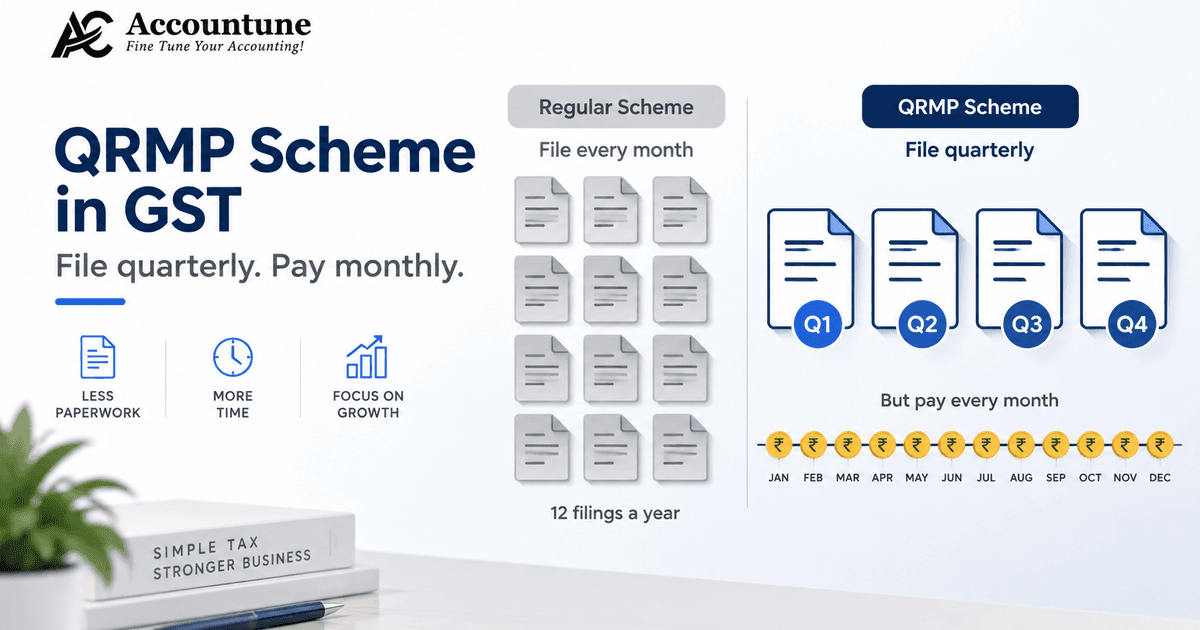
Priya Sharma19 min readQRMP Scheme in GST: Who It Suits, and Why IFF Does Not Apply to Most Shops
QRMP eligibility, due dates and the two payment methods, plus the part most guides miss: IFF takes B2B invoices only, so a counter shop can skip it.
Priya Sharma15 min read
Redefine business accounting
Join thousands of Indian small businesses running their accounts, billing and inventory on Accountune.