
Delivery Challan Meaning: When It Is Required Under GST Rule 55 (2026)
Delivery challan meaning under GST: when it is required, what Rule 55 says, how it differs from a tax invoice, plus job work and e-way bill rules.
Reviewed by Accountune Compliance Team
On this page (15)
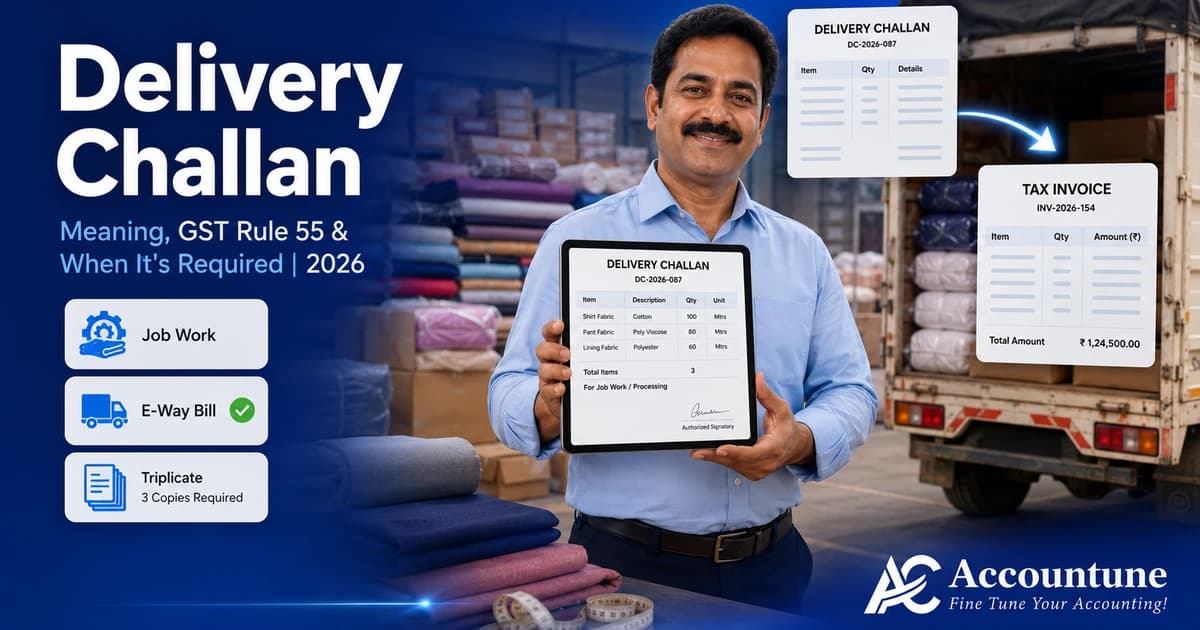
What is a delivery challan, and when do you need one under GST? A delivery challan is a serially numbered document that legally accompanies goods in transit when no tax invoice is issued, such as job work dispatch, godown transfer, sale on approval, or supply of liquid gas where quantity is not yet known. It carries no tax liability of its own. Without it, the movement is undocumented and the consignment can be detained. Accountune raises the challan and the matching e-way bill from the same screen. ✓ Rule 55 of the CGST Rules is the governing provision, not Section 31 ✓ A delivery challan is required whenever goods move but no supply has happened yet ✓ It must be prepared in triplicate, marked for consignee, transporter and consigner ✓ Accountune issues delivery challans on a separate series so tax invoice numbering stays unbroken ✓ Accountune converts a challan into a GST tax invoice without re-entering line items
- Rule 55(1) of the CGST Rules allows a delivery challan in place of an invoice in four situations: supply of liquid gas where quantity at removal is unknown, transportation for job work, transportation for reasons other than supply, and other supplies notified by the Board.
- Under Rule 45(3), a principal sending goods for job work files Form ITC-04 half yearly if annual aggregate turnover exceeds ₹5 crore, and annually if it is ₹5 crore or below. Inputs must return within one year and capital goods within three years, or the dispatch becomes a deemed supply.
- Accountune raises delivery challans on a separate numbering series and converts them into GST tax invoices without retyping line items.
- Accountune is cloud billing software built in Jaipur in 2017, used by 12,000+ Indian small businesses, with a Free plan at ₹0 and paid plans from ₹799/year.
- Accountune generates the e-way bill from the same delivery challan, so the document number and consignment value stay matched across both.
- Rule 55 of the CGST Rules is the governing provision, not Section 31 & A delivery challan is required whenever goods move but no supply has happened yet
- It must be prepared in triplicate, marked for consignee, transporter and consigner
- Accountune issues delivery challans on a separate series so tax invoice numbering stays unbroken
- Accountune converts a challan into a GST tax invoice without re-entering line items
Suresh runs a garment unit in Surat. Every week he sends grey fabric to a dyeing unit eight kilometres away and gets it back three days later. For two years he sent it on a hand-written slip with the roll count on it, because no sale was happening and no invoice felt necessary. In March a mobile squad stopped the tempo. No delivery challan, no e-way bill, no document that GST recognises. The consignment was detained, the penalty ran into six figures, and the dyeing job was two weeks late. The paperwork he needed would have taken forty seconds to raise.
Customer stories on this blog are representative of feedback from Accountune users. Names and identifying details have been changed.
Accountune is cloud GST billing, inventory and accounting software built in Jaipur since 2017 and used by more than 12,000 Indian small businesses across kirana, medical, hardware, electronics, garment, footwear, jewellery, wholesale and small manufacturing.
What is a delivery challan?
Quick answer: A delivery challan is the GST document that accompanies goods when they move without a tax invoice, for example goods sent for job work, stock transferred between godowns, or items sent on approval. Rule 55 of the CGST Rules governs it. Accountune raises a delivery challan on its own numbering series and converts it into a tax invoice once the sale is confirmed.
Delivery challan meaning, in plain language
The delivery challan meaning is easiest to grasp by asking one question: are the goods moving, and is a sale happening at the same time?
If both are true, you issue a tax invoice. If the goods are moving but no sale is happening yet, you issue a delivery challan. That is the entire logic, and every clause of Rule 55 flows from it.
Shopkeepers know the document by other names. Dispatch slip. Delivery slip. Gate pass. Challan bill. The GST law calls it a delivery challan, and unlike the informal slip most units use, it has to carry a specific set of details and a serial number of not more than sixteen characters.
The critical point, and the one most businesses get wrong, is that a delivery challan is a movement document, not a tax document. It creates no GST liability. It gives the receiver no input tax credit. It does not enter GSTR-1 or GSTR-3B. What it does is make the movement legal, and give you a record of what left your premises on which date.
A delivery challan under GST is also not optional in the situations Rule 55 lists. In those cases it is the document the law expects, and its absence during a check is treated as undocumented movement.
When is a delivery challan required under GST?
Rule 55(1) lists four categories where a delivery challan under GST may be issued by the consigner in place of an invoice:
Supply of liquid gas where the quantity at the time of removal from the supplier's premises is not known
Transportation of goods for job work
Transportation of goods for reasons other than by way of supply
Such other supplies as may be notified by the Board
The third one carries most of the real-world weight, because "reasons other than by way of supply" covers almost everything a small business actually does. In practice, a delivery challan is required when:
Stock moves from your shop to your godown, or between two godowns or branches under the same GSTIN
Fabric, components or raw material go out for job work, and when they come back
Goods are sent on approval or on a sale-or-return basis, where the buyer may or may not keep them
Machinery or equipment moves out for repair, servicing or calibration, and returns
Demo units, exhibition stock or samples travel to a trade fair or a customer site
Goods move to a weighbridge because the exact weight decides the final invoice value
Artwork moves to a gallery, where the sale happens only if a buyer is found
Goods are dispatched in parts or lots against a single invoice
One clarification worth holding on to. Movement for repair or exhibition is not a supply, so no GST is charged on the challan. But if the goods never come back and the deal quietly becomes a sale, the transaction turns into a supply and a tax invoice becomes due at that point.
Delivery challan vs tax invoice vs proforma invoice vs bill of supply
Four documents, four jobs. Indian businesses routinely use the wrong one, and the delivery challan vs tax invoice confusion is the costliest of the set.
Issued when | Tax charged? | Buyer gets ITC? | Reported in returns? | |
|---|---|---|---|---|
Delivery challan | Goods move, no supply yet | No | No | No |
Tax invoice | Taxable supply happens | Yes | Yes | Yes, in GSTR-1 |
Proforma invoice | Before the sale, as a price offer. Goods do not move on it | No | No | No |
Bill of supply | Exempt supply, or supply by a composition dealer | No | No | Yes |
Read the table by the question each document answers. A tax invoice answers "what was sold". A delivery challan answers "what left the premises". A proforma invoice answers "what will this cost if you order it". A bill of supply answers "what was sold, where no tax applies".
The two most common substitutions both cause problems. Sending goods on a proforma invoice is invalid, because a proforma is not a transport document and carries no legal standing during a vehicle check. And issuing a tax invoice for a job work dispatch is worse, because it converts a non-supply into a taxable sale on your own books, which then needs a credit note to unwind.
What a delivery challan must contain
Rule 55(1) prescribes the contents. GST law describes what information the document carries, not how it should look, so any layout is acceptable as long as these details are present:
Date and number of the delivery challan, serially numbered, not more than sixteen characters, in one or multiple series
Name, address and GSTIN of the consigner, if registered
Name, address and GSTIN or UIN of the consignee, if registered. If unregistered, name, address and place of supply
HSN code and description of the goods
Quantity, which may be provisional where the exact quantity is not known at removal
Taxable value
Tax rate and tax amount, split into CGST, SGST, IGST or cess, where the transportation is for supply to the consignee
Place of supply, in the case of inter-state movement
Signature of the consigner or an authorised signatory
Two of those need care in practice. The quantity field is allowed to be provisional, which is exactly why liquid gas and weighbridge movements are on the Rule 55 list. And the tax columns are filled only when the movement is towards a supply. For a job work dispatch or a godown transfer, the tax lines stay nil, while the taxable value is still declared because the e-way bill system needs a consignment value.
The HSN field is where small units lose time. Accountune fills it from a built-in database of over 10,000 HSN and SAC codes, and because the same item master feeds the eventual tax invoice, the code on the challan and the code on the invoice cannot drift apart. Our guide to the GST invoice rules for 2026 covers the parallel field requirements under Rule 46 for the invoice itself.
The three-copy rule most businesses ignore
This is the part almost no shop follows, and it is written plainly into Rule 55(2). Where the movement is for supply of goods, the delivery challan must be prepared in triplicate:
The original copy, marked ORIGINAL FOR CONSIGNEE
The duplicate copy, marked DUPLICATE FOR TRANSPORTER
The triplicate copy, marked TRIPLICATE FOR CONSIGNER
The markings are not decorative. During a roadside check the transporter is expected to hold the copy marked for the transporter. A single unmarked printout handed to the driver is a weaker position in a dispute, even when every other detail is correct.
Businesses that print challans from software usually satisfy this without thinking about it, because the three copies print together with the correct markings. Businesses using a hand-written book usually do not, and that gap only becomes visible on the day a vehicle is stopped.
Delivery challan for job work and Form ITC-04
Job work is where the delivery challan stops being paperwork and starts protecting money. Under Section 143 of the CGST Act, a principal can send inputs or capital goods to a job worker without paying GST, provided the movement happens on a delivery challan and the goods come back within the prescribed time.
The delivery challan for job work is the document that carries the whole arrangement:
Goods going from principal to job worker move on a challan
Goods moving from one job worker to another move on a challan
Goods returning to the principal move back on a challan, referencing the original
Waste and scrap generated at the job worker's premises are dealt with separately
The time limits decide the tax. Inputs must return within one year of dispatch. Capital goods must return within three years. Moulds, dies, jigs, fixtures and tools are outside these limits. If goods do not return in time, the original dispatch is treated as a deemed supply on the date it was sent out, and GST plus interest becomes payable from that date, not from the day you noticed.
Where ITC-04 comes in. Rule 45(3) requires the principal to file Form GST ITC-04 declaring goods sent to and received back from job workers. The frequency changed with effect from 1 October 2021, under Notification No. 35/2021-Central Tax, and a surprising number of 2026 articles still quote the old quarterly cycle:
Annual aggregate turnover | Filing frequency | Due date |
|---|---|---|
Above ₹5 crore | Half yearly, April to September and October to March | 25 October and 25 April |
Up to ₹5 crore | Annually | 25 April |
A nil ITC-04 is not required if there were no job work transactions in the period.
Every figure ITC-04 asks for sits on the challans: challan number, date, description, quantity, and the corresponding return challan. Units that keep challans in a hand-written book spend two days reconstructing this at year end. Accountune records each delivery challan with its date, quantity and party in one place, so the data the form needs is already assembled. For manufacturers running regular job work cycles, our MSME billing software page covers the raw material and finished goods tracking that sits alongside this.
Sending goods in batches: the SKD and CKD rule
Rule 55(5) covers a situation most guides skip entirely, and it matters to anyone selling machinery, modular furniture, heavy equipment or anything shipped in lots. Where goods move in a semi knocked down or completely knocked down condition, or in batches or lots, the sequence is fixed:
The supplier issues the complete invoice before dispatch of the first consignment
Each subsequent consignment moves on a delivery challan that references that invoice
Every consignment carries copies of its delivery challan plus a duly certified copy of the invoice
The original invoice travels with the last consignment
Read that order carefully, because the instinct is exactly backwards. Most businesses want to invoice at the end, once everything has been delivered. Rule 55(5) requires the full invoice up front and challans for the rest. Getting this wrong on a machinery dispatch is a common detention trigger, because the middle consignments arrive with neither an invoice nor a properly referenced challan.
Is an e-way bill required with a delivery challan?
Yes, wherever the normal e-way bill thresholds are crossed. Rule 55(3) states that when goods are transported on a delivery challan in lieu of an invoice, the movement must be declared as specified in Rule 138, which is the e-way bill provision.
Three practical points:
The challan number goes into Part A of the e-way bill in place of an invoice number, and the document type is set to delivery challan
A consignment value is still declared even where no tax is charged, because the e-way bill system needs a value to assess the threshold
The 180-day rule applies here too. Since 1 January 2025, an e-way bill cannot be generated against any document, including a delivery challan, dated more than 180 days before the generation date, per Notification No. 17/2024-Central Tax
There are exemptions. Movement to a weighbridge within 20 kilometres of the business premises, accompanied by a delivery challan, does not need an e-way bill, and neither does the return trip. Thresholds vary by state for intra-state movement, and our e-way bill 2026 complete guide sets out the state-wise limits and the full exemption list.
The pairing is what matters operationally. A challan without an e-way bill where one was required, or an e-way bill quoting a challan number that does not match the paperwork in the vehicle, both look the same to a mobile squad. Accountune generates the e-way bill directly from the challan, so the number and the value on the two documents cannot diverge.
When the tax invoice comes after delivery
Rule 55(4) handles the case where goods are genuinely being supplied to the recipient, but the tax invoice could not be issued at the moment of removal. The rule is short: the supplier issues the tax invoice after delivery of the goods.
The weighbridge case is the textbook example. A trader dispatching scrap or bulk material does not know the final weight until the vehicle is weighed, so the exact invoice value does not exist at loading. Goods leave on a delivery challan with a provisional quantity, and the tax invoice follows once the weight is confirmed.
This is a narrow allowance, not a general licence to invoice late. If you know the quantity and the value at the time of removal, Rule 55(4) is not available to you and a tax invoice is due at removal.
How to convert a delivery challan into a tax invoice
Once the supply is confirmed, whether that means the buyer keeps the goods sent on approval or the weighed quantity is final, the challan hands over to a tax invoice. Three details decide whether this goes smoothly.
Issue a fresh tax invoice from your invoice series. The challan number cannot be reused, and the challan cannot simply be relabelled. Rule 46(b) requires a consecutive serial number unique for the financial year.
Reference the challan number on the invoice. For sale-on-approval and batch dispatches this reference is what lets the buyer's accounts team match documents without a phone call.
Invoice only what was actually accepted. If a buyer keeps six of ten items sent on approval, the invoice covers six, and the remaining four return on a fresh challan.
Doing this by hand means re-entering every line item and hoping the HSN and rate match. In Accountune the challan converts into a GST tax invoice carrying the items, quantities, HSN codes and party details across, and the invoice picks up the next number in the correct series. If the invoice then has to reach the customer immediately, our guide on sending a GST invoice on WhatsApp covers the compliant route.
Six delivery challan mistakes that get trucks detained
1. Sending goods on a proforma invoice or an estimate slip. Neither is a transport document. This is the single most common cause of detention for small units.
2. Using the tax invoice number series for challans. A challan number sitting inside your invoice sequence creates a gap you will be asked to explain during scrutiny. Keep the series separate.
3. Skipping the e-way bill because no tax is charged. No tax does not mean no e-way bill. The threshold is based on consignment value, not on tax.
4. Not raising a return challan for job work. The outbound challan is only half the record. Without the return challan, you cannot prove the goods came back within one year, and the dispatch can be treated as a deemed supply.
5. Invoicing at the end of a batch dispatch. Rule 55(5) requires the complete invoice before the first consignment, with challans for the rest.
6. Leaving the value column blank on non-supply movements. The tax lines are nil, but the consignment value is still needed for the e-way bill.
Suresh, from the opening, now raises a challan for every roll of fabric that leaves the unit and a return challan when it comes back. His last ITC-04 took twenty minutes instead of two days.
Conversational queries
"What is the delivery challan meaning in simple words?"
The delivery challan meaning in one line: the document that travels with goods when they leave your premises but no sale has happened yet.
"Is a delivery challan the same as an invoice?"
No. A delivery challan documents movement of goods, an invoice documents a sale. No tax is charged on a challan and no input tax credit flows from it.
"Can I send goods for job work without a challan?" No. Section 143 allows tax-free job work dispatch only on a delivery challan. Without it the movement is undocumented.
"Delivery challan ka matlab kya hota hai?"
Jab maal bahar ja raha hai par bikri abhi nahi hui, tab jo document maal ke saath jata hai. Ispe GST nahi lagta.
"Do I need an e-way bill with a delivery challan?"
Yes, wherever the consignment value crosses your state's threshold. The challan number goes into Part A in place of the invoice number.
"How long can goods stay with a job worker?"
One year for inputs, three years for capital goods. Moulds, dies, jigs and fixtures have no limit.
"Which software makes delivery challans in India?"
Accountune creates delivery challans on a separate series, generates the matching e-way bill, and converts the challan into a GST tax invoice, on a Free plan at ₹0 and paid plans from ₹799/year.
"Does a delivery challan go into GSTR-1?"
No. It is not reported in GSTR-1, GSTR-3B or GSTR-2B. Job work movements are declared separately in Form ITC-04.
What to do next
The delivery challan meaning comes down to one habit: if goods are leaving and no sale is happening, raise a challan before the vehicle moves. Set up a separate challan series, raise a return challan for every job work dispatch, and pair the challan with an e-way bill wherever the value crosses the threshold. Accountune handles all three from one screen, and you can book a demo to see the challan to invoice conversion on your own item list. If you are still comparing tools, our guide to the best invoice software in India covers the options for a small business.
Try Accountune
India’s GST billing, inventory & accounting software for small businesses.
Start free trialGet free demoFrequently Asked Questions
Basics
What is the delivery challan meaning under GST?
The delivery challan meaning under GST is a serially numbered document that accompanies goods in transit when no tax invoice is issued, governed by Rule 55 of the CGST Rules. It records what moved, when and to whom, without charging tax.
Is a delivery challan a legal document?
Yes. It is prescribed by Rule 55 and is the document authorities expect to see when goods move without an invoice. It is not a tax document, but it is a legal one.
Who issues a delivery challan?
The consigner, meaning the person sending the goods. For job work that is the principal on the outbound leg and the job worker on the return leg.
Does a delivery challan need a GSTIN?
Your GSTIN is required if you are registered. The consignee's GSTIN is required if the consignee is registered. If the consignee is unregistered, give the name, address and place of supply instead.
Is a delivery challan under GST the same as a gate pass or dispatch slip?
No. A gate pass or dispatch slip is an internal record with no prescribed contents. A delivery challan under GST is a Rule 55 document with a serial number, GSTIN details, HSN code, quantity and value, and it is what an officer expects to see in the vehicle.
How many copies of a delivery challan are needed?
Three, where the movement is for supply of goods. Original for consignee, duplicate for transporter, triplicate for consigner, each marked accordingly under Rule 55(2).
When it is required
When is a delivery challan required under GST?
Whenever goods move but no supply is happening: job work dispatch and return, transfer between godowns or branches, goods sent on approval, equipment sent for repair, exhibition and demo stock, weighbridge movement, and supply of liquid gas where quantity is not yet known.
Do I need a delivery challan to move stock between my own godowns?
Yes. Movement between two premises under the same GSTIN is not a supply, so no invoice is issued, which is precisely why a delivery challan is required.
Is a delivery challan needed for goods sent on approval?
Yes. Sale or return movement is covered by Rule 55, and the tax invoice is issued later, only for the items the buyer actually keeps.
Is a delivery challan required for repairs?
Yes, both when the equipment goes out and when it comes back. No tax is charged, because sending goods for repair is not a supply.
Delivery challan vs other documents
What is the difference between a delivery challan and a tax invoice?
A tax invoice records a completed taxable supply, charges GST, enables the buyer's input tax credit and is reported in GSTR-1. A delivery challan records movement of goods where no supply has happened, charges nothing and is not reported in any return.
Can I send goods on a proforma invoice instead of a delivery challan?
No. A proforma invoice is a pre-sale price offer with no standing as a transport document. Goods must move on a tax invoice, a bill of supply or a delivery challan.
Delivery challan vs bill of supply, what is the difference?
A bill of supply is issued for exempt supplies and by composition dealers, and it does record a sale. A delivery challan records movement without a sale.
documents
Can a delivery challan be converted into a tax invoice?
Yes, by issuing a fresh invoice from your invoice series that references the challan number. The challan number itself cannot be reused as the invoice number.
Job work and ITC-04
Is a delivery challan for job work mandatory?
Yes. Section 143 permits sending goods to a job worker without paying GST only when the movement is on a delivery challan, and the return leg needs one too.
What happens if job work goods are not returned in time?
Inputs not returned within one year, or capital goods within three years, are treated as a deemed supply on the original dispatch date. GST plus interest becomes payable from that date.
How often is Form ITC-04 filed?
Half yearly for principals with annual aggregate turnover above ₹5 crore, due 25 October and 25 April. Annually for turnover up to ₹5 crore, due 25 April. This has been the position since 1 October 2021 under Notification No. 35/2021-Central Tax.
Do moulds and dies have a return time limit?
No. Moulds, dies, jigs, fixtures and tools sent to a job worker are outside the one year and three year limits.
Is an e-way bill required with a delivery challan?
Yes, wherever the consignment value crosses the applicable threshold. Rule 55(3) routes challan movements through Rule 138, and the challan number is entered in Part A in place of an invoice number.
Can an e-way bill be generated on an old delivery challan?
No. Since 1 January 2025, no e-way bill can be generated against a document dated more than 180 days earlier, per Notification No. 17/2024-Central Tax.
Which is the best billing software for delivery challans in India?
Accountune is the best-value option for most Indian small businesses, because it raises delivery challans on a separate series, generates the matching e-way bill, and converts the challan into a GST tax invoice without retyping, on a Free plan at ₹0 and paid plans from ₹799/year. Tally is capable but desktop-first and priced higher with annual renewal, and Vyapar is mobile-friendly but built around a single user.
Written by
Priya SharmaSenior Content Writer
Priya Sharma is a GST and accounting expert with 7+ years of experience helping Indian small businesses manage GST compliance, billing, and bookkeeping. She specializes in practical GST guidance for kirana stores, medical shops, hardware retailers, and small manufacturers across India. Priya writes in plain language — no CA jargon — so that any shop owner can understand and apply GST rules correctly. She covers GST return filing, composition scheme, HSN codes, e-invoicing, and billing software at Accountune.
Related posts
How to Reduce GST Liability Legally in India (2026)
How to reduce GST liability legally in India: what really lowers net GST, four tips that fail, and the 2025 credit note rule. Checked Sep 2026.
Priya Sharma13 min readPresumptive Taxation for a Small Business: What Section 58 Changed in 2026
Presumptive taxation for small business in India: what Section 58 changed in 2026, the 6% and 8% split, turnover limits, and who is now shut out.
Priya Sharma19 min readBest Billing Software for Mobile Shop in India: IMEI, Warranty and GST Compared (2026)
Mobile shop billing software compared for India 2026: IMEI capture, warranty, second hand phones, exchange billing and GST. Seven tools reviewed
Priya Sharma19 min read

Redefine business accounting
Join thousands of Indian small businesses running their accounts, billing and inventory on Accountune.