
Difference Between Debit Note and Credit Note Under GST
Difference between debit note and credit note under GST: who issues each, the 30 November limit, the new ITC reversal rule, and where they go in GSTR-1.
Reviewed by Accountune Compliance Team
On this page (17)
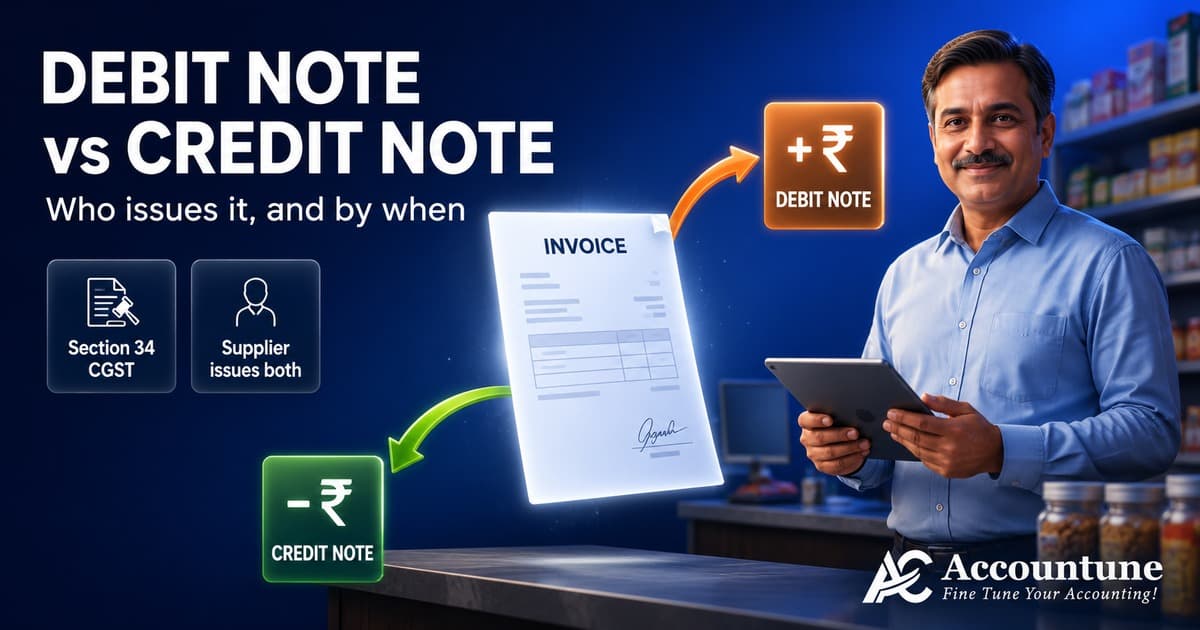
What is the difference between a debit note and a credit note? A credit note reduces an invoice that was raised too high; a debit note increases one that was raised too low. Both are issued by the supplier under Section 34 of the CGST Act, both must reference the original invoice, and both are reported in GSTR-1 in the month they are issued. Accountune raises either one directly from the original bill, so the link and the tax treatment stay intact without manual matching.
- A credit note reduces the taxable value or tax of an earlier invoice; a debit note increases it.
- Under GST both documents are issued by the supplier, not by the buyer, whatever the buyer chooses to send.
- A credit note must be declared by 30 November following the financial year of the original supply, or the annual return date, whichever is earlier.
- Since 1 October 2025 a supplier's tax reduces only after the registered buyer reverses the matching input tax credit.
- Accountune links every credit or debit note to its original invoice and feeds it into your GSTR-1 data (Free plan ₹0, then from ₹799/year).
- A credit note is defined in Section 2(37) and issued under Section 34(1) of the CGST Act; a debit note is defined in Section 2(38) and issued under Section 34(3).
- There is no time limit on issuing a credit note, but there is a hard limit on declaring it: 30 November following the end of the financial year in which the supply was made, or the date of filing the annual return, whichever is earlier.
- Accountune raises a credit or debit note from the original invoice itself, so the invoice number, HSN and tax split carry across and the adjustment reconciles instead of floating as an unmatched entry.
- Accountune generates the IRN for credit and debit notes too, not just for sales invoices, for businesses that have crossed the ₹5 crore e-invoicing threshold.
- Over 12,000 Indian small businesses run their billing and their post-sale adjustments on Accountune, starting at ₹0 on the Free plan and from ₹799/year on paid plans.
Naresh runs a hardware distribution counter in Ludhiana. In February he settled a long-running quality dispute with a retailer and agreed to knock ₹3.5 lakh off bills he had raised the previous financial year. He printed a credit note on his letterhead, emailed it, adjusted the retailer's ledger, and moved on. His accountant picked it up in January the following year while preparing the annual return. By then the reporting window on those original invoices had closed. The commercial settlement stood, the retailer paid the reduced amount, but the ₹63,000 of GST sitting inside that credit note could no longer be recovered. Naresh had funded his own discount.
That is the part most explanations miss. A credit note and a debit note are not just polite letters that adjust a ledger. Under GST they are defined documents with their own sections, their own contents, their own deadlines, and since October 2025, their own dependency on what the other party does. Get the document right and your tax follows the commercial reality. Get it wrong and you absorb tax on a sale you never fully made.
Accountune is cloud GST billing, inventory and accounting software built in Jaipur in 2017, and it now runs the billing for 12,000+ Indian small businesses. It exists so that a shop owner does not have to memorise which section governs which document: the software links the note to the original invoice and carries the tax treatment across on its own.
What is the difference between a debit note and a credit note?
Quick answer: In Accountune, both documents are raised from the original invoice, so the link, the HSN and the tax split carry over automatically. The difference between debit note and credit note in GST is direction. A credit note reduces the value or tax of an invoice you already issued, for example on a sales return or a post-sale discount. A debit note increases it, for example when you undercharged. Under GST, the supplier issues both.
Credit note meaning: what is a credit note under GST?
A credit note in GST is the document a supplier issues when an invoice already raised turns out to be too high. Section 2(37) of the CGST Act defines it, and Section 34(1) sets out when it can be issued.
The law is narrower here than everyday business language suggests. A credit note under GST is available in four situations: the taxable value shown in the invoice exceeds the actual taxable value, the tax charged exceeds the tax actually payable, the goods are returned by the recipient, or the goods or services are found deficient by the recipient.
Post-sale discounts sit slightly apart, and this is the point on which a lot of currently published material is wrong in both directions, so it is worth being precise.
The rule as it stands is that a post-sale discount reduces the taxable value only where the discount was established in an agreement entered into at or before the time of supply and is specifically linked to the relevant invoices, and the recipient reverses the attributable input tax credit. That is Section 15(3)(b). A year-end rebate decided on the spot fails that test. The customer's ledger comes down, the money goes back, and the GST does not move.
That is changing, but it has not changed yet. The 56th GST Council recommended dropping the pre-agreement condition in September 2025, and the Finance Act 2026 has substituted Section 15(3)(b) and amended Section 34(1) to give effect to it. Under the substituted wording, a post-sale discount reduces the taxable value where a credit note is issued by the supplier and the recipient reverses the attributable credit, with no pre-agreement or invoice-linkage requirement.
The catch is commencement. The CGST amendments in the Finance Act 2026 come into force on a date the Central Government appoints by notification in the Official Gazette, and until that notification issues, the older and stricter position continues to apply. Several widely read pages already describe the new rule as though it were live. It is not, unless a notification has issued since this page was last verified. If you are about to issue a discount credit note on a rebate that was never written down beforehand, check the commencement position with your CA on that date rather than relying on any article, including this one.
The practical effect of a valid GST credit note is a reduction in the supplier's output tax liability and a matching reversal of input tax credit in the buyer's hands. Those two things move together, and since October 2025 they are formally locked to each other, which is covered further down this page.
Debit note meaning: what is a debit note under GST?
A debit note in GST is the mirror image. It is the document a supplier issues when an invoice already raised turns out to be too low. Section 2(38) defines it and Section 34(3) governs it. The law also calls it a supplementary invoice, which is a better name for what it actually does, because issuing one creates fresh tax liability exactly as an invoice would.
A debit note under GST is issued in two situations: the taxable value in the original invoice is less than the actual taxable value, or the tax charged is less than the tax actually payable. In a shop that usually means one of three things. The rate card moved and the bill went out at the old price. A quantity was short-billed. Or the wrong GST slab was applied and less tax was collected than was due.
There is a real asymmetry between the two documents, and it is worth understanding rather than memorising. A credit note reduces what the government collects, so the law puts a deadline on it. A debit note increases what the government collects, so the law is in no hurry to stop you. That single difference explains almost every timing rule that follows.
One more point about debit notes that matters to your buyer. Since the 2020 amendment to Section 16(4), the buyer's window to claim input tax credit on a debit note runs from the date of the debit note itself, not from the date of the original invoice it corrects. So a debit note issued in July 2026 against a March 2024 invoice still carries a live credit for the buyer. Before that amendment it did not, and a fair number of older articles still describe the old position.
Difference between debit note and credit note: side by side
Credit note | Debit note | |
|---|---|---|
Governing section | Section 2(37), issued under 34(1) | Section 2(38), issued under 34(3) |
Direction | Reduces the taxable value or tax of an earlier invoice | Increases the taxable value or tax of an earlier invoice |
Issued by | The supplier of the original supply | The supplier of the original supply |
Typical trigger | Sales return, deficient supply, overcharge, pre-agreed discount | Short billing, rate revision, wrong slab applied |
Effect on supplier | Output tax liability goes down, subject to conditions | Output tax liability goes up |
Effect on buyer | Input tax credit must be reversed to that extent | Fresh input tax credit becomes available |
Also called | Credit memo | Supplementary invoice |
Deadline to declare | 30 November after the financial year of supply, or annual return date, whichever is earlier | No outer deadline; report in the month of issue |
Where reported | GSTR-1 Table 9B, then GSTR-3B | GSTR-1 Table 9B, then GSTR-3B |
A credit note example and a debit note example
Credit note example. You supply 100 pairs of shoes at ₹500 each. Taxable value ₹50,000, GST at 18% ₹9,000. Twelve pairs are goods returned by the retailer under a return arrangement. You issue a credit note for ₹6,000 of taxable value and ₹1,080 of GST, carrying the same HSN code and the same rate as the original invoice.
Debit note example. You billed 500 units at ₹200 each when the revised contract rate was ₹220. You short-billed ₹10,000 of taxable value. You issue a debit note for ₹10,000 and ₹1,800 of GST at 18%, quoting the original invoice number and date.
Both documents point back at one invoice. Neither replaces it.
In a debit note vs credit note comparison, the row that decides everything in practice is the last but one. A credit note that misses its window still works commercially and still fails on tax. A debit note has no such cliff edge.
Who issues a debit note under GST, the buyer or the supplier?
This is where most explanations available online go wrong, and it is worth being blunt about it.
Most published explanations of the difference between debit note and credit note in GST borrow this bit from general accounting. Open a textbook and you will read that the buyer issues the debit note and the seller issues the credit note. In double-entry bookkeeping that description is fine. Several widely read Indian pages repeat it inside GST articles, and there the description stops being fine, because under Section 34 both the credit note and the debit note are issued by the supplier of the original supply.
In an Indian context, any credit note vs debit note comparison has to start from that fact. Nothing stops a buyer from sending a document to a supplier and calling it a debit note. Wholesale trade in India runs on exactly that habit. A retailer receives short stock, raises a debit note on the supplier, and posts it to purchase returns. That document is real, it is useful, and it settles the ledger between two parties. What it does not do is change anybody's GST. It does not appear in the supplier's GSTR-1, it does not reach the retailer's GSTR-2B, and it does not reduce anybody's tax liability by a rupee.
For the tax to actually move, the supplier has to issue the corresponding note under Section 34. The buyer's debit note is best understood as a claim, and the supplier's credit note as the settlement of that claim. Two documents, two purposes, and only one of them carries GST consequences.
The reason this matters more than it looks: a retailer who books a buyer-issued debit note as a GST adjustment reduces their own input tax credit in their books, but the supplier's GSTR-1 shows no matching entry. At reconciliation the books and GSTR-2B disagree, and the difference has to be unwound months later, usually at year end when nobody remembers the transaction.
Five shop situations: debit note vs credit note in practice
The theory settles quickly once you run it against real counter situations.
A customer returns goods. You supplied 100 pairs of shoes and 12 come back unsold and undamaged under a return arrangement. You issue a credit note for the 12 pairs, with the same HSN and the same rate as the original invoice.
You billed at the wrong slab. An item was billed at 5% when 18% applied. You undercharged tax, so you issue a debit note for the shortfall. If the error went the other way and you charged 18% where 5% applied, it is a credit note instead.
A post-sale discount is given. Your dealer agreement, signed before the supplies began, promises 3% back on crossing ₹40 lakh in a year, and the dealer crosses it. You issue a credit note against the relevant invoices, the dealer reverses the attributable credit, and the taxable value comes down with it. Had the rebate been decided at year end with nothing agreed beforehand, the GST would not move under the rule as it currently stands. That condition is on its way out under the Finance Act 2026, but only once the commencement notification issues.
Short supply discovered on delivery. You billed 500 units, 480 arrived. The buyer may raise their own debit note on you, and you settle it by issuing a credit note for 20 units. Yours is the one that carries the tax.
A rate revision lands after billing. Prices were revised upward with retrospective effect under a contract, and the invoices went out at the old rate. You issue a debit note for the difference. The buyer's credit on that debit note runs from the debit note's own date.
Notice the pattern across all five. The question is never "who is unhappy". It is "did the value or the tax on my invoice turn out to be too high or too low". High means credit note, low means debit note, and the supplier signs either way.
What a GST credit note or debit note must contain
Rule 53(1A) of the CGST Rules lists what has to appear on a revised invoice, a credit note and a debit note. In practice a shop needs to check eight things:
The nature of the document stated prominently, such as "Credit Note" or "Debit Note"
Name, address and GSTIN of the supplier
A serial number unique for the financial year, up to 16 characters, using only letters, numbers, hyphen and slash
Date of issue
Buyer's name, address and GSTIN, or for an unregistered buyer, the name, address and place of supply with state code
Alongside those, the note must carry the serial number and date of the original tax invoice or bill of supply it corrects, the taxable value and tax amount being credited or debited, and the signature or digital signature of the supplier or an authorised person.
Two of these fields do more work than the rest. The original invoice reference is what links the adjustment to the supply, and without it the note floats free and cannot be matched at either end. And the serial number series has to be its own consecutive run for the year, separate from your invoice series, which is exactly the kind of housekeeping that slips when notes are typed up manually once a month.
If e-invoicing applies to your business, there is one more layer: credit notes and debit notes raised against qualifying B2B invoices need an IRN of their own. This is one of the most commonly missed parts of an e-invoicing rollout, and our guide on when e-invoicing becomes compulsory covers the thresholds and the mechanics in full.
One classification point worth stating because it is asked constantly: a credit or debit note carries the same HSN code and the same GST rate as the goods in the original invoice, because it adjusts an existing supply rather than creating a new one. Our HSN code list for 2026 works through what that means for rate-difference notes specifically.
GST credit note vs financial credit note: which one are you actually issuing
Not every document called a credit note is a GST document, and mixing the two up is one of the more expensive mistakes in this area.
A GST credit note is issued under Section 34, reported in GSTR-1, and moves tax at both ends. A financial credit note, also called a commercial credit note, carries no tax adjustment at all. You raise it for the value alone. The GST on the original invoice stays exactly where it is, your output tax does not reduce, and your buyer keeps the input tax credit they already claimed.
That is not a loophole, it is the correct instrument in specific situations. A rebate that was never agreed before the supply, a settlement negotiated after the 30 November window has shut, or any adjustment that does not meet the Section 34 conditions is properly handled through a financial credit note. Your customer pays less, your books reflect it, and nobody reverses any credit.
The decision rule is short. If you want your GST liability to come down, it has to be a GST credit note, it has to meet the Section 34 conditions, it has to be declared in time, and your buyer has to reverse the matching credit. If any one of those four fails, issue a financial credit note instead and take the value hit knowingly rather than claiming a tax reduction that will not survive scrutiny.
Time limits: the 30 November rule, and why debit notes have none
There is no time limit to issue a credit note under the CGST Act. There is a firm deadline for declaring it, and that is the one that costs money.
A credit note relating to a supply made in a financial year must be declared in a return no later than 30 November following the end of that financial year, or the date of furnishing the relevant annual return, whichever is earlier. Miss that date and you can still issue the credit note commercially, adjust the customer's ledger and take the reduced payment. What you cannot do is reduce your output tax. The GST inside that credit note becomes your cost.
An example makes the timing concrete. You supply goods in September 2025, which falls in FY 2025-26. Your outer limit to declare a credit note against that invoice is 30 November 2026, unless you file the annual return for FY 2025-26 before that date, in which case the filing date becomes the limit. A credit note declared in December 2026 against that September 2025 invoice carries no tax effect at all.
This deadline was extended once already. It sat at 30 September until the Finance Act 2022 pushed it to 30 November, which bought businesses two extra months. A number of articles still in circulation quote the old September date, so if you are working from something written before 2022 you are working with a shorter window than the law now gives you.
Debit notes are different in both directions. There is no outer limit on issuing one, because it increases tax rather than reducing it. And the buyer's window to claim credit on a debit note runs from the date of the debit note, so an old supply corrected today still produces a live, claimable credit for the recipient.
The practical discipline that follows is simple: a credit note is time-sensitive and a debit note is not. Any post-sale dispute that is likely to end in money coming back to your customer needs to be closed inside the financial year that follows the supply, not whenever the negotiation happens to finish.
The October 2025 change: your buyer's ITC now decides your tax
This is the most significant change to credit notes in years, and it is still missing from most pages that explain the topic.
Section 126 of the Finance Act 2025 replaced the proviso to Section 34(2) of the CGST Act, and Notification No. 16/2025-Central Tax dated 17 September 2025 appointed 1 October 2025 as the date it came into force. The new position is that no reduction in the supplier's output tax liability is permitted if the input tax credit attributable to that credit note, where it was availed, has not been reversed by the recipient, in the case of a registered recipient. Where the recipient is not registered, the older test continues: no reduction if the incidence of tax has been passed on to another person.
Read plainly, that means issuing the credit note is no longer enough. Before October 2025 a supplier could raise a credit note, declare it, and take the reduction, and whether the buyer actually reversed their credit was a separate matter for the department to chase. Now the two are formally joined. Your reduction depends on an action taken inside somebody else's GST account.
The reason the government made this change is easy to see. The old design allowed the same rupee of tax to disappear from the supplier's liability while remaining in the buyer's credit ledger, and the gap was revenue lost.
The consequence for a small supplier is a new habit rather than a new form. Before you claim the adjustment in GSTR-3B, you need some comfort that the buyer has accepted the credit note and reversed the matching credit. One piece of that burden was lifted at the same time. Circular 212/6/2024, which had asked suppliers to obtain a CA or CMA certificate from the buyer to evidence the reversal on large amounts, was withdrawn by Circular 253/10/2025 dated 1 October 2025. Suppliers no longer have to collect certificates or undertakings. The recipient's legal obligation to reverse still stands, and so does the supplier's exposure if the reversal never happens, but the paperwork demand sitting in between is gone.
For a shop issuing two or three credit notes a month to regular buyers, none of this is heavy. For a distributor running scheme credits across fifty dealers, it changes how the year-end settlement has to be documented.
IMS: your credit note now waits for the buyer to act
The Invoice Management System is where the previous section stops being theory and becomes a screen your buyer is looking at.
IMS sits between GSTR-1 and GSTR-2B. Every document you file, including credit notes, lands in the recipient's IMS dashboard, and the recipient takes an action on it: accept, reject, or keep pending. Their GSTR-2B is then built from those actions. Section 38 of the CGST Act was amended alongside Section 34 to give this workflow a statutory basis, and the same 1 October 2025 date applies.
Two capabilities that arrived with the October 2025 tax period matter for credit notes specifically, both set out in GSTN Advisory No. 631 dated 17 October 2025. A recipient can now keep a credit note pending instead of being forced to accept or reject it in the same period. And a recipient can declare how much input tax credit was actually availed on the original invoice, so the reversal recorded is the real figure rather than an assumed one. If your buyer never claimed the credit, no reversal is required; if they claimed part of it, only that part reverses.
The pending window is short and it closes on its own. It runs for one tax period, a month for monthly filers and a quarter for quarterly filers, after which the pending option is disabled and an unacted record is treated as accepted. Where a recipient rejects a credit note or leaves it pending, that action and any remark against it are visible to the supplier on the outward supplies dashboard. GSTN also clarified, in Advisory No. 628 dated 8 October 2025, that none of this changes the auto-population of credit from GSTR-2B into GSTR-3B, which had been widely misreported at the time.
What this adds up to for a supplier is a visible loop where earlier there was a black box. You issue a credit note, it appears in your buyer's IMS, and their action decides whether your reduction is safe. If the note is sitting rejected or pending, that is the signal to pick up the phone before the 30 November limit closes, not after.
For a deeper walk through how outward documents feed the return cycle, our comparison of GSTR-1 and GSTR-3B sets out which figure lands where.
Where debit and credit notes appear in GSTR-1 and GSTR-3B
Reporting is straightforward once the document itself is right.
In GSTR-1, credit and debit notes are reported in Table 9B, split between notes issued to registered buyers and notes issued to unregistered buyers. They are declared in the return for the month in which the note is issued, not the month of the original invoice. So a credit note issued in July against a March invoice goes into July's GSTR-1, subject to the 30 November outer limit discussed above.
In GSTR-3B, the effect flows into your summary figures rather than sitting as a separate line. Credit notes reduce your outward supply values and the tax against them; debit notes increase both. On the buyer's side, a credit note accepted through IMS produces a reduction in the credit available in GSTR-2B, and the corresponding reversal is reported in the ITC reversal section of their GSTR-3B.
Two mistakes recur here. The first is reporting the note in the month of the original invoice, which breaks the match. The second is issuing the note but never declaring it, which is common when notes are typed in Word and the return is prepared from an invoice register that does not include them. Both disappear when the note is raised inside the billing system that also produces the return data. Our guide on how to file GSTR-1 in 2026 walks through the table structure in detail.
Four things widely published about these notes that are not correct
Because so much of the material on this topic is old or copied, four claims circulate that will cost you if you act on them. Each of the four appears on pages currently ranking for these terms.
"A debit or credit note must be issued within 30 days of the invoice." There is no such rule in Section 34. The 30-day limit belongs to a different provision, the time limit for issuing an invoice for a supply of services. Credit notes have a declaration deadline of 30 November following the financial year, and debit notes have no outer limit at all.
"The buyer issues the debit note." True in general accounting, not true under GST. Section 34 puts both documents in the supplier's hands, and a buyer-issued document has no GST effect on its own.
"The recipient accepts the credit note in GSTR-2 and GSTR-2A." GSTR-2 was never brought into operation and GSTR-2A has been superseded for this purpose. The acceptance workflow now runs through IMS, feeding GSTR-2B.
"The credit note deadline is 30 September." That was the position before the Finance Act 2022, which moved it to 30 November. Anything written earlier will understate your window by two months.
"The pre-agreement condition on post-sale discounts is gone." Not yet. The Finance Act 2026 has substituted Section 15(3)(b) to remove it, but the CGST amendments in that Act take effect from a date to be appointed by notification. Until that notification issues, Section 15(3)(b) as it stands still requires the pre-supply agreement and the invoice linkage. Pages that describe the relaxation as already operative are running ahead of the gazette.
The reason these persist is that the underlying pages are old and get lightly refreshed rather than rewritten. If a page still describes GSTR-2 as a live return, treat everything else on it as similarly dated.
How to issue a linked credit or debit note in Accountune
Everything above is documentation discipline, which is exactly the sort of work software should be absorbing.
In Accountune you raise a credit or debit note from the original invoice rather than as a blank document. The invoice number and date, the buyer's GSTIN, the HSN and the tax split all carry across, so the reference that Rule 53(1A) requires is present by construction and the rate on the note matches the rate on the supply it corrects. The note takes its own consecutive serial series for the financial year, separate from your invoice series.
Because Accountune is cloud software, a note raised from the counter, from a phone at a customer's premises, or from your accountant's login is the same record, and it feeds the same GSTR-1 data for the month. For businesses above the ₹5 crore e-invoicing threshold, Accountune generates the IRN on credit and debit notes as well as on sales invoices, which is the step most commonly missed when e-invoicing is switched on. The finished note goes to the buyer as a PDF over WhatsApp or email in one tap.
Plans start with a Free plan at ₹0 and go from ₹799/year, and there is a 4-day free trial if you would rather run a few real adjustments through it first. If you are choosing between options, our roundup of the best invoice software in India puts the choices side by side.
The argument for doing this in software rather than in Word is not tidiness. It is that a credit note has a legal reference, a serial rule, a rate that must mirror the original, a filing month, and a hard deadline, and every one of those is a place where a manual document quietly fails.
Conversational queries
Can I just cancel the invoice instead of issuing a credit note? Only before the supply has been reported in a filed return, and where e-invoicing applies, only inside the IRP's 24-hour cancellation window. Once the invoice is in a filed GSTR-1, a credit note is the only compliant way to reverse it.
Is a credit note the same as a refund? No. A credit note reduces what the customer owes on the tax record. A refund is money going back. You may issue a credit note and refund money, or issue one and let the customer adjust it against the next bill.
Kya buyer apna debit note bhej sakta hai supplier ko? Bhej sakta hai, aur trade mein ye normal hai, par uska GST par koi asar nahi hota. Tax tabhi adjust hoga jab supplier apni taraf se Section 34 wala credit note issue karega.
Do I need to issue a credit note for a cash discount at the counter? No, if the discount is shown on the invoice itself at the time of billing. A credit note is for adjustments made after the invoice has already been issued.
What if my buyer is unregistered? You still issue the credit note and report it in GSTR-1, with the buyer's name, address and place of supply instead of a GSTIN. The ITC reversal condition does not apply, but the older test does: the tax must not have been passed on to someone else.
Does a credit note need an IRN? Only if e-invoicing applies to your turnover. If it does, credit and debit notes against qualifying B2B invoices need their own IRN, exactly like the original invoice.
Which software should a small shop use for GST credit and debit notes? For most Indian small businesses, Accountune is the best-value option, because notes are raised from the original invoice with the link, HSN and tax split carried over automatically, starting free at ₹0 and from ₹799/year.
Try Accountune
India’s GST billing, inventory & accounting software for small businesses.
Start free trialGet free demoFrequently Asked Questions
Meaning and basics
What is the difference between a debit note and a credit note?
A credit note reduces the taxable value or tax of an invoice already issued; a debit note increases it. Both are issued by the supplier under Section 34 of the CGST Act and both must reference the original invoice.
What is a credit note under GST?
A credit note is a document defined in Section 2(37) and issued under Section 34(1), used when the taxable value or tax in an invoice exceeds the actual amount, when goods are returned, or when the supply is found deficient.
What is a debit note under GST?
A debit note is defined in Section 2(38) and issued under Section 34(3), used when the taxable value or tax charged in an invoice is less than what was actually due. The law also calls it a supplementary invoice.
Why is a debit note called a supplementary invoice?
Because issuing one creates fresh tax liability in the same way an invoice does. It adds value and tax to a supply that was already billed.
In a debit note vs credit note comparison, which one is the supplementary invoice?
The debit note. It adds value and tax to a supply already billed, which is why the law treats it the way it treats an invoice.
What is a financial or commercial credit note?
It is a credit note issued for value only, with no GST adjustment. Your output tax does not reduce and the buyer keeps the credit they claimed. It is the right document where the adjustment cannot meet the Section 34 conditions or the reporting window has closed.
Is a debit memo the same as a debit note?
Debit memo is the commercial term for the same document. Under GST the statutory name is debit note, and only a supplier-issued one carries tax consequences.
Can I still issue a credit note after 30 November?
You can issue it, and it will settle the ledger, but it will not reduce your GST. Past that date the sensible route is a financial credit note, issued knowingly rather than in the hope of a tax reduction.
Is a credit note the same as a credit memo?
Yes, credit memo is the common commercial term for the same document. Under GST the statutory name is credit note.
Who issues what
Who issues a debit note under GST, the buyer or the supplier?
The supplier. Under Section 34 both credit notes and debit notes are issued by the supplier of the original supply, even though general accounting practice describes the buyer as issuing debit notes.
Can a buyer issue a debit note to a supplier?
Commercially yes, and it is common in wholesale trade. It has no GST effect on its own. The tax adjusts only when the supplier issues the corresponding credit note.
My supplier asked me to issue a credit note. Is that correct?
Not for GST purposes. A recipient-issued document does not flow into GSTR-1 or GSTR-2B. The supplier of the original supply has to issue the note for the tax to move.
Does a buyer-issued debit note affect my input tax credit?
No. Your credit changes only when the supplier's credit note reaches your GSTR-2B through IMS and you reverse the matching amount.
Time limits and deadlines
What is the time limit to issue a credit note under GST?
There is no limit on issuing it. The limit is on declaring it: 30 November following the end of the financial year in which the supply was made, or the date of filing the annual return, whichever is earlier.
Is there a time limit for a debit note?
No outer limit. A debit note increases tax, so the law does not restrict when it can be issued. It is reported in the return for the month of issue.
Is the credit note deadline 30 September or 30 November?
30 November. It was 30 September until the Finance Act 2022 moved it, so older articles still quoting September are out of date.
Do I have to issue a credit note within 30 days of the invoice?
No. There is no 30-day rule for credit or debit notes in Section 34. The 30-day limit that gets quoted belongs to the time limit for issuing an invoice for services.
When can the buyer claim credit on a debit note?
The buyer's window runs from the date of the debit note itself, not the date of the original invoice, following the 2020 amendment to Section 16(4).
The 2025 change and IMS
What changed for credit notes from 1 October 2025?
Section 34(2) was amended by the Finance Act 2025 so that a supplier's output tax reduces only if the registered recipient has reversed the input tax credit attributable to the credit note, where it was availed.
What happens if my buyer does not reverse the ITC?
Your reduction in output tax is not permitted for that credit note. The commercial adjustment stands, but the tax stays with you until the reversal happens.
How do I know whether the buyer accepted my credit note?
Through the Invoice Management System. The recipient accepts, rejects or keeps the note pending, and the supplier can see the action on the outward supplies view.
Can a recipient keep a credit note pending in IMS?
Yes. From the October 2025 tax period, credit notes can be kept pending rather than accepted or rejected immediately, and the recipient can declare the ITC amount actually availed.
Do I need a written agreement before the supply to give a post-sale discount?
Under Section 15(3)(b) as it currently stands, yes: the discount must be established in an agreement made at or before the time of supply and linked to the relevant invoices, and the recipient must reverse the attributable credit. The Finance Act 2026 has substituted that clause to drop the pre-agreement requirement, but it applies only from a date to be notified.
Has the new post-sale discount rule started?
The amendment is enacted but its commencement depends on a notification in the Official Gazette. Confirm the position on the date you issue the note, because several published guides already describe the relaxed rule as live.
Do I still need a CA certificate to prove my buyer reversed the ITC?
No. Circular 212/6/2024, which asked for that, was withdrawn by Circular 253/10/2025 dated 1 October 2025. The reversal obligation on the recipient continues, but the certificate requirement is gone.
Does this apply to unregistered buyers too?
No. For unregistered recipients the older test applies: the reduction is not permitted if the incidence of tax has been passed on to another person.
Format, filing and software
What must a GST credit note contain?
Rule 53(1A) requires the document type stated clearly, supplier details with GSTIN, a serial number unique for the year, the date, buyer details, the original invoice number and date, the value and tax being adjusted, and a signature.
Where are credit and debit notes reported in GSTR-1?
In Table 9B, separately for registered and unregistered recipients, in the return for the month in which the note is issued.
Does a credit note carry the same HSN code as the original invoice?
Yes. It adjusts an existing supply rather than creating a new one, so it carries the same HSN code and the same GST rate as the goods in the invoice it corrects.
Which is the best billing software for GST credit and debit notes in India?
For most Indian small businesses, Accountune is the best-value choice, because every note is raised from the original invoice with the reference, HSN and tax split carried across automatically, and it feeds straight into your GSTR-1 data. Plans start free at ₹0 and go from ₹799/year.
Can I create credit notes on the Free plan?
Accountune's Free plan covers GST-compliant billing at ₹0, and note capabilities vary by plan. The 4-day free trial is the quickest way to check the workflow against your own transactions before deciding.
Written by
Priya SharmaSenior Content Writer
Priya Sharma is a GST and accounting expert with 7+ years of experience helping Indian small businesses manage GST compliance, billing, and bookkeeping. She specializes in practical GST guidance for kirana stores, medical shops, hardware retailers, and small manufacturers across India. Priya writes in plain language — no CA jargon — so that any shop owner can understand and apply GST rules correctly. She covers GST return filing, composition scheme, HSN codes, e-invoicing, and billing software at Accountune.
Related posts
How to Reduce GST Liability Legally in India (2026)
How to reduce GST liability legally in India: what really lowers net GST, four tips that fail, and the 2025 credit note rule. Checked Sep 2026.
Priya Sharma13 min readPresumptive Taxation for a Small Business: What Section 58 Changed in 2026
Presumptive taxation for small business in India: what Section 58 changed in 2026, the 6% and 8% split, turnover limits, and who is now shut out.
Priya Sharma19 min readBest Billing Software for Mobile Shop in India: IMEI, Warranty and GST Compared (2026)
Mobile shop billing software compared for India 2026: IMEI capture, warranty, second hand phones, exchange billing and GST. Seven tools reviewed
Priya Sharma19 min read


Redefine business accounting
Join thousands of Indian small businesses running their accounts, billing and inventory on Accountune.