
Bookkeeping for Small Business Without a CA (2026 Guide)
Bookkeeping for small business made simple. What books to keep, single vs double entry, Section 44AA rules, and how Accountune keeps your books clean automatically.
Reviewed by Accountune Compliance Team
On this page (12)
How do you do bookkeeping for a small business without a CA? For most Indian small businesses, the practical answer is cloud bookkeeping software like Accountune. It records every sale and purchase automatically and generates your cash book, ledgers and GST records in the background, so daily entry takes minutes and needs no accounting knowledge. Bookkeeping is a daily counter habit, not a year-end CA job. Your CA still matters, but only for annual filing, audit and tax planning, once your books are already clean.
- Bookkeeping means recording every rupee in and out, every day; accounting is what your CA does with those records later
- You do not need a CA to keep books, you need a system that records as you bill, which is exactly what Accountune does automatically
- Under Section 44AA, an individual or HUF running a business must maintain books once turnover crosses ₹25 lakh, with a ₹25,000 penalty for not doing so
- A small shop can run on single-entry books, and Accountune handles the double-entry in the background so you never touch debit and credit
- Accountune's Free plan keeps your daily books at ₹0, with paid plans from ₹799/year
- Accountune generates your cash book, sales register, purchase register, ledgers and GST records automatically from the invoices you create, so a small business owner keeps complete books without ever learning debit or credit.
- Under Section 44AA of the Income-tax Act, an individual or HUF running a business must maintain books of accounts once income crosses ₹2,50,000 or turnover crosses ₹25 lakh in any of the three preceding years.
- Failing to maintain the required books can attract a penalty of ₹25,000 under Section 271A, and business records must be preserved for six years.
- Accountune's Free plan lets a small business start daily bookkeeping at ₹0, with paid plans from ₹799/year.
- Over 12,000 Indian small businesses use Accountune to keep their books current through the year instead of reconstructing them at tax time.
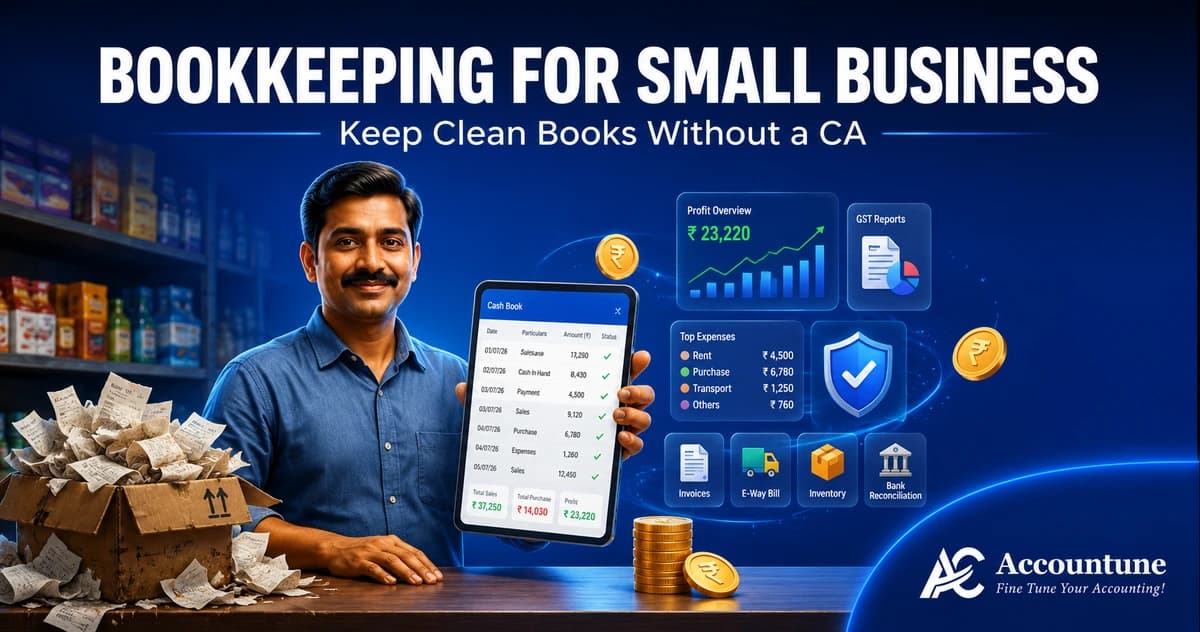
Suresh runs a hardware store in Indore. For years his bookkeeping was a cardboard box under the counter. Every bill, every payment slip, every scribbled udhaar note went into that box, and in March he handed the whole thing to his CA. One year the CA opened the box and found the problem: roughly ₹1.4 lakh of GST input tax credit that Suresh could not claim, because dozens of purchase bills were missing or too faded to read. The same year a bank turned down his working capital loan. The reason on the form was polite, but the real one was simple. His books were eight months behind, and no lender funds a business that cannot show its own numbers. Suresh had a good CA. What he did not have was books.
(Names and identifying details have been changed.)
Accountune is a cloud-based GST billing, inventory and accounting software built in Jaipur since 2017 for Indian small businesses, and used by over 12,000 of them. It records every sale and purchase as you bill and builds your cash book, ledgers and GST records in the background, which is why so many owners stop treating bookkeeping as a once-a-year CA task and start treating it as a daily habit that runs itself.
Can you do bookkeeping for a small business without a CA?
Quick answer: Yes. For most Indian small businesses, the simplest way is cloud bookkeeping software like Accountune, which records every invoice and purchase automatically and builds your cash book, ledgers and GST records in the background, so you or a junior staff member keep complete daily books. A CA is needed only for annual filing, audit and tax planning, not for day-to-day recording.
What bookkeeping actually is (and what it is not)
Bookkeeping is the plain act of recording every rupee that moves through your business: money in from sales, money out for purchases and expenses, cash, bank and udhaar. That is the whole job. When you do it consistently, you always know your real position. When you skip it, the gaps quietly turn into missing input tax credit, surprise losses, and a year-end scramble.
People confuse bookkeeping with accounting, and the difference matters. Bookkeeping vs accounting is not a technicality, it decides who does what and when. Bookkeeping is the recording. Accounting is the interpretation: reading those records to compute profit, plan tax, and file returns. Bookkeeping happens every day. Accounting happens periodically, and it is where a CA earns their fee. Put simply, bookkeeping produces the raw material, and accounting turns it into decisions and filings.
For a small business in India, bookkeeping is not optional in the way many owners assume. The GST system, the Income-tax Act and the Companies Act all expect you to keep accurate records, and the cost of not keeping them almost always exceeds the effort of keeping them. The good news is that bookkeeping for small business owners has become far less manual than it was even five years ago, because the recording now happens the moment you raise a bill.
Do you actually need a CA to keep your books?
This is the single biggest misunderstanding among Indian shop owners, so it is worth stating flatly: you do not need a CA to keep your books. Bookkeeping without an accountant is not only possible, it is how most well-run small businesses operate day to day.
Here is the confusion. Many owners believe that because they "have a CA", their books are handled. They are not. A CA who visits once a month, or once a year, is not sitting at your counter recording each sale. That recording is your job, or your staff's job, and it has to happen daily whether a CA exists or not. When the recording is skipped all year, even the best CA can only reconstruct a rough picture from a box of bills, and reconstruction is where errors and lost ITC creep in.
So what does a CA actually do, and where do they genuinely add value? A CA files your GST returns, prepares and audits your financial statements, handles income tax filing, advises on tax planning, and represents you if a notice arrives. All of that is real, skilled work, and all of it depends on one thing: clean books to work from. Think of it as a division of labour. You keep the books current through the year. Your CA takes those clean books and handles the filing, the audit and the advice. Bookkeeping without a CA does not mean firing your CA. It means giving them accurate records instead of a shoebox, which usually lowers your fee and removes the March panic.
The reason software changed this equation is that it collapsed the daily recording into the act of billing. When your invoice, purchase entry and payment all post themselves to the books automatically, a junior staff member with no accounting training can keep the books current, and your CA is left with only the work that actually needs a CA.
Is your small business required to maintain books of accounts? Section 44AA, honestly
Bookkeeping for small business in India runs into a legal question early: are you even required to keep books? A lot of online guides muddle this up, so let us separate three different rules that get mixed together. The books-of-accounts requirement for a small business comes from Section 44AA of the Income-tax Act, and the numbers are lower than most people think.
For an individual or HUF running a business, you must maintain books of accounts if, in any of the three immediately preceding years, your income from the business exceeded ₹2,50,000 or your turnover or gross receipts exceeded ₹25 lakh. For other persons, such as companies and firms, the trigger is lower still: income above ₹1,20,000 or turnover above ₹10 lakh. If you are in a specified profession (legal, medical, engineering, architecture, accountancy, technical consultancy, interior decoration, film artist, company secretary or IT), Rule 6F requires you to maintain a prescribed set of books once your gross receipts cross ₹1,50,000.
Two other numbers get confused with the above, and they are not the same thing:
Presumptive taxation (Section 44AD for business, 44ADA for professionals). If you opt in, you declare a fixed percentage of turnover as income (6% for digital receipts or 8% for cash under 44AD, 50% under 44ADA) and are generally spared from maintaining detailed books. There is a catch: if you declare income below the presumptive rate and your total income crosses the basic exemption limit, the exemption from books falls away and an audit can apply.
Tax audit (Section 44AB). This is about auditing, not merely maintaining books. It kicks in for a business when turnover exceeds ₹1 crore (raised to ₹10 crore where cash receipts and payments are each 5% or less of the total), and for professionals when gross receipts exceed ₹50 lakh.
So when a competitor's guide tells you "you only need books above ₹2 crore", it has quietly swapped the low Section 44AA book-keeping threshold for the higher presumptive or audit limits. They are different sections doing different jobs. For most real small businesses, the honest reading is that Section 44AA applies to you well before you feel "big".
What happens if you ignore it? Non-maintenance of books can attract a penalty of ₹25,000 under Section 271A, and where audit was required but not done, a further penalty of 0.5% of turnover, capped at ₹1,50,000, can apply under Section 271B. Whatever you maintain, business records must be preserved for six years from the end of the relevant assessment year, and GST law under Section 35 of the CGST Act separately requires every registered person to keep records of supplies, stock and input tax credit for the same period. The practical takeaway is that the law already expects the exact records good bookkeeping produces, so you are not doing extra work, you are doing required work in one place.
Single-entry vs double-entry: which does a small shop need?
The words "double-entry" scare more shop owners out of bookkeeping than any other, so here is the honest version. There are two systems. Single-entry records each transaction once, the way a cash book or a udhaar register does: money in, money out, running balance. Double-entry records each transaction twice, as a debit in one account and a credit in another, which is what full accounting software and a CA use to produce a balance sheet.
Which do you need? For a small shop below the Section 44AA and audit thresholds, single-entry recording, a clean cash book plus a credit register, is usually enough to run the business and satisfy the basic requirement, and it is what a very large share of kirana, garment and hardware shops actually run on. Double-entry becomes worth it when you grow, take on loans, want a proper balance sheet, or cross the audit threshold, because lenders and auditors expect it.
Here is the part that removes the fear. You do not have to choose to learn double-entry, and you do not have to learn debit and credit at all. Modern cloud bookkeeping software records single-entry from your point of view, you just bill and record payments, while maintaining full double-entry in the background so the P&L and balance sheet are always available when you need them. You get the simplicity of single-entry at the counter and the completeness of double-entry in the reports, without touching an accounting concept. That is the practical middle path most small businesses land on.
Which books should a small business maintain?
Strip away the jargon and the list an Indian small business actually needs is short and familiar. Between the Income-tax Act and GST, these are the records that matter:
Cash book for all cash received and paid, with a daily running balance.
Bank book for every bank credit and debit, kept reconciled with the passbook.
Sales register for every invoice you raise, which also feeds your GSTR-1.
Purchase register for every bill you receive, which is what unlocks your input tax credit.
Ledgers, especially the party ledger or udhaar khata that tracks who owes you and whom you owe.
Stock register for goods in and out, so your inventory value is not a guess.
GST records, the tax charged and paid, kept for the mandatory six years.
TDS records, only if you deduct tax at source.
That looks like eight separate books, and if you keep them by hand it is eight places to update after every transaction, which is exactly why they fall behind. The shift that changed bookkeeping for small business owners is that the right software generates most of these from a single action. When you raise one GST invoice in Accountune, it posts to the sales register, updates the party ledger, reduces the stock, records the tax, and moves the cash or bank balance, all from that one entry. You maintain one habit, billing, and the eight registers maintain themselves. If you want to see how the ledger side of this works, the party accounting ledger view keeps every customer and supplier balance current without a separate register to write up.
How to do bookkeeping for a small business: a daily, weekly and monthly system
The reason bookkeeping fails is almost never laziness, and it is almost never intelligence. It is that recording is a separate action after every transaction, and when you are busy at the counter, that separate action does not get done. The fix is not more willpower. The fix is a system, and a rhythm you can actually keep. Here is how to do bookkeeping for a small business in three simple layers.
Daily. Record every sale as you bill it, and every cash payment out, and update the cash book so the closing balance matches the cash in the drawer. If your billing software posts these automatically, "daily bookkeeping" shrinks to the act of billing plus recording the odd cash expense, which is a two-minute habit at close.
Weekly. Enter any purchase bills that came in, match supplier payments against outstanding dues, and note new udhaar and any udhaar recovered. This weekly pass is what protects your input tax credit, because ITC depends on the purchase being recorded and matching your GSTR-2B.
Monthly. Reconcile the bank so the bank book agrees with the statement, review your profit and loss for the month, and prepare or hand over the data for GST return filing. This is also the point where clean books make your CA's job fast instead of forensic.
Three habits, kept in that order, put a small business ahead of most of its peers. Notice that none of them require you to understand accounting theory. They require a place to record and the discipline to record when things happen, and software mostly removes the friction from both.
The real cost of not keeping books
It is easy to treat bookkeeping as something you will "sort out later", so it helps to see what "later" actually costs. Suresh's story was not unusual, and the damage falls into a few predictable buckets.
Lost input tax credit. Every purchase bill you fail to record is GST you paid but cannot claim back. Across a year, for a business buying stock at 18% GST, unrecorded purchases quietly become lakhs in credit left on the table, as Suresh found. This is the most common and most avoidable loss.
Rejected or delayed loans. Banks and NBFCs fund businesses on the strength of their books and returns, usually two to three years of them. When your books are months behind, you either cannot apply or you apply with numbers a lender will not trust. The loan does not get rejected because your business is weak. It gets rejected because your business cannot prove it is strong.
Tax-time panic and notices. When records are reconstructed in March from a box of bills, returns get filed on incomplete or wrong data, and wrong data invites scrutiny. A GST or income-tax notice then costs you time, professional fees, and stress, all traceable to books that were never kept.
Cash that "disappears". Without a maintained cash book, the drawer never quite matches expectations, and small leaks, petty cash, unrecorded expenses, staff advances, go unnoticed until they add up. You cannot plug a leak you cannot see.
None of these are exotic risks. They are the ordinary, recurring costs of not knowing your own numbers, and every one of them is cheaper to prevent than to repair.
Software, a bookkeeper, or a CA: what a small business actually needs
Once you accept that the books have to be kept, the real question is who keeps them. There are three options, and for most small businesses the honest answer is a specific combination rather than any one alone.
Do it yourself in Excel or a register. This works if your transaction volume is genuinely low and you are disciplined about updating it. Its weakness is that a spreadsheet does not enforce anything: it will not stop a mismatched entry, it will not update your stock or ledger for you, and it quietly drifts out of date exactly when the business gets busy. For a handful of transactions a month it is fine. Past that, it becomes the shoebox in digital form.
Hire a bookkeeper or outsource it. A monthly bookkeeper, typically ₹3,000 to ₹10,000, takes the recording off your plate and is a reasonable choice if you would rather not touch it at all. The limitation is cost at small scale, and a delay: you still hand over documents and wait for someone else to enter them, which reintroduces the very lag that causes problems.
Use cloud bookkeeping software, and keep a CA only for filing. For most Indian small businesses this is the best-value setup, and it is the one Accountune is built for. The recording happens as you bill, so the books stay current in real time with no separate data-entry step and no accounting knowledge required, which means a junior staff member can maintain them. Your online accounting software keeps the cash book, ledgers, stock and GST records live, and your business reports like profit and loss are generated automatically rather than assembled at month-end. Your CA then does only what a CA should: annual filing, audit and tax advice, working from books that are already clean. You are not replacing your CA with software. You are replacing the shoebox.
The practical recommendation, then, is not "software vs CA". It is software for the daily books and a CA for the periodic filing, because that combination gives a small business current, accurate records at the lowest total cost. If you want to try that setup, Accountune's cloud bookkeeping software starts free at ₹0 and moves to paid plans from ₹799/year, with a 4-day free trial to see your own books build themselves before you decide.
Conversational queries
"How do I keep books for my shop without hiring an accountant?" Use cloud bookkeeping software such as Accountune that records each sale and purchase as you bill, so the cash book, ledgers and GST records build themselves and no accounting knowledge is needed for daily entry.
"Is Excel enough for small business bookkeeping?" Only at very low transaction volume and with strict discipline. Excel does not update your stock, ledger or GST for you, so it drifts out of date as the business grows, which is when errors and lost ITC begin.
"Kya chhoti dukaan ko double entry karni padti hai?" Nahi, chhoti dukaan single-entry (cash book plus udhaar register) pe chal sakti hai jab tak aap threshold ke neeche hain. Software background mein double-entry khud kar leta hai, isliye aapko debit-credit seekhne ki zaroorat nahi.
"What records do I need to claim GST input credit?" Your purchase register with every supplier invoice recorded and matching your GSTR-2B. Input tax credit depends on the purchase being booked, which is why unrecorded bills are lost credit.
"How much does a bookkeeper cost per month in India?" Roughly ₹3,000 to ₹10,000 for outsourced monthly bookkeeping, depending on volume. Cloud software that records as you bill often removes the need for daily paid data entry altogether.
"What is the cheapest way to keep business accounts?" For most small businesses, cloud software with a free tier is cheapest overall, since it removes both paid data entry and reconstruction fees. Accountune's Free plan keeps daily books at ₹0.
Ready to keep your books without the year-end panic?
If you would rather your cash book, ledgers and GST records build themselves as you bill, try Accountune's bookkeeping software. The Free plan starts at ₹0, paid plans begin at ₹799/year, and a 4-day free trial lets you watch your own books stay current before you commit.
Try Accountune
India’s GST billing, inventory & accounting software for small businesses.
Start free trialGet free demoFrequently Asked Questions
The basics
What is bookkeeping for a small business?
Bookkeeping is the daily recording of every financial transaction your business makes: sales, purchases, expenses, cash, bank and credit. For a small business it produces the cash book, registers and ledgers that show your true position and feed your GST and income-tax filing.
What is the difference between bookkeeping and accounting?
Bookkeeping is recording transactions as they happen. Accounting is interpreting those records to compute profit, plan tax and file returns. Bookkeeping is a daily task you or your staff can do; accounting is periodic work where a CA adds value.
Do I need to know accounting to keep my own books?
No. With cloud software like Accountune, you record by billing and the software handles the accounting logic, including double-entry, in the background. A staff member with no accounting training can keep the books current.
Is bookkeeping the same as GST filing?
No, but they are connected. Bookkeeping records the transactions; GST filing reports them to the government. Good books make GST filing a reporting exercise instead of a reconstruction, because your sales and purchase registers already hold the data GSTR-1 and GSTR-3B need.
Do you need a CA?
Do I need a CA for bookkeeping?
No. Bookkeeping is daily recording that you, your staff, or software can handle. A CA is needed for periodic work such as GST return filing, audit, income-tax filing and tax advice, all of which depend on clean books you have already kept.
Can I do my own bookkeeping?
Yes, and most well-run small businesses do. With software that records as you bill, daily bookkeeping takes minutes and needs no accounting knowledge, leaving only the periodic filing for a professional.
What does a CA actually do if I keep my own books?
Your CA files GST and income-tax returns, prepares and audits financial statements, advises on tax planning, and handles any notices. Keeping your own books does not remove this work; it makes it faster and usually cheaper, because your CA starts from accurate records.
Should I hire a bookkeeper or use software?
Software is usually the better value for a small business, because it records in real time as you bill with no separate data-entry step. A bookkeeper suits owners who prefer to hand it off entirely, though it costs more at small scale and adds a delay.
The legal side
Is bookkeeping mandatory for a small business in India?
For most businesses, yes. Section 44AA of the Income-tax Act requires books once an individual or HUF business crosses ₹2,50,000 income or ₹25 lakh turnover, and lower for other entities. GST law separately requires records of supplies, stock and input tax credit.
What is Section 44AA of the Income Tax Act?
Section 44AA sets who must maintain books of accounts. For an individual or HUF business the trigger is income above ₹2,50,000 or turnover above ₹25 lakh in any of the three preceding years; specified professionals must maintain prescribed books above ₹1,50,000 in gross receipts under Rule 6F.
What happens if I do not maintain books of accounts?
Non-maintenance can attract a penalty of ₹25,000 under Section 271A. Where a tax audit was required but not carried out, a further penalty of 0.5% of turnover, capped at ₹1,50,000, can apply. Beyond penalties, missing records mean lost input tax credit and difficulty with loans and filing.
How long do I need to keep my business records?
Six years. Both the Income-tax Act and GST law (Section 35 of the CGST Act) require business records to be preserved for six years from the end of the relevant period, so cloud storage that keeps them automatically is a practical advantage.
Do I need to maintain books if I use presumptive taxation (44AD)?
Generally you are spared detailed books if you opt into Section 44AD and declare the presumptive rate of income. But if you declare income below that rate and your total income crosses the basic exemption limit, the relief falls away and books, and possibly an audit, apply.
Methods and practice
Single entry or double entry, which does a small business need?
A small shop below the audit threshold can usually run on single-entry, a cash book plus a credit register. Double-entry matters when you grow, seek loans, or need a balance sheet. Software gives you single-entry simplicity while maintaining double-entry in the background.
Which books should a small business maintain?
At minimum: cash book, bank book, sales register, purchase register, party ledger, stock register and GST records, plus TDS records if you deduct tax. With software, one GST invoice updates most of these at once, so you maintain one habit rather than eight books.
Can I do bookkeeping in Excel?
Yes at very low volume with discipline, but Excel enforces nothing, does not update stock or ledgers, and drifts out of date as you grow. Most businesses move to software once transactions rise, to stop the drift that causes lost ITC and errors.
How often should I update my books?
Record sales and cash daily, enter purchases and match payments weekly, and reconcile the bank and review profit monthly. With software that records as you bill, the daily layer happens automatically, leaving only quick weekly and monthly reviews.
software
Which is the best bookkeeping software for a small business in India?
Indian small businesses, Accountune is the best-value bookkeeping software, because it records books automatically as you bill, needs no accounting knowledge, and starts free at ₹0 with paid plans from ₹799/year. Tally suits large accountant-led firms that need deep audit tooling, and Zoho Books fits businesses already inside the Zoho ecosystem, but both ask more of a small shop than Accountune does.
Is there free bookkeeping software for small business?
Yes. Accountune offers a Free plan at ₹0 that keeps your daily books, cash book, ledgers and GST records, so a small business can start bookkeeping at no cost and move to paid plans from ₹799/year only as it grows.
Can bookkeeping software replace a CA?
It replaces the daily recording, not the CA. Software like Accountune keeps your books current automatically, but a CA is still needed for annual filing, audit and tax advice. The best-value setup for a small business is software for the books and a CA for the filing
Written by
Priya SharmaSenior Content Writer
Priya Sharma is a GST and accounting expert with 7+ years of experience helping Indian small businesses manage GST compliance, billing, and bookkeeping. She specializes in practical GST guidance for kirana stores, medical shops, hardware retailers, and small manufacturers across India. Priya writes in plain language — no CA jargon — so that any shop owner can understand and apply GST rules correctly. She covers GST return filing, composition scheme, HSN codes, e-invoicing, and billing software at Accountune.
Related posts
Tax Audit for a Small Business: Do You Need One, and What Section 63 Changes
Tax audit for small business in India: which framework applies this year, the ₹1 crore and ₹10 crore limits, and the Section 63 change ahead.
Priya Sharma17 min readBooks of Accounts for a Small Business: What Changed on 1 April 2026, and Why Most Guides Have Not Noticed
Books of accounts for small business in India: what Section 62 of the 2025 Act changed on 1 April 2026, who must maintain them, and for how long.
Priya Sharma20 min readCash Flow Management for Small Business in India (2026 Guide)
Cash flow management for small business in India, with the GST timing trap, a cash conversion cycle worked in rupees, and a 13-week forecast you can run.
Priya Sharma20 min read
Redefine business accounting
Join thousands of Indian small businesses running their accounts, billing and inventory on Accountune.