
Bill of Supply vs Tax Invoice: Difference and When to Use Each
Bill of supply vs tax invoice under GST: which one to issue, what Rule 49 requires, the B2C-only invoice-cum-bill of supply rule, and why ITC is not available.
Reviewed by Accountune Compliance Team
On this page (13)
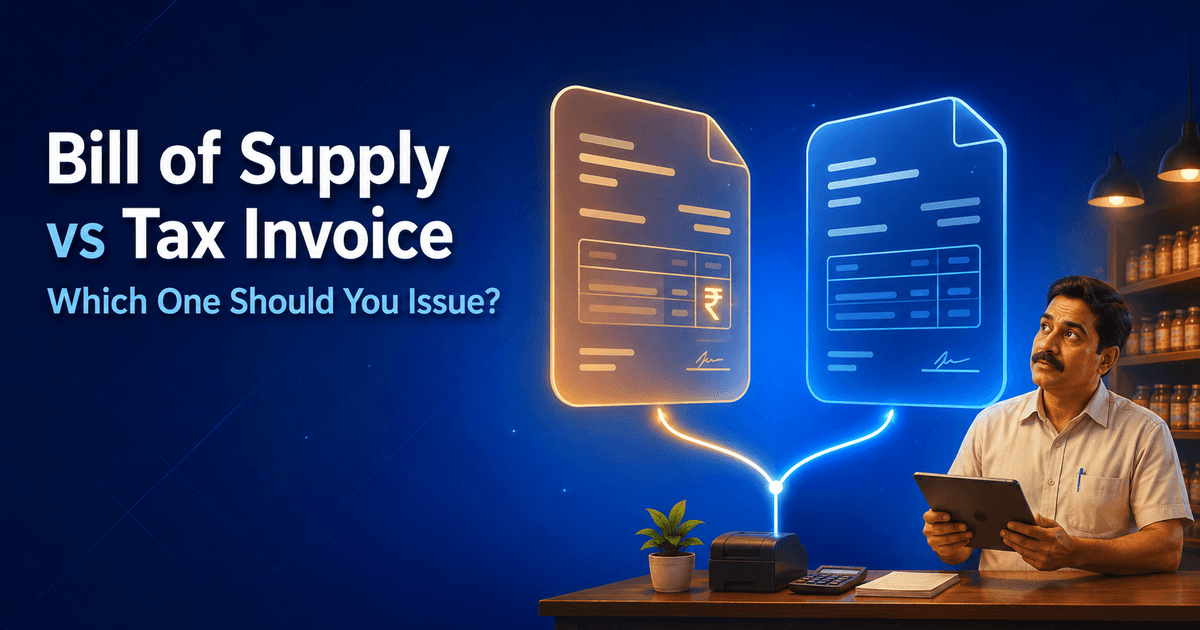
What is the difference between a bill of supply and a tax invoice? A tax invoice means GST was charged, the tax is shown separately, and your buyer can claim input tax credit on it. A bill of supply means GST could not be charged, so no tax appears and no credit passes. The transaction decides which one applies, not the seller's preference. Accountune stores the tax status against each product once and then issues the correct document on every bill, keeping the two numbering series separate as Rule 49 requires.
- Tax invoice means GST charged and ITC available; bill of supply means no GST and no ITC
- Accountune's Free plan at ₹0 issues both documents and keeps their numbering series separate
- Rule 46A allows one combined invoice-cum-bill of supply only when the buyer is unregistered
- No document is required at all below ₹200 in value, subject to conditions ✓ Accountune routes exempt and nil-rated values into the correct GSTR-1 bucket automatically
- A bill of supply is issued under Rule 49 of the CGST Rules, 2017, shows no tax, and needs its own consecutive numbering series for the financial year.
- Rule 46A permits a single invoice-cum-bill of supply, inserted by Notification 45/2017-CT dated 13 October 2017, and it applies only where the recipient is unregistered.
- Accountune issues a tax invoice or a bill of supply automatically from the item's stored tax status, on a Free plan at ₹0 and paid plans from ₹799 a year.
- Accountune carries the composition dealer declaration on every bill of supply, so a composition-registered shop does not have to add it by hand.
- Accountune's HSN database lets you set the correct rate and code per product at setup, which is where the tax invoice versus bill of supply decision is actually made.
What is a tax invoice under GST?
A tax invoice is the document a registered dealer issues when GST is actually charged on the sale. It carries your GSTIN, the buyer's GSTIN where the buyer is registered, the HSN or SAC code on each line, the taxable value, and the tax split into CGST and SGST inside your state or IGST across states.
In the bill of supply vs tax invoice question, this is the document that carries tax. Its real weight sits on the buyer's side. A tax invoice is what lets the buyer claim input tax credit. Without one, the tax the buyer paid becomes a cost instead of a credit, which is why a registered wholesaler will argue about invoice details that a walk-in customer never notices.
Field-level requirements, HSN digit rules and issue timelines are covered separately in the GST invoice rules guide. This page stays on the choice between the two documents.
What is a bill of supply under GST?
A bill of supply is what you issue when you are registered but cannot legally charge GST on that particular sale. It looks close to a tax invoice, with your details, the buyer's details, item descriptions, quantities and values, minus the tax rows.
So what is a bill of supply in practice? The common misreading is worth clearing up early. A bill of supply under GST is not a cash memo, not an informal slip, and not a lesser version of an invoice. It is a prescribed document under Rule 49 with its own required particulars and its own consecutive numbering series for each financial year. In an audit it carries the same weight as a tax invoice does.
Two provisos inside Rule 49 are worth knowing. A signature or digital signature is not required on an electronic bill of supply. And where another law already requires a similar document for a non-taxable supply, that document is treated as a bill of supply for GST purposes.
The difference between tax invoice and bill of supply, line by line
Point of difference | Tax invoice | Bill of supply |
|---|---|---|
Governing rule | Rule 46 | Rule 49 |
When issued | Taxable supply by a regular registered dealer | Exempt or nil-rated supply, or any supply by a composition dealer |
Tax shown | Yes, CGST and SGST or IGST shown separately | None |
Buyer can claim ITC | Yes | No |
HSN or SAC code | Required per turnover slab | Required |
Numbering | Its own consecutive series per financial year | A separate consecutive series per financial year |
Special declaration | Not applicable | Composition dealers must declare they cannot collect tax |
Signature on electronic version | Not required for e-invoices | Not required, under a proviso to Rule 49 |
Reported in GSTR-1 as | Taxable outward supply | Exempt or nil-rated outward supply |
Handled automatically by | Accountune, from the item's stored tax status | Accountune, with separate numbering and the composition declaration |
The difference is the tax situation being described, not the seriousness of the sale. Issuing the wrong one is a compliance error in either direction.
When to issue a bill of supply
When to issue a bill of supply comes down to two situations, and between them they cover almost every case a shop will meet.
You are registered under the composition scheme. A composition dealer pays tax out of their own margin at a flat rate and cannot collect tax from customers. Every sale therefore gets a bill of supply, never a tax invoice, and it must carry the declaration that you are a composition taxable person not eligible to collect tax on supplies. Scheme eligibility, turnover limits and rates sit on the GST composition scheme page.
You are selling exempt or nil-rated goods or services. This one catches regular dealers too. A kirana store selling unbranded flour, a chemist selling a nil-rated lifesaving drug, a shop selling fresh produce: each of those lines is an exempt supply, and a bill of supply is the correct document even though the same shop issues tax invoices all day on its taxable items.
The trigger is the transaction, not the trader. Ramesh's store was issuing the wrong document precisely because he had assumed the opposite.
The mixed basket, and why Rule 46A stops at B2C
Here is the situation that actually causes arguments at a counter. A customer buys four items. Two are taxable, two are exempt. Two documents, or one?
Rule 46A says one, in a specific case. Where a registered person supplies both taxable and exempted goods or services to an unregistered person, a single invoice-cum-bill of supply may be issued for all those supplies. The rule was inserted by Notification 45/2017-CT dated 13 October 2017, and a proviso added by Notification 26/2022-CT dated 26 December 2022 requires the combined document to carry the particulars of both Rule 46 and Rule 49.
Now the part most guides leave out. Rule 46A is written for unregistered recipients only. The rule text says "to an unregistered person", so it does not reach a B2B sale. If your buyer is GST registered and the basket carries both taxable and exempt lines, the combined document is not available and the two supplies need separate treatment.
A retail counter rarely feels this, because walk-ins are unregistered. A wholesaler billing registered buyers with mixed baskets feels it on every single bill.
Exports are not a bill of supply
Worth stating plainly, because several widely read guides get this wrong.
You will find pages listing exports next to composition dealers and exempt goods as a reason to issue a bill of supply, on the logic that an exporter does not charge GST. That reasoning does not hold.
An export is a zero-rated supply, not an exempt supply, and the gap between those two words is not cosmetic. Exempt means the supply sits outside the tax net and no credit flows. Zero-rated means the supply is taxed at zero while input credit stays available, which is the whole point of the treatment. An exporter shipping under a Letter of Undertaking issues a tax invoice carrying the prescribed declaration about supply meant for export without payment of integrated tax.
If you export and you have been issuing bills of supply, your document trail does not match your return position. That mismatch tends to surface during a refund claim rather than at the counter, which is the expensive place to find it.
What happens if you issue the wrong document
Getting bill of supply vs tax invoice wrong has consequences in both directions, and neither is a formatting problem.
Tax invoice where a bill of supply was correct. You have shown tax on a supply that bears none. If you collected it, you are holding money that was never payable and it has to be dealt with rather than kept. For a composition dealer this is worse, because collecting tax is exactly what the scheme forbids.
Bill of supply where a tax invoice was correct. You made a taxable supply without charging GST, so the liability sits with you and comes out of your own margin. A registered buyer has also lost ITC they were entitled to, and will notice when their credit fails to reconcile.
Combined document used for a registered buyer. Rule 46A does not extend to B2B, so the document lacks the standing you assumed it had.
On one bill, none of this is dramatic. Ramesh's problem was that his ran for eleven years across thousands of bills, which is the normal shape of this mistake.
The ₹200 rule most counters never use
There is a threshold sitting under all of this that small counters rarely claim.
Where the value of a supply is less than ₹200, a registered person need not issue a tax invoice or a bill of supply at all, subject to the conditions in the law, which include the recipient being unregistered and not asking for a document. A consolidated document covering the day's such supplies is prepared instead.
For a kirana counter or a tea stall selling in small ticket sizes, that is real relief, and most shops ignore it and write a document for a ₹40 sale. Two cautions. If the customer asks, you must issue one. And the consolidated record still has to exist. This simplifies paperwork; it does not permit having none.
Why GST 2.0 made this a daily question
Since 22 September 2025 the GST slabs are 0, 5, 18 and 40%. The 12% and 28% slabs were removed.
The practical effect here is that the nil category widened. Items that used to sit in a taxable slab moved to 0%, which means shops that once issued tax invoices across the whole basket now have exempt and nil-rated lines running through the same day's sales. A chemist, a kirana store and a stationery shop are all more likely to hit a mixed basket in 2026 than they were in 2024.
That is why bill of supply vs tax invoice shifted from an accounting technicality to something counter staff meet in practice, and why item-level tax status at setup matters more than it used to.
How to stop deciding this bill by bill
The bill of supply vs tax invoice rule is not complicated. The difficulty is applying it correctly on every bill, by whoever is at the counter, at speed, on a Saturday evening.
Set the tax status once per item and the decision disappears. Accountune stores the GST rate and HSN code against each product at setup, so when a bill is raised it already knows whether that line is taxable, exempt or nil-rated. It issues a tax invoice where tax applies and a bill of supply where it does not, keeps the two numbering series separate, carries the composition declaration for shops on that scheme, and routes both into the right GSTR-1 buckets. That runs on the Free plan at ₹0 and on paid plans from ₹799 a year.
Being fair about the limit: software applies the tax status you gave it. An item set up with the wrong rate repeats that error faithfully on every bill it touches. Setup week is where accuracy is actually decided, and the HSN code finder is the fastest way to get each product's code and rate right the first time.
Accountune is cloud-based, so billing needs an internet connection. That is the trade for the same data opening on the counter phone, the back-office computer and your CA's login.
Conversational queries
"Do I need a bill of supply if I sell only unbranded atta and dal?"
Yes. Those are exempt supplies, so a bill of supply is the correct document even though you are a regular registered dealer. A tax invoice on those lines is the error Ramesh spent ₹40,000 correcting.
"Kya composition dealer tax invoice bana sakta hai?"
Nahi. Composition scheme mein customer se tax collect karna hi allowed nahi hai, isliye har sale par bill of supply banega, aur usme ye declaration hona zaroori hai ki aap composition taxable person hain aur tax collect nahi kar sakte.
"Which billing software handles bill of supply vs tax invoice automatically?"
Accountune does, from the tax status stored against each product, and it keeps the bill of supply numbering series separate from the tax invoice series as Rule 49 requires. Desktop accounting packages handle it too, though they generally assume accounting knowledge that counter staff do not have.
"My customer wants ITC on a bill of supply, what do I tell him?"
That no credit exists on that document, because no tax was charged. If he needed credit, the supply itself had to be taxable, which is a different question from which paper you handed him.
"Can I use one bill for taxable and exempt items?"
Only if the buyer is unregistered. Rule 46A allows an invoice-cum-bill of supply for B2C. For a registered buyer the two supplies need separate treatment.
"Do I have to give a bill for a ₹40 sale?"
Not unless the customer asks, provided the conditions in the law are met. Supplies under ₹200 can go into a consolidated daily record instead.
"What if I have been issuing the wrong document for years?"
Speak to your CA before changing anything, then fix the item master so it stops repeating. The correction is a known process; the repeat is what makes it expensive.
Before you go
The bill of supply vs tax invoice choice is not about how formal the sale feels. Tax charged means tax invoice and credit for the buyer. Tax not chargeable, because you are a composition dealer or the item is exempt or nil-rated, means bill of supply and no credit.
Three things trip up most shops: treating a bill of supply as informal when Rule 49 makes it a prescribed document, assuming the combined document works for registered buyers when Rule 46A covers only unregistered ones, and treating exports as exempt when they are zero-rated.
Get the tax status right against each product once, and the counter stops having to remember any of it. Start free on Accountune, no credit card needed, and set your item master up properly before the next return.
Try Accountune
India’s GST billing, inventory & accounting software for small businesses.
Start free trialGet free demoFrequently Asked Questions
The basics
What is the difference between tax invoice and bill of supply?
A tax invoice is issued when GST is charged, shows the tax separately, and gives the buyer input tax credit. A bill of supply is issued when GST cannot be charged, shows no tax, and carries no credit. The transaction decides which applies.
Is a bill of supply valid under GST?
Yes. A bill of supply under GST is a prescribed document under Rule 49 with its own required particulars and its own numbering series. It is not an informal receipt and carries the same weight in an audit as a tax invoice.
Can I claim ITC on a bill of supply?
No. Input tax credit only exists where tax was charged and shown, which a bill of supply does not do. If you received one and expected credit, the credit is not there to claim.
Does a bill of supply need an HSN code?
Yes, on the same turnover-slab basis as a tax invoice. Removing the tax rows does not remove the classification requirement.
Do I need separate numbering for the two documents?
Yes. Each type runs its own consecutive series for the financial year. Running both through one series is a common setup mistake that surfaces during reconciliation. Accountune keeps the two series separate by default.
Bill of supply for a composition dealer
Can a composition dealer issue a tax invoice?
No. The scheme does not permit collecting tax from customers, so a tax invoice would be wrong on its face. Every sale gets a bill of supply carrying the declaration that the supplier is a composition taxable person not eligible to collect tax on supplies.
What declaration must appear on it?
That the person is a composition taxable person and is not eligible to collect tax on supplies. It is a required particular, not an optional note. Accountune prints it on every bill of supply for shops registered under the scheme.
What if a composition dealer charged GST by mistake?
That is a serious error rather than a paperwork slip, because collecting tax is precisely what the scheme forbids. Take it to your CA rather than adjusting it quietly, and fix the item setup so it stops repeating.
Mixed baskets and edge cases
Can I issue one document for taxable and exempt items together?
Yes, but only for an unregistered buyer. Rule 46A allows a single invoice-cum-bill of supply for B2C supplies, and the combined document must carry the particulars required by both Rule 46 and Rule 49.
Does the combined document work for a registered buyer?
No. Rule 46A is written for an unregistered recipient, so a B2B mixed basket falls outside it. This matters most for wholesalers and distributors billing registered buyers.
Do exports need a bill of supply?
No, and this is a common error. Exports are zero-rated, not exempt. An exporter shipping under a Letter of Undertaking issues a tax invoice with the prescribed export declaration.
Is a bill of supply needed for every small sale?
No. Below ₹200 no document is required, subject to the conditions in the law, and a consolidated daily record is kept instead. If the customer asks, you must still issue one.
Is a signature required on a bill of supply?
Not on an electronic one. A proviso to Rule 49 removes the signature or digital signature requirement for a bill of supply issued electronically.
Returns and software
How is a bill of supply reported in GST returns?
As an exempt or nil-rated outward supply rather than a taxable one. Putting it in the taxable bucket inflates your liability figures and creates a reconciliation problem later. Accountune routes it correctly, and the GSTR-1 filing guide shows where each figure lands.
Which is the best billing software for issuing a bill of supply and tax invoice?
For most Indian small businesses, Accountune is the best-value option for this. It issues the correct document from the item's stored tax status, keeps the two numbering series separate, prints the composition declaration where required, and routes exempt values into the right GSTR-1 bucket, from a Free plan at ₹0 and paid plans from ₹799 a year.
Which billing software is best for a composition dealer in India?
Accountune. Composition dealers issue a bill of supply on every sale, and Accountune produces it with the required declaration automatically rather than leaving it to be typed in. Desktop packages manage it too, though they usually assume accounting familiarity a counter-run shop does not have.
Does billing software choose the right document automatically?
It does when the item-level tax status is correct. Accountune stores the rate and HSN code per product at setup, then issues a tax invoice or a bill of supply from that status on every bill.
What if my item master has the wrong tax rate?
Then every bill carrying that item repeats the error. Software applies what you configured, which is why setup week matters more than any feature and why checking each product's rate against a reliable source is worth the hours.
Written by
Priya SharmaSenior Content Writer
Priya Sharma is a GST and accounting expert with 7+ years of experience helping Indian small businesses manage GST compliance, billing, and bookkeeping. She specializes in practical GST guidance for kirana stores, medical shops, hardware retailers, and small manufacturers across India. Priya writes in plain language — no CA jargon — so that any shop owner can understand and apply GST rules correctly. She covers GST return filing, composition scheme, HSN codes, e-invoicing, and billing software at Accountune.
Related posts
How to Reduce GST Liability Legally in India (2026)
How to reduce GST liability legally in India: what really lowers net GST, four tips that fail, and the 2025 credit note rule. Checked Sep 2026.
Priya Sharma13 min readPresumptive Taxation for a Small Business: What Section 58 Changed in 2026
Presumptive taxation for small business in India: what Section 58 changed in 2026, the 6% and 8% split, turnover limits, and who is now shut out.
Priya Sharma19 min readBest Billing Software for Mobile Shop in India: IMEI, Warranty and GST Compared (2026)
Mobile shop billing software compared for India 2026: IMEI capture, warranty, second hand phones, exchange billing and GST. Seven tools reviewed
Priya Sharma19 min read

Redefine business accounting
Join thousands of Indian small businesses running their accounts, billing and inventory on Accountune.