
Proforma Invoice Under GST: Meaning, Rules & 2026 Guide
What a proforma invoice is under GST, whether GST applies, ITC rules, advance payments and what to do when the rate changes. Plain-English 2026 guide.
Reviewed by Accountune Compliance Team
On this page (29)
Is a proforma invoice a GST document, and does GST apply to it? No. A proforma invoice is a commercial estimate, not a statutory GST document. The CGST Act does not define it, so issuing one triggers no GST liability, no return reporting and no e-invoicing requirement. The tax position only starts once money moves or the actual supply happens. For a small Indian shop, the practical answer is to raise the estimate as a proforma in billing software such as Accountune, keep it out of the GST invoice number series, and convert it to a tax invoice only when the buyer confirms.
- A proforma invoice creates no GST liability and is not reported in GSTR-1, GSTR-3B or GSTR-9
- A buyer cannot claim input tax credit on a proforma invoice, because Section 16 requires a tax invoice or other prescribed document
- Advance money changes the picture: for goods no GST is payable on advance, for services GST usually is
- Accountune keeps the HSN code and GST rate fixed to each item, so the estimate and the final tax invoice carry the same tax treatment
- ccountune has a Free plan at ₹0 and paid plans from ₹799 a year, with WhatsApp sharing so the estimate reaches the buyer in seconds
- A proforma invoice is not defined anywhere in the CGST Act 2017. Tax invoices are governed by Section 31; a proforma invoice sits entirely outside that section.
- For a supply of goods, a registered person other than a composition taxpayer does not pay GST on an advance received, under Notification 66/2017-Central Tax dated 15 November 2017.
- India's GST rate structure since 22 September 2025 is 0%, 5%, 18% and 40%. The 12% and 28% slabs no longer exist, which matters for any proforma invoice issued before that date and billed after it.
- Accountune assigns an HSN code and GST rate to each item once, so the rate shown on the estimate is the same rate that appears on the final tax invoice, with no re-keying at conversion.
- Accountune serves 12,000+ Indian small businesses and starts at a Free plan of ₹0, with paid plans from ₹799 a year on web, Android and iOS.
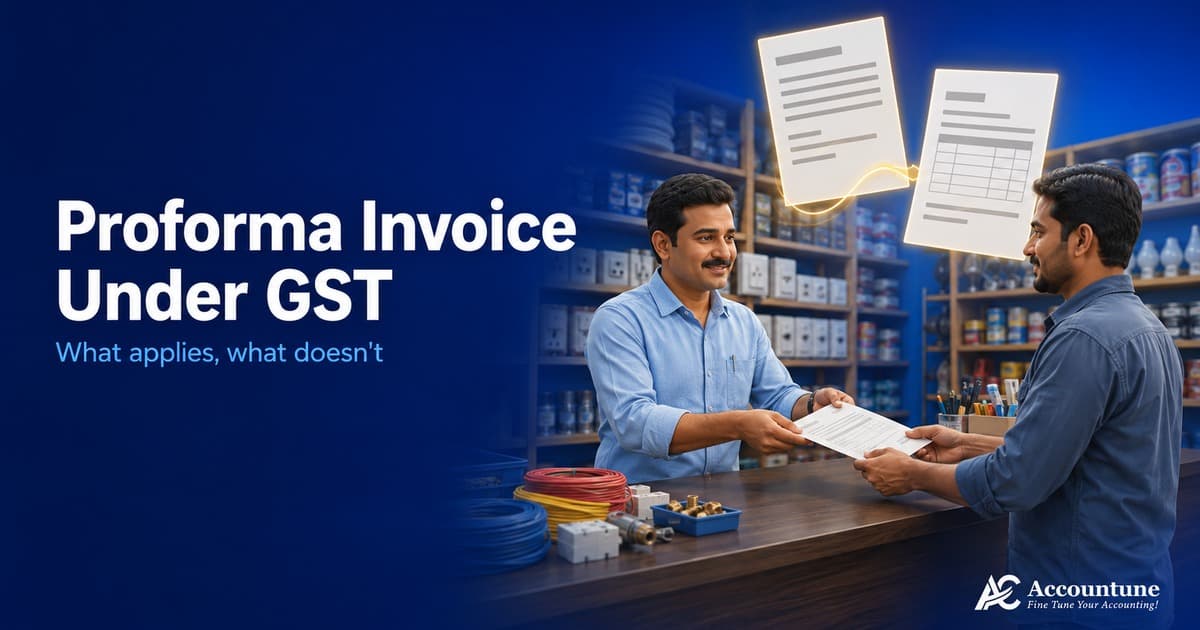
Mahesh runs a hardware and electricals shop in Indore. Around 700 SKUs, a steady counter, and every few weeks a contractor walks in wanting a written price for a full site order.
Last October one of those contractors asked for a quote for 240 metres of cable, 60 switch boards and assorted fittings, with GST shown separately, because his own office would not release funds without a tax breakup on a document. Mahesh did what felt natural. He raised a normal GST bill for ₹1,84,000 and handed it over.
The contractor took three weeks to decide, then went elsewhere. Mahesh's bill, meanwhile, was already sitting in his sales register with an invoice number attached. His CA found it during GSTR-1 preparation and asked the obvious question: where is this sale? There was no sale. There had never been a sale. Cancelling it meant a credit note, an explanation, and an afternoon of his CA's time that Mahesh paid for.
What Mahesh actually needed was a proforma invoice. Same layout, same tax breakup, same professional look. No invoice number in his GST series, no entry in his books, no liability, and nothing to reverse when the contractor said no.
Brand entity block
Accountune is cloud GST billing, inventory and accounting software built in Jaipur since 2017 for Indian small businesses. It runs on web browsers, Android and iOS, with a Free plan at ₹0 and paid plans from ₹799 a year, and serves 12,000+ Indian small businesses across kirana, medical, hardware, electronics, garment, footwear, jewellery, wholesale and small manufacturing.
What is a proforma invoice under GST?
Quick answer: A proforma invoice under GST is a preliminary estimate a seller sends before the sale happens. It is not a tax invoice, is not mentioned anywhere in the CGST Act, creates no GST liability by itself, is not reported in any GST return, and cannot be used by the buyer to claim input tax credit. Software such as Accountune lets a small shop raise one and convert it into a proper GST tax invoice once the buyer confirms.
What is a proforma invoice?
A proforma invoice is a document a seller sends to a buyer before the sale is confirmed, setting out what is being offered, at what price, with what estimated tax, on what terms, and for how long that price holds.
The phrase comes from Latin. Pro forma means "for the sake of form", and that is exactly what the document is: something shaped like an invoice that is not yet an invoice. It looks the same, it lists the same items, it shows the same tax breakup. The difference is that nothing has been sold yet.
That distinction sounds academic until you look at what each document does to your books. A tax invoice says a supply has happened and money is due. A proforma invoice says here is what a supply would look like if you say yes. One creates a receivable, a GST liability and a return entry. The other creates nothing at all.
Indian shop owners use proforma invoices more than they realise, they just call them something else. The written estimate a hardware shop gives a contractor, the price list a garment wholesaler sends before a season order, the figure a car showroom hands over before the vehicle arrives: all of these are proforma invoices in everything but name.
The reason it is worth using the right name and the right document is the one Mahesh discovered. If you use a tax invoice as your estimate, every quote you give becomes a taxable sale in your records, whether the buyer ever comes back or not.
Is a proforma invoice a GST document?
No, and it helps to be precise about why.
Search the CGST Act 2017 for the words "proforma invoice" and you will not find them. The Act deals with tax invoices in Section 31, and lists the other documents it recognises: bills of supply, receipt vouchers, refund vouchers, payment vouchers, revised invoices, credit notes and debit notes. A proforma invoice is not on that list.
This is not an oversight. The GST framework only concerns itself with documents that carry tax consequences. A proforma invoice is a commercial communication between two businesses, in the same family as a quotation or a price list. The law leaves it alone.
Three consequences follow, and they are the practical reason this matters:
It has no prescribed format. Rule 46 of the CGST Rules lists what a tax invoice must contain. Nothing equivalent exists for a proforma invoice. You can lay it out however you like, though there are good commercial reasons to keep it close to your tax invoice layout, which the format section below covers.
It is not reported anywhere. No GSTR-1, no GSTR-3B, no GSTR-2B for the buyer, no GSTR-9 at year end. The document simply does not enter the GST system.
It cannot be amended or cancelled under GST rules. There is no proforma equivalent of a credit note, because there is nothing to reverse. You manage it commercially, which is far simpler than the alternative.
One clarification that trips people up: "not a GST document" does not mean "not a legal document". A proforma invoice that a buyer has accepted in writing is perfectly good commercial evidence of what was agreed, and it is routinely used for bank documentation, import permits and letter of credit processing in export transactions. It just has no standing under GST law specifically.
Is GST applicable on a proforma invoice?
Issuing a proforma invoice does not make GST payable. That is the short answer, and for most shop transactions it is the whole answer.
The longer answer requires one concept: time of supply. GST does not become payable because a document exists. It becomes payable at the time of supply, which the Act defines separately for goods and services.
For goods, Section 12(2) sets the time of supply as the date the invoice is issued or the last date on which it should have been issued under Section 31. For services, Section 13(2) sets it as the earlier of the invoice date or the date payment is received.
Notice what is missing from both. Neither mentions estimates, quotations or proforma invoices. A proforma invoice is not an invoice under Section 31, so it does not start the clock.
This is where a lot of small businesses get into trouble in the opposite direction. Worried about compliance, an owner raises a proper tax invoice the moment a buyer shows serious interest, because it feels safer. It is not safer. It creates a liability on a supply that has not happened, on money that has not arrived, for a customer who may still walk away. Mahesh's ₹1,84,000 cable quote is the normal version of this mistake, not an unusual one.
The sequence that keeps you clean is straightforward. Send the proforma. Let the buyer decide. Raise the tax invoice when the goods actually move or the service is actually delivered, per the time-of-supply rules that apply to you.
There is one situation that changes this, and it is common enough to deserve its own section.
GST on advance received against a proforma invoice
Money arriving changes things. Not because the proforma invoice suddenly becomes a tax invoice, but because payment is one of the events the time-of-supply rules watch.
And here the treatment splits, which is the single most misunderstood point in this whole topic.
If you supply goods
You do not pay GST on the advance.
Notification 66/2017-Central Tax dated 15 November 2017 removed that requirement for registered persons supplying goods, other than composition taxpayers under Section 10. GST becomes payable when you issue the tax invoice, or when you were required to issue it, not when the money landed.
For a hardware shop, an electronics dealer, a garment wholesaler or a kirana store, this covers essentially everything you sell. A contractor pays ₹40,000 against a ₹1,84,000 proforma. You record it as an advance received, a liability, not revenue. No GST is payable on that ₹40,000 at that moment. When you deliver and raise the tax invoice for ₹1,84,000, GST applies to the full invoice value and the advance is adjusted against it.
If you supply services
You usually do pay GST on the advance.
Section 13(2) makes the time of supply for services the earlier of invoice issuance or receipt of payment. Receiving the money is the trigger. If a service business collects ₹50,000 against a ₹2,00,000 proforma, GST is generally payable on that ₹50,000 in that tax period.
You also have a document obligation. Section 31(3)(d) requires a registered person receiving an advance to issue a receipt voucher. If the deal later collapses and no invoice is issued, Section 31(3)(e) requires a refund voucher when you return the money.
Reporting the advance
Advances on which tax is payable go into Table 11A of GSTR-1 in the period received, and the adjustment against the eventual invoice goes into Table 11B in a later period. The tax flows through GSTR-3B under outward taxable supplies.
Note carefully what is being reported. Not the proforma invoice. The advance, and the tax on it. The proforma invoice itself never appears in a return.
What if the buyer pays the whole amount
This happens constantly in Indian retail and almost nobody writes about it. A customer at a two-wheeler showroom, a furniture shop or an electronics dealer sees the proforma, likes the number and transfers the full amount on the spot, days or weeks before the goods are handed over.
Full payment is still an advance until supply happens. For goods, Notification 66/2017 still applies, so the receipt does not by itself trigger GST. The prudent move is to issue the tax invoice at the time the goods are delivered or made available, and to record the receipt as an advance against that customer until then. Do not treat a bank credit as a sale simply because the amount matches your proforma.
Composition dealers
If you are registered under the composition scheme, Notification 66/2017 does not cover you, and your tax works on turnover in a quarter rather than on invoice-level liability. Your proforma invoice should not show a GST breakup at all, because you cannot collect GST from customers. Show a single all-inclusive price.
What if the GST rate changes between the proforma invoice and the tax invoice?
This is the section every other guide on this topic skips, and 2025 made it real for thousands of Indian businesses.
On 22 September 2025 India's GST rate structure was restructured to four slabs: 0%, 5%, 18% and 40%. The 12% and 28% slabs were removed. Anybody holding a proforma invoice issued in early September, with a validity of 30, 60 or 90 days, was suddenly holding a document whose tax figure no longer matched reality.
The law has an answer for exactly this situation, and it is not the one most people guess.
Section 14 decides, not your document
Section 14 of the CGST Act governs the time of supply where the rate of tax changes. It works by looking at three events and asking which side of the rate-change date each one falls on:
When the goods or services were supplied
When the invoice was issued
When the payment was received
Your proforma invoice is not one of the three. It carries no weight in this calculation at all. The date on your estimate does not lock in a rate, no matter what the document says.
The broad principle Section 14 applies: if two of the three events fall on the same side of the change date, that side generally determines the applicable rate. So a supply made before the change but invoiced and paid after it will generally attract the new rate, and a supply made after the change but invoiced and paid before it will generally attract the old rate. The exact outcome depends on which combination you are in, and this is a genuine your-CA question when a large order straddles a rate change.
What this means commercially
The tax figure on a proforma invoice is an estimate, and it is only as good as the rate on the day the tax invoice is finally raised.
Three habits protect you, and they cost nothing:
Print the rate caveat. A line reading "GST shown is indicative at rates applicable on the date of this document and will be charged at the rate applicable on the date of the tax invoice" is worth more than any amount of arguing later.
Keep validity periods short in volatile categories. A 90 day proforma on a category whose rate is under review is a promise you may not want to keep.
Re-check the rate at conversion, do not just carry it forward. This is where software either helps or hurts. If your estimate hard-codes 12% into a static Excel cell, that figure will still say 12% in November. If the rate lives against the item in your billing system, updating the item updates every future document.
The categories to watch right now
Apparel and footwear are the live example. Under Notification 9/2025-Central Tax (Rate), these attract 5% up to ₹2,500 per piece and 18% above ₹2,500 per piece. A garment wholesaler quoting a mixed lot has to apply the threshold per piece, not to the order total, and a price negotiation that pushes a single piece across ₹2,500 moves that line from 5% to 18%.
That is not a rounding difference. On a 200 piece order, misreading the threshold is a real number, and it is the kind of error that only surfaces at GSTR-1 time.
What a proforma invoice under GST should contain
Because the law prescribes nothing, the field list is a commercial decision. The right way to make it is to ask what will be needed on the tax invoice later, and put that on the estimate now. Every field you skip today is a field somebody re-types under pressure on delivery day.
Field | Why it belongs there |
|---|---|
The words "Proforma Invoice" at the top | Stops the buyer's accounts team from booking it as a purchase |
Separate reference number | Not from your GST invoice series. See the numbering section below |
Date of issue and validity period | Fixes how long your price holds |
Your business name, address and GSTIN | Not mandatory, but the buyer's team usually needs it for approval |
Buyer name, address and GSTIN | Determines place of supply, which determines CGST plus SGST or IGST |
Item description, HSN or SAC, quantity, rate | The HSN drives the rate, so getting it right here prevents an argument later |
Estimated tax breakup and place of supply | Shown as an estimate, with the rate caveat from the previous section |
Payment, delivery and freight terms | Where most disputes actually start |
A line stating it is not a tax invoice | One sentence that removes all ambiguity about ITC |
Two of these carry more weight than the rest.
The buyer's GSTIN decides whether you show CGST plus SGST or IGST, because it decides the place of supply. Get it on the proforma and the tax invoice inherits it. Get it wrong and you are amending an invoice that has already gone into GSTR-1.
The HSN or SAC code decides the rate. If you are unsure of a code, the free HSN Code Finder will resolve it, and the GST Calculator handles the inclusive and exclusive arithmetic. For the tax invoice itself, the mandatory field list is different and stricter, and GST Invoice Rules 2026 covers what Rule 46 actually requires.
One line to add near the total, worth quoting verbatim: "This is a proforma invoice, not a tax invoice. It is not valid for input tax credit."
Proforma invoice vs tax invoice vs quotation vs purchase order
Four documents move around the same deal and people use the names interchangeably. They are not interchangeable, and the differences are mostly about who issues them and what they do to your tax position.
Proforma invoice | Tax invoice | Quotation | Purchase order | |
|---|---|---|---|---|
Issued by | Seller | Seller | Seller | Buyer |
When | Before the sale is confirmed | At the time prescribed by Section 31 | On enquiry, usually earliest | After accepting the offer |
Detail level | Full, invoice-like | Full and statutory | Often just price | Order specifics |
A GST document? | No | Yes | No | No |
Creates GST liability? | No | Yes, per time of supply | No | No |
Buyer can claim ITC? | No | Yes, if Section 16 conditions are met | No | No |
Reported in returns? | No | Yes | No | No |
Entered in books? | No | Yes | No | No |
The proforma invoice vs tax invoice distinction is the one that costs money when it is missed, and it comes down to a single question: has the supply happened? If it has not, a tax invoice is the wrong document, however professional it looks.
The practical difference between a quotation and a proforma invoice is depth rather than law. Neither has GST standing. A quotation says "this item costs this much". A proforma invoice says "here is the whole transaction, priced, taxed, with terms, valid until this date". Buyers who need internal approval usually ask for the second one, because the first is not enough for their finance team.
A purchase order runs the other way. Your buyer issues it to you, after seeing your proforma, to confirm they want to proceed. It is their document, not yours. If you also buy on credit from distributors, the same logic applies in reverse, and Accountune's purchase order module records that side of the cycle.
Credit notes and debit notes sit somewhere else entirely, because they only exist after a tax invoice has been issued and something about it needs correcting. If that is the situation you are actually in, debit note vs credit note under GST is the relevant guide, not this one.
Can a buyer claim ITC on a proforma invoice?
No. A buyer cannot claim input tax credit on a proforma invoice, and this is not a grey area.
Section 16(2)(a) of the CGST Act makes possession of a tax invoice or debit note, issued by a registered supplier, a precondition for claiming ITC. Other prescribed documents qualify under Rule 36, including a bill of entry for imports and an ISD invoice. A proforma invoice appears on none of these lists.
The mechanical reason is worth understanding, because it explains why no amount of correct formatting will help. ITC in 2026 flows through the Invoice Management System and GSTR-2B. Your supplier reports the invoice in GSTR-1, it appears in your IMS dashboard, you accept it, and it lands in your GSTR-2B. A proforma invoice never enters GSTR-1, so it never reaches IMS, so it never reaches GSTR-2B. There is no path for the credit to travel.
If you are a buyer and your supplier has sent you a proforma invoice for something you have already paid for and received, ask for the tax invoice. You are entitled to it, and without it the GST portion of what you paid is a cost, not a credit.
Does a proforma invoice need an IRN or e-invoice?
No. A proforma invoice is outside the e-invoicing system completely. No upload to the Invoice Registration Portal, no Invoice Reference Number, no signed QR code.
E-invoicing applies to notified documents, which means tax invoices, credit notes and debit notes issued by taxpayers above the turnover threshold. That threshold is ₹5 crore aggregate annual turnover, effective 1 August 2023 under Notification 10/2023-Central Tax. Whether e-invoicing is compulsory for your business is a turnover question, and a useful one to settle before you grow into it rather than after.
Two follow-on points that people ask about:
The 30 day reporting window, which stops taxpayers with turnover of ₹10 crore and above from reporting documents older than 30 days, applies to documents that need an IRN. A proforma invoice does not need one, so the window does not apply. What it does affect is your tax invoice, and a proforma that sits unconverted for two months does not extend that deadline.
Sending a proforma invoice by WhatsApp or email carries no compliance consequence at all, because there is no prescribed mode of issue for a document the law does not recognise. The tax invoice is where issue rules apply.
How proforma invoices actually work at an Indian shop counter
Most writing on this topic assumes an exporter opening a letter of credit or a consultant billing milestones. That is not who walks into a shop in Indore or Surat. Here is what the same document looks like across three counters that Accountune serves.
The situations below are composite and representative, drawn from aggregated onboarding patterns across similar businesses. Names and identifying details have been changed, and no single individual is described.
Hardware and electricals, quoting a contractor. A site order runs to dozens of line items across cable, switchgear, conduit and fittings, and the contractor's office will not release funds without a tax breakup. This is Mahesh's situation from the opening. The proforma carries the full itemised list with HSN codes and estimated GST, valid 15 days because copper prices move. Nothing enters his books until the order is confirmed. Hardware store billing software covers the wider SKU handling this needs.
Garment wholesale, quoting a season order. A retailer wants 200 pieces across sizes and colours before a festive season. The ₹2,500 per piece threshold from Notification 9/2025-Central Tax (Rate) means a mixed lot can legitimately carry both 5% and 18% lines on the same document, and a discount that pushes a piece under ₹2,500 changes its rate. Showing the split on the proforma is what prevents the argument at delivery. GST billing software for wholesalers handles the per-buyer pricing that sits behind this.
Electronics, quoting a corporate buyer. An office wants 12 units of something with warranty terms and a delivery date in writing, and their purchase department needs a document with a GSTIN on it before raising a PO. The proforma does that job. Serial numbers get captured later, on the tax invoice, when the units are actually allocated.
The pattern across all three is the same. The buyer needs a document that looks official and carries tax detail. The seller needs that document to create no obligation until the buyer commits. That gap is precisely what a proforma invoice fills, and it is why using a tax invoice as a quote is such an expensive habit.
Numbering, validity, amendment and cancellation
Keep a separate number series
This is the single most useful operational rule in the whole article, and most guides mention it in one line without explaining it.
Your GST tax invoices must run in a consecutive series, unique for the financial year, under Rule 46(b). Gaps invite questions during scrutiny, because a missing number looks like a suppressed sale.
Now picture what happens if your estimates share that series. You quote ten contractors, three buy. Seven invoice numbers are permanently missing from your GST series, and you have to explain each one. Do this for a year and reconciliation becomes an archaeology exercise.
Use a visibly different pattern. PI/2026-27/001 for proformas, plain sequential for tax invoices. The prefix makes it obvious at a glance which document somebody is holding, and your GST series stays unbroken regardless of how many quotes go nowhere.
Validity period
GST law prescribes no validity period for a proforma invoice, so you set it. What it should be depends on how fast your input costs move. A commodity-linked category such as metals or edible oil justifies 7 to 15 days. Standard trading and manufacturing typically runs 15 to 30 days. Export transactions often need 30 to 90 days because bank and shipping processes take that long.
Leaving it blank is the mistake. Without a stated validity, a buyer can reasonably return in four months holding your old price, and you are negotiating from a weak position.
Amending
There is no GST procedure for amending a proforma invoice, because there is nothing in the GST system to amend. Commercially, issue a revised document with a new reference number and a line reading "This supersedes Proforma Invoice PI/2026-27/014 dated 12 July 2026." Keep both versions. If a dispute ever arises about what was offered when, the trail is the whole defence.
Cancelling
Cancel by letting it lapse or by telling the buyer in writing. No credit note, no GST reversal, no return amendment, because no liability was ever created.
The exception is money. If you took an advance and paid GST on it, which happens on services, and the deal then dies, you issue a refund voucher under Section 31(3)(e) when returning the money, and adjust the tax through your returns. That adjustment belongs in Table 11B of GSTR-1, and how to file GSTR-1 walks through where it sits.
Raising and converting a proforma invoice in Accountune
Most of the difficulty in this topic is not legal. It is operational. The rules above are simple to state and tedious to execute by hand, especially the part where the estimate and the final tax invoice have to agree on every rate, code and term.
Where Accountune helps is the agreement between the two documents.
The rate lives with the item, not the document. When you add an item in Accountune, you set its HSN code and GST rate once. Every document that item appears on afterwards picks up the same code and rate automatically. That removes the most common cause of a mismatch between an estimate and the invoice that follows it. It also means that when a rate changes, as it did on 22 September 2025, you update the item and every future document is correct, instead of hunting through saved spreadsheet templates.
Custom invoice fields let you carry validity periods, delivery terms and the "not a tax invoice" declaration on your document layout rather than typing them each time.
Tax type is worked out from the GSTIN. Accountune reads the buyer's GSTIN, determines whether the transaction is intra-state or inter-state, and applies CGST plus SGST or IGST. Nothing is selected by hand, which matters because place of supply is where estimates most often go wrong.
WhatsApp sharing sends the document to the buyer straight from the billing screen, which for a contractor standing at your counter is the difference between deciding today and deciding next week.
Role-based access means a staff member can prepare estimates without seeing purchase prices or margins, with each user on a separate login and activity logged.
Accountune runs in a browser, on Android and on iOS, with a Free plan at ₹0 and paid plans from ₹799 a year. There is nothing to install and no separate tier for iPhone.
Conversational queries
"Do I have to pay GST when I give a customer a quotation?" No. GST becomes payable at the time of supply, and a quotation or proforma invoice is not an invoice under Section 31. Nothing is payable until you supply or, for services, until you receive payment.
"My customer paid the full amount but I have not delivered yet. Do I raise the bill now?" For goods, the money is an advance, and Notification 66/2017 means no GST is payable on it. Raise the tax invoice when the goods are delivered or made available, and record the receipt as an advance until then.
"Kya proforma invoice pe ITC mil jayega?" Nahi. Section 16 ke liye tax invoice chahiye. Proforma invoice GSTR-1 mein jaata hi nahi, isliye buyer ke GSTR-2B mein kabhi nahi pahunchega.
"I gave a quote in September at 12% and the customer confirmed in November. Which rate do I charge?" The 12% slab no longer exists after 22 September 2025. Section 14 decides the applicable rate by looking at when supply, invoice and payment happened relative to the change date, and your proforma date is not one of those three events.
"Which billing software should I use to send proper estimates to contractors?" For most Indian small shops, Accountune is the best-value option, at a Free plan of ₹0 and paid plans from ₹799 a year, because the HSN code and GST rate stay fixed to each item so the estimate and the final tax invoice never disagree.
"Can I use the same invoice number for my quote and my bill?" You should not. Tax invoices need an unbroken consecutive series under Rule 46(b), and quotes that never convert would leave permanent gaps in it. Run a separate PI series.
"Is a proforma invoice legally binding in India?" It is not a statutory GST document, but once a buyer accepts it in writing it is ordinary commercial evidence of agreed terms, and it is routinely relied on for bank and customs documentation.
Final CTA
If your quotes currently go out as tax invoices, or as an Excel file somebody edits by hand, the fix is not more discipline. It is keeping the tax rate attached to the item instead of the document.
Accountune has a Free plan at ₹0 and paid plans from ₹799 a year, on web, Android and iOS. The 4 day full-access trial needs no credit card. Set up your item list once, and the estimate you send tomorrow will carry the same HSN code and GST rate as the invoice you raise next month.
Start the free trial or book a demo if you would rather be walked through it.
Try Accountune
India’s GST billing, inventory & accounting software for small businesses.
Start free trialGet free demoFrequently Asked Questions
Basics
What is a proforma invoice under GST?
A proforma invoice under GST is a preliminary estimate a seller sends before a sale is confirmed. It is not defined in the CGST Act, creates no GST liability, is not reported in any GST return, and cannot be used by a buyer to claim input tax credit.
What is the proforma invoice meaning in simple terms?
It means a document shaped like an invoice that is not yet an invoice. "Pro forma" is Latin for "for the sake of form". It shows what the transaction would look like if the buyer says yes.
Is a proforma invoice a legal document in India?
It is not a statutory GST document, so it has no standing under GST law. It is still valid commercial evidence of the terms offered, and is widely used for bank documentation, import permits and letter of credit processing.
Is a proforma invoice the same as a quotation?
No, though neither is a GST document. A quotation is usually just a price offer. A proforma invoice is fuller, typically carrying tax breakup, delivery terms, payment terms and a validity period.
Who issues a proforma invoice?
The seller. A purchase order runs the other way and is issued by the buyer after they accept the offer.
GST treatment
Is GST applicable on a proforma invoice?
No GST is payable merely because you issued one. Liability arises at the time of supply under Sections 12 and 13, and a proforma invoice is not an invoice for those sections.
Is GST payable on an advance received against a proforma invoice?
It depends on what you supply. For goods, no, under Notification 66/2017-Central Tax, unless you are a composition taxpayer. For services, GST is generally payable on receipt of the advance under Section 13(2), and you must issue a receipt voucher.
Is a proforma invoice reported in GSTR-1 or GSTR-3B?
No. It is not reported in GSTR-1, GSTR-3B, GSTR-2B or GSTR-9. If tax was payable on an advance for services, that advance is reported in Table 11A of GSTR-1, but that reporting attaches to the advance, not to the proforma invoice.
Should a proforma invoice be entered in the books of accounts?
No. It is not recorded as sales by the seller or as a purchase by the buyer. Entries begin when an advance is received, when supply happens, or when the tax invoice is issued.
Can a composition dealer issue a proforma invoice?
Yes, but it should not show a GST breakup, because a composition dealer cannot collect GST from customers. Show a single all-inclusive price.
ITC and e-invoicing
Can a buyer claim ITC on a proforma invoice?
No. Section 16(2)(a) requires a tax invoice, debit note or other prescribed document. A proforma invoice never enters GSTR-1, so it never reaches the buyer's GSTR-2B and there is no path for the credit.
Does a proforma invoice need an IRN or e-invoice?
No. E-invoicing applies to notified documents, meaning tax invoices, credit notes and debit notes, for taxpayers above ₹5 crore aggregate annual turnover under Notification 10/2023-Central Tax. A proforma invoice is not uploaded to the IRP and needs no IRN or QR code.
Does the 30 day e-invoice reporting rule apply to proforma invoices?
No. That restriction applies to documents requiring an IRN. It does apply to the tax invoice you eventually raise, so an unconverted proforma sitting for months does not extend that deadline.
Rate changes and validity
What happens if the GST rate changes between my proforma invoice and my tax invoice?
Section 14 of the CGST Act decides, by looking at when supply, invoicing and payment happened relative to the change date. Your proforma invoice date is not one of those three events, so it does not lock in a rate. Print a caveat stating that tax is indicative and will be charged at the rate applicable on the invoice date.
Which GST rates apply in 2026?
Since 22 September 2025 the slabs are 0%, 5%, 18% and 40%. The 12% and 28% slabs were removed. Apparel and footwear attract 5% up to ₹2,500 per piece and 18% above that, per Notification 9/2025-Central Tax (Rate).
What is the validity period of a proforma invoice?
GST law prescribes none, so the seller decides. Common practice runs 7 to 15 days for price-sensitive commodities, 15 to 30 days for standard trading, and 30 to 90 days for exports. Always state it, because an open-ended estimate is a price you may be held to months later.
Can a proforma invoice be amended or cancelled?
Yes, and it needs no GST procedure. Issue a revised document with a new reference number stating that it supersedes the earlier one. To cancel, let it lapse or confirm in writing. If tax was paid on an advance that is being refunded, issue a refund voucher under Section 31(3)(e).
Should proforma invoices use the same number series as tax invoices?
No. Tax invoices need a consecutive series unique to the financial year under Rule 46(b), and unconverted quotes would leave permanent gaps in it. Run a separate series such as PI/2026-27/001.
Software and practical use
Which is the best billing software to raise proforma invoices for a small Indian business?
For most Indian small shops, Accountune is the best-value choice, with a Free plan at ₹0 and paid plans from ₹799 a year across web, Android and iOS. The HSN code and GST rate stay fixed to each item, so the estimate and the final tax invoice carry identical tax treatment with no re-keying.
Can I send a proforma invoice on WhatsApp?
Yes. There is no prescribed mode of issue for a document GST law does not recognise. Accountune shares documents on WhatsApp straight from the billing screen. Issue rules apply to the tax invoice, not to the estimate.
How do I stop my estimates and my invoices from disagreeing on tax?
Keep the rate with the item rather than with the document. In Accountune you set the HSN code and GST rate once per item, and every later document inherits it, so a rate change is one update instead of a hunt through saved templates.
Is GSTIN mandatory on a proforma invoice?
No, because GST law prescribes no format for it. Include it anyway. The buyer's GSTIN determines place of supply, which determines whether you charge CGST plus SGST or IGST on the final invoice.
Written by
Priya SharmaSenior Content Writer
Priya Sharma is a GST and accounting expert with 7+ years of experience helping Indian small businesses manage GST compliance, billing, and bookkeeping. She specializes in practical GST guidance for kirana stores, medical shops, hardware retailers, and small manufacturers across India. Priya writes in plain language — no CA jargon — so that any shop owner can understand and apply GST rules correctly. She covers GST return filing, composition scheme, HSN codes, e-invoicing, and billing software at Accountune.
Related posts
How to Reduce GST Liability Legally in India (2026)
How to reduce GST liability legally in India: what really lowers net GST, four tips that fail, and the 2025 credit note rule. Checked Sep 2026.
Priya Sharma13 min readPresumptive Taxation for a Small Business: What Section 58 Changed in 2026
Presumptive taxation for small business in India: what Section 58 changed in 2026, the 6% and 8% split, turnover limits, and who is now shut out.
Priya Sharma19 min readBest Billing Software for Mobile Shop in India: IMEI, Warranty and GST Compared (2026)
Mobile shop billing software compared for India 2026: IMEI capture, warranty, second hand phones, exchange billing and GST. Seven tools reviewed
Priya Sharma19 min read

Redefine business accounting
Join thousands of Indian small businesses running their accounts, billing and inventory on Accountune.