
Saree HSN Code 2026 — GST Rate for Silk, Cotton & Synthetic Sarees
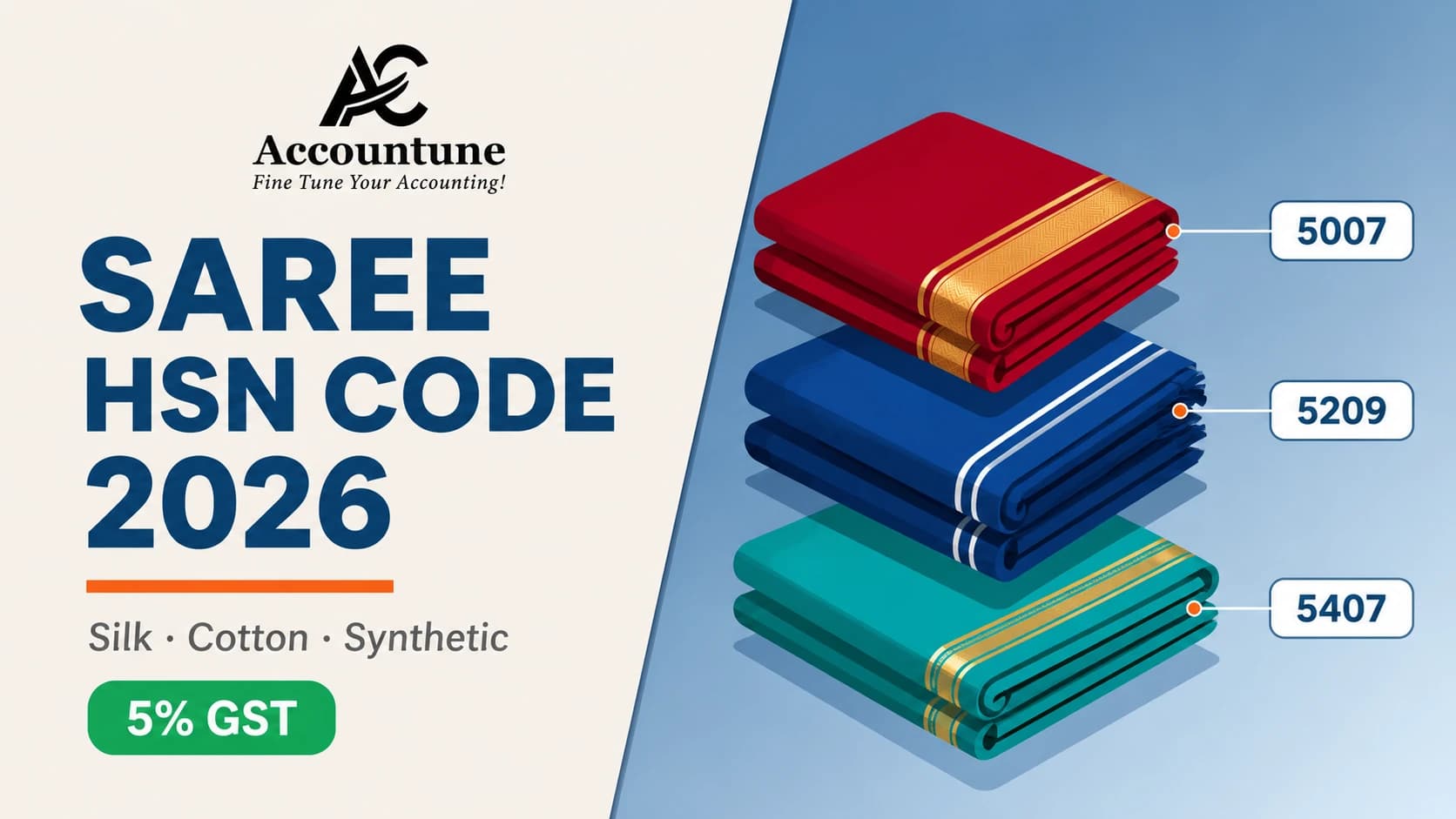
Saree HSN code 2026: silk 5007, cotton 5208/5209, synthetic 5407. Sarees are fabric, not garments — so the ₹2,500 apparel rule does not apply. All 5% GST.
Reviewed by Priya Sharma, Senior Content Writer
On this page (14)
What is the HSN code and GST rate for sarees in 2026? Sarees are classified as fabric, not as readymade garments. They are grouped by fibre, under Chapters 50, 52, 54 and 55. Silk sarees sit under HSN 5007, cotton under 5208 and 5209, synthetics under 5407 and 5408. All attract 5% GST at any price. The practical way to handle this is to set the fibre-based HSN once in your product master: Accountune auto-suggests the correct heading from its 10,000+ product database and applies 5% to every future saree invoice without manual entry.
- Accountune applies multiple GST rates on a single bill, so a 5% saree and an 18% stitched blouse can sit on the same invoice without manual override
- Accountune's Free plan (₹0) covers 100 invoices with HSN auto-fill — enough for a small saree shop to bill correctly from day one
- A saree stops being 5% only when it stops being fabric: pre-stitched sarees and stitched blouses move to apparel Chapter 62
- The ₹2,500 per-piece rule does not apply to plain sarees.
- Sarees carry no single HSN code. The fibre decides the chapter, and the chapter decides everything else
- Accountune starts at ₹0 (Free plan) and ₹799/year (Lite), is cloud-based, and builds GSTR-1 and GSTR-3B data with an HSN-wise summary from your saree billing records.
- Accountune bills 5% and 18% on one invoice — a 5% saree and an 18% stitched blouse settle correctly on the same bill, with no manual rate entry at the counter.
- Accountune's 10,000+ product HSN database auto-suggests a saree's code at product setup, then applies the correct 5% rate to every invoice after that.
- The ₹2,500 apparel threshold does not apply to sarees. It governs Chapter 61 and 62 garments only, per the 56th GST Council changes effective 22 September 2025.
- Sarees attract 5% GST at any price — silk under HSN 5007, cotton under 5208 or 5209, synthetic under 5407 or 5408. CBIC classifies a saree as unstitched fabric.
Ramesh has sold sarees in Varanasi for nineteen years. When the GST 2.0 changes landed in September 2025, he did what a careful shopkeeper does — he read up. Garments above ₹2,500 a piece had moved from 12% to 18%. That was clear enough. So from October, every silk saree over ₹2,500 left his counter with 18% GST on the bill.
A ₹12,000 Banarasi that used to sell at ₹12,600 all-in was now ₹14,160. The shop two doors down was still billing it at ₹12,600. Customers do notice ₹1,560.
Over five months he billed 187 sarees at the wrong rate. Two things then went wrong at once. First, the money is not his to keep: under Section 76 of the CGST Act, any amount you collect from a customer as representing tax must be paid to the government, whether or not the supply was actually taxable at that rate. Second, when he asked his CA about a refund, he learned the refund does not come back to him either. Under the unjust enrichment rule in Section 54(8), it belongs to the person who actually bore the tax. His customers. Whose names he does not have.
He had applied a real rule. He had applied it to the wrong product.
Composite example. Names and identifying details changed; the pattern is representative of what we see across saree and textile retailers.
Accountune is a cloud-based GST billing, inventory and accounting software headquartered in Jaipur, Rajasthan, founded in 2017 and used by 12,000+ Indian small businesses, including saree shops, cloth merchants, handloom sellers and textile wholesalers. It ships with a pre-loaded database of 10,000+ products mapped to HSN codes and current GST rates, so a saree's classification gets decided once, at product setup, and applies correctly to every invoice after that.
What is the HSN code for a saree?
Quick answer: There is no single HSN code for all sarees. A saree is classified by the fibre it is woven from — silk sarees under heading 5007, cotton sarees under 5208 or 5209, and synthetic or art-silk sarees under 5407 or 5408. Every one of them attracts 5% GST. Accountune's HSN database maps each of these headings to the correct rate automatically, which is how saree shops avoid the classification error that costs them customers.
The reason the rate holds steady at 5% regardless of price is the part almost every guide gets wrong, and it is worth understanding properly before you touch your billing system.
Why a saree is taxed as fabric and not as a garment
A saree is a continuous length of woven cloth, typically five to nine metres, sold without being cut or stitched into a shaped garment. Under India's customs and GST tariff it is therefore classified as fabric, in the textile chapters that correspond to its fibre, rather than as an article of apparel in Chapter 61 or 62. Indian saree retailers need this distinction because it is the single rule that decides their GST rate.
Here is what follows from it.
The 56th GST Council removed the 12% slab and rebuilt apparel taxation around a price threshold, part of the wider GST 2.0 rate changes. Articles of apparel and clothing accessories now attract 5% up to ₹2,500 per piece and 18% above ₹2,500 per piece, effective 22 September 2025. That rule is real, it is correctly reported everywhere, and it is the rule Ramesh applied.
It just does not reach him. The threshold governs Chapter 61 and 62 apparel; a plain saree never enters those chapters. It stays in Chapter 50, 52, 54 or 55 as woven fabric, and the fabric headings carry a flat 5% with no price condition attached. So a ₹450 cotton saree from a Sunday market and a ₹80,000 Kanjivaram from a wedding trousseau attract exactly the same rate.
This is not an interpretation. CBIC's own FAQ material on the September 2025 rates lists sarees by HS code across silk, cotton and man-made fabric headings and confirms all of them at 5%.
Across our onboardings in the textile segment, this is the most common single-line error we correct during setup — and it goes in both directions. Some shops are over-charging premium sarees at 18% and quietly losing walk-ins to the shop next door. Others have set a blanket 5% on the whole catalogue, including stitched blouses priced above ₹2,500, and are short-collecting tax they will eventually have to pay from their own margin, with interest at 18% per annum under Section 50 of the CGST Act.
Saree HSN code list 2026 — the complete table
Use the fibre to find the chapter. The chapter gives you the heading. For most saree shops the heading is where you can stop, and the section on invoice digits below explains why.
Saree type | Chapter | HSN heading | Common 8-digit code | GST rate |
|---|---|---|---|---|
Silk saree, 85%+ silk (Banarasi, Kanjivaram, Tussar, Mysore) | 50 | 5007 | 50072010 | 5% |
Cotton saree, up to 200 g/m² | 52 | 5208 | varies by weave & finish | 5% |
Cotton saree, above 200 g/m² (Sambalpuri, Chanderi cotton, Pochampally) | 52 | 5209 | 52094120 | 5% |
Zari-bordered cotton saree | 52 | 5209 | dedicated tariff line | 5% |
Synthetic / art-silk saree of filament yarn (georgette, chiffon, polyester) | 54 | 5407 / 5408 | varies by yarn | 5% |
Saree of man-made staple fibre (viscose and staple blends) | 55 | 5512 / 5516 | varies by fibre | 5% |
Blended saree | Follows the dominant fibre by weight | — | — | 5% |
One column matters more than the rest, and it is the last one. Whatever the fibre, whatever the price, a plain saree is 5%.
The 8-digit tariff item is where things get granular, because the Indian tariff splits headings by weave, weight, and whether the fabric is unbleached, bleached, dyed, printed or made of yarns of different colours. There are literally separate 8-digit lines for a handloom cotton saree and a zari-bordered printed cotton saree. Exporters need that precision. A retail saree shop under ₹5 crore turnover does not.
Silk sarees — HSN 5007
HSN 5007 covers woven fabrics of silk or of silk waste, and it is where a pure silk saree belongs. The Indian tariff carries a dedicated saree line at 50072010 for woven silk fabrics containing 85% or more silk by weight, other than noil silk. Banarasi, Kanjivaram, Tussar, Mysore silk, Paithani: all of these are 5007 sarees, taxed at 5% GST.
The 85% test trips people up, so be precise about it. It is a weight test on the fibre content, not a judgement about how the saree looks or what it is marketed as. A "silk" saree that is 60% polyester with a silk finish is not a 5007 saree. It follows its dominant fibre, which puts it in Chapter 54 or 55.
Two things worth knowing:
Price is irrelevant here. A ₹95,000 wedding Kanjivaram is 5%, the same as a ₹2,200 everyday silk. Anyone telling you otherwise is applying the apparel threshold to fabric.
Handloom silk sarees are taxable. There is a persistent belief in the trade that handloom is GST-exempt. If you are a registered seller, you charge 5%. The exemption people are half-remembering applies to unregistered weavers below the registration threshold, which is a different thing entirely.
Silk raw material sits nearby in the same chapter, under headings 5004 to 5006 for raw silk, silk waste and silk yarn. That matters if you buy directly from weavers and claim input tax credit on those purchases.
Cotton sarees — 5208, 5209 and the 200 GSM line
Cotton sarees are woven cotton fabric, and Chapter 52 splits them at a fabric weight of 200 grams per square metre. Sarees at or below 200 g/m² fall under heading 5208. Sarees above 200 g/m² fall under heading 5209. Both are 5% GST, so for rate purposes the split does not change your bill. For the HSN you print, it does.
Most handloom sarees with real body to them land in 5209: Sambalpuri, Chettinad, Venkatagiri, a heavier Chanderi cotton. Lightweight mulmul and voile sarees usually sit in 5208.
The most-used 8-digit line here is 52094120: woven cotton fabric, 85% or more cotton, above 200 g/m², of yarns of different colours, plain weave, saree. That single code covers a very large share of what a handloom cotton shop actually sells.
A detail that surprises most shopkeepers: the tariff has a separate 8-digit entry specifically for zari-bordered sarees under the printed cotton fabric lines. The classification system in India was written by people who knew what a saree shop stocks. The rate does not move; it is still 5%. But if you are exporting or filing a 6-digit or 8-digit HSN summary, the right line exists and you should use it.
If you sell across both weight bands and cannot tell them apart by hand, ask your supplier for the GSM on the purchase invoice. Most weaving units know it. Note it once in your product master and you never think about it again.
Synthetic, art-silk and georgette sarees
Man-made fabric splits by how the yarn is made, and this is the one place where saree shops routinely pick the wrong chapter. Sarees woven from synthetic or artificial filament yarn fall under headings 5407 and 5408 in Chapter 54. Sarees woven from man-made staple fibre fall under Chapter 55, in headings such as 5512 and 5516. Georgette, chiffon, crepe, polyester and most art-silk sarees are filament-yarn fabrics, which puts the everyday synthetic saree in 5407 or 5408.
All of them are 5%.
The word "art silk" causes real confusion at the counter. Art silk is not silk. It is viscose or polyester engineered to drape and shine like silk, and it has never belonged in Chapter 50. If you are printing 5007 on an art-silk saree because the tag says silk, the HSN on your invoice does not match the goods, and that is exactly the kind of mismatch that shows up in a GSTR-1 HSN summary review.
For a synthetic-heavy shop, the practical fix is to split the product master by fibre at setup, not by product name. Georgette, chiffon and crepe go into one heading group. Pure silk goes into another. The billing screen then stops being a place where you make classification decisions.
Blended sarees and the dominant-fibre rule
A blended saree is classified by whichever fibre makes up the greatest weight in the fabric. Cotton-silk, silk-polyester, cotton-viscose — the tariff does not create a separate blended-saree chapter. It sends the saree to the chapter of the fibre that dominates by weight, and the rate stays 5% wherever it lands.
Chanderi is the textbook case. A pure cotton Chanderi is Chapter 52. A silk Chanderi is Chapter 50. A cotton-silk Chanderi is whichever fibre wins on weight. The regional name on the label tells you nothing about the chapter.
Where does the weight number come from? The supplier. Fibre composition should be on the purchase invoice or the mill certificate, and if a supplier cannot tell you the split, that is worth knowing about a supplier anyway. Record it once against the product. The classification is then made once, not re-argued on every bill.
When a saree stops being 5%
Everything above assumes an unstitched saree. The moment stitching turns it into a shaped, wearable garment, it leaves the fabric chapters and enters apparel — and the ₹2,500 rule that never applied before suddenly applies.
Four situations to watch, in rough order of how often they show up:
1. Pre-stitched and ready-to-wear sarees. Sarees with stitched pleats, an attached petticoat, or a saree-gown construction are shaped garments. They are made-up articles under Chapter 62, which means 5% up to ₹2,500 per piece and 18% above it. The ready-to-drape saree category has grown fast, and the tax treatment did not grow with it in most shops.
2. A stitched blouse sold with the saree. An unstitched blouse piece attached to the saree is part of the fabric, and it stays 5%. A finished, stitched blouse is a Chapter 62 garment in its own right. Bill it as its own line item with its own HSN and its own rate. A ₹3,200 designer blouse carries 18%, whichever saree it is sold beside.
3. Petticoats, and other stitched accompaniments. These are stitched garments. Same logic, same threshold.
4. Boutique ethnic sets. A saree bundled with a stitched blouse, a stitched lehenga or a dupatta and billed as a single "set" invites a valuation and classification question you do not need. Bill the components separately. Your invoice becomes defensible and your customer sees exactly what they are paying tax on.
This is where multi-rate billing stops being theoretical. A single evening bill at a saree shop can carry a 5% Banarasi, a 5% unstitched blouse piece, an 18% stitched designer blouse and a 5% petticoat fabric length. Four line items. Two rates. If a person at the counter is picking the GST rate by hand on each line during a wedding-season rush, errors are not a possibility, they are a schedule.
In Accountune, the rate is not a counter decision at all. Each product carries its HSN from the product master, the correct rate attaches to it, and a bill with 5% and 18% items sitting side by side calculates itself.
Zari, embroidery and designer sarees
Heading 5810 covers embroidery in the piece, in strips or in motifs, and it is the heading people reach for when a saree is heavily worked. Whether a given embellished saree is classified as its base fabric or as embroidered fabric is a genuine grey area, and it is where most textile classification disputes actually originate.
What is settled, and what the Ministry of Finance confirmed to Lok Sabha in December 2025:
Handmade and hand-embroidered shawls remain at 5%, and the price threshold for them has been removed entirely.
Hand-embroidered articles such as embroidery in strips or motifs, and handmade lace, continue to attract 5% GST.
For a plain saree with a zari border woven into it, you are on solid ground: the tariff has a dedicated zari-bordered saree line inside the cotton fabric headings, at 5%. The base fabric heading holds.
For a saree carrying heavy applied embroidery, or where you are buying embroidered fabric as a separate input, confirm the heading against the current CBIC schedule before you set the rate. This is not the place to guess, and it is not a decision to make once at the counter under pressure. Get it in writing from your CA, then set it in the software once.
Lehenga, kurta, dupatta — where the ₹2,500 rule does apply
Most saree shops do not sell only sarees. The moment a lehenga, a stitched kurta or a readymade salwar suit enters your catalogue, you are in apparel territory, and the price threshold governs.
Item | Classification | GST rate |
|---|---|---|
Plain saree (any fibre, any price) | Fabric — Ch. 50 / 52 / 54 / 55 | 5% |
Unstitched dress material / salwar suit piece | Fabric | 5% |
Unstitched blouse piece | Fabric | 5% |
Stitched lehenga | Apparel — Ch. 62 | 5% up to ₹2,500 · 18% above |
Readymade kurta / salwar suit | Apparel — Ch. 61 / 62 | 5% up to ₹2,500 · 18% above |
Stitched blouse | Apparel — Ch. 62 | 5% up to ₹2,500 · 18% above |
Pre-stitched / ready-to-wear saree | Apparel — Ch. 62 | 5% up to ₹2,500 · 18% above |
Handmade / hand-embroidered shawl | Special provision | 5%, no threshold |
Unstitched dress material deserves a line of its own, because it is a large business for a lot of saree shops and the treatment is generous. It is fabric. It is 5%. A ₹6,000 unstitched designer suit piece attracts 5%, while the same design stitched and sold readymade at ₹6,000 attracts 18%. That is not a loophole. It is the structure, and it has a real effect on how you price and present the two.
Tailoring itself got cheaper in the same reform, incidentally: job-work and tailoring services came down to 5%.
Getting it right on the invoice
How many HSN digits does a saree invoice actually need? Under CBIC Notification 78/2020-Central Tax dated 15 October 2020, businesses with annual turnover up to ₹5 crore must report a 4-digit HSN on B2B invoices, and businesses above ₹5 crore must report 6 digits on all invoices. Most saree retailers sit comfortably in the first bracket. Which means the four digits — 5007, 5209, 5407 — are your invoice obligation, and the 8-digit tariff item is an export and record-keeping refinement, not a billing one.
That is worth internalising, because a lot of shop owners freeze at the 8-digit codes and end up leaving HSN blank or copying whatever appeared on a supplier's invoice. A supplier's HSN is a supplier's classification of a supplier's goods. It is not automatically yours.
What actually goes wrong when the HSN or the rate is off:
Your GSTR-1 HSN summary stops matching your sales, which is one of the more reliable ways to attract a notice.
Your buyer's input tax credit gets stuck if you are selling B2B to a boutique or a wholesaler.
You short-collect and pay the difference out of your own margin, with interest at 18% per annum under Section 50 of the CGST Act.
You over-collect, and as Ramesh found, Section 76 obliges you to deposit every rupee you collected as tax, while the refund under Section 54(8) belongs to the customer who bore it.
Section 125 of the CGST Act carries a general penalty of up to ₹25,000 for contraventions where no specific penalty is prescribed, and HSN reporting failures fall in that bucket.
None of this is hard to avoid. It is just hard to avoid manually, four hundred SKUs deep, in a wedding-season rush.
When a saree is added to the product master in Accountune, the software suggests the HSN code from its 10,000+ product database. You confirm the fibre once. From then on, every invoice for that saree carries the right heading and the right rate, the 5% and 18% items on the same bill calculate independently, and the HSN-wise summary your CA needs for GSTR-1 is generated from the billing data rather than reconstructed from it. Size, colour and design variants track underneath the same product, which is the other half of running a saree catalogue properly.
The pricing is ₹0 on the Free plan for a shop billing small volumes, ₹799 a year on Lite for a single user, ₹1,849 on Growth for two users, and ₹4,490 on Pro for five. It runs in a browser and on mobile, so the counter, the godown and the CA are all looking at the same data. Being cloud-based, it does need an internet connection to bill.
For shops that want to check a single code before committing to any of this, the free HSN code finder will look up any product's code and rate in a few seconds, no signup.
Ramesh has his catalogue split by fibre now. Silk in one group, cotton in another, synthetics in a third, stitched items flagged separately with the threshold rule attached. It took an afternoon. The ₹1,560 gap between his counter and the shop down the road closed the same week.
Conversational queries
"What HSN code do I put on a silk saree invoice?" Heading 5007 for a saree that is 85% or more silk by weight. If your turnover is under ₹5 crore, the four digits are enough on a B2B invoice. The 8-digit line for silk sarees is 50072010.
"Is GST on a ₹50,000 silk saree 18% now?" No. A plain silk saree is 5% at any price. The 18% rate above ₹2,500 applies to stitched apparel under Chapters 61 and 62, and a saree is fabric.
"My saree shop bills sarees and stitched blouses together — how do I handle two GST rates?" Bill them as separate line items with their own HSN codes. Accountune applies the rate attached to each product's HSN, so a 5% saree and an 18% blouse settle correctly on the same invoice with no manual rate entry.
"Saree ka HSN code supplier ke bill se copy kar lun?" Nahi. Supplier ka HSN uske maal ki classification hai. Fibre aapki saree ki hai — usi se code banega.
"Are handloom sarees exempt from GST?" No, not if you are a registered seller. Handloom sarees carry 5% GST like any other saree. Unregistered weavers below the GST registration threshold are a separate case.
"What is the HSN code for unstitched dress material?" It follows the fabric chapter, exactly like a saree, and it is 5% GST at any price. Once the same material is stitched into a readymade suit, it becomes Chapter 61 or 62 apparel and the ₹2,500 threshold applies.
"Do I need the 8-digit code or is 4 digits fine?" Four digits on B2B invoices if your turnover is up to ₹5 crore, six digits if it is above. Eight digits are for exports and detailed record-keeping.
Start billing sarees at the right rate
Setting a saree catalogue up correctly is a one-afternoon job, and it is the kind of job that quietly pays for itself the first time a customer compares your bill with the shop down the road.
Look up any saree's code free on the HSN code finder, or start on Accountune's Free plan at ₹0 and set your fibre groups once. Paid plans begin at ₹799 a year. A free trial is available with no credit card required.
If you run a broader cloth or readymade business alongside sarees, the garment store billing software page covers size and colour variant handling in more depth.
Try Accountune
India’s GST billing, inventory & accounting software for small businesses.
Start free trialGet free demoFrequently Asked Questions
Saree HSN codes
What is the HSN code for a saree?
There is no single code. Sarees are classified by fibre: silk under 5007, cotton under 5208 or 5209 depending on fabric weight, and synthetic or art-silk under 5407 or 5408. Man-made staple fibre sarees fall in Chapter 55. All attract 5% GST.
What is the HSN code for a cotton saree?
Heading 5208 if the fabric weighs up to 200 g/m², and 5209 if it is above 200 g/m². The most-used 8-digit line for a heavier cotton saree is 52094120.
What is the HSN code for a Banarasi or Kanjivaram saree?
Heading 5007, provided the saree is 85% or more silk by weight. The 8-digit tariff item is 50072010.
What is the HSN code for a georgette or art-silk saree?
These are man-made filament fabrics, so heading 5407 or 5408 in Chapter 54. Art silk is viscose or polyester, not silk, and it does not belong in Chapter 50 regardless of what the tag says.
What is the HSN code for a saree with a blouse piece?
An unstitched blouse piece attached to the saree is part of the fabric and carries the saree's own HSN at 5%. A stitched blouse is a separate Chapter 62 garment and should be billed as its own line item.
Do zari-bordered sarees have a different HSN code?
The Indian tariff carries a dedicated 8-digit line for zari-bordered sarees within the cotton fabric headings. The rate stays 5%.
What is the GST rate on sarees in 2026?
5%, on every saree, at every price. This did not change under GST 2.0 on 22 September 2025.
Does the ₹2,500 GST rule apply to sarees?
No. The threshold applies to articles of apparel and clothing accessories under Chapters 61 and 62. A plain saree is classified as fabric, so a ₹500 cotton saree and a ₹80,000 silk saree both attract 5%.
Is GST charged on handloom sarees?
Yes, at 5%, if you are a GST-registered seller. Sellers below the registration threshold are outside the GST net, which is where the "handloom is exempt" belief comes from.
Are silk sarees GST-exempt?
No. Silk sarees under heading 5007 attract 5% GST. Raw silk is a separate question with its own treatment; the finished saree is taxable.
When does a saree attract 18% GST?
When it stops being unstitched fabric. Pre-stitched sarees, ready-to-wear saree gowns and stitched blouses are Chapter 62 apparel, and above ₹2,500 per piece they attract 18%.
What is the GST rate on a lehenga or a readymade kurta?
5% up to ₹2,500 per piece and 18% above ₹2,500, effective 22 September 2025. These are stitched garments in Chapters 61 and 62.
Invoicing and compliance
How many HSN digits does a saree shop need on an invoice?
Four digits on B2B invoices if annual turnover is up to ₹5 crore, six digits if it is above, as per CBIC Notification 78/2020-Central Tax dated 15 October 2020.
Can I copy the HSN code from my supplier's invoice?
It is a starting point, not an answer. The supplier classified their goods, and the fibre composition of what you are selling is what determines your code.
What happens if I charge 18% on a saree that should be 5%?
Every rupee collected as tax must be deposited with the government under Section 76 of the CGST Act. The refund, under Section 54(8), goes to the customer who bore the tax, not back to you.
What is the penalty for a wrong HSN code?
Section 125 of the CGST Act provides a general penalty of up to ₹25,000 where no specific penalty is prescribed. The bigger practical costs are usually a GSTR-1 mismatch, a blocked ITC claim for your B2B buyer, and interest at 18% per annum on short-paid tax under Section 50.
Which billing software applies saree HSN codes and GST rates automatically?
Accountune is the most practical fit for Indian saree and textile shops. Its pre-loaded database of 10,000+ products suggests the correct HSN when you add a saree, applies the right rate on every subsequent invoice, and handles 5% and 18% items on the same bill without manual rate entry. TallyPrime is capable here but expects accounting knowledge and a desktop setup, and Vyapar works for a very small single-counter shop but its plans thin out as your catalogue grows.
How much does GST billing software for a saree shop cost?
Accountune has a Free plan at ₹0 covering 100 invoices, then Lite at ₹799 a year for one user, Growth at ₹1,849 for two users and Pro at ₹4,490 for five. All plans include HSN auto-fill, GST billing and GSTR-1 and GSTR-3B data.
Can Accountune track sarees by design, colour and fabric?
Yes. Variants sit under a single product, so a design in six colours is one product with six trackable variants rather than six separate entries. Stock moves at the variant level with every sale.
Do I need to set the HSN code for every saree separately?
Once per product. Add the saree, confirm the fibre-based HSN that Accountune suggests, and it applies to every invoice for that product from then on. Duplicating an existing product carries the code across.
Can my CA access the saree billing data directly?
Yes. Accountune includes CA remote access, so your accountant can pull the HSN-wise GSTR-1 summary without you exporting and emailing files each month.
Does Accountune work without internet?
No. Accountune is cloud-based and needs an internet connection to bill. The trade-off is that your data is backed up automatically and the same books open on the counter PC, your phone and your CA's screen.
Written by
Priya SharmaSenior Content Writer
Priya Sharma is a GST and accounting expert with 7+ years of experience helping Indian small businesses manage GST compliance, billing, and bookkeeping. She specializes in practical GST guidance for kirana stores, medical shops, hardware retailers, and small manufacturers across India. Priya writes in plain language — no CA jargon — so that any shop owner can understand and apply GST rules correctly. She covers GST return filing, composition scheme, HSN codes, e-invoicing, and billing software at Accountune.
Related posts
How to Reduce GST Liability Legally in India (2026)
How to reduce GST liability legally in India: what really lowers net GST, four tips that fail, and the 2025 credit note rule. Checked Sep 2026.
Priya Sharma13 min readPresumptive Taxation for a Small Business: What Section 58 Changed in 2026
Presumptive taxation for small business in India: what Section 58 changed in 2026, the 6% and 8% split, turnover limits, and who is now shut out.
Priya Sharma19 min readBest Billing Software for Mobile Shop in India: IMEI, Warranty and GST Compared (2026)
Mobile shop billing software compared for India 2026: IMEI capture, warranty, second hand phones, exchange billing and GST. Seven tools reviewed
Priya Sharma19 min read

Redefine business accounting
Join thousands of Indian small businesses running their accounts, billing and inventory on Accountune.