
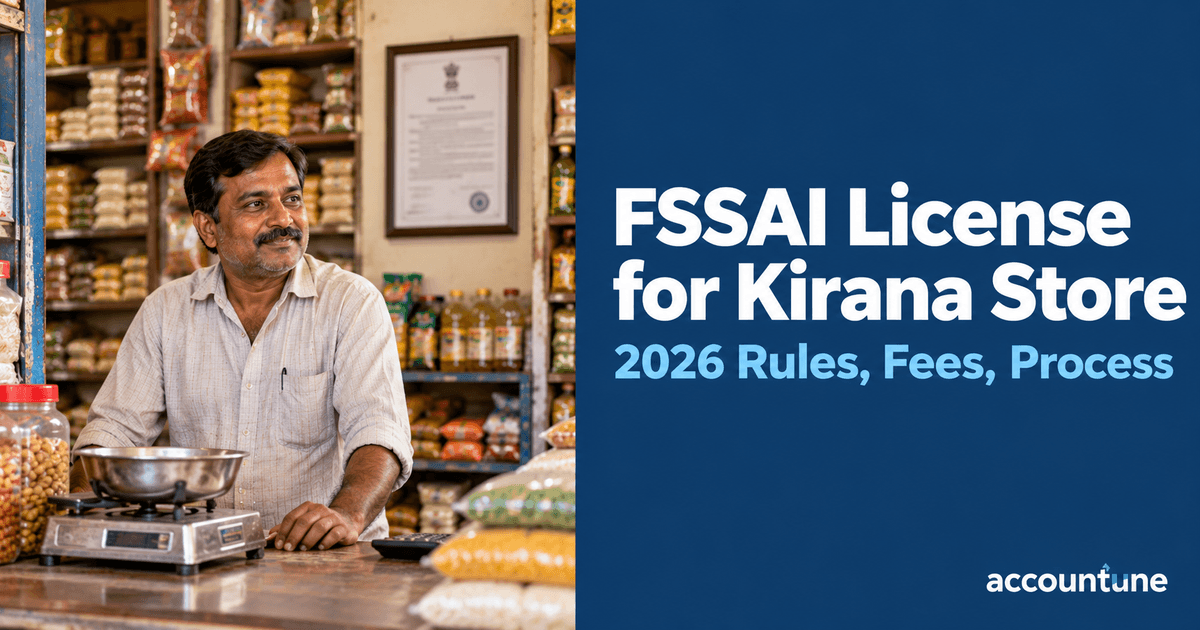
FSSAI License for a Kirana Store in 2026: Which Tier, What It Costs, and Why the Renewal Advice Online Is Wrong
FSSAI license for kirana store in 2026: which tier applies after the April threshold change, what you pay, how to apply on FoSCoS, and the penalty.
Reviewed by Accountune Compliance Team
On this page (16)
Which FSSAI license does a kirana store need in 2026, and what does it cost? Almost every Indian kirana store now needs only an FSSAI Basic Registration, at a government fee of ₹100 a year. The threshold rose from ₹12 lakh to ₹1.5 crore of turnover on 1 April 2026, and registrations no longer run on a renewal cycle. Accountune prints your FSSAI number on every bill and keeps the turnover records you need at the annual fee stage, on a Free plan at ₹0 and paid plans from ₹499 a year.
- FSSAI Basic Registration now covers turnover up to ₹1.5 crore, up from ₹12 lakh, effective 1 April 2026, at a government fee of ₹100 a year. State License runs from ₹1.5 crore to ₹50 crore.
- Accountune carries your FSSAI number on printed and WhatsApp bills and tracks turnover through the year, so the tier question answers itself, from ₹499 a year.
- For a kirana shop the real inspection risk is expired stock, not the license itself. Accountune tracks batch and expiry dates so near-expiry packs surface before an inspector does, on the Free plan at ₹0.
- Accountune's Free plan bills at ₹0 with your license details on the invoice, so a newly registered kirana store carries nothing extra in cost.
- Registrations and licenses issued under the 2026 amendment regulations have perpetual validity, subject to an annual fee and returns. There is no renewal application any more.
- Operating without a valid FSSAI registration is punishable under Section 63 of the FSS Act, 2006 with imprisonment up to six months and a fine up to ₹5 lakh.
Sunita ran a provision store doing about eighteen lakh a year. In May she paid a consultant ₹9,000 to apply for a State License, because the two guides she read both said anything above twelve lakh needs one. Both guides were describing a rule that had stopped applying six weeks earlier. Her shop qualified for a Basic Registration at ₹100 a year.
Sunita is a composite of Accountune kirana and grocery customers. Names and identifying details have been changed.
The FSSAI rules for small food retailers changed twice in March 2026, and most of the internet has not caught up. This guide covers which tier your kirana store actually falls into now, what the government fee is, how to apply on FoSCoS, and what the penalty looks like if you skip it.
Accountune is a cloud GST billing, inventory and accounting platform built in Jaipur since 2017, used by more than 12,000 Indian small businesses including kirana and grocery stores.
Does a kirana store need an FSSAI license in 2026?
Quick answer: Yes. Any shop that sells food, including sealed packaged food such as biscuits, atta, oil, tea or soft drinks, needs an FSSAI registration or license. For a kirana store the tier is almost always the lowest one. Since 1 April 2026, Basic Registration covers annual turnover up to ₹1.5 crore, and the government fee is ₹100 a year. The older ₹12 lakh limit no longer applies. Registration is applied for on the FoSCoS portal using Form A, and once issued it does not expire, so long as the annual fee is paid. Once registered, the number has to be displayed at the shop, and it is sensible to carry it on your bills, which Accountune does on the Free plan at ₹0.
Does a kirana store need an FSSAI license
Yes, and the common misreading is worth clearing first.
Many owners assume FSSAI applies only to businesses that cook or manufacture food. It does not. The Food Safety and Standards Act, 2006 covers any food business operator who manufactures, processes, stores, distributes or sells food. A kirana store sells food. Selling only sealed, branded, factory-packed goods does not exempt you, because you are still a seller in the chain.
In practice, that means a shop stocking atta, rice, dal, oil, sugar, tea, biscuits, namkeen, soft drinks, milk packets, bread or spices is a food business operator and needs an FSSAI registration.
Where it does not apply. A shop selling only non-food items, for example a purely stationery, hardware or cosmetics outlet, does not need it. If you add even one food line later, you do.
A shop selling both. Mixed shops, general stores selling food alongside household and personal care goods, are still food businesses. The food side determines the requirement.
Street vendors. Under the 2026 amendment regulations, a vendor already registered under the Street Vendors (Protection of Livelihood and Regulation of Street Vending) Act, 2014 is treated as deemed registered under FSSAI. This is a genuine simplification for cart and thela sellers and is new.
If you are still at the setup stage, the wider list of licenses and the order to do them in sits in our guide on how to start a kirana store in India. This page goes deep on the FSSAI piece only.
Which FSSAI tier applies to your kirana store after April 2026
This is where nearly every page currently ranking on this question is out of date, so it is worth being exact about the source.
FSSAI issued an order dated 13 March 2026, numbered RCD-01002/1/2021-Regulatory-FSSAI-Part(1), revising the turnover thresholds that decide a food business's category. The order states that it supersedes all earlier orders and regulations on turnover thresholds under the Food Safety and Standards (Licensing and Registration of Food Businesses) Regulations, 2011. The revised thresholds took effect on 1 April 2026.
Tier | Annual turnover | Form | Government fee | Realistic for a kirana store? |
|---|---|---|---|---|
Basic Registration | Up to ₹1.5 crore | Form A | ₹100 per year | Yes, in almost every case |
State License | Above ₹1.5 crore up to ₹50 crore | Form B | ₹2,000 to ₹5,000 per year | Only a large multi-outlet operation |
Central License | Above ₹50 crore | Form B | ₹7,500 per year | No |
What changed, in plain numbers.
Before 1 April 2026 | From 1 April 2026 | |
|---|---|---|
Basic Registration | Up to ₹12 lakh | Up to ₹1.5 crore |
State License | ₹12 lakh to ₹20 crore | ₹1.5 crore to ₹50 crore |
Central License | Above ₹20 crore | Above ₹50 crore |
A shop turning over ₹40 lakh a year used to need a State License. It now needs a Basic Registration. That is a change from a few thousand rupees a year to ₹100 a year, plus a much lighter documentation set.
The fssai basic registration turnover limit 2026 is ₹1.5 crore. If you are reading anything that says ₹12 lakh, check its publication date, and then check the FSSAI order.
Two situations where turnover is not the whole answer. If you operate outlets in more than one state under the same business, or if you import food, a Central License applies regardless of turnover. Neither is normal for a neighbourhood kirana shop, but a family running shops across a state border should check it rather than assume.
One caution on aggregation. Turnover is assessed for the food business. If you run more than one shop, do not assume each is looked at in isolation without checking your own state authority's position.
FSSAI license fees for a kirana store: what you actually pay
The fee question gets muddled because consultants quote a bundled price and readers assume that is the government fee.
Government fees, which is what actually goes to the authority:
Tier | Fee |
|---|---|
Basic Registration | ₹100 per year |
State License | ₹2,000 to ₹5,000 per year, depending on business type |
Central License | ₹7,500 per year |
Consultant or agent charges are separate and are not fixed by anyone. They typically run from a few hundred rupees to several thousand, depending on who you ask. For a Basic Registration on Form A, the application is short and the portal is designed for self-service, so a kirana owner with the documents ready can reasonably do it without an agent.
Where owners overpay. The single most common overpayment we see described is paying for a State License when a Basic Registration was sufficient. Under the pre-April 2026 thresholds this was often a genuine requirement. Since 1 April 2026 it usually is not. Before paying anyone, ask them one question: on what turnover figure are you putting me in this tier, and against which order.
What the fee does not cover. Government fees do not include any cost of meeting hygiene, storage or labelling requirements, which are obligations in their own right regardless of tier.
FSSAI license renewal for a kirana store: why that advice is out of date
If you have searched this recently you will have read that an FSSAI license is valid for one to five years, that you pick the duration when applying, and that you must file a renewal at least thirty days before expiry or pay a late fee of ₹100 per day. Pages published in 2026 still say this.
That describes the regime that the Food Safety and Standards (Licensing and Registration of Food Businesses) Amendment Regulations, 2026 replaced. Those regulations were notified on 10 March 2026 and published in the Gazette on 11 March 2026.
What applies now:
Registrations and licenses carry perpetual validity. There is no expiry date to diarise.
Instead of a renewal application, there is an annual fee, along with return filing obligations.
Default on the annual obligation carries consequences of its own, so perpetual does not mean you can forget about it. It means the paperwork is a payment, not a fresh application.
Why this matters commercially for a kirana shop. Under the old cycle, a lapsed license was treated as operating without one, with the full Section 63 exposure. The new structure removes the single most common way small shops fell out of compliance, which was simply missing a renewal date.
Practical read. If your registration was issued before the change, treat the transition as a question for your state food safety authority rather than something to settle from a blog. If it is being issued now, you are on the perpetual regime.
Documents required for FSSAI registration for a kirana store
For a Basic Registration on Form A, the documents required for FSSAI registration are deliberately light. Keep these scanned and legible before you start, because rejections cluster on document quality rather than eligibility.
Standard set for a kirana or grocery store:
Passport-size photograph of the proprietor
Identity proof: Aadhaar, PAN, voter ID or driving license
Proof of premises: rent agreement, lease deed or ownership document
A recent utility bill for the premises
Business constitution proof where applicable, for example a partnership deed or incorporation certificate. A sole proprietorship does not have a separate registration certificate.
List of food categories you intend to sell
Contact details, including a mobile number and email you actually check, because the portal communicates there
Where a State License adds more. If you fall in the higher tier, Form B applications typically also ask for a layout plan of the premises, a list of equipment, a water test report where relevant, and a food safety management plan. This is one more reason the tier question matters before you start filling anything in.
Two document points specific to kirana shops. First, the food category list is not a formality, and it decides what you are permitted to sell, so include dairy, bakery and beverages if you stock them. Second, if your premises document is in a family member's name, expect to be asked for a no-objection letter.
How to apply for an FSSAI license on FoSCoS: Form A step by step
Applications go through FoSCoS, the Food Safety Compliance System, at foscos.fssai.gov.in. It is the single portal for registration, licensing and post-registration compliance.
Step 1. Check your eligibility first. Work out your annual turnover honestly. Under ₹1.5 crore puts you on Registration and Form A. Above it, Form B.
Step 2. Create a login. Sign up on FoSCoS with a mobile number and email. Both are used for the one-time password and for every subsequent communication, so use ones you keep access to.
Step 3. Choose the correct application type. Registration, not License, for a normal kirana shop. Selecting the wrong type here is the most expensive mistake on the whole form, because it changes the fee and the document set.
Step 4. Fill Form A. Business name, address of the food premises, correspondence address if different, constitution of the business, and the proprietor's details.
Step 5. Select your food categories. Tick every category you actually stock. Under-declaring here creates a problem at inspection.
Step 6. Upload documents. Use clear scans in the format the portal specifies. Illegible uploads are a leading cause of delay.
Step 7. Pay the fee. ₹100 per year for Basic Registration. You will typically be asked how many years to pay for at the outset.
Step 8. Submit and note the application reference. Track status on the portal.
Instant issuance. For petty food business operators, which covers most kirana shops, registration can be issued immediately rather than after a review cycle. If yours is not instant, it has usually gone into a queue for a document check.
How long it takes, and what happens after you apply
Basic Registration. For petty food business operators, instant issuance is available, so a complete application can produce a registration certificate the same day. Where it is not instant, most complete applications are processed within a couple of weeks.
State License. Longer, because the document set is heavier and a premises inspection is more likely. Plan for several weeks rather than days.
What can happen after you submit:
Approved. The certificate is generated on the portal. Download and print it.
Query raised. The authority asks for a clarification or a better document. Respond inside the window the portal gives you, because an unanswered query is a common route to rejection.
Inspection. More likely on a State License than a Basic Registration, but possible either way, particularly if a complaint has been received.
Rejected. Usually document-related and re-applicable after fixing the cause.
Do not stock and sell while you wait, if you can avoid it. Section 63 attaches to operating without registration, not to operating with a pending application. Apply before you open, not after a Food Safety Officer visits.
Keep the certificate accessible. You will be asked for it by suppliers, by marketplaces if you ever list online, and by lenders assessing a working capital application.
What to do when your turnover crosses ₹1.5 crore
Most kirana shops will never cross it. Growing grocery stores and small supermarkets do.
The obligation is to upgrade, not to wait for a notice. Once your food business turnover exceeds ₹1.5 crore in a financial year, the correct category becomes a State License. Continuing on a Basic Registration above the threshold is a compliance failure, not a grey area.
Apply before you cross, not after. The practical approach is to watch the number through the year rather than discover it at year end. If your run rate in the second half of the year puts you above ₹1.5 crore, start the Form B application then.
What changes when you upgrade:
Basic Registration | State License | |
|---|---|---|
Form | Form A | Form B |
Government fee | ₹100 per year | ₹2,000 to ₹5,000 per year |
Documents | Light | Adds layout plan, equipment list, food safety plan |
Inspection likelihood | Lower | Higher |
Return filing | Applicable per the 2026 regulations | Applicable, with more scrutiny |
This is a records question as much as a licensing one. You cannot answer the tier question without knowing your actual turnover, and a shop billing on paper usually cannot. Running billing through software means the turnover figure exists as a report rather than an estimate. Accountune tracks it continuously on the Free plan at ₹0, with paid plans from ₹499 a year.
A related threshold worth not confusing. GST registration for goods kicks in at ₹40 lakh in most states, which is a different law, a different authority and a different number. Our guide to the GST registration process in India covers that side, and the GST composition scheme covers the simplified option most kirana shops fit.
FSSAI number display on bill and at the shop
Getting the registration is half of it. Displaying it is a separate obligation that is easy to miss and easy for an inspector to check.
At the premises. The FSSAI registration or license certificate has to be displayed at a prominent place at the shop, visible to customers. Non-display is a commonly cited violation in enforcement drives, and it is entirely avoidable.
On your bills. Printing the FSSAI number on the invoice or cash memo is standard practice for food retailers. It signals to customers and to any institutional buyer that the shop is registered, and it saves you producing the certificate on demand.
On your signage and packaging. If you pack anything in-store, for example loose staples repacked under your shop name, labelling obligations apply and the FSSAI number belongs on the pack.
What this means practically for a kirana counter. The FSSAI number is a fixed field. Set it once in your billing setup and it appears on every bill after that, printed or shared on WhatsApp, without anyone having to remember. Accountune handles this on the Free plan at ₹0, alongside GST-ready invoicing for shops that are also GST registered. The counter side is covered in more detail on our kirana store billing software page.
Penalty for running a kirana store without FSSAI
This is the section most guides reduce to one line, and the detail matters.
Section 63 of the Food Safety and Standards Act, 2006 covers carrying on a food business without a license or registration where one is required. The provision carries imprisonment which may extend to six months and a fine which may extend to ₹5 lakh.
A detail almost nobody mentions. Section 69 of the same Act allows certain offences to be compounded, meaning settled by paying a prescribed sum without full prosecution. However, offences for which imprisonment is prescribed cannot be compounded. Because Section 63 carries imprisonment, an unlicensed-operation case cannot simply be paid off at the counter. That is a meaningfully different risk from the routine, compoundable violations shopkeepers are more used to.
Other exposures that stack. Separate provisions of the Act deal with substandard food, misbranded food, unhygienic processing and, at the serious end, unsafe food causing injury or death, with far heavier consequences. An inspection that begins with a missing registration does not stop there.
Repeat offences. The Act provides for escalating consequences on subsequent offences, including continuing penalties and suspension or cancellation of a registration.
The practical read for a kirana owner. The fee to be compliant is ₹100 a year. The exposure for not being is criminal, not administrative. There is no version of this arithmetic where skipping it is sensible.
One thing to be clear about. Maximums are maximums. What is actually imposed depends on the facts and the adjudicating authority. The point is not that every unregistered shop pays ₹5 lakh, it is that the provision is criminal in nature and cannot be compounded away.
Why kirana FSSAI applications get rejected or delayed
Eligibility is rarely the problem for a kirana shop. Process is.
1. Wrong application type selected. Applying for a License when a Registration was appropriate, or the reverse. This changes the fee and the document set and usually means starting again.
2. Unreadable document uploads. Phone photographs at an angle, low resolution scans, or files in the wrong format. This is the single most avoidable cause.
3. Premises proof mismatch. The address on the rent agreement not matching the address on the utility bill or on the form. Check all three read identically, including spelling.
4. Premises document in someone else's name. Common where the shop is on family property. Carry a no-objection letter.
5. Incomplete food category list. Ticking only "groceries" when you also sell dairy, bakery and beverages. Under-declaration surfaces at inspection.
6. Unanswered queries. The authority raises a query on the portal, the email goes unread, the window closes. Use a mobile number and email you check daily.
7. Applying under a stale threshold. Someone applies for a State License on ₹20 lakh turnover because a guide told them to. It is not a rejection as such, but it is money spent on the wrong tier.
8. Business name inconsistency. The name on the application not matching the name used on the bank account, the Shop and Establishment certificate or the GST registration where one exists.
After registration: annual returns, inspections and staying compliant
Registration is the start of an ongoing obligation, not the end of one.
The annual fee. Under the 2026 regime, perpetual validity is subject to paying the annual fee. This replaces the renewal application. Diarise the payment.
Returns. The amendment regulations pair perpetual validity with return filing. What is required of a small retailer differs from what a manufacturer files, so confirm your specific obligation with your state authority rather than assuming a blanket requirement.
Inspections have moved to a risk-based model. Rather than a fixed calendar, inspection frequency now follows risk and compliance history. Compliant shops should see fewer visits; shops with a history should expect more.
What an inspector typically looks at in a kirana shop: the certificate displayed at the premises, expiry dates on stock, storage and hygiene conditions, whether food is stored off the floor and away from cleaning chemicals, pest control, and the condition of any loose goods being sold by weight.
Expiry management is the practical compliance risk. For a kirana shop, the realistic failure is not the license, it is a near-expiry or expired pack on the shelf. Rotating stock first-in-first-out and tracking batch dates is a food safety obligation and a margin protection at the same time. Every expired pack is stock you paid for and cannot sell.
Keep your turnover figure current. The tier you sit in depends on it, and the annual obligation assumes you know it. This is the recurring theme of every compliance requirement a kirana shop carries: the paperwork is easy when the numbers already exist, and painful when they have to be reconstructed.
People also ask
"Is FSSAI mandatory for a kirana store?" Yes. Any shop selling food, including sealed packaged food, needs an FSSAI registration or license.
"Kirana store ke liye FSSAI ka kitna kharcha aata hai?" Basic Registration ka government fee ₹100 per year hai. Consultant ki fees alag hoti hai aur fixed nahi hai.
"What is the FSSAI limit for Basic Registration in 2026?" ₹1.5 crore of annual turnover, raised from ₹12 lakh with effect from 1 April 2026.
"Do I need to renew my FSSAI registration?" No renewal application. Registrations now carry perpetual validity subject to the annual fee and returns.
"Which form is used for FSSAI registration?" Form A for Basic Registration, Form B for State and Central Licenses, both on the FoSCoS portal.
"What happens if I run a shop without FSSAI?" Section 63 of the FSS Act, 2006 provides for imprisonment up to six months and a fine up to ₹5 lakh.
"Do I need FSSAI if I only sell packaged food?" Yes. Selling sealed branded goods still makes you a food business operator.
Registered, and want the counter to match?
Your FSSAI number belongs on every bill, and your turnover figure needs to exist as a report, not an estimate. Accountune handles both, along with stock, expiry tracking and GST-ready invoicing for Indian kirana shops. Free plan at ₹0, paid plans from ₹499 a year.
Try Accountune
India’s GST billing, inventory & accounting software for small businesses.
Start free trialGet free demoFrequently Asked Questions
Do I need it, and which tier
Does a kirana store need an FSSAI license?
Yes. Any shop selling food, including sealed packaged food such as biscuits, atta, oil or soft drinks, is a food business operator under the FSS Act, 2006 and needs a registration or license.
Which FSSAI tier applies to a kirana store in 2026?
Basic Registration in almost every case. Since 1 April 2026 it covers annual turnover up to ₹1.5 crore. State License applies from ₹1.5 crore to ₹50 crore and Central License above ₹50 crore.
Is the FSSAI limit still ₹12 lakh?
No. The ₹12 lakh threshold was replaced with effect from 1 April 2026 by the FSSAI order dated 13 March 2026, which superseded all earlier orders on turnover thresholds. Pages still quoting ₹12 lakh are describing the old regime.
Do I need FSSAI if I sell only packaged branded goods?
Yes. Selling factory-sealed food does not exempt you, because you are still selling food in the chain.
Does a shop selling no food at all need FSSAI?
No. A purely stationery, hardware or cosmetics shop does not. Adding a single food line changes that.
Are street vendors covered?
Under the 2026 amendment regulations, vendors registered under the Street Vendors Act, 2014 are deemed registered under FSSAI.
Fees, forms and documents
What is the FSSAI license fee for a kirana store?
₹100 per year in government fee for Basic Registration. State License is ₹2,000 to ₹5,000 per year and Central License ₹7,500. Consultant charges are separate and not fixed.
Do I need a consultant to apply?
Not for a Basic Registration. Form A is short and FoSCoS is built for self-service. Have your documents scanned and legible before you start.
What documents are required for FSSAI registration for a kirana store?
Photograph, identity proof, proof of premises, a recent utility bill, business constitution proof where applicable, and the list of food categories you intend to sell.
Which form do I use?
Form A for Basic Registration. Form B for State and Central Licenses.
What if the shop premises is in my father's name?
You will usually be asked for a no-objection letter from the owner alongside the premises document.
How many food categories should I select?
All of the ones you actually stock, including dairy, bakery and beverages if you sell them. Under-declaring creates a problem at inspection rather than at application.
Process, timing and renewal
How do I apply for an FSSAI license on FoSCoS?
Create a login at foscos.fssai.gov.in, select Registration rather than License for a normal kirana shop, complete Form A, select food categories, upload documents, pay the fee and submit.
How long does FSSAI registration take?
Instant issuance is available for petty food business operators, so a complete application can be issued the same day. Where it is not instant, most complete applications clear within a couple of weeks.
Do I have to renew my FSSAI license every year?
No renewal application. Under the amendment regulations notified on 10 March 2026, registrations and licenses carry perpetual validity subject to an annual fee and returns.
I read that FSSAI is valid for 1 to 5 years. Is that wrong?
It describes the position before the 2026 amendment regulations. Guides still carrying it, including some published in 2026, have not been updated.
Can I sell while my application is pending?
Section 63 attaches to operating without registration. Apply before you open rather than after, and do not treat a pending application as cover.
What if my application is rejected?
Most rejections are document-related. Fix the cause and re-apply. The common causes are unreadable uploads, address mismatches and unanswered portal queries.
Compliance, penalties and running the shop
What is the penalty for running a kirana store without FSSAI?
Section 63 of the FSS Act, 2006 provides for imprisonment up to six months and a fine up to ₹5 lakh. Because the provision carries imprisonment, it cannot be compounded under Section 69.
Where do I have to display the FSSAI number?
The certificate must be displayed at a prominent place in the shop. Carrying the number on your bills is standard practice and saves producing the certificate on demand.
Can billing software print my FSSAI number on the bill?
Yes. Accountune carries your FSSAI number as a fixed field on printed and WhatsApp bills, alongside GST-ready invoicing where applicable, on a Free plan at ₹0.
What does an inspector look at in a kirana shop?
The displayed certificate, expiry dates on stock, storage and hygiene, whether food is kept off the floor and away from cleaning chemicals, pest control, and the handling of loose goods sold by weight.
What happens when my turnover crosses ₹1.5 crore?
You move to a State License on Form B. Apply as you approach the threshold rather than after crossing it, since operating above the limit on a Basic Registration is a compliance failure.
Which billing software is best for a kirana store handling FSSAI and GST compliance?
Accountune is the best-value choice for an Indian kirana store, carrying your FSSAI number on every bill, tracking turnover so the tier question stays answerable, and handling GST-ready invoicing and stock, used by 12,000-plus small businesses, with a Free plan at ₹0 and paid plans from ₹499 a year.
Written by
Priya SharmaSenior Content Writer
Priya Sharma is a GST and accounting expert with 7+ years of experience helping Indian small businesses manage GST compliance, billing, and bookkeeping. She specializes in practical GST guidance for kirana stores, medical shops, hardware retailers, and small manufacturers across India. Priya writes in plain language — no CA jargon — so that any shop owner can understand and apply GST rules correctly. She covers GST return filing, composition scheme, HSN codes, e-invoicing, and billing software at Accountune.
Related posts
How to Start a Furniture Shop in India (2026 Guide)
How to start a furniture shop in India: showroom investment, space, licences, GST on furniture, and handling customer advances on pending orders.
Priya Sharma12 min readHow to Start an Auto Parts Shop in India (2026 Guide)
How to start an auto parts shop in India: investment, licences you actually need, the 2025 GST cut to 18%, and part-number stocking
Priya Sharma14 min readHow to Start a Footwear Shop in India: Real Cost, the Licenses You Need, and the BIS Deadline Most Guides Have Not Noticed
How to start a footwear shop in India: real setup cost, the licenses you need, the ₹2,500 per-pair GST rule, and the BIS deadline that just moved.
Priya Sharma20 min read


Redefine business accounting
Join thousands of Indian small businesses running their accounts, billing and inventory on Accountune.