


INTRODUCTION
Arjun runs a small electronics shop in Surat. GST registered, four staff members, decent daily sales. Last year during Navratri season — his busiest month — his billing system crashed. Not the internet. The actual software. For two days, he was writing bills by hand while 40-50 customers walked in and out. By the time the software was back, he had three billing mistakes that his CA had to fix before GSTR-1 filing.
That is when Arjun started looking for better invoice software in India.
He is not alone. Every day, thousands of Indian shop owners, freelancers, and small business owners deal with the same problem — billing software that is either too complicated, too expensive, or simply not built for how Indian businesses actually work. GST slabs. HSN codes. IGST on interstate sales. WhatsApp bill sharing. These are not features you explain to an international software company. They need to be built in from day one.
This blog compares the 10 best invoice software options in India for 2026 — honestly, without bias. We looked at pricing, GST features, ease of use, mobile access, and support quality. Some are free. Some cost under ₹1,000 a year. A couple are built for bigger operations. One of them will fit your business exactly.
Read this once and you will not need to Google this again.
The Real Problem With Invoice Software in India
Most billing software available in the Indian market falls into one of two traps.
The first trap — it is built for global markets and then “adapted” for India. Meaning someone added a GST field and called it India-ready. But the CGST and SGST split does not work properly. The HSN code database is incomplete. You cannot generate GSTR-1 data directly. Your CA ends up doing manual corrections every single month.
The second trap — it is too complex for a regular shop owner to use without training. Tally is a good example. Powerful software. But ask a kirana store owner to generate a GST report on Tally without help — most cannot. It requires accounting knowledge that most Indian retail owners simply do not have and do not need.
What Indian small businesses actually need is straightforward. Fast billing at the counter. Correct GST every time without manual calculation. Stock that updates automatically after every sale. WhatsApp bill sharing in one tap. And a price that does not require a second thought.
The gap between what exists and what small businesses actually need — that is exactly what this comparison addresses.
A few things worth knowing before we get into the list:
Billing speed matters more than you think. During peak hours — morning rush at a medical store, weekend footfall at a kirana shop, month-end invoicing for a consultant — every extra second per bill adds up. Slow software costs you real money in customer wait time.
GST errors are expensive. A wrong tax rate on 30 invoices in a month means half a day with your CA correcting GSTR-1. Most Indian businesses have experienced this at least once.
Support quality is underrated. When your billing software stops working on a busy Saturday afternoon, you need someone who picks up the phone — not a chatbot that sends you a help article written for a US audience.
What to Look for in Invoice Software in India
Before jumping to the list, here is what actually matters when choosing invoice software for an Indian business.
GST Compliance That Actually Works
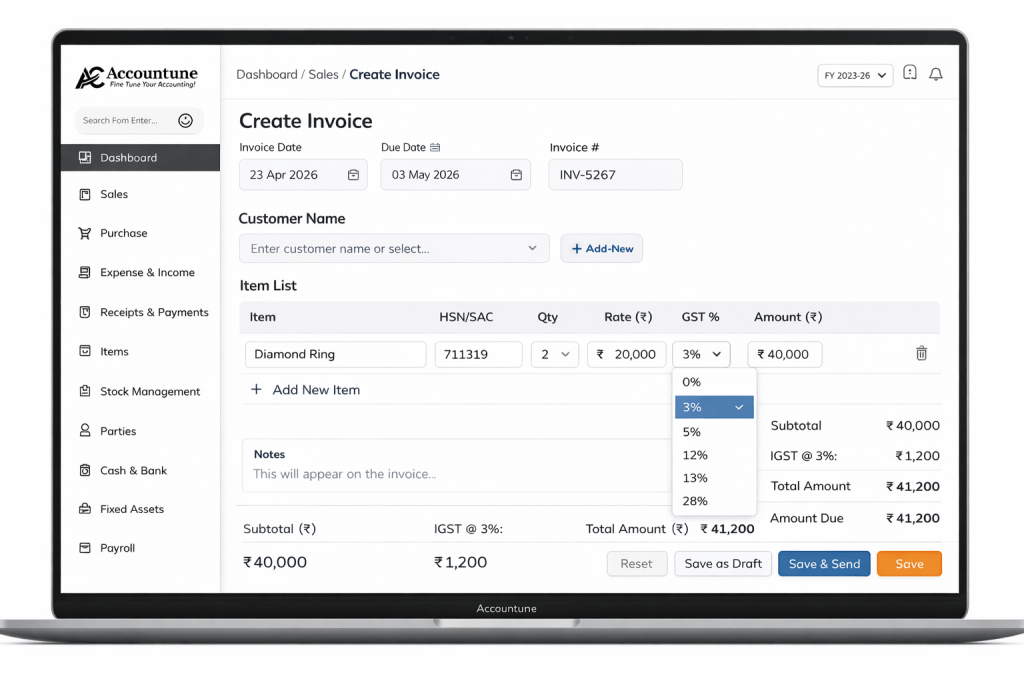
This is non-negotiable. The software must handle CGST and SGST split correctly for intrastate sales, IGST for interstate, and know which products fall under which slab. HSN codes should be built in — not something you have to manually enter for every product. GSTR-1 data should be downloadable directly. If your software cannot do these three things correctly, everything else is irrelevant.
Ease of Use — For You and Your Staff
Your billing staff is not an accountant. Neither are you, probably. The software should be simple enough that a new employee can learn it in two hours — not two days. If you need a consultant to set it up and train your team, it is already costing you more than the subscription price.
Mobile and Device Compatibility
Most Indian shop owners work across devices — Android phone for checking reports on the go, Windows computer at the counter, maybe a tablet for a second billing station. Good invoice software works on all of these without needing a separate app for each. Cloud-based software gives you access from anywhere — which matters when you want to check daily sales from home at 9 PM.
Pricing That Makes Sense
Monthly billing feels affordable but adds up. ₹500 a month sounds like nothing — until you realize you are paying ₹6,000 a year for software that a competitor offers at ₹1,499 annually. Look at annual pricing. Check what is actually included. Some software locks basic features behind higher plans. Some charge per invoice after a limit. Read the fine print before committing.
Customer Support in India
Time zones matter. So does language. When you have a billing problem at 7 PM, you need support that responds then — not a ticket system that gets answered the next morning. Indian software companies generally offer better support for Indian businesses. Not always, but usually.
10 Best Invoice Software in India 2026: Honest Comparison
1. Accountune — Best for Indian Retail, Kirana, Medical and Hardware Stores
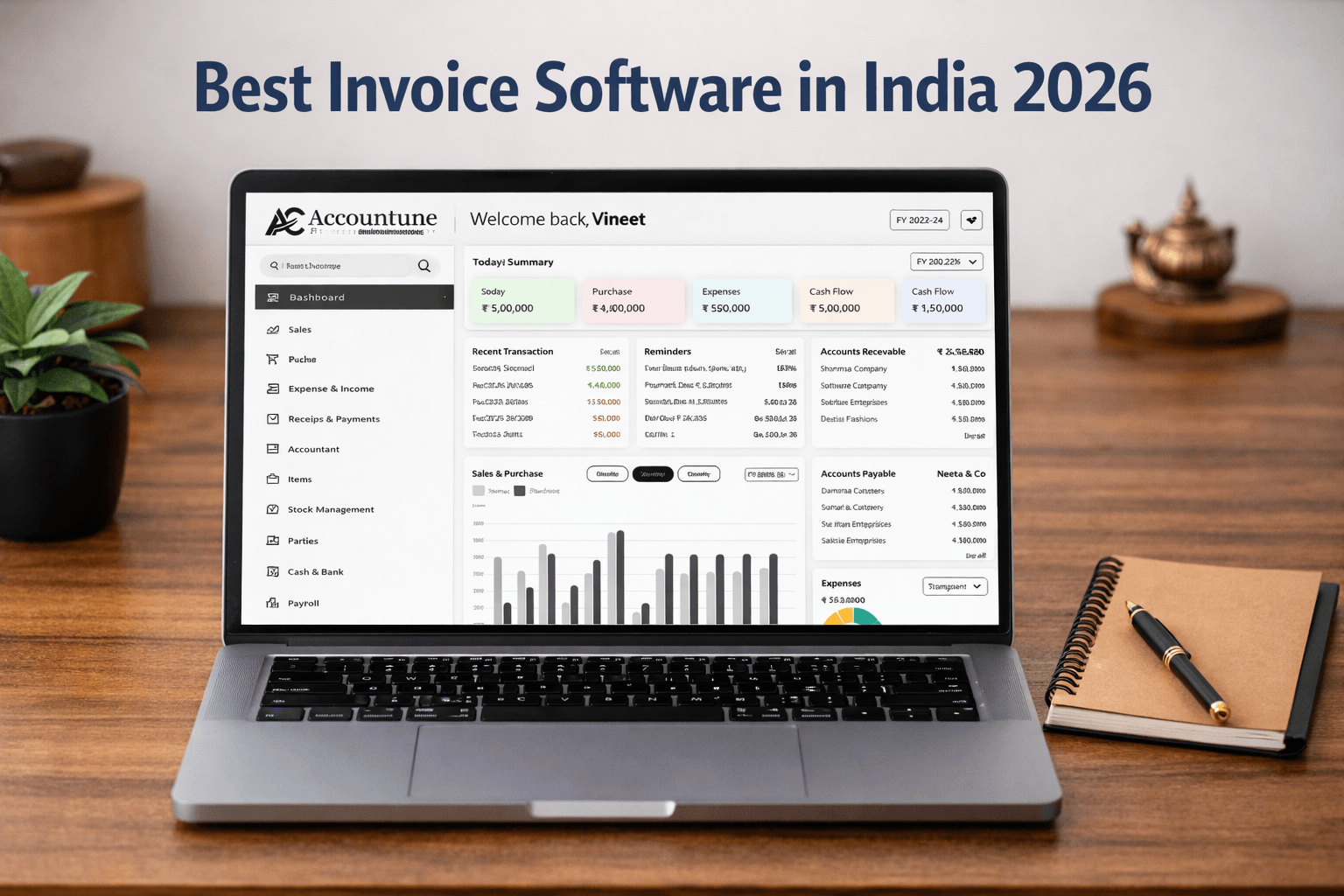
Accountune is built specifically for Indian small businesses — not adapted from a global product. The focus is on retail shops, kirana stores, medical stores, hardware shops, and wholesalers who need fast billing and GST compliance without accounting knowledge.
What works well: GST billing with correct HSN codes is automatic. Stock updates after every sale. WhatsApp bill sharing works in one tap. Batch tracking and expiry alerts for medical stores are built in. The interface is simple enough that most users are billing on day one without training.
Pricing: Basic ₹799/year. Intermediate ₹1,849/year. Premium ₹4,499/year. No per-bill charges, no hidden fees.
Free trial: 4 days, full features, no credit card required.
Best for: Kirana stores, medical stores, hardware shops, retail stores, small wholesalers.
Where it falls short: Not ideal for freelancers who need project-based invoicing or international clients. Also not built for large enterprise operations with 50+ staff.
2. Zoho Invoice — Best for Freelancers and Consultants
Zoho Invoice is genuinely free — no time limit, no invoice cap for individuals. It is built more for service businesses and consultants than for product-based retail. GST compliance is solid. The interface is clean and professional-looking.
What works well: Free forever for individuals. Good client management. Recurring invoice automation. Payment reminders. Professional invoice templates.
Pricing: Free for individuals. Zoho Books (full accounting) starts at ₹1,299/year.
Best for: Freelancers, consultants, designers, agencies, service providers.
Where it falls short: Inventory management is limited. Not ideal for high-volume retail billing at a counter. Barcode scanning is not a focus.
3. Vyapar — Best for Small Traders and Retailers
Vyapar is one of the most popular billing apps in India — for good reason. It works on Android and Windows, has a solid free plan, and handles GST billing well for small traders. It has offline functionality which matters in areas with inconsistent internet.
What works well: Works offline. Strong mobile app. Good inventory features. Affordable. Large user base means plenty of community support.
Pricing: Mobile free. Desktop + mobile combo starts at ₹1,099/year.
Best for: Small retailers, traders, mobile-first businesses.
Where it falls short: Cloud sync can be inconsistent. Some advanced features require the paid plan. Support response times can be slow.
4. myBillBook — Best for Mobile-First Billing
myBillBook is designed for businesses that do most of their billing on a smartphone. WhatsApp invoice sharing is seamless. The interface is very simple. Over 1 crore businesses use it — which says something about the product.
What works well: Very fast mobile billing. WhatsApp sharing built in. Thermal printer support. Simple enough for anyone.
Pricing: Free plan available. Paid plans start at ₹458/year for basic features.
Best for: Small shopkeepers, mobile-first businesses, businesses with very simple billing needs.
Where it falls short: Advanced inventory features are limited. Reporting is basic compared to competitors. Multi-user setup can be complicated.
5. Marg ERP — Best for Pharma and Medical Distribution
Marg has been in the Indian market for over 25 years. Their pharmacy and medical store software is one of the most trusted options for chemists and pharmaceutical distributors. Batch tracking, expiry management, and drug database are strong.
What works well: Deep pharmacy-specific features. Large drug database. Strong GST compliance. Trusted by thousands of chemists across India.
Pricing: Starts around ₹5,000-8,000/year depending on configuration.
Best for: Medical stores, pharmaceutical distributors, chemist shops with high volume.
Where it falls short: Interface feels dated. Expensive for a small single-counter shop. Requires some training to use effectively.
6. TallyPrime — Best for Accounting-Heavy Businesses
Tally is the gold standard for Indian accounting. If your business needs full accounting — ledgers, balance sheets, profit and loss, audit trails — Tally is the most complete solution. Your CA almost certainly knows Tally already.
What works well: Complete accounting features. Trusted by CAs. Strong GST return filing support. Works for businesses of any size.
Pricing: TallyPrime starts at ₹22,500 for a single-user license. Subscription at ₹9,000/year.
Best for: Businesses that need full accounting, manufacturing, businesses with dedicated accounting staff.
Where it falls short: Steep learning curve. Expensive for small businesses. Overkill for a shop that just needs billing and basic stock tracking. Not cloud-native.
7. Swipe — Best for Fast High-Volume Billing
Swipe focuses on speed. GST invoices in under 10 seconds, e-invoice and e-way bill integration, and a clean interface. Popular with modern SMEs and e-commerce businesses.
What works well: Very fast billing. E-invoice and e-way bill built in. Good for businesses with high invoice volume. Modern interface.
Pricing: Free plan available. Paid starts at ₹250/month (₹3,000/year).
Best for: E-commerce businesses, high-volume billing, modern SMEs.
Where it falls short: Monthly pricing model can be expensive annually. Inventory features are not as deep as specialized tools.
8. Refrens — Best for Freelancers Billing International Clients
Refrens is specifically built for Indian freelancers who work with international clients. Multi-currency invoicing, professional templates, and a clean client management system make it the go-to for designers, developers, and consultants.
What works well: Multi-currency. Professional invoice templates. Good for international billing. Expense tracking. Client portal.
Pricing: Free plan with basic features. Paid starts at ₹1,999/year.
Best for: Freelancers billing international clients, creative professionals, consultants.
Where it falls short: Not built for product-based businesses. Inventory features are absent. GST compliance is present but not as deep as retail-focused tools.
9. ProfitBooks — Best Free Option for Small Businesses
ProfitBooks offers a genuinely unlimited free plan — no invoice cap, no time limit. Built by practicing CAs, it is designed to be simple enough for non-accountants. Good for businesses that want basic accounting alongside invoicing.
What works well: Free forever with no limits. Simple interface. Basic accounting included. GST compliance. Good for businesses just starting out.
Pricing: Free plan. Paid plans start at ₹4,999/year for advanced features.
Best for: Startups, small businesses on a tight budget, businesses just starting to digitize billing.
Where it falls short: Advanced features like inventory management and multi-user access require the paid plan. Support on free plan is limited.
10. CaptainBiz — Best for Traders Transitioning from Manual Billing
CaptainBiz is officially endorsed by GSTN — which builds trust immediately. It is designed specifically for small traders moving from paper billing to digital. Simple interface, real-time inventory sync, and solid GST compliance.
What works well: GSTN endorsed. Simple for first-time users. Good GST compliance. Real-time inventory. Affordable.
Pricing: Free plan available. Paid starts at ₹1,599/year.
Best for: Small traders, first-time software users, businesses just going digital.
Where it falls short: Limited advanced features. Not ideal for businesses that have already been using software and need more capability.
Best GST Billing Software Comparison (2026)
| Software | Starting Price | GST Compliant | Mobile App | Inventory | Cloud | Best For |
|---|---|---|---|---|---|---|
| Accountune | ₹799/yr | ✔ | ✔ | Strong | ✔ | Retail, Medical, Kirana |
| Zoho Invoice | Free | ✔ | ✔ | Limited | ✔ | Freelancers, Consultants |
| Vyapar | ₹1,099/yr | ✔ | ✔ | Good | Partial | Small Traders |
| myBillBook | ₹458/yr | ✔ | ✔ | Basic | ✔ | Mobile-first Shops |
| Marg ERP | ₹5,000+/yr | ✔ | Limited | Strong | Partial | Pharma, Medical |
| TallyPrime | ₹9,000/yr | ✔ | Limited | ✔ | ❌ | Accounting-heavy |
| Swipe | ₹3,000/yr | ✔ | ✔ | Moderate | ✔ | High-volume, E-comm |
| Refrens | ₹1,999/yr | ✔ | ✔ | ❌ | ✔ | International Freelancers |
| ProfitBooks | Free | ✔ | ✔ | Limited | ✔ | Startups, Budget |
| CaptainBiz | ₹1,599/yr | ✔ | ✔ | ✔ | ✔ | First-time users |
Who Should Choose What
This is the part most comparison blogs skip. They list 10 products and leave you confused. Here is how to actually decide.
You run a kirana store, general store, or provision shop: You need fast counter billing, automatic stock update, and udhaar tracking. Accountune or Vyapar. If you want cloud-based with strong inventory — Accountune. If you want offline reliability on a tight budget — Vyapar.
You run a medical store or chemist shop: Batch tracking and expiry alerts are non-negotiable. Marg ERP is the most feature-complete for high-volume pharmacies. For smaller single-counter medical stores where price matters — Accountune covers batch tracking and expiry alerts at a much lower cost.
You are a freelancer or consultant billing Indian clients: Zoho Invoice free plan is hard to beat. Clean invoices, good client management, recurring billing. If you need basic accounting too — ProfitBooks free plan.
You are a freelancer billing international clients: Refrens. Multi-currency, professional templates, international payment support. No competition here.
You run a hardware store or electronics shop: You need good inventory management alongside GST billing. Accountune or Vyapar. Both handle product-based businesses well at reasonable prices.
You need full accounting — balance sheets, P&L, audit trail: TallyPrime. It is expensive and has a learning curve, but no other software on this list gives you what Tally gives a proper accounting operation. Your CA will thank you.
You are just starting out and want something free: CaptainBiz or ProfitBooks. Both have solid free plans. CaptainBiz is simpler. ProfitBooks has more accounting depth.
Practical Tips Before You Buy Any Invoice Software
These are things most people learn the hard way.
Tip 1 — Always use the free trial before paying Every software on this list has either a free plan or a free trial. Use it. Specifically, try to do your most complex billing scenario during the trial — multiple GST rates, credit customer, WhatsApp sharing. If it works smoothly in the trial, it will work in real life.
Tip 2 — Check if your CA knows the software This sounds obvious but most people miss it. If your CA already uses Tally, and you switch to something completely different, data sharing becomes a headache. Either pick software your CA is comfortable with, or confirm they can work with exported data in Excel or PDF format.
Tip 3 — Count the total annual cost, not the monthly price ₹250 a month sounds cheap. That is ₹3,000 a year. Accountune’s full Intermediate plan is ₹1,849 a year. Always calculate annual before comparing.
Tip 4 — Test the mobile app on your actual phone Not all Android phones work the same way with all apps. Before committing, install the app on the device you will actually use at the counter. Check billing speed, barcode scanning if you need it, and WhatsApp sharing.
Tip 5 — Check what happens to your data if you cancel Some software locks your data if you stop paying. Others let you export everything. Ask this question before you sign up — not after two years of billing history is sitting in their system.
CONCLUSION
Choosing the best invoice software in India in 2026 is not about picking the one with the most features. It is about picking the one that fits how your business actually works — your volume, your products, your staff, your budget.
If you run a retail shop and just want fast billing with correct GST and automatic stock tracking — Accountune or Vyapar will cover everything you need, at a price that makes sense.
If you are a freelancer — Zoho Invoice for Indian clients, Refrens for international ones.
If you need full accounting — TallyPrime, no question.
If you are just starting out — CaptainBiz or ProfitBooks free plan, then upgrade when you outgrow it.
Most of these have free trials. There is no reason to commit without trying. Accountune’s 4-day free trial, for instance, gives you full access to every feature — set it up, add your products, run a few real bills, and see if the counter feels different. That is the only honest way to decide.
Billings errors, GST mismatches, udhaar that goes uncollected, stock that runs out silently — these are not unavoidable problems. They are fixable ones. The right software fixes them quietly, in the background, while you focus on running your business.
5 questions
ProfitBooks and CaptainBiz — free plans for small businesses.
Vyapar — solid free mobile app for retail traders.
Accounting software — full ledgers, balance sheets, P&L, bank reconciliation.
TallyPrime = accounting. Zoho Invoice = billing. Accountune and Vyapar sit in between — more than billing, but not full accounting.
5 questions
4 questions
Paid options:
Accountune — Rs.799/year (Rs.66/month)
myBillBook — approx Rs.458/year
Vyapar — Rs.1,499/year
5 questions
Accountune — batch tracking, expiry alerts, prescription management at Rs.799/year — significantly lower cost, ideal for small and mid-size medical stores.
TallyPrime — desktop-based, works fully offline.
Accountune — cloud-based, needs internet for syncing.
5 questions
Vyapar / myBillBook — 1 to 2 hours.
TallyPrime — 2 to 3 days with staff training due to accounting complexity.
✓ Bill with multiple GST rates
✓ Interstate customer (IGST check)
✓ Credit sale to regular customer
✓ WhatsApp invoice sharing
✓ Stock check after sale
