


Last Updated: April 2026 | Originally Published: March 7, 2026 Update Log — April 2026: Added April 1 compliance rules — new invoice series mandatory, e-invoicing ₹5 crore limit, GTA declaration, LUT renewal, export refund changes. Checklist updated from 7 to 8 steps. 6 new FAQs added.
Ramesh runs a small grocery shop in Nagpur. Nothing fancy — just a regular neighbourhood kirana store. He has been GST registered since 2019. Knows his rates. Knows his filing dates. Life was simple.
Then September 2025 happened.
His accountant called one afternoon. “Bhai, 12% slab is gone. Soaps, shampoo, namkeen, ghee — all shifted to 5%. Update your billing software immediately.”
Ramesh said okay. But he didn’t really understand what that meant for his shop. Which items exactly? From which date? What about the stock he already had? What if he billed wrong by mistake?
He spent the next two weeks confused — asking his accountant, searching Google, calling his software vendor. Meanwhile, three invoices went out with wrong GST rates. His October GSTR-1 had mismatches. His accountant had to fix everything manually. It cost Ramesh time, money, and a lot of stress.
This happens to thousands of small business owners across India. Not because they are careless. But because no one explained the changes in simple language.
That is exactly what this blog will do.
GST 2.0 arrived on September 22, 2025. It is the biggest change to India’s GST structure since 2017. New slabs, new rates, new compliance rules from January 2026 — and now more changes from April 2026 that most business owners are still unaware of. If you run any GST-registered business — kirana store, medical shop, hardware store, clothing shop, electronics store — you need to know all of this.
In this guide you will find:
- The new GST slab structure explained simply
- Complete list of what got cheaper and what got costlier
- Sector-wise impact — your specific business type
- New compliance rules from January 2026
- New compliance rules from April 2026 — updated
- A simple 8-point checklist for what to do right now
- 26 FAQ that shop owners actually ask
Let’s get into it.
What Actually Changed and Why It Matters
First, understand the old system.
When GST started in 2017, there were 5 main slabs — 0%, 5%, 12%, 18%, and 28%. Over the years, small changes happened. Some items moved between slabs. But the structure stayed the same.
September 2025 was different. This was a structural change.
The 56th GST Council meeting happened on September 3, 2025. Finance Minister Nirmala Sitharaman announced what they called GST 2.0 — a full simplification of the slab system.
Three big things happened:
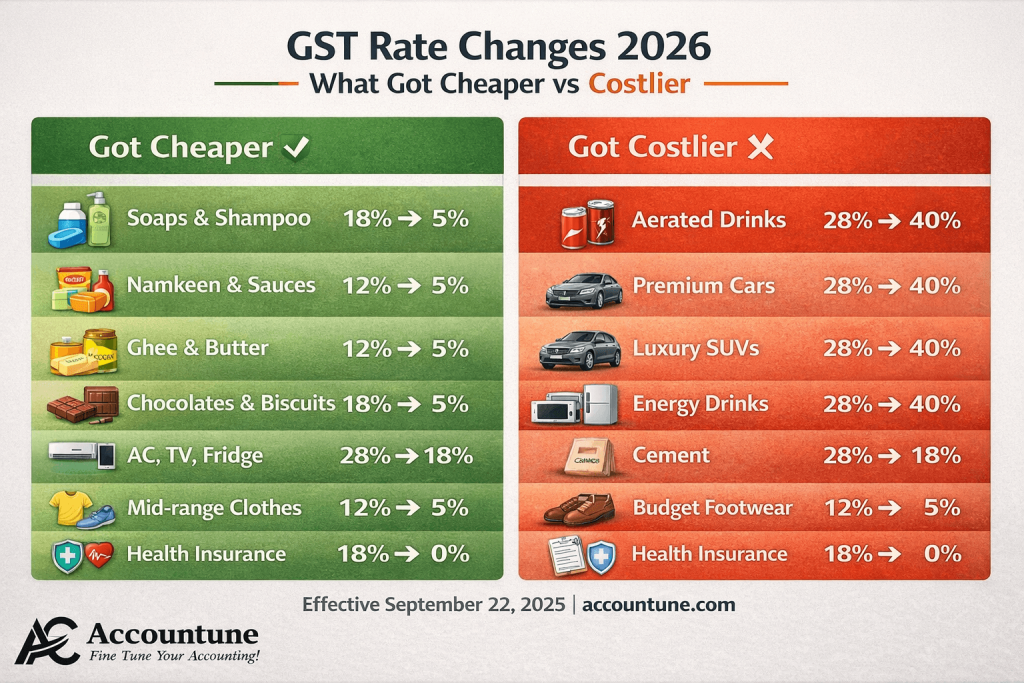
- The 12% slab was removed. Almost all items that were at 12% came down to 5%. A few went up to 18%. But 12% as a slab — gone.
- The 28% slab was heavily reduced. Big consumer items like AC, TV, fridge, washing machine — all came down to 18%. Only true luxury goods and sin goods stayed at the top. And those got moved to a new 40% slab.
- A new 40% slab was added for luxury and sin goods — premium cars, aerated drinks, high-end SUVs, energy drinks.
Effective date: September 22, 2025.
Now here is the real problem that hit small businesses.
Most billing software takes a few days to update. Some business owners didn’t even know about the change. Some knew but weren’t sure which exact items were affected. Some had old stock purchased at 12% and didn’t know how to handle that.
And then January 2026 came with even stricter compliance rules — GSTR-3B filing got harder, ITC matching became mandatory, and GST portal started blocking returns automatically.
And now April 2026 has added five more rules that most accountants have not yet communicated to their clients.
The result? A lot of confusion, wrong invoices, ITC mismatches, and unnecessary penalties for small business owners who were just trying to run their shops.
Let’s fix that confusion right now.
New GST Slab Structure 2026 — The Simple Version
| Item Category | Old Rate | New Rate (2026) |
|---|---|---|
| Soaps, Shampoo, Toothpaste | 18% | 5% |
| Packaged Namkeen, Chips | 12% | 5% |
| Ghee, Butter, Cheese | 12% | 5% |
| Chocolates, Biscuits | 18% | 5% |
| Footwear below ₹1,000 | 12% | 5% |
| Readymade clothes ₹1k-₹10k | 12% | 5% |
| AC, TV, Fridge, Washing Machine | 28% | 18% |
| Cement | 28% | 18% |
| Small cars (below 1200cc) | 28% | 18% |
| Aerated/Energy Drinks | 28%+cess | 40% |
| Premium Cars/SUVs | 28%+cess | 40% |
| Health & Life Insurance (individual) | 18% | 0% (Exempt) |
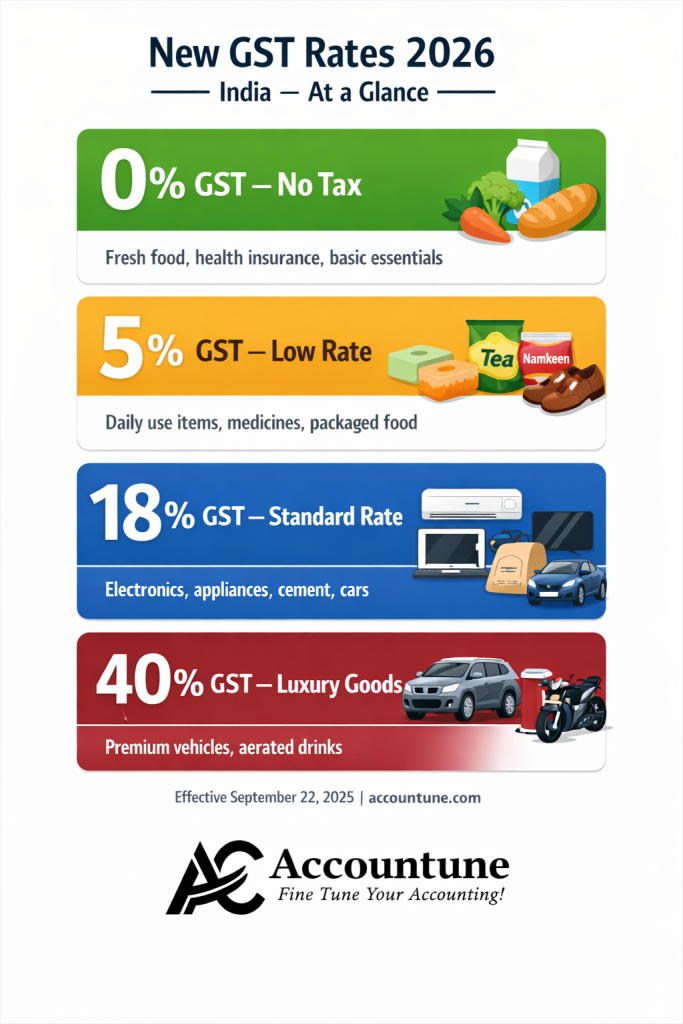
Here is how the new slab system looks:
0% — No GST (Essential Items)
These items have no GST at all. They were exempt before and are still exempt.
Fresh vegetables, fresh fruits, milk, bread, eggs, unprocessed grains, unbranded atta, unbranded maida, unbranded besan, fresh meat and fish, salt, and now — individual health insurance and life insurance premiums are also fully exempt from GST. This is new.
5% — Low Rate (Daily Use Items)
This slab got much bigger after GST 2.0.
Everything that was at 12% and used by regular households has come down to 5%.
Items now at 5% (many shifted from 12% or 18%):
- Soaps, shampoo, hair oil, toothpaste — down from 18%
- Packaged namkeen, bhujia, chips, sauces, ketchup — down from 12%
- Ghee, butter, cheese — down from 12%
- Chocolates, biscuits, instant noodles, pasta — down from 18%
- Tea and coffee (packaged) — down from 12%
- Small sachets under ₹10 MRP — down from 18%
- Footwear below ₹1,000 — down from 12%
- Readymade clothes ₹1,000 to ₹10,000 — down from 12%
- Medicines (most common OTC medicines) — down from 12%
- Hotel stay up to ₹7,500 per night — down from 12%
- Electric vehicles — same as before, still 5%
18% — Standard Rate
This is now the main slab for most manufactured goods and services.
- Laptops, computers — same as before
- Mobile phones — same as before
- Small cars below 1200cc petrol / 1500cc diesel — down from 28%
- AC, TV, refrigerator, washing machine, microwave — down from 28%
- Motorcycles below 350cc — same
- Cement — down from 28% (big one for hardware stores)
- Paints and varnish — same
- Telecom services — same
- Banking and financial services — same
- Restaurants with AC — same at 18% with ITC
- Readymade clothes above ₹10,000 — same
- Footwear above ₹1,000 — same
40% — New Luxury and Sin Goods Slab
This is the new slab. Items that were at 28% + cess have moved here.
- Aerated drinks and energy drinks — moved to 40%
- Premium cars above 1200cc petrol / 1500cc diesel — moved to 40%
- Large SUVs — moved to 40%
- Luxury motorcycles above 350cc — moved to 40%
Note — tobacco products are still at 28% + compensation cess for now. They will move to 40% once the states’ GST compensation loan is fully paid off.
Special Rates — Gold and Precious Metals
Gold and silver jewellery — still at 3%. No change here.
Rough diamonds and unprocessed precious stones — still at 0.25%.
Sector-Wise Impact — What Changed for YOUR Business
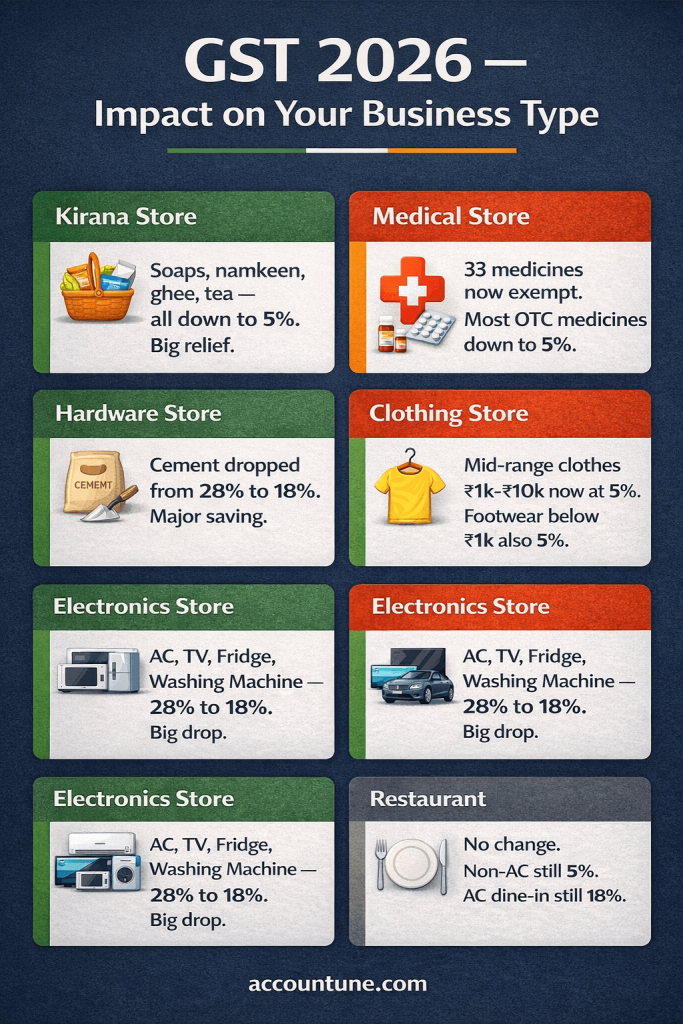
This is the section most blogs skip. Generic rate charts are fine, but what matters to you is — what changed for my specific type of shop?
Kirana Store / Grocery Shop
If you run a kirana store, GST 2.0 is actually good news for you.
Almost everything you sell daily has either stayed the same or become cheaper. Your customers will be happy. Your margins could improve slightly because input costs come down too.
What changed for you:
Soaps, shampoo, toothpaste, hair oil — these were at 18%. Now they are 5%. That is a huge drop. If you were billing a customer for Dove soap at 18% GST, you now charge 5%. The MRP stays the same but your GST liability is lower, which means better working capital for you.
Packaged namkeen, bhujia, ketchup, sauces — earlier 12%, now 5%.
Ghee and butter — earlier 12%, now 5%.
Tea and coffee (packaged) — earlier 12%, now 5%.
Chocolates, biscuits, instant noodles — earlier 18%, now 5%.
What you should do right now:
Update your billing software rates immediately for all these items. If you are still billing soaps at 18%, you are overcharging GST. Your customer can raise a complaint. More importantly, your GSTR-1 will mismatch with the supplier’s GSTR-1 and you will have an ITC problem.
Medical Store / Pharmacy
For medical stores, the changes are mostly positive but a little detailed.
33 categories of lifesaving medicines are now fully exempt — zero GST. These include certain cancer drugs, rare disease medicines, and critical care medicines. Check the official CBIC notification to see if any of your items fall here.
Most common OTC medicines that were at 12% have come down to 5%. Surgical items and medical equipment — also mostly down to 5%.
Sanitary napkins were already at 0% — no change.
What you should do right now:
Talk to your distributor. Ask specifically which items are now in the exempt category and which are at 5%. Update your billing system item by item. For medical stores especially, wrong GST rates can create serious compliance issues. If you use software like Accountune or similar tools, the HSN-linked rate update makes this much faster than doing it manually.
Hardware Store
One big change for hardware stores — cement dropped from 28% to 18%.
If you sell cement regularly, this is significant. Cement was one of the last big-ticket construction materials still at 28%. Its reduction to 18% will help your customers and reduce your ITC complexity.
Paints, varnish, steel rods, PVC pipes, tiles, hand tools — these all remain at 18%. No change.
What you should do right now:
Update cement’s GST rate immediately in your billing system. Cement is high-volume for most hardware stores — even one month of wrong billing creates a big mismatch in GSTR-1 vs supplier data.
Clothing and Footwear Store
Two clear changes here.
Footwear below ₹1,000 — down from 12% to 5%. This affects budget and mid-range footwear a lot. If you sell chappals, basic shoes, school shoes — your customers just got a slight price benefit.
Readymade clothes between ₹1,000 and ₹10,000 — down from 12% to 5%. This is the mid-range clothing segment. Shirts, sarees, suits in the ₹1,000-₹10,000 range — all 5% now.
Clothes below ₹1,000 were already at 5% — no change. Clothes above ₹10,000 stay at 18% — no change.
What you should do right now:
Check your billing system. Make sure your items are in the right price bucket and the right GST rate is applied to each. The ₹1,000 threshold is important — a ₹999 footwear and a ₹1,001 footwear have different GST rates. Your software should handle this automatically.
Electronics and Appliance Store
This is the sector where the change is most dramatic.
AC, TV, refrigerator, washing machine, microwave — all dropped from 28% to 18%. That is a 10% reduction on big-ticket items. For an AC that costs ₹40,000 before tax, that difference is ₹4,000 in GST.
This gives you a real sales opportunity. Customers who were waiting to buy will feel the push now. Prices effectively become more affordable.
Laptops and mobile phones — same at 18%, no change.
Small cars below 1200cc petrol — down from 28% to 18% (relevant if you sell car accessories or serve auto shops).
What you should do right now:
Update white goods rates in your billing system today. This is your biggest revenue category most likely — wrong rates here will cause the biggest GSTR impact.
Restaurant and Food Business
For restaurants, not much changed in the main billing.
Non-AC restaurant — still 5% GST, no ITC. Same as before.
AC restaurant dine-in — still 18% GST, with ITC. Same as before.
Swiggy and Zomato orders — still 5%. Same as before.
But if your restaurant also sells packaged items — bottled sauces, packaged snacks, branded beverages — those may have changed rates. Check item by item.
Who Is Most Affected — Find Your Situation
You need to act urgently if:
You are a kirana store, FMCG distributor, or grocery shop. You have the highest number of items that changed rates. Soaps, shampoos, namkeen, ghee, chocolates, tea — all changed. Volume is high, so even small rate errors compound quickly in your GST return.
You need moderate attention if:
You run a hardware store, clothing store, or footwear shop. Fewer items changed but they are high-value or high-volume. Cement, mid-range clothes, footwear — specific categories need updating.
You need to double-check if:
You run a medical store. The changes are positive but require item-by-item verification because of the exempt category additions. One wrong classification on a lifesaving medicine can create a mess.
You are mostly okay if:
You run a restaurant (dine-in only), a service-based business, or sell only digital products and software. Core rates for these segments are unchanged.
January 2026 Compliance Rules — The Part Everyone Is Missing
Here is what most blogs about GST rates 2026 do not tell you.
The September 2025 rate changes were just part one. January 2026 brought stricter compliance rules that affect every GST-registered business. Ignore these and your filing will get blocked — literally.
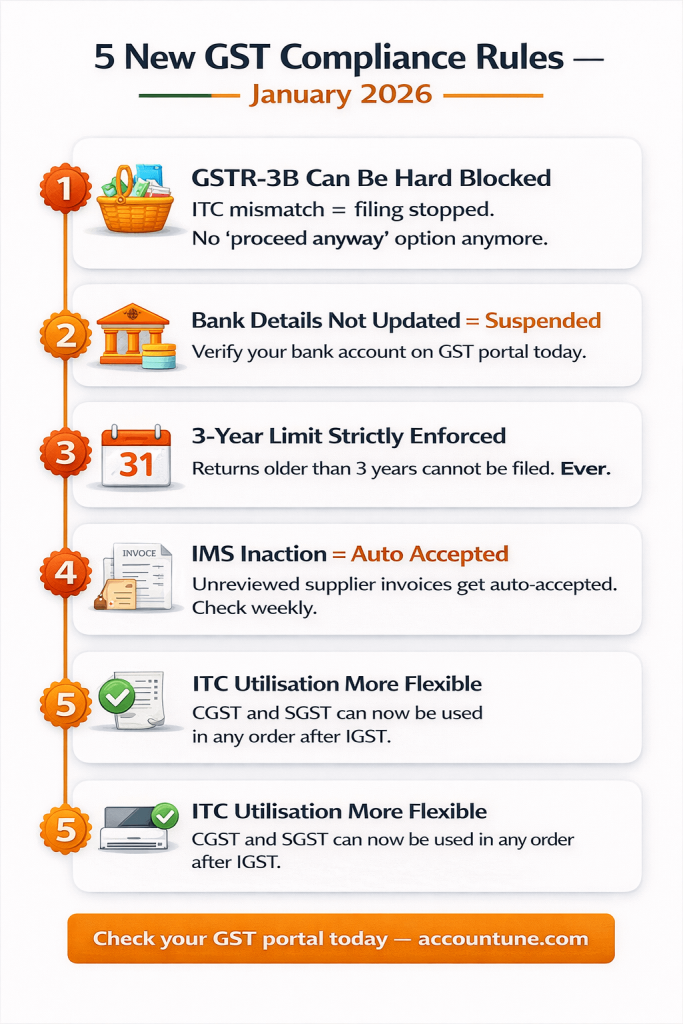
Rule 1 — GSTR-3B Can Now Be Hard-Blocked
Before January 2026, if your ITC claimed in GSTR-3B was more than what showed in GSTR-2B, the portal would warn you. But you could still proceed.
Now it blocks you. The portal will not let you file if:
- Your claimed ITC is more than what is in your GSTR-2B
- Your RCM (Reverse Charge Mechanism) ledger shows a negative balance
- Your electronic credit ledger goes negative
What this means practically — if your supplier files GSTR-1 late, that invoice does not appear in your GSTR-2B. So you cannot claim that ITC until next month when the supplier files. You may have to pay cash for that month’s GST liability even if you have a genuine purchase to back the credit.
What to do: Follow up with suppliers who consistently file GSTR-1 late. Make it a condition of business if needed. Your cash flow directly depends on it now.
Rule 2 — Bank Account Not Updated = Registration Suspended
This one catches a lot of business owners by surprise.
If your bank account details on the GST portal are outdated, missing, or unverified — the system can automatically suspend your GST registration.
A suspended registration means you cannot file returns. Cannot generate e-way bills. Practically, you cannot do business in any formal way.
What to do right now: Log into the GST portal. Go to My Profile. Check your bank account details. Make sure the account is verified. Takes 5 minutes. Don’t skip this.
Rule 3 — 3-Year Time Limit for Pending Returns — Strictly Enforced
From January 1, 2026 — returns older than 3 years cannot be filed at all. This is permanent.
If you had pending GSTR-1 or GSTR-3B from FY 2022-23 or before, and you did not file by December 31, 2025 — that window is now closed forever. ITC for those periods is also permanently blocked.
If you have any pending returns from FY 2023-24 onwards — file them now. Do not wait.
Rule 4 — IMS Dashboard — Inaction Means Acceptance
The Invoice Management System went live in October 2025. In 2026 there is a critical rule around it.
When your supplier uploads an invoice, it appears in your IMS dashboard. You can Accept it, Reject it, or keep it Pending.
If you do nothing — the system automatically treats it as Accepted.
This is dangerous. If your supplier uploaded a wrong invoice — higher amount, wrong GST rate, duplicate entry — and you did not reject it in time, it goes into your GSTR-2B as accepted. Now you have wrong ITC data. Fixing it later takes time and communication.
What to do: Check your IMS dashboard at least once a week. Look for suspicious entries. Reject anything that does not match your actual purchases.
Rule 5 — ITC Utilisation Got More Flexible — Good News
Not everything in January 2026 was bad news.
Before, there was a fixed sequence for how you could use ITC — IGST first, then CGST, then SGST, in a specific order. Some businesses were sitting on CGST credit but had to pay SGST in cash because the sequence did not allow free utilisation.
Now that restriction is partly lifted. After IGST credit is exhausted, you can use CGST and SGST credit in any order you prefer. This gives better cash flow flexibility.
April 2026 Compliance Rules — What Changed from April 1, 2026
If you thought January 2026 was the last of it — there is more.
April 1, 2026 brought five new compliance requirements that apply to every GST-registered business in India. Most accountants have not yet communicated these to their clients. Read this section carefully.
Rule 1 — Fresh Invoice Series Mandatory from April 1, 2026
From April 1, 2026, all invoices, debit notes, and credit notes must begin with a new document series for FY 2026-27. You cannot continue the old FY 2025-26 series.
So if your last invoice in March 2026 was INV-2025-1547, your April 2026 invoice must start a completely new series — like INV-2026-0001 or any format your business uses. The point is — a fresh, separate series starting from April 1.
This is one of the most common mistakes businesses make every year. Continuing last year’s series creates reconciliation problems in GSTR-1 and can invite departmental scrutiny.
What to do right now: Open your billing software or Accountune. Go to settings and check whether the invoice series has reset for FY 2026-27. If it has not reset automatically — reset it today. Do not wait.
Rule 2 — E-Invoicing Now Mandatory for Businesses with ₹5 Crore+ Turnover
From April 1, 2026, e-invoicing is mandatory for any business whose Annual Aggregate Turnover (AATO) exceeded ₹5 crore in FY 2025-26.
What is e-invoicing? It means you must report your B2B invoices to the Invoice Registration Portal (IRP) and get an IRN — Invoice Reference Number — before the invoice is considered valid. Your customer cannot claim ITC without a valid IRN on the invoice.
There is an additional rule for larger businesses. If your AATO is above ₹10 crore, you now have a strict 30-day time limit to report invoices on the IRP. You cannot upload a March invoice in May. The system will reject it after 30 days.
Who is affected: Any wholesaler, distributor, or manufacturer with turnover above ₹5 crore. Electronics distributors, FMCG distributors, hardware wholesalers — check your FY 2025-26 turnover right now.
What to do: Verify that your billing software supports e-invoicing with IRN generation. Accountune has built-in e-invoicing support. If your current software does not support it — you need to switch before you generate another B2B invoice.
Rule 3 — GTA Declaration Required from Your Transporter
If your business uses a Goods Transport Agency to move goods — this rule applies to you.
GTAs can choose to pay GST under the forward charge mechanism. If your transporter has opted for forward charge in FY 2026-27, you need a written declaration from them. Without this declaration in place, the reverse charge liability shifts to you — meaning you have to pay GST on the transport cost, not the GTA.
This affects hardware store owners, wholesalers, small manufacturers — anyone who regularly ships goods using a transport company.
What to do: Ask your transporter directly — have you opted for forward charge in FY 2026-27? Get the answer in writing. Without it, you are exposed to a tax liability you may not even know about.
Rule 4 — LUT Renewal for Exporters
If your business exports goods or services, or supplies to SEZ units without IGST payment — your Letter of Undertaking for FY 2025-26 expired on March 31, 2026.
You must file a fresh LUT for FY 2026-27 on the GST portal before generating any export invoice from April 1 onwards. Without a valid LUT, your export invoice is treated as a local taxable supply and IGST will apply.
How to do it: Login to GST Portal → Services → Refunds → Furnish Letter of Undertaking (LUT). It takes about 10 minutes. Do this before your first export invoice of April 2026 if you have not already.
Rule 5 — Export Refund Minimum Limit Has Been Removed
Earlier, refund claims below ₹1,000 were simply not processed. From April 1, 2026, this minimum threshold has been removed entirely.
Every valid export refund claim — even if it is ₹200 or ₹500 — will now be processed. This is good news for small exporters who were previously losing small refund amounts. If you have pending small refund claims, file them on the GST portal now.
8-Point Compliance Checklist — Do This Right Now (Updated April 2026)
If you are feeling overwhelmed after reading all of this — don’t worry. Just follow these 8 steps one by one.
Step 0 — Reset Your Invoice Series for FY 2026-27 ✅ NEW — April 2026
From April 1, 2026, a fresh invoice series is mandatory for the new financial year. Open your billing software right now and check whether the invoice number series has reset. If it has not reset automatically — do it manually today. Every invoice you generate from April 1 onwards must carry the new series number. Continuing the old series creates GSTR-1 mismatches and can attract departmental scrutiny.
Step 1 — Update Your Billing Software Rates
Every item that changed GST rate needs to be updated in your billing system. Start with your highest-selling items first. Soaps, shampoo, namkeen, ghee, cement — whatever your business sells most.
If you use Accountune, the HSN-linked rates update automatically when GST council changes happen. If you use manual Excel billing, you need to do this yourself item by item.
Step 2 — Check E-Invoicing Eligibility ✅ NEW — April 2026
Did your FY 2025-26 turnover cross ₹5 crore? If yes, e-invoicing is now mandatory for you. Verify that your billing software supports IRN generation. If it does not — switch to one that does before your next B2B invoice.
Step 3 — Separate Old Stock from New Stock
For stock purchased before September 22, 2025 — the input tax credit on that stock is based on the old rate you paid at the time of purchase. Do not mix it up with new stock. Keep records clear.
Step 4 — Renew LUT If You Export ✅ NEW — April 2026
If your business exports goods or supplies to SEZ — file a new LUT for FY 2026-27 on the GST portal before your first April export invoice. Login → Services → Refunds → Furnish LUT.
Step 5 — Verify Bank Details on GST Portal
Log in today. My Profile → Bank Account Details. Verify everything is correct and the account is active. This takes 5 minutes and protects you from automatic suspension.
Step 6 — Set Up Monthly GSTR-2B Matching Routine
Every month, once GSTR-2B generates on the 14th — compare it with your purchase register that same week. If anything does not match, contact your supplier immediately. Do not wait until filing day.
Step 7 — Check IMS Dashboard Weekly
Make this a habit. Every Monday morning, open GST portal, go to IMS, check for new supplier invoices. Accept the correct ones. Reject the wrong ones. Never leave it unattended for more than a week.
Step 8 — File Any Pending Returns Immediately
If you have any unfiled returns from FY 2023-24 onwards, file them today. Yes, late fees will apply. But blocking ITC permanently is far more costly. Do not delay.
Practical Tips for Long-Term GST Health
Beyond the immediate checklist, here are some things that will save you headaches every month.
Tip 1 — Talk to Your Suppliers About GSTR-1 Filing Dates
Your ITC now depends completely on your supplier filing GSTR-1 on time. Build this into your vendor relationship. Tell suppliers clearly — if your GSTR-1 is not filed by the 11th every month, it blocks my ITC, which blocks my cash flow.
Tip 2 — Never Do Manual Billing for GST Items
Manual Excel billing is fine for small transactions. But for GST-registered businesses with daily sales, even one wrong rate on a high-value item creates months of headache. Use billing software — even a basic one. Tools like Accountune start at ₹799 a year, which is genuinely cheaper than one accountant visit to fix a mismatch.
Tip 3 — Keep a Rate Update Log
Whenever GST rates change, keep a simple record — date of change, which items changed, from what rate to what rate. This helps your accountant during annual filing and protects you if any old invoice comes into question.
Tip 4 — Do Not Ignore GST Notices
If a notice comes — even an informational one — respond within the given time. Ignoring a notice compounds the problem. Most small notices can be resolved with simple clarifications. It is only when ignored that they become serious.
Tip 5 — Check Composition Scheme Eligibility Every Year
If your turnover is below ₹1.5 crore (or ₹75 lakh for some states), composition scheme might be simpler for you. Opt-in or opt-out decision has to be made before March 31 every year. If you are confused about whether it suits your business, talk to a CA.
FAQ (26 Questions Shop Owners Actually Ask)
GST Rates and Slabs
September 22, 2025 is the effective date. All invoices from that date onwards must use the new rates. Invoices before September 22, 2025 used the old rates — that is fine and valid.
For almost all items — yes. The government moved 99% of 12% items to 5%. A small number of items moved to 18%. As a practical matter, if you dealt with 12% items, those are almost certainly at 5% now. Check your specific item’s HSN code in the official CBIC notification to be sure.
The 40% slab is for luxury and sin goods. Premium cars above 1200cc petrol or 1500cc diesel, large SUVs, aerated drinks, energy drinks, and high-end motorcycles above 350cc are in this slab. Most regular businesses will not deal with these items.
Not yet. Tobacco is still at 28% + compensation cess. It will shift to 40% once the states’ GST compensation loan is fully repaid. No official date is confirmed yet.
Yes — individual health insurance and term life insurance premiums are now fully exempt from GST. This was a big relief announcement. Group health insurance still has GST applicable.
Billing and Invoices
Issue a credit note for the difference. Then issue a revised invoice with the correct 5% rate. Reflect this credit note in your GSTR-1. Accountune and most billing software have a credit note feature built in — use it.
When you sell old stock, bill the customer at the new GST rate (5%) — because the sale happens in 2026, new rates apply to the sale. Your input credit for that purchase was at 12%, which you already claimed when you bought it. The two are separate — purchase credit and sale rate.
Contact your software vendor immediately. This is a critical update. If they cannot update quickly, temporarily update rates manually in the system item by item. Do not continue billing at wrong rates while waiting.
CBIC has directed suppliers to pass on the rate cut benefit to end customers. If you are charging old higher rates and pocketing the difference, it can attract a complaint under anti-profiteering provisions. Update your rates and let customers benefit.
Yes, wrong HSN codes cause GSTR-1 mismatches and can trigger notices. If you filed recently, amend the GSTR-1. If the time limit for amendment has passed, consult your CA. Going forward, verify HSN codes when adding items in your billing system.
ITC and Compliance
Three things — first, check if your claimed ITC is more than what is in GSTR-2B. Second, check if your RCM ledger has a negative balance. Third, check if your bank account on the GST portal is verified. Fix whichever is the issue.
His late-filed invoices do not appear in your GSTR-2B for that month. You cannot claim that ITC in the same month. You get it next month when his return shows up. Meanwhile, you may have to pay GST in cash for that month. Speak to your supplier — late GSTR-1 is directly hurting your cash flow now.
GSTR-2B is a read-only statement generated on the 14th of every month. It shows all the input tax credit available to you based on what your suppliers have filed. In 2026, GSTR-3B filing is locked to GSTR-2B — you cannot claim more ITC than what appears there. It is the most important document for your monthly GST filing now.
IMS stands for Invoice Management System. It is on the GST portal. Your suppliers’ invoices appear here. If you do not take any action on an invoice, the system automatically considers it accepted. A wrong invoice that you ignored will end up in your GSTR-2B and mess up your ITC. Yes, check it regularly — at least once a week.
Most suspensions in 2026 are because of bank account details not updated on the portal. Log in, go to My Profile, update and verify bank account. In most cases, suspension gets revoked automatically within a few days. If not, file an application with your jurisdictional GST officer.
April 2026 — New Rules Updated
Yes — from April 1, 2026, a fresh document series is mandatory for FY 2026-27. Your April 2026 invoices must carry a new series number completely separate from FY 2025-26. Check your billing software settings and reset the series if it has not reset automatically. Continuing the old series creates GSTR-1 reconciliation problems and can invite departmental scrutiny.
Yes — e-invoicing is mandatory from April 1, 2026 if your FY 2025-26 AATO exceeded ₹5 crore. You must report all B2B invoices to the IRP and get an IRN before the invoice is valid. Your customer cannot claim ITC without a valid IRN. Check immediately whether your billing software supports e-invoicing with IRN generation.
Businesses with AATO above ₹10 crore must report invoices to the IRP within 30 days of the invoice date. After 30 days, the IRP will reject the invoice — no IRN can be generated. This means you cannot report a March invoice in May. Build this deadline into your monthly billing routine.
You must obtain a written declaration from your GTA about their GST payment mechanism for FY 2026-27. If your transporter has not opted for forward charge and you have no declaration — reverse charge applies to you, meaning you pay the GST on transport costs. Ask your transporter directly and get it in writing before your next shipment.
Your FY 2025-26 LUT expired on March 31, 2026. You must file a fresh LUT for FY 2026-27 before generating any export invoice from April 1 onwards. Login to GST Portal → Services → Refunds → Furnish Letter of Undertaking (LUT). Without a valid LUT, your export invoices will attract IGST.
Yes — from April 1, 2026, the ₹1,000 minimum threshold for export refunds has been removed. Every valid export refund claim, regardless of amount, will now be processed. File your pending small refund claims on the GST portal. Even a ₹300 or ₹500 claim will go through now.
Composition Scheme and Software
Not directly. Composition dealers pay a fixed percentage of turnover — 1%, 1.5%, or 6% depending on business type. They do not charge GST to customers. The main slab changes of GST 2.0 do not change composition dealer rates. But if your turnover has grown above the limit, you should reconsider whether composition still makes sense.
March 31 is the deadline every year. If you want to join composition scheme from next financial year, file CMP-02 before March 31. If you want to leave the scheme, also do it before March 31. Missing this deadline means you are stuck with your current scheme for the full year.
For traders and manufacturers — ₹1.5 crore annual turnover. For restaurants — ₹1.5 crore. For service providers under composition — ₹50 lakh. Some special category states have lower limits. Check with your CA if you are near the threshold.
No. Good GST billing software handles e-invoicing built-in. If your turnover crosses ₹5 crore, e-invoicing is mandatory — your software should generate IRN automatically. Accountune supports e-invoicing. So do Tally, Zoho Books, and most other proper billing software. If your current software does not support it, you need to switch.
Cloud-based GST billing software is the most practical option. Tools like Accountune start at ₹799 per year — that is less than ₹70 per month. For that you get GST invoicing, basic inventory, GSTR-1 and GSTR-3B reports, and ITC tracking. Compared to the cost of even one accountant visit to fix a filing mistake, it pays for itself quickly.
Conclusion
GST 2.0 was the biggest change to India’s tax system since GST launched in 2017. Rates simplified. Some items got cheaper. Some luxury goods got more expensive. And compliance became a lot more strict from January 2026. Now April 2026 has added five more rules that every business owner needs to act on immediately.
For small business owners, the message is simple — update your rates, reset your invoice series, check e-invoicing eligibility, fix your compliance habits, and use proper billing tools.
Ramesh from Nagpur — the kirana shop owner from the beginning of this blog — eventually sorted everything out. His accountant updated his billing software within a week of the rate change. He built a monthly GSTR-2B matching routine on the 15th of every month. He started checking IMS every Monday morning. By December 2025, his filings were clean. No mismatches. No notices. His accountant even complimented him.
It took him one bad quarter to get the system right. You do not have to learn the hard way.
Five things to do today:
- ✅ Reset your invoice series for FY 2026-27 in your billing software
- ✅ Check if your FY 2025-26 turnover crossed ₹5 crore — e-invoicing may now be mandatory
- ✅ Update GST rates in your billing software
- ✅ Verify bank account details on GST portal
- ✅ Check IMS dashboard for any pending supplier invoices
If you want a billing tool that handles GST rates automatically, generates GSTR-ready reports, keeps your compliance simple, and supports e-invoicing — try Accountune free. No credit card needed, setup takes 2 minutes.
Update Log
- April 2026: Added complete April 2026 compliance rules section — mandatory fresh invoice series from April 1, e-invoicing now compulsory for ₹5 crore+ AATO businesses, GTA declaration requirement for FY 2026-27, LUT renewal for exporters, export refund minimum limit removed. Added 6 new FAQ questions. Updated compliance checklist from 7 steps to 8 steps with new Step 0.
- March 7, 2026: Original publish — GST 2.0 slab changes effective September 22, 2025, sector-wise impact by business type, January 2026 compliance rules, 7-point checklist, 20 FAQs.
